Snowy Owl is a bird I’ve
wanted to see in Britain since I was very young, having made a small “Owls in
the UK” checklist complete with little photographs to tick off each species as
I saw it – Snowy Owl sitting right at the bottom with “VAGRANT” written next to
it.
Fast forward several years
with all owls now ticked off (even European Scops making it on to the list!)
just Snowy Owl remained, with a big blank square sitting next to its name.
Having never made it to either
the Cairngorms, Scilly Isles or East Anglia over recent times to twitch the
long-staying birds that set up home there, it was therefore a bit of a surprise
and a stroke of good luck and timing when reports of a Snowy Owl seen on
Anglesey came trickling in on a Friday afternoon back in June. Showing well all
afternoon on Point Lynas coastal path, as soon as the first photos of
confirmation came through on Twitter I left work early to try and connect,
beating the rush hour traffic and picking up Alex en-route.
Snowy Owl!
Making good time and arriving
mid-afternoon, we were unfortunately met with the news it had just this second
flown over the brow of the hill and lost to view – horrendous bad luck on our
part! Thankfully we didn’t have long to wait for a reappearance, as after just
a tense 5 minute wait the owl was refound further along the track, being
harassed by one of the local Buzzards but standing it’s ground and sitting
serenely amongst the gorse.
Setting up our scopes (my
ankles getting slashed to pieces in the process by the local plant life – ankle
socks were NOT a good idea) we were able to get great and prolonged views as
this majestic arctic owl sat peacefully on a patch of rocky ground, turning its
head regularly and blinking obliviously at its small crowd of admirers.
Normally a far arctic species
much more at home in the Canadian, Greenland or Russian expanses, 2018 has seen
a bit of a mini influx of Snowy Owls in to the UK, with individuals of this
stately owl recorded in locations such as Shetland, Orkney, the Outer Hebrides,
Gwent, Gwynedd, Lincolnshire/Norfolk, the Scilly Isles and Pembrokeshire to name
a few.
The normal range of Snowy Owls
And the latest sightings in the UK this year as per Birdguides
With the St. David’s Head bird
in Pembrokeshire last seen on the 7th April, and subsequent
sightings of a Snowy Owl further north in Ceredigion a day later and on Skomer
Island on the 30th May, it’s entirely plausible that this could be
the same female moving north. However reports of a Snowy Owl on Anglesey have
been doing the rounds since the spring, with a bird reported at South Stack as
far back as the 24th March and again at Rhosneigr on the 13th
April, so it is equally as likely that this is a different individual
altogether from Pembrokeshire bird, having set up home in the remote Welsh
mountains and remaining undetected for long periods of time. Indeed, after
making itself available at Point Lynas, it wasn’t until 3 weeks later that it
was spotted again further west at South Stack, with another month on top of
that before it was reported once more.
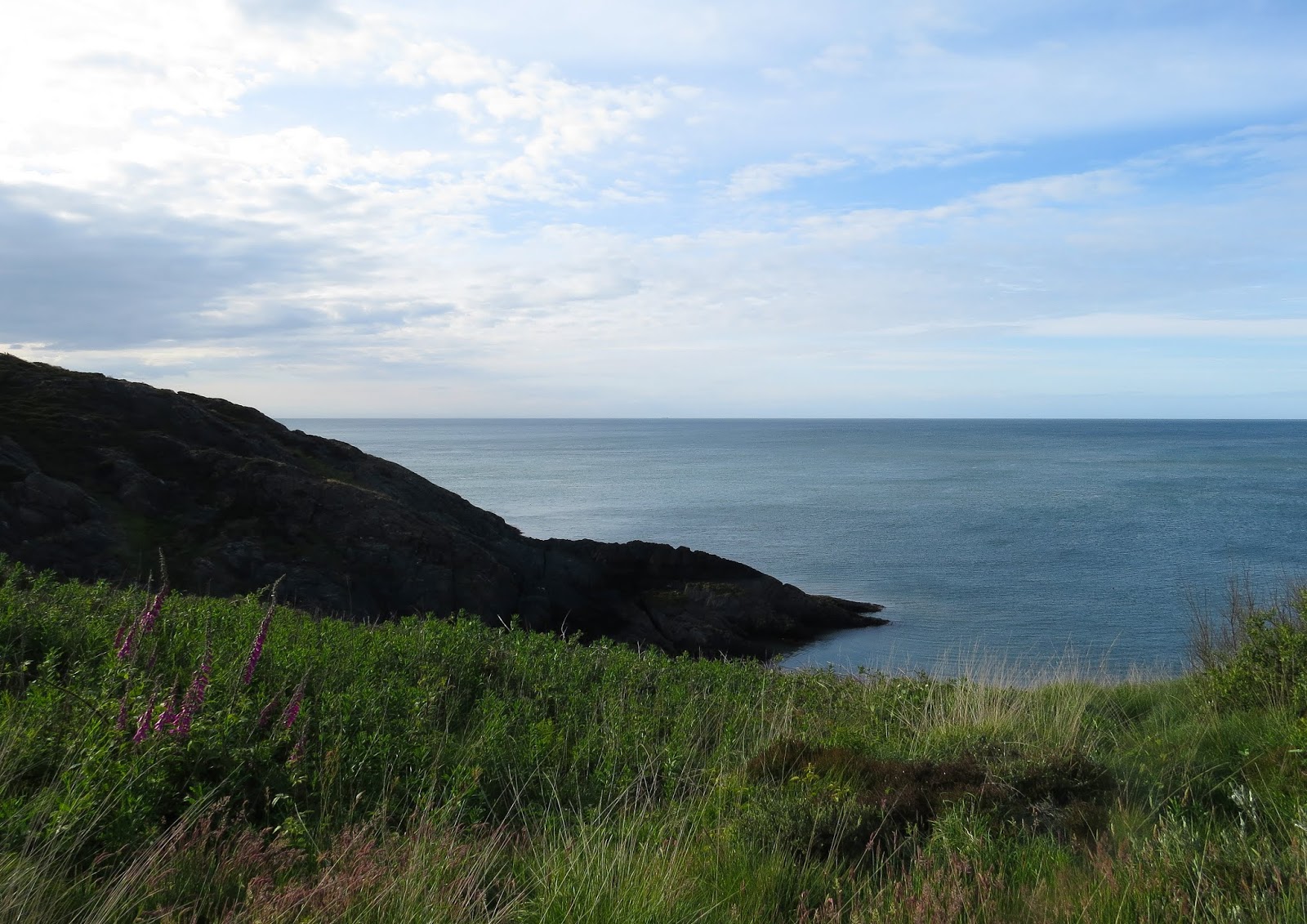
The beautiful views from the coastal path
Regardless, this was a
fantastic local bird to see in a beautiful, rugged Welsh coastal setting, and a
bird that means I can finally tick off that blank square on my owl checklist
after all these years.
Another weekend, another transatlantic mega heron, this time in the form of a Green Heron found stalking fish at a garden pond in Pembrokeshire, deep in the heart of South Wales.
Green Heron!
Like the American Bittern, I hadn’t been twitching when the Heligan Green Heron of October 2010 turned up, and curiously in a strange twist of fate, 8 years later the occasion of having both mega American herons in the UK at once mirrored 2010, when both species turned up in Cornwall together.
With Alex making light work of the 4 hour drive through the rolling Welsh hills and quaint villages, Red Kites drifting lazily overhead in good numbers for the latter part of the journey, we were soon on site at Llan-mill and making the short walk up the track to the garden of the finder, MP Simon Hart, where the heron had temporarily set up residence.
The heron's new home - a far cry from the swamps of America
Immediately upon arrival the heron performed brilliantly, perched right out in the open on a small branch at the front of the pool, rich chestnut and bottle green feathers shining in the sun with bright yellow eyes glinting and alert on the lookout for tiny fish below.
Lapping up the views for a further two hours as the heron made its way around the pond, these were some of our best views of Green Heron to date, having previously seen birds on several occasions in America either distantly or partly obscured by reeds. Only the 8th record for Britain, this is the latest in a flurry of birds since the turn of the millennium, and despite this being the 5th bird in the last 17 years alone, it’s still a great bird for the UK and one we were both pleased to make the journey down for.
Alex's great little video of the Green Heron
With a supporting cast of a nice Dipper zipping up and down the brook running alongside the house, huge thanks to the finder for putting out news and allowing hordes of birders to utilise his back garden in order to view.
Having last seen Bird’s-nest Orchids once before way back in 2010, I was keen to catch up with several plants in bloom on the Great Orme in Llandudno, handily just over an hour away from home. Not being able to get over there to see them last year, late May saw us take a trip over to this botanically rich hotspot to explore the woodlands around the base of the Orme in an effort to try and find them.
Parking up at the Happy Valley car park area and taking one of the small trails into the trees, expecting a lengthy search I was surprised at just how quickly we stumbled across our orchids – looking up the slope we were met with two distinctive caramel-brown flower spikes nestled among the Dog’s Mercury and looming out of the dark understorey gloom.
At first glance perhaps appearing dead to the untrained eye, on closer inspection they were flowering to perfection, tiny golden florets adorning tall leafless stems in the deep shade of the woodland floor.
A quick exploration of the surrounding area also revealed a third spike hidden a little bit further up into the trees, but we were unable to spot any additional plants in the immediate vicinity. With just three spikes (there were apparently only three plants last year too) this looks to be a very small population, but with extensive woodland carrying on further up the slope it’s highly likely there could well be more in the area.
Although Bird’s-nest Orchids can often be perceived as drab, uninteresting and plain looking due to their uniform brown flowers and stems (especially compared to some of the other more extravagant orchid species), there is actually a subtle beauty to these unusual orchids, with each petal looking as if it has been brushed with a delicious coating of sticky golden honey and almost looking good enough to eat.
Their lack of leaves and chlorophyll (hence the brown colouration) also adds to their interest, mystery and allure, going against the grain of how plants are traditionally perceived and creating an air of botanical charisma. Completely lacking the ability to photosynthesise from the sun and instead obtaining all the nutrients they need from their fungal hosts deep in the soil, this allows them to tolerate the extensive shade and darkness that other flowers simply can’t manage.
The Bird’s-nest Orchid has a tangled mass of roots, shaped, unsurprisingly, like a bird’s nest and indicating how it gets its name
With a scattered distribution across the UK and classed as Near-threatened in Britain on the Red Data list, there are only a handful of sites for the Bird’s-nest Orchid in the North West, although the north-east Welsh woodlands appear to be a bit of a local stronghold with occurrences around Wrexham, Mold and Ruthin all in recent years. Notably, 25 plants were also recorded in a small wood just south of Abergele hospital in 2005, as well as another record in 2006 near Bryn-y-maen, south of Colwyn Bay.
Looking back at the historical records it seems Bird’s-nest Orchid was present on the Great Orme back in the 1970’s and up to 1986, but a lack of reports after this time indicates they may have disappeared at the site until recently (I’m aware they’ve been occurring here for the past three years though at least).
Bird's nest Orchid photography in action!
With at least 7 species of orchid present on this botanically rich limestone headland, hopefully the Bird’s-nest Orchids will continue to thrive here in the coming years, expanding their population and continuing to add a sparkle to the jewel in the botanical crown that is the Great Orme.
With just two native species
of orchid left to see in Britain (not counting those elusive Ghost Orchids), we
planned a visit during half term to Cors Erddreiniog NNR on Anglesey to find one of my last
remaining species – Pugsley’s Marsh Orchid.
A fine specimen of Pugsley's Marsh Orchid - Anglesey
Pugsley’s Marsh Orchids are
considerably scarce and local, only growing in a few select locations,
including the rich fens of Anglesey.
Stopping over in Llandudno for
the night, myself and Alex headed over to this fantastic fen reserve the next
day in an effort to locate them, the weather following the trend for the week
and providing us with clear blue skies and glorious sunshine.
Treading the path down through
the reserve gates and over the boardwalk, we had soon found our prize – a large
group of Dactylorhizas nestled within the wet marshy grass right at the end of
the trail.
Consisting of a mix with Early
Marsh Orchids (subsp. Incarnata) present, I was soon able to pick out the
Pugsley’s Marsh Orchids within what I can only presume was a mixture of variations
and Dact hybrids – the marked purple flowers didn’t really seem consistent with
any species!
Never the less, we found a
number of plants that fitted the characteristics of Pugsley’s Marsh perfectly
(Mr Orchid himself Sean also later confirmed from photos) and I happily set
about photographing these delicate and subtle beauties.
Relatively hard to identify
without knowing what to look for, a range of features give Pugsley’s Marsh
Orchids a subtle but distinctive appearance. The flowering spike is usually
distinctly one sided (with all flowers facing roughly the same way) and there
tends to be a limited number (on average 6-14) well-spaced flowers on the
spike.
A typically lop sided flower spike
The lip is also prominently 3 lobed with the central lobe projecting out
as a prominent ‘tooth’, while the few leaves are relatively narrow (hence its
former name of Narrow-leaved Marsh Orchid). The upper stem is also washed
purple, as are the upper bracts, and the whole plant seems to have a rather
delicate appearance.
Note the purple washed stem and upper bracts.
A number of individuals in the colony should always be
examined to confirm the identity, and Pugsley’s Marsh Orchids rarely bloom as
just a single specimen in a mixed colony of Dactylorhiza.
There has also been a
considerable amount of research conducted centred on the genetic background and
ancestry of Pugsley’s Marsh Orchid. Populations in Norfolk, Suffolk and
elsewhere in southern England (south of a line from The Wash to the Severn)
were long placed with Pugsley’s Marsh Orchid until 2012, when new genetic
evidence suggested that they were instead a subspecies of Southern Marsh
Orchid. It now seems that only the northern populations can be classed as true
Pugsley’s Marsh Orchids.
I had previously visited Parsonage Moor reserve in Oxfordshire in the search for
Pugsley’s Marsh Orchids, but sadly had only come across what at the time
appeared to be a hybrid. Regardless, with the recent genetic analysis and
revised distribution, this would now have been classes as a subspecies of
Southern Marsh anyway.
Southern Marsh Orchid at Parsonage Moor
Alongside the orchids we also
found an interesting selection of carnivorous plants (always a favourite of
mine) with several dew-drop laden leaves of Round-leaved Sundews visible
growing on the moist mossy tussocks, as well as an abundance of Common
Butterwort – a new species for me in the wild. Each had several small flies
entrapped on the sticky leaves – fascinating, especially as wild carnivorous
plants are not something I encounter all too often!
Round-leaved Sundew
Common Butterwort
With just once species of
orchid left to see in the UK (Lindisfarne Helleborine) I’ll hopefully be able
to catch up with my final target later on in the summer - fingers crossed for a
good flowering season up on Lindisfarne!
How to get there:
There is no parking at Cors Erddreiniog
itself, but there are spaces in the nearby village of Capel Coch - just a two
minute walk from the reserve entrance gate. The post code for parking is LL73
8PH and the reserve is on the east side of the road down a small track next to
a white cottage. Once through the gate, follow the track down the hill to a
second gate and entrance board sign.
When news of a Broad-billed
Sandpiper seen at Gronant emerged late on a Saturday evening, I was hopeful it
would stick around in the area and that I’d finally be able to grip back on the
Hoylake bird I missed out on 5 years ago! Unfortunately, the fact that it was
still there early on Sunday morning didn’t surface until well in to the
afternoon (much too late to travel over especially when a delicious lamb roast
was cooking in the oven courtesy of my Mum) and with no sign on Monday, that
appeared to be the end of any chances I had of catching up with a Broad-billed
Sandpiper any time soon!
The Broad-billed Sandpiper!
What I hadn’t bargained for
however was eagle-eyed Alex staking out Kimnel Bay and Rhyl Harbour in an
effort to relocate it the next day, and sure enough, around high tide just
before 7, I received a photo from him depicting one Broad-billed Sandpiper,
head tucked under its wing and happily roosting on the pebble shore near
Horton’s Nose. Argh!
Alex's photo he sent to me!
Half way through cooking
5-spice chicken and noodles, I had to wait until we’d gobbled the last strand
down before setting off in pursuit of this attractive vagrant shorebird. With
Alex heroically staying on site until I got there (3 hours in total!) I had a
running commentary on the way over – the bird seemed very flighty and on more
than once occasion was flushed and flew away further up the beach. Then, when
we were just 7 minutes away, Alex relayed news that it had flown away high to
the west after being harassed by a Ringed Plover – nightmare!!
Pulling in to the Rhyl Harbour
car park and heading up the path to Kimnel Bay, the Dunlins that the
Broad-billed Sandpiper had been associating with had returned, but there was no
sandpiper in sight. With the light now fading and the evening dog walkers
heading out in force, it was a race against time to see if we could relocate
it. With Alex rushing off down the beach where it had last headed, we soon
encountered a mixed group of waders feeding in one of the pools further down
the shore- it had to be amongst them, surely! With Alex getting a brief glimpse
of the Broad-billed Sand in the scope and confirming that it was still there moments
before two large dogs flushed the flock, it seemed inevitable that the birds
would get spooked and we’d miss our chance – so near yet so far!
Luckily however, the birds
stuck around, and with the dogs heading off in to the distance we could focus
our efforts on relocating that Broad-billed. Several Turnstones pottered around
the rocks looking for morsels while Dunlins scuttled amongst them – then, what
was that - a small silver-grey bird dashing across the sand caught our
attention. With a strong pattered back and bold stripes across the head it was
immediately obvious we had our target! Bingo! One Broad-billed Sandpiper
showing nicely!
The arrowhead streaks on the flanks were obvious too
With the light now fading it
was difficult to get any good photos, but I managed a few record shots as it
scurried about on the sand, at one point even flying right towards us and
landing on the rocks in front, providing excellent scope views of what is
definitely one of the more attractive sandpipers.
Alex's video of the Broad-billed Sandpiper
A great find by Alex and a
well-deserved reward for patching the area so thoroughly – proving that if you
put the effort in and search enough times you’ll eventually strike gold and
come up with something special!