A tale of nature, wildlife and birding from Cheshire, North Wales and across the globe....

A tale of nature, wildlife and birding from Cheshire, North Wales and across the globe....
Showing posts with label North Wales. Show all posts

Monday, 9 January 2017

Black-throated Thrush in St Asaph, North Wales!

When news broke of a Black-throated Thrush photographed only an hour away in St Asaph towards the end of December, it was a no brainer to make the short journey over the next day in an attempt to catch up with this Siberian visitor. With just a single observation in the Hawthorn trees surrounding the football pitch on the Friday afternoon and again showing itself only on one occasion early on Saturday morning to just a handful of birders, the trail went cold over the following days as the thrush seemingly vanished in to thin air, despite the hundred or so strong flock of Redwings and Blackbirds remaining to take advantage of the rich pickings in the leaf litter.
Black-throated Thrush - St Asaph, North Wales
The St Asaph Black-throated Thrush
Luckily, Alex was on the case living just 10 minutes away, and over successive visits throughout the next two days, he finally managed to pin down this elusive thrush’s location! Having been frequenting an area just a short hop over the other side of the River Elwy and favouring the stubble field and Hawthorn tree next to the New Inn pub, the re-find certainly made a lot of local birders extremely happy! A large amount of people were able to connect over the following days as a result, but being back in work meant I wasn’t able to see this local rarity myself until the Thursday. Unfortunately, the thrush didn’t play ball upon my arrival after two days of showing well, and the trail once more went cold as it did a disappearing act mid-morning shortly before I arrived – I couldn’t dip for a third time surely?! 
St Asaph
The Hawthorn alleyway I'd been scoping for most of the day
Thankfully, 4 ½ hours of trudging up and down the muddy riverside path later, a pale brown thrush flew in to the favoured Hawthorn tree and the shouts went up that all those remaining looking had been hoping for: “That’s it – Black-throated Thrush, here now!!” Abandoning my half eaten sandwich I quickly got it in the scope, the gorgeous brown speckled chest almost glowing in the late afternoon sun as it perched proudly in the bare winter branches. Fantastic!
Black-throated Thrush - St Asaph, North Wales
Luckily we had prime position on our side of the river – the 30 or so others on the opposite bank had the agonising choice to make of whether to try and scope into the ditch the thrush had now flown in to (out of sight from the east side and at an impossible angle to see) or walk all the way back around to the bridge and hope that it stayed feeding until they could get on it!!

It did indeed stay, and over the next half an hour or so we enjoyed great views as the thrush fed in the stubble field - showing off the light brown chest that indicated that this was a female and lacking the jet black throat that a male bird would display. At one point it pulled up a huge worm, tucking in before eventually flying off over towards the nearby houses.
Black-throated Thrush - St Asaph, North Wales
The Black-throated Thrush's favourite stubble field
Heading back to the car as the light was fading, a quick check of the Hawthorn alleyway I’d been scoping all day surprisingly revealed the thrush had perched up for a last feed before dark, and we enjoyed great views just to ourselves as it scrambled through the branches above us before flying off in to the tall trees behind the houses – presumably to roost.
Black-throated Thrush - St Asaph, North Wales
St Asaph
The gardens and houses the Black-throated Thrush had been frequenting
An absolute nightmare to catch up with and one of the most elusive birds I’ve ever twitched, it was a relief to finally get it on my 3rd attempt after over 11 hours of searching! With the Black-throated Thrush staying in the same stubble field and surrounding Hawthorns up until New Year’s Eve, there has been no sign of it since the turn of the New Year, the firework display at the New Inn pub perhaps moving it on overnight to a new patch of ground and favoured feeding spot. A great local bird to catch up with and yet another rare thrush delivered after an exceptional autumn! Overwintering Siberian Thrush now anyone?!

Wednesday, 29 June 2016

Welsh Pearls - Pearl-bordered Fritillaries at Eyarth Rocks

Having never seen Pearl-bordered Fritillary before and sadly missing them at Glasdrum Wood earlier in the week, reports of a number of individuals on the wing at Eyarth Rocks near Ruthin saw me and Alex plan a visit during half term to try and catch up with them.
Pearl-bordered Fritillary - Eyarth Rocks
Eventually arriving on site, we made our way up the steep woodland slopes to the start of the reserve, navigating the many un-signposted tracks in the wood (with a few wrong turns) before the trees opened up to reveal the sunny hill top summit. Surrounded by open stands of bracken, the area was clearly being managed with Pearl-bordered Fritillaries in mind, and within a matter of minutes we had seen our first individual gliding majestically by.
Pearl-bordered Fritillary - Eyarth Rocks
Despite exploring the summit, it transpired the small patch of ground right at the start near the gate and entrance sign was the most productive, and we had up to four individuals feeding on the buttercups and Birds-foot Trefoil in the vicinity.

Tuesday, 14 June 2016

Broad-billed Sandpiper at Kimnel Bay!

When news of a Broad-billed Sandpiper seen at Gronant emerged late on a Saturday evening, I was hopeful it would stick around in the area and that I’d finally be able to grip back on the Hoylake bird I missed out on 5 years ago! Unfortunately, the fact that it was still there early on Sunday morning didn’t surface until well in to the afternoon (much too late to travel over especially when a delicious lamb roast was cooking in the oven courtesy of my Mum) and with no sign on Monday, that appeared to be the end of any chances I had of catching up with a Broad-billed Sandpiper any time soon!
Broad-billed Sandpiper - Kimnel Bay
The Broad-billed Sandpiper! 
What I hadn’t bargained for however was eagle-eyed Alex staking out Kimnel Bay and Rhyl Harbour in an effort to relocate it the next day, and sure enough, around high tide just before 7, I received a photo from him depicting one Broad-billed Sandpiper, head tucked under its wing and happily roosting on the pebble shore near Horton’s Nose. Argh!
Broad-billed Sandpiper - Kimnel Bay
Alex's photo he sent to me!
Half way through cooking 5-spice chicken and noodles, I had to wait until we’d gobbled the last strand down before setting off in pursuit of this attractive vagrant shorebird. With Alex heroically staying on site until I got there (3 hours in total!) I had a running commentary on the way over – the bird seemed very flighty and on more than once occasion was flushed and flew away further up the beach. Then, when we were just 7 minutes away, Alex relayed news that it had flown away high to the west after being harassed by a Ringed Plover – nightmare!!

Pulling in to the Rhyl Harbour car park and heading up the path to Kimnel Bay, the Dunlins that the Broad-billed Sandpiper had been associating with had returned, but there was no sandpiper in sight. With the light now fading and the evening dog walkers heading out in force, it was a race against time to see if we could relocate it. With Alex rushing off down the beach where it had last headed, we soon encountered a mixed group of waders feeding in one of the pools further down the shore- it had to be amongst them, surely! With Alex getting a brief glimpse of the Broad-billed Sand in the scope and confirming that it was still there moments before two large dogs flushed the flock, it seemed inevitable that the birds would get spooked and we’d miss our chance – so near yet so far!

Luckily however, the birds stuck around, and with the dogs heading off in to the distance we could focus our efforts on relocating that Broad-billed. Several Turnstones pottered around the rocks looking for morsels while Dunlins scuttled amongst them – then, what was that - a small silver-grey bird dashing across the sand caught our attention. With a strong pattered back and bold stripes across the head it was immediately obvious we had our target! Bingo! One Broad-billed Sandpiper showing nicely!
Broad-billed Sandpiper - Kimnel Bay
The arrowhead streaks on the flanks were obvious too
With the light now fading it was difficult to get any good photos, but I managed a few record shots as it scurried about on the sand, at one point even flying right towards us and landing on the rocks in front, providing excellent scope views of what is definitely one of the more attractive sandpipers.

Alex's video of the Broad-billed Sandpiper

Broad-billed Sandpiper - Kimnel Bay
A great find by Alex and a well-deserved reward for patching the area so thoroughly – proving that if you put the effort in and search enough times you’ll eventually strike gold and come up with something special! 

Friday, 12 February 2016

Birding in North Wales - Snow Buntings, Hawfinches, Purple Sandpipers and Black Redstarts!

There have been some fantastic birds present in North Wales recently, with a whole host of great subjects for photography all along the coast.

After Alex first found a Snow Bunting at Horton’s nose near Kimnel Bay back at the start of December, a pair of these attractive buntings were found a little further down the shore at the start of January – presumably the same bird Alex found relocating up the beach. With up to 6 birds having been reported (along with records at Pensarn, Llandullas and Point of Ayr) the two seem to have now taken a liking to this small stretch of coast and what is now a regularly seeded area at SH 986 808, offering amazing views and a great opportunity to study these charismatic little birds up close.
Snow Bunting - Kimnel Bay, North Wales
Luckily I had my camera with me when I called in to Kimnel Bay, and the single Snow Bunting that was present when I visited allowed fantastic views as it fed unperturbed on the seed.
Snow Bunting - Kimnel Bay, North Wales
Being the first bird I travelled some distance to see at Kimnel Bay 5 years ago, it is great to see them returning to the North Wales coastline after a considerable absence for some years, and hopefully the numbers will be able to get back up to the 14 or so birds that were present back in 2011.

The Hawfinches at Llanbedr-y-Cennin are also providing excellent views this winter after proving to be very elusive back in January and February 2015. With over 20 birds reported to be present, we had a flock of 10 fly from the trees lining the field at SH 76007 69740, before flying back in to land, offering excellent scope views as seen from the cattle grid. 
Hawfinch - Llanbedr-y-Cennin, North Wales
With a huge bulky appearance in flight and prominent white patches on the wings, we soon became familiar with their silhouette, making it much easier to spot individuals as they flew from tree to tree. The trees around the churchyard and the field at the above grid reference seem to be the best places to spot these huge billed finches.

The Purple Sandpipers at Rhos Point continue to be found in low numbers at both high and low tide on the rocky shoreline while the Black Redstarts on the Little Orme are also producing great views this winter, with up to three individuals having been present. There is an excellent supporting cast of Red-throated Divers, Shags and nesting Fulmars on the cliffs and on the sea, while the seal colony at Angel Bay below holds double figures of Grey Seals, often hauled out on the shingle or with heads poking above the waves. This is a great opportunity to study these pinnipeds through the scope from the cliff top path, and we got great views of several large males and females resting on the sand.
Fulmars - Little Orme, North Wales
Fulmars!
Grey Seals - Angel Bay, Little Orme

Sunday, 7 February 2016

Little Auk makes landfall at Connahs Quay!

Having sadly missed the influx of Little Auks to the East coast last November and with Little Auk being one of my top targets for last year, I thought I had missed the boat when it came to seeing one of these tiny arctic visitors. When an alert popped up on my phone in the middle of January telling me a Little Auk had been seen at Connah’s Quay Nature Reserve in North Wales, I opened it up expecting the report to be just a fly-by – the typical view of Little Auks over on the West coast. I was therefore shocked to read there was one apparently swimming around the inland pools outside Dee and Middle Hides!!

I was determined that I wanted to see my first Little Auk up close as opposed to a distant dot flying over stormy waves, and knowing that it could fall victim to a marauding crow or gull at any moment, we left Alex’s house in record speed (I’ve never got ready so fast). With Connah’s Quay being a permit only reserve, I had luckily bought Alex a key for Christmas – money that was now definitely well spent!

Despite a few setbacks where the Sat-nav kept insisting on directing us to a random field, we were soon on site, just missing this dainty alcid by moments with it having just that second swam around the bend. A small chase of cat and mouse then ensued, where we attempted to follow it from hide to hide before eventually pinning the elusive Auk down to Middle Hide – relief and my first UK Little Auk, a much wanted bird for some time!
Little Auk - Connah's Quay NR, North Wales
Little Auk swimming along the channel at Connah's Quay NR
We watched as the tiny Auk swam swiftly along the back of the pool before powering off to the left hand side of the channel and out of sight – a much speedier swimmer than I’d anticipated! Heading back on to the road and over to where it looked to be heading, we were surprised to find it had beat us to it and had completely disappeared - seemingly vanishing in front of the assembled birders eyes – presumably taking shelter in the large rocks that lined the banks.
Little Auk - Connah's Quay NR, North Wales
With no sign for a good hour or so and with the bird having either taken shelter in the bank or forced its way through the small weir blocking the access in to the estuary (unlikely!) we headed over to Burton Marsh to enjoy the views of Short-eared Owls, Hen Harriers and Bewick’s Swans that were present. With reports just after lunch that the Little Auk was back in front of the hide again, we made the decision to head back to Connah’s Quay – it’s not every day you get to see a Little Auk so close after all!

Arriving at the hide to find the Little Auk had climbed on to the grassy bank at the side of the water, it was clear that this particular individual was not in completely good health, having seemingly injured one of its legs. 
Little Auk - Connah's Quay NR, North Wales
Watching it for some time and following it down the channel again when it eventually swam off, we enjoyed fantastic views just metres away as it powered past us towards the weir again, and unable to pass, it once again positioned itself in the rocks out of sight to rest.
Little Auk - Connah's Quay NR, North Wales
Little Auk is an excellent record for North Wales, with birds occasionally seen as fly-bys on sea watches during the winter months, and it was even more exceptional that it was found on the pools at Connah’s Quay instead of the harbour.
Connah's Quay NR, North Wales
The small channel the Little Auk kept favouring
With our Little Auk making a final appearance just before dusk, again showing exceptionally closely before swimming off back up the channel and out of sight, we can only hope that under the safety of darkness it managed to make a getaway and head back out to sea. A report of a Little Auk flying west past Hoylake subsequently had the optimist in me hoping that this was our little bird and that he made it to safety! A truly fantastic experience and one I certainly won’t be forgetting in a hurry. 

Thursday, 5 November 2015

Autumnal Birding - Short-eared Owls, Scaup, Jack Snipe and Cetti's

With the rustic tones of autumn coming to a close and the cool chill of winter fast approaching, I’ve been able to catch up with a selection of good birds locally as the seasons shift and the birds follow suite.

Short-eared Owls in particular seem to be in great abundance this year, and I managed to see up to 6 different birds at Parkgate/Burton Point during the recent high tides, all taking advantage of the large numbers of voles and other small mammals forced out of the vegetation as the water levels rose. With further individuals at Frodsham Marsh as well as this beautiful bird found hunting along the banks of the River Clywd in Rhyl, the winter of 2015/16 already seems to be a bumper year for these charismatic owls.
Short-eared Owl - River Clwyd
There also appears to have been a mini-invasion of Firecrests taking place throughout the North Wales coastline over the past few weeks, with up to 5 spotted at Conwy RSPB near the pond bridge and further individuals scattered across the coastline and up to the Great Orme, particularly around Llys Helig Drive.

The female/immature Scaup at Eirias Park boating lake also provided excellent views when I visited, and having been associating with a group of Mallards for several weeks now, is still present. Whilst occasionally flushed by dogs (such as on one occasion while I was present) the Scaup seems to have taken this small patch of water to its liking, showing fantastically well and being easy to spot on such a small water body. With the lake slowly being drained for the winter however, it will more than likely soon move on, perhaps to the coast or to one of the other pools or lakes nearby.
Scaup - Colwyn Bay, Wales
Burton Mere Wetlands is also playing host to two Jack Snipe at present, most often seen from the first boardwalk screen hidden amongst the stubble of cut reeds. Cryptically camouflaged and usually asleep amongst the Common Snipe with its beak concealed, the distinctive facial markings give the ID away along with the darker and bolder patterns on the back. Luckily, we managed to get great views of one individual doing its characteristic bobbing motion as it moved through the reeds before settling back down and remaining hidden behind the vegetation.
Jack Snipe - Burton Mere Wetlands
Two Cetti’s Warblers have also taken up residence in the patch of reeds between the reedbed screen and the second hide. Usually remaining hidden deep within the depths of the reeds, with just the distinctive explosive call giving their location away, we were lucky to get amazing views as they became incredibly active late in the afternoon before heading off to roost, showing unbelievably well and performing right in front of the screen out in the open. These were by far my longest ever views of Cetti’s Warblers, having previously only ever got glimpses at various reserves before the bird dashed back in to the safety of the reeds. A pair of Brambling on the feeders were also lovely to see, completing what has been a fantastic few weeks for classic autumnal/winter birds.

Wednesday, 17 June 2015

Little Terns at Gronant

Paying a visit to the fantastic Little Tern colony at Gronant earlier in June, upon arriving at the shingle nest site we were greeted by hundreds of these beautiful and dainty terns bombing through the sky, busily catching fish to bring back to their waiting chicks and mates. The only nesting colony nearby, it is well worth a visit during the late spring and summer months to watch them in action and admire these tiny wonders up close as they go about their business during the breeding season. 
Little Tern - Gronant, North Wales

Tuesday, 14 April 2015

Ring Ouzels on the Great Orme

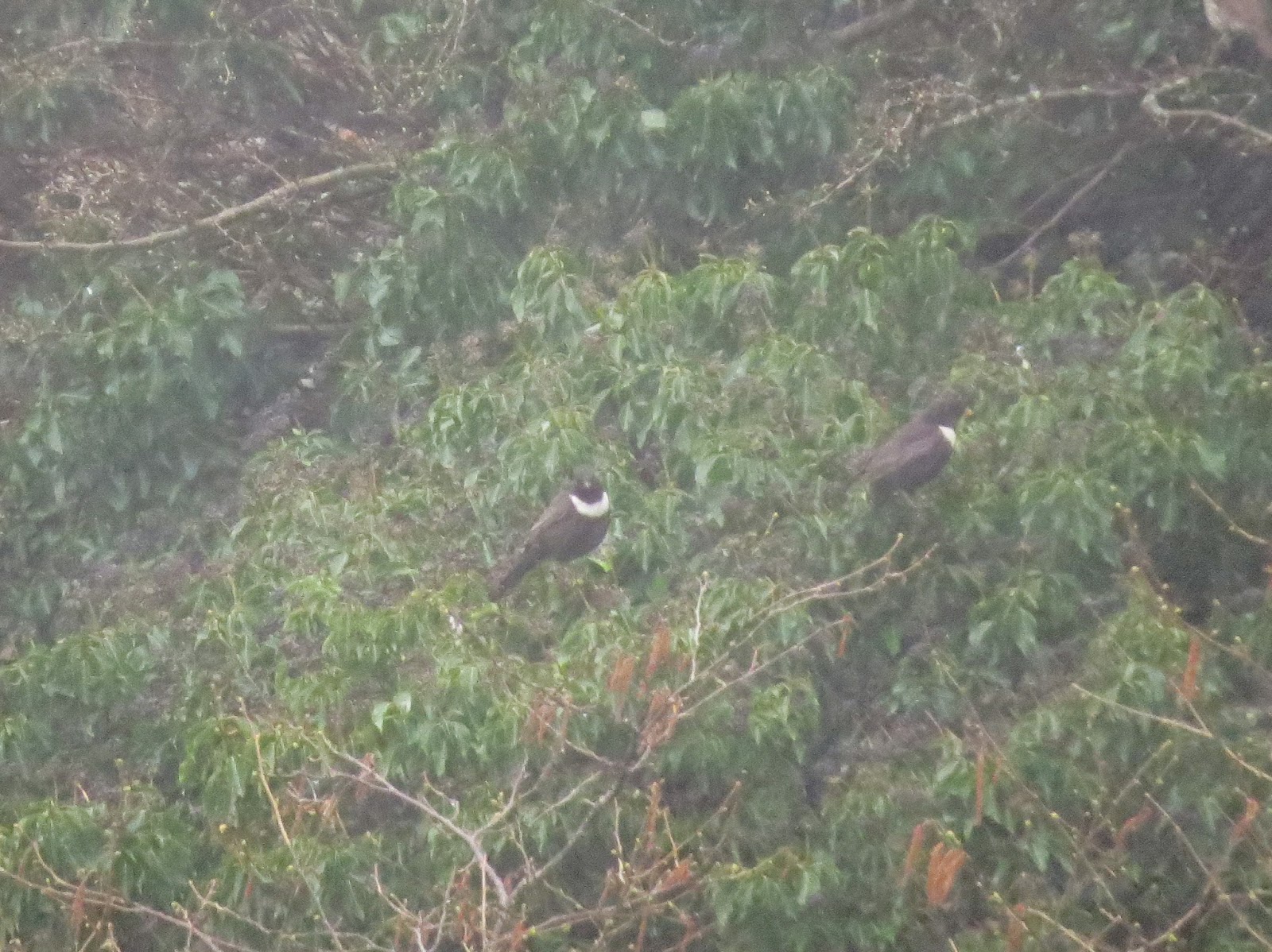
With a huge fall of Ring Ouzels documented throughout the UK from Friday onwards, and with up to 20 birds present on the Great Orme since Saturday morning, we decided to call in on the Sunday after returning from Scotland. Despite the absolutely howling gales and driving rain (which caused the car to rock from side to side with the sheer force of it all), and with the helpful directions from Alex’s friend Steve Culley, I eventually picked up 2 birds in flight and calling near the Copper Mines. I soon located a lot more birds further down the slope, all actively feeding in the same ivy tree, and despite the far from perfect conditions we counted 7+ birds.
Ring Ouzel - The Great Orme
A record shot of the male Ouzel
Ring Ouzel - The Great Orme
I was especially pleased to track down these birds as I haven’t had great views of Ring Ouzels before, merely a quick fleeting glimpse on a fence before a pair flew away on a visit to Moel-y-parc a few years ago, and a female by the side of the road whilst driving in Cheshire being my only other sightings, so it was great to watch these large thrushes going about their business at leisure, despite the absolutely horrific weather.
Ring Ouzels - The Great Orme
The driving rain made it hard to get even record shots!
Ring Ouzel - The Great Orme
Interestingly, Ring Ouzels haven’t been picked up from this side of the Orme before, with birds usually getting found on the opposite side in the sheep fields. However, the fields and patches of grass surrounding the Copper Mines and over towards the nearby houses seemed the perfect habitat for these migrants, and it was clear why they had all congregated in this one patch of trees – this sheltered spot offered a welcome respite from the harsh winds and abysmal weather.
Ring Ouzels - The Great Orme
All the birds had congregated in one tree - 4 can be seen in this one shot alone with another just to the left out of frame
The row of ivy trees in particular at the back of the donkey field next to the rubble track appeared to be the most favourable, and this little sheltered spot seems like it would pose an attractive area for migrants in the spring and autumn months – definitely an area to watch more closely in the future!

Monday, 23 March 2015

Surf Scoters in North Wales

After failing to catch up with the regular Surf Scoters that can be found off the North Wales coast each year for an incredible 4 winters (despite numerous visits probably nudging in to the 20s!!) I finally saw them for the first time last January off Pensarn.

This weekend as the weather was gloriously sunny (perfect for scoter searching) I made a return trip – this time to Old Colwyn where the reports suggested the birds had been spotted earlier that morning.

Ranging across Llandulas, Pensarn and Old Colwyn, it is always useful to know beforehand where the birds are favouring. Whereas last year they were mostly spotted off Pensarn near to the cafƩ, this year the birds seemed to have switched preferences to nearby Old Colwyn, where the majority of the reports have come from this winter.

Used to spending several cold hours staring out to sea in search of them, after around 5 or 10 minutes I couldn’t believe it when I actually picked one out! In one of the more distant flocks, the perfect spring sun made the distinctive white patch on the back of the head and brightly coloured bill literally stand out a mile away. Alex later spotted the second drake a little closer in, and eventually the two came together – a pair of white blobs clearly visible amongst a sea of thousands of all-black Common Scoters.
Surf Scoter, Old Colwyn
My phone scoped scoter!
Finding 2 Surf Scoters amongst a flock of thousands upon thousands of Common Scoters may seem daunting, but it is the large white patch on the back of the head and a second white patch where the bill is (sometimes they are too distant to make out the yellow and orange colouration) that gives them away.
Surf Scoter, Old Colwyn
The white on the back of the head is clearly visible even at a distance
The light was absolutely perfect for seawatching and by timing it with an exceptionally high tide at midday with a flat calm sea and no wind, I couldn’t have asked for more ideal conditions. Several Velvet Scoters were also in some of the closer rafts – the yellow lower bill and even the white around the eye of the drakes visible through the scope! One in particular seemed very active – flying from raft to raft and proudly displaying the gorgeous bold white squares on the wings as he flew.
Velvet Scoter, Old Colwyn
The white eye and yellow bill of the velvet (third from the right) can just be made out in Alex's picture
Velvet Scoter, Old Colwyn
The structural differences between the Velvet and Commons is also obvious
It’s definitely worth waiting for the ideal day to come along, as this makes it so much easier to spot the Surfs in the good light as opposed to fruitlessly scanning a choppy sea in gloomy weather. When all the birds are constantly bobbing behind the waves it can soon turn in to an absolute nightmare!

The birds will soon be leaving the wintering grounds along the North Wales coast to head to their breeding grounds, and with up to 7 drakes spotted this year, they must surely be breeding somewhere in Europe along with the many thousands of Commons. Fingers crossed they all return next year – who knows, they may even reach double figures!

To view from the Rainbow Bridge at Old Colwyn, park next to the small playground on Glan-Y-Mor Road (LL29 9AY) and follow the path to the right towards the sea and past the cliffs. Go over the large bridge that crosses the A55 road and find a good vantage point on the rocks near the small stone hut. 

Wednesday, 8 October 2014

A grey day in North Wales

After dipping the Grey Phal that had been found at Morfa Madryn NR near Bangor the previous weekend, a whole week at work had to be endured before we could give it another shot. Having previously seen this species twice before (one at Conwy RSPB and another at Pennington Flash) the fact that it was showing ridiculously well meant I was keen to catch up with this individual – and it didn’t disappoint. After a fruitless search in the direction of the marshes with just pipits and linnets knocking around, we heard that it was apparently being seen near to the white cottage right by the railway line. Retracing our steps (and ignoring suggestions to jump over the stream and in to the deadly looking quicksand on the other side!) I soon relocated the phalarope stood on the bank amongst several ducks. Waving over the small crowd that had now gathered to look for it, we enjoyed brief views before it swam off down one of the small channels intersecting the sand and out of view. Guessing it was heading towards its favoured feeding spot by the outflow, we set off in that direction to find it busy spinning around and actively picking up morsels out of the flow. For the next 20 minutes or so we enjoyed great views – some of my closest yet, and I was able to get some photos. My hands (having left my gloves in my car) were now absolutely freezing by this point, so we decided to call it a day, leaving the phal to bumble around in the shallow water.


Note the thicker bill than the similar Red-necked Phalarope (which this individual was originally mis-IDed as) an easy feature to look out for when separating the two species.