A tale of nature, wildlife and birding from Cheshire, North Wales and across the globe....

A tale of nature, wildlife and birding from Cheshire, North Wales and across the globe....
Showing posts with label Plants. Show all posts

Tuesday, 4 June 2019

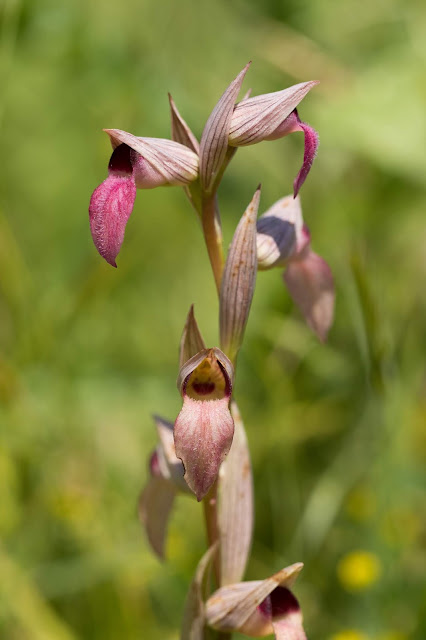
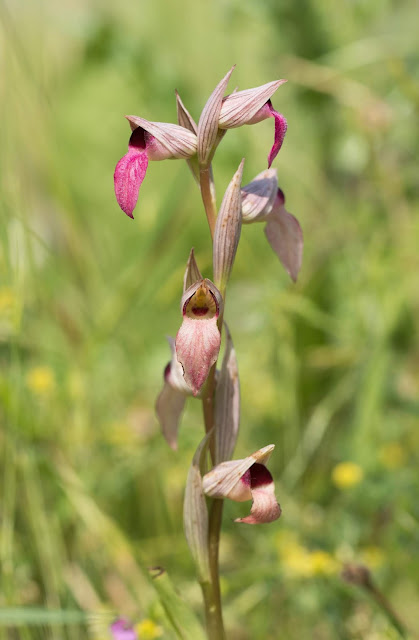
Greater Tongue Orchids - Tiptree, Essex!

When a colony of Greater Tongue Orchids was discovered in Essex during the summer of 2017, the race was on to track the plants down and establish whether they were naturally occurring or had arrived artificially. With just a single photo of several flowering spikes in a field to go on (which was hastily removed from the Facebook page to which it was posted) several of the orchid world's enthusiasts expertly narrowed down the location, and by carefully checking the vegetation on site to that in the photo, were remarkably able to pin down the exact spot where these exotic orchids were growing.
Greater Tongue Orchid - Tiptree, Essex
Sadly, by the time they were found all but a very small handful of the plants had completely gone over, and as such, arrangements were kindly made for a number of organised visits last summer so those interested could admire these Mediterranean beauties in all their glory.

Therefore, at the beginning of June last year, me and my Dad made the long journey down to Essex and were met on site by local resident Jonathan who showed us the exact location in the meadows where this small cluster of orchids were growing, thankfully in prime condition despite the scorching sun and allowing for excellent photographic opportunities (despite some tripod issues!).
Greater Tongue Orchid - Tiptree, Essex
v
Greater Tongue Orchid - Tiptree, Essex
With around 36 plants in flower last year, the number was slightly down on 2017's showing, but luckily each delicate maroon flowering spike was in top condition (I had actually been away in America the previous week so was a bit concerned the flowers may have been past their best by the time I got there) and the colony had been carefully marked out with several small canes to prevent trampling by unaware dog walkers.
Greater Tongue Orchid - Tiptree, Essex
However, despite the excitement of such a remarkable botanical find, the question remains: are the Tiptree Greater Tongue Orchids naturally occurring or did they arrive through artificial means?

With orchid seed being particularly fine and easily carried by the wind, there is of course every possibility that seed from the continent had blown over naturally, with the nearest populations occurring in France, Spain and Italy. However, a number of other circumstances need to be considered before determining whether these continental plants really did make it over here without a little bit of human help.

A single specimen could easily have been planted out by a keen botanist or gardener many years ago, reproducing year on year to result in the small colony seen now (the plants were all restricted to a tiny area about a metre squared in size and found nowhere else on the meadows as you would expect from plants in a natural continental setting). Likewise, seed blown artificially from plants growing in a pot in a nearby garden could have easily kick started a colony.

However, this would be an odd site for a deliberate planting, and no pot grown specimens are growing nearby to our knowledge - even if they were, the Greater Tongue Orchids natural pollinator is not known to occur in Britain, making seed set very unlikely without assistance. 

Upon talking to Jonathan, he explained that decades ago the meadows were used as strawberry fields alongside a plant nursery that amongst other things was known to grow tropical orchids. This therefore creates an entirely feasible scenario of Tongue Orchid seed being accidentally imported - getting in to the mix of soil, clippings and cuttings discarded on site and germinating, eventually becoming established and naturalised - in my opinion the most likely origin.
Greater Tongue Orchid - Tiptree, Essex
This is not the first occurrence of Greater Tongue Orchid in the UK however, with a small well-known colony of Greater Tongue Orchids situated at Wakehurst Place in Sussex alongside the introduced Loose-flowered Orchids (never proven but very unlikely to be of natural origin as a consequence). Three flower spikes were also discovered near to the coast in Kingsbridge, south Devon back in 1998, but once again, their origins were never proven - some suspecting seed had come from an artificial source such as a nearby plant collection or agricultural seed mix. 

Small-flowered Tongue Orchids have also previously gotten a very shallow toehold on British soil in the past with individuals cropping up near Rame Head in SE Cornwall, having first been discovered there in 1989, but sadly disappearing in the early 2000s. With seed suspected to have blown in from the continent as opposed to a deliberate planting due to the remote location, it's entirely probable these were the result of natural colonisation from across the channel.

It’s likely that we’ll never know for certain the origins of the Tiptree plants, but whatever their background, the Tongue Orchids have clearly been on site for a number of years now, vegetatively reproducing to increase in number each year and creating a naturalised and self-sustaining population in the process. 
Greater Tongue Orchids - Tiptree, Essex
The Tongue Orchids have reproduced vegetatively to cover a small patch of ground in the meadow
Greater Tongue Orchids - Tiptree, Essex
Spot the Tongue Orchid! The small patch where the orchids were growing
Unfortunately despite being the only known 'natural' colony in Britain, the Tiptree Tongue Orchids face an uncertain future, with developers knocking on the door eager to build on the site despite the protestations of residents and orchid enthusiasts alike. This year, due to the sensitivities of the site, visitors are also being asked to keep away. Hopefully some sort of compromise can be found, where the future of the orchids is secured and many more people can get to enjoy them for years to come - it would be a real shame indeed if these fascinating plants were to be lost almost as quickly as they were found.
Greater Tongue Orchid - Tiptree, Essex
Greater Tongue Orchids - Tiptree, Essex
Greater Tongue Orchid Meadow - Tiptree, Essex
The meadow in Tiptree, Essex where the Greater Tongue Orchids were found

Tuesday, 6 June 2017

Bird's-nest Orchids on the Great Orme, Llandudno!

Having last seen Bird’s-nest Orchids once before way back in 2010, I was keen to catch up with several plants in bloom on the Great Orme in Llandudno, handily just over an hour away from home. Not being able to get over there to see them last year, late May saw us take a trip over to this botanically rich hotspot to explore the woodlands around the base of the Orme in an effort to try and find them.
Bird's-nest Orchid - Great Orme, Llandudno
Parking up at the Happy Valley car park area and taking one of the small trails into the trees, expecting a lengthy search I was surprised at just how quickly we stumbled across our orchids – looking up the slope we were met with two distinctive caramel-brown flower spikes nestled among the Dog’s Mercury and looming out of the dark understorey gloom. 
Bird's-nest Orchid - Great Orme, Llandudno
At first glance perhaps appearing dead to the untrained eye, on closer inspection they were flowering to perfection, tiny golden florets adorning tall leafless stems in the deep shade of the woodland floor.
Bird's-nest Orchid - Great Orme, Llandudno
A quick exploration of the surrounding area also revealed a third spike hidden a little bit further up into the trees, but we were unable to spot any additional plants in the immediate vicinity. With just three spikes (there were apparently only three plants last year too) this looks to be a very small population, but with extensive woodland carrying on further up the slope it’s highly likely there could well be more in the area.

Although Bird’s-nest Orchids can often be perceived as drab, uninteresting and plain looking due to their uniform brown flowers and stems (especially compared to some of the other more extravagant orchid species), there is actually a subtle beauty to these unusual orchids, with each petal looking as if it has been brushed with a delicious coating of sticky golden honey and almost looking good enough to eat. 
Bird's-nest Orchid - Great Orme, Llandudno
Their lack of leaves and chlorophyll (hence the brown colouration) also adds to their interest, mystery and allure, going against the grain of how plants are traditionally perceived and creating an air of botanical charisma. Completely lacking the ability to photosynthesise from the sun and instead obtaining all the nutrients they need from their fungal hosts deep in the soil, this allows them to tolerate the extensive shade and darkness that other flowers simply can’t manage. 
Bird's-nest Orchid - Great Orme, Llandudno
The Bird’s-nest Orchid has a tangled mass of roots, shaped, unsurprisingly, like a bird’s nest and indicating how it gets its name
With a scattered distribution across the UK and classed as Near-threatened in Britain on the Red Data list, there are only a handful of sites for the Bird’s-nest Orchid in the North West, although the north-east Welsh woodlands appear to be a bit of a local stronghold with occurrences around Wrexham, Mold and Ruthin all in recent years. Notably, 25 plants were also recorded in a small wood just south of Abergele hospital in 2005, as well as another record in 2006 near Bryn-y-maen, south of Colwyn Bay.

Looking back at the historical records it seems Bird’s-nest Orchid was present on the Great Orme back in the 1970’s and up to 1986, but a lack of reports after this time indicates they may have disappeared at the site until recently (I’m aware they’ve been occurring here for the past three years though at least).
Bird's-nest Orchid - Great Orme, Llandudno
Bird's nest Orchid photography in action!
With at least 7 species of orchid present on this botanically rich limestone headland, hopefully the Bird’s-nest Orchids will continue to thrive here in the coming years, expanding their population and continuing to add a sparkle to the jewel in the botanical crown that is the Great Orme. 

Sunday, 25 September 2016

Lindisfarne Helleborines!

Out of 50 species of orchid that regularly occur in Britain & Ireland and having been on a quest to see them all for the past 8 years, I had finally got down to just one species left to find – Lindisfarne Helleborine.
Lindisfarne Helleborine - Lindisfarne
Endemic to just the small island of Lindisfarne off the north Northumberland coast, this unobtrusive and at first glance relatively plain looking orchid is in fact rather special – it grows nowhere else in the world and is restricted to just a few dune slacks towards the western edge of the island. With plants quickly going over if the weather is particularly hot, as soon as I got word that the Helleborines were in flower I arranged a day off work so we could travel up to see this British speciality. Usually flowering at the start of July, the particularly wet season meant that this year they were several weeks late – just coming into their peak on the third weekend of the month.
Lindisfarne Helleborine - Lindisfarne
With Lindisfarne cut off from the mainland during high tide, we had arranged overnight accommodation nearby ready for a morning crossing, and meeting one of the wardens on site at just after 11 we were led through the dunes and to the outskirts of the colony. 
Lindisfarne Helleborine - Lindisfarne
To prevent trampling and destruction of the site due to curious orchid hunters searching for the plants, the wardens led us to a small group on the edge of the dune slacks where about 7 plants were in flower, the aim being to preserve the main colony and allowing those interested to admire and photograph the orchids to their hearts content.
Lindisfarne Helleborine - Lindisfarne
Lindisfarne Helleborines - Lindisfarne
Spot the Helleborines!
Snook - Lindisfarne
Similar to the closely related Dune Helleborine in both looks and habitat, DNA testing confirmed that Lindisfarne Helleborines are indeed separate and worthy of full species status. With around 200 flowering plants on the Snook (a section of the island) and growing nowhere else in the world, their existence could potentially be precarious - habitat degradation or severe flooding may prove disastrous for this isolated colony.
Lindisfarne Helleborine - Lindisfarne
Lindisfarne Snook
Whilst the abundant Early and Northern Marsh Orchids scattered across the dunes were already over, the Marsh Helleborines also on site were in prime condition, creating a beautiful carpet of white frilled flowers across the wetter dune slacks.
Marsh Helleborine - Lindisfarne
Marsh Helleborines - Lindisfarne
As the tide was fully in over lunchtime rendering the causeway flooded and unpassable until after 5pm, this presented an opportunity to explore the rest of the island, with several Grey seals, a colony of nesting terns across the bay and a female Eider with her fully young in tow all notable highlights as we walked to the castle.
Lindisfarne Castle - Lindisfarne
Lindisfarne Castle
Lindisfarne Priory - Lindisfarne
Lindisfarne Priory
Lindisfarne Causeway
The causeway!
With an 8 year long quest now completed and having seen and photographed all of the regular flowering orchids in Britain & Ireland, this now just leaves the almost mythical Ghost Orchid to track down deep in the Herefordshire or Chilterns woodlands – no small task by any means!
Lindisfarne Helleborine - Lindisfarne