A tale of nature, wildlife and birding from Cheshire, North Wales and across the globe....

A tale of nature, wildlife and birding from Cheshire, North Wales and across the globe....
Showing posts with label Anglesey. Show all posts

Thursday, 16 August 2018

Snow in June? Snowy Owl makes landfall on Anglesey!!

Snowy Owl is a bird I’ve wanted to see in Britain since I was very young, having made a small “Owls in the UK” checklist complete with little photographs to tick off each species as I saw it – Snowy Owl sitting right at the bottom with “VAGRANT” written next to it.

Fast forward several years with all owls now ticked off (even European Scops making it on to the list!) just Snowy Owl remained, with a big blank square sitting next to its name.

Having never made it to either the Cairngorms, Scilly Isles or East Anglia over recent times to twitch the long-staying birds that set up home there, it was therefore a bit of a surprise and a stroke of good luck and timing when reports of a Snowy Owl seen on Anglesey came trickling in on a Friday afternoon back in June. Showing well all afternoon on Point Lynas coastal path, as soon as the first photos of confirmation came through on Twitter I left work early to try and connect, beating the rush hour traffic and picking up Alex en-route.
Snowy Owl, Anglesey
Snowy Owl!
Snowy Owl, Anglesey
Point Lynas, Anglesey
Making good time and arriving mid-afternoon, we were unfortunately met with the news it had just this second flown over the brow of the hill and lost to view – horrendous bad luck on our part! Thankfully we didn’t have long to wait for a reappearance, as after just a tense 5 minute wait the owl was refound further along the track, being harassed by one of the local Buzzards but standing it’s ground and sitting serenely amongst the gorse.
Snowy Owl, Anglesey
Snowy Owl, Anglesey
Setting up our scopes (my ankles getting slashed to pieces in the process by the local plant life – ankle socks were NOT a good idea) we were able to get great and prolonged views as this majestic arctic owl sat peacefully on a patch of rocky ground, turning its head regularly and blinking obliviously at its small crowd of admirers.
Snowy Owl, Anglesey
Snowy Owl, Anglesey
Snowy Owl, Anglesey
Snowy Owl, Anglesey
Normally a far arctic species much more at home in the Canadian, Greenland or Russian expanses, 2018 has seen a bit of a mini influx of Snowy Owls in to the UK, with individuals of this stately owl recorded in locations such as Shetland, Orkney, the Outer Hebrides, Gwent, Gwynedd, Lincolnshire/Norfolk, the Scilly Isles and Pembrokeshire to name a few.
https://www.xeno-canto.org/species/Bubo-scandiacus
The normal range of Snowy Owls
And the latest sightings in the UK this year as per Birdguides
With the St. David’s Head bird in Pembrokeshire last seen on the 7th April, and subsequent sightings of a Snowy Owl further north in Ceredigion a day later and on Skomer Island on the 30th May, it’s entirely plausible that this could be the same female moving north. However reports of a Snowy Owl on Anglesey have been doing the rounds since the spring, with a bird reported at South Stack as far back as the 24th March and again at Rhosneigr on the 13th April, so it is equally as likely that this is a different individual altogether from Pembrokeshire bird, having set up home in the remote Welsh mountains and remaining undetected for long periods of time. Indeed, after making itself available at Point Lynas, it wasn’t until 3 weeks later that it was spotted again further west at South Stack, with another month on top of that before it was reported once more.
Point Lynas, Anglesey
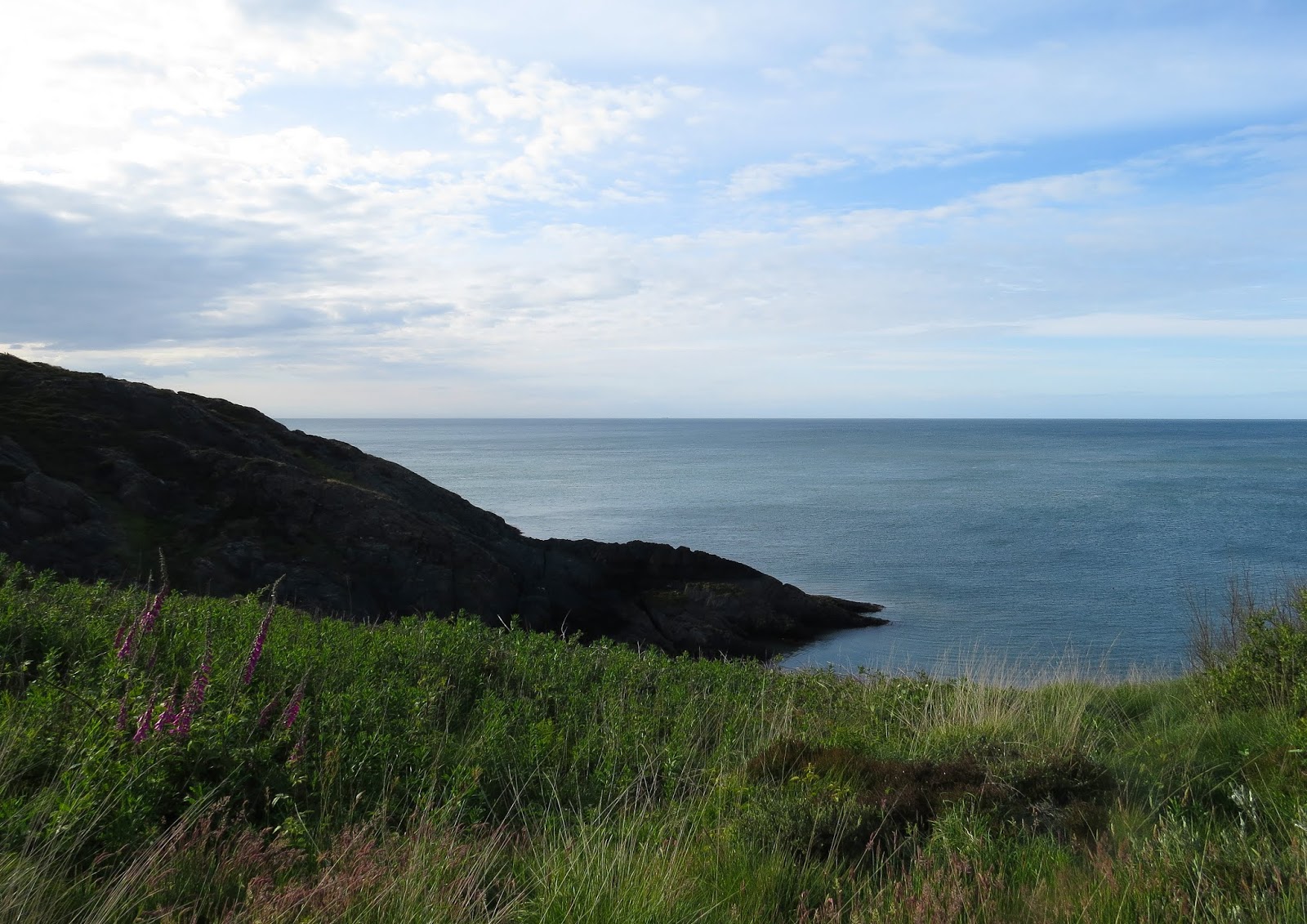
The beautiful views from the coastal path
Regardless, this was a fantastic local bird to see in a beautiful, rugged Welsh coastal setting, and a bird that means I can finally tick off that blank square on my owl checklist after all these years.

Saturday, 23 July 2016

Pugsley's Marsh Orchid on Anglesey

With just two native species of orchid left to see in Britain (not counting those elusive Ghost Orchids), we planned a visit during half term to Cors Erddreiniog NNR on Anglesey to find one of my last remaining species – Pugsley’s Marsh Orchid.
Pugsley's Marsh Orchid - Anglesey
A fine specimen of Pugsley's Marsh Orchid - Anglesey
Pugsley’s Marsh Orchids are considerably scarce and local, only growing in a few select locations, including the rich fens of Anglesey.

Stopping over in Llandudno for the night, myself and Alex headed over to this fantastic fen reserve the next day in an effort to locate them, the weather following the trend for the week and providing us with clear blue skies and glorious sunshine.

Treading the path down through the reserve gates and over the boardwalk, we had soon found our prize – a large group of Dactylorhizas nestled within the wet marshy grass right at the end of the trail.

Consisting of a mix with Early Marsh Orchids (subsp. Incarnata) present, I was soon able to pick out the Pugsley’s Marsh Orchids within what I can only presume was a mixture of variations and Dact hybrids – the marked purple flowers didn’t really seem consistent with any species!

Never the less, we found a number of plants that fitted the characteristics of Pugsley’s Marsh perfectly (Mr Orchid himself Sean also later confirmed from photos) and I happily set about photographing these delicate and subtle beauties.
Pugsley's Marsh Orchid - Anglesey
Relatively hard to identify without knowing what to look for, a range of features give Pugsley’s Marsh Orchids a subtle but distinctive appearance. The flowering spike is usually distinctly one sided (with all flowers facing roughly the same way) and there tends to be a limited number (on average 6-14) well-spaced flowers on the spike. 
Pugsley's Marsh Orchid - Anglesey
A typically lop sided flower spike
The lip is also prominently 3 lobed with the central lobe projecting out as a prominent ‘tooth’, while the few leaves are relatively narrow (hence its former name of Narrow-leaved Marsh Orchid). The upper stem is also washed purple, as are the upper bracts, and the whole plant seems to have a rather delicate appearance. 
Pugsley's Marsh Orchid - Anglesey
Note the purple washed stem and upper bracts.
A number of individuals in the colony should always be examined to confirm the identity, and Pugsley’s Marsh Orchids rarely bloom as just a single specimen in a mixed colony of Dactylorhiza.
Pugsley's Marsh Orchid - Anglesey
There has also been a considerable amount of research conducted centred on the genetic background and ancestry of Pugsley’s Marsh Orchid. Populations in Norfolk, Suffolk and elsewhere in southern England (south of a line from The Wash to the Severn) were long placed with Pugsley’s Marsh Orchid until 2012, when new genetic evidence suggested that they were instead a subspecies of Southern Marsh Orchid. It now seems that only the northern populations can be classed as true Pugsley’s Marsh Orchids.
Pugsley's Marsh Orchid - Anglesey
I had previously visited Parsonage Moor reserve in Oxfordshire in the search for Pugsley’s Marsh Orchids, but sadly had only come across what at the time appeared to be a hybrid. Regardless, with the recent genetic analysis and revised distribution, this would now have been classes as a subspecies of Southern Marsh anyway.
Southern Marsh Orchid - Parsonage Moor
Southern Marsh Orchid at Parsonage Moor
Alongside the orchids we also found an interesting selection of carnivorous plants (always a favourite of mine) with several dew-drop laden leaves of Round-leaved Sundews visible growing on the moist mossy tussocks, as well as an abundance of Common Butterwort – a new species for me in the wild. Each had several small flies entrapped on the sticky leaves – fascinating, especially as wild carnivorous plants are not something I encounter all too often!
Round-leaved Sundew - Anglesey
Round-leaved Sundew
Common Butterwort - Anglesey
Common Butterwort
With just once species of orchid left to see in the UK (Lindisfarne Helleborine) I’ll hopefully be able to catch up with my final target later on in the summer - fingers crossed for a good flowering season up on Lindisfarne!

How to get there:

There is no parking at Cors Erddreiniog itself, but there are spaces in the nearby village of Capel Coch - just a two minute walk from the reserve entrance gate. The post code for parking is LL73 8PH and the reserve is on the east side of the road down a small track next to a white cottage. Once through the gate, follow the track down the hill to a second gate and entrance board sign.
Cors Erddreiniog - Anglesey

Tuesday, 26 January 2016

Winter Birding on Anglesey - Hooded Crow, Iceland Gull, Black Guillemots and Slavonian Grebe!

With a whole host of great birds present on Anglesey over the winter, we decided to make the trip over from the mainland to try and catch up with what was an excellent selection of quality birding goodies on offer.

First stop was the Hooded Crow that has been favouring the McDonald’s car park in Holyhead for the past month. Presumably a bird from Ireland or the Isle of Man, it was great to see this subtly beautiful corvid up close, perching obligingly on the aerials of nearby houses and on the lampposts in the car park itself. 
Hooded Crow - Holyhead, Anglesey

With various hybrids scattered across the line where both Hooded and Carrion Crows reside up in Scotland, it was refreshing to see what is definitely a pure looking bird.
Hooded Crow - Holyhead, Anglesey

The Black Guillemots at Holyhead Harbour dutifully performed on cue, and viewing from Beach Road they were in their usual spot feeding near the ferry terminal.

The Iceland Gull near South Stack RSPB at the Range also proved to be extremely easy to connect with, and as soon as we turned the corner towards the farm fields that the gird reference had directed us to (SH 22971 80396), we spotted a bright white shape feeding in the grass. 
Iceland Gull - The Range, Anglesey

Thursday, 30 July 2015

Terrific Terns - Cemlyn Bay, Anglesey

The tern colony at Cemlyn Bay on Anglesey offers some truly amazing views as the birds return to their nests with beaks laden with sand eels – often flying low down right overhead! 
Sandwich Tern - Cemlyn Bay, Anglesey
A must see for anyone visiting the area, this year held Sandwich terns in huge numbers, as well as around 30 pairs of nesting Commons and 15 pairs of Arctic on the smaller of the two islands. A single pair of Med gulls have also bred again on the smaller island, and it was suspected that the eggs had just hatched a few days prior to visiting. 
Sandwich Tern - Cemlyn Bay, Anglesey
With South Stack’s seabird colony not too far away holding nesting Guillemots, Razorbills, Puffins, Kittiwakes and Fulmars, along with the Choughs and Peregrines that perform their aerial acrobatics over the cliffs, a great days birding can be had by combining the two sites, even stopping off to call on the brilliant Black Guillemots that make Holyhead harbour their home on the way. 

Thursday, 19 March 2015

Lapland Bunting showing well at Cemlyn Bay, Anglesey

The Lapland Bunting at Cemlyn Bay on Anglesey had been showing really well for several days last week, so me and Alex decided to take a trip across to try and catch up with this confiding individual. Having seen a group of Lapland Buntings on the Great Orme in Llandudno a few autumns prior, but with them often staying quite hidden in the grass, I was keen to drop in on this particular bird as it had been allowing views of just a few feet away.

Sure enough, after a short wait, the bird flew in from the east and began feeding on the sprinkling of seed that remained on the path, allowing truly amazing views at just a metre away and providing some fantastic photo opportunities!
Lapland Bunting, Anglesey

Lapland Bunting, Anglesey

Lapland Bunting, Anglesey

Lapland Bunting, Anglesey
This individual was particularly great to see as it was nearing breeding plumage – being far more bright and colourful than the autumn birds I’ve seen before with the bold black markings on the chest and the gorgeous rustic reds on the neck really standing out.
Lapland Bunting, Anglesey

Lapland Bunting, Anglesey

Lapland Bunting, Anglesey
It was great to finally catch up with a Lapland Bunting at Cemlyn, after dipping a small flock that frequented the area nearly 4 years ago, with just some Barnacle Geese in one of the fields for consolation!
Lapland Bunting, Anglesey


Lapland Bunting, Anglesey
For anyone going, (it was still reported up to Tuesday) the bird is just a short walk from the car park near to the tern viewing area, a few metres up on the track that heads north and towards the sea.  It seems to favour the grassy patch and section of footpath near the old tumbling down buildings, just where the path turns left next to the wall by the fields. 
Lapland Bunting, Anglesey


Tuesday, 25 November 2014

Purple Heron on Anglesey

With a Purple Heron turning up in a small marshy field in Capel Gwyn on Anglesey during the week, but having to attend a conference on the Saturday, I wasn’t able to make the journey over until the following Sunday. However, this turned out to be the best course of action, as the bird was showing considerably well after being quite elusive the previous day.

Upon arrival, it was clear to see the field the bird had taken up residence in, and with the assembled birders having already received permission to walk in the field the heron was occupying by the lady that owned it, the bird was quickly picked up hiding in one of the waterlogged ditches, seemingly settled and unperturbed by its admirers.

Purple Heron - Anglesey

Keeping a safe distance, we were able to fully appreciate the bird up close, taking note of the subtle brown plumage and exceptionally long dagger-like bill – no match for any unsuspecting voles or amphibians unfortunate enough to come across it.

Having already seen adults of this species in Spain earlier in the year, (the normal range for this Mediterranean heron) it was still lovely to see this first winter juvenile even if it was not yet in its beautiful purple finery. It was also clear to see the difference from our resident Grey Herons, with the bright yellow bill, warm brown plumage and the black and yellow striped head pattern just starting to come through.

Purple Heron - Anglesey

Purple Heron - Anglesey

 There have been reports of the bird having an extreme limp with a possible broken leg, although recently it appears that this is in fact the result a birth defect, with the bird having one leg quite a bit shorter than the other. Only time will tell how it gets on, but hopefully it will continue feeding happily and be able to live its life out to the full with no problems at all.

Purple Heron - Anglesey