A tale of nature, wildlife and birding from Cheshire, North Wales and across the globe....

A tale of nature, wildlife and birding from Cheshire, North Wales and across the globe....
Showing posts with label Flora. Show all posts

Tuesday, 4 June 2019

Greater Tongue Orchids - Tiptree, Essex!

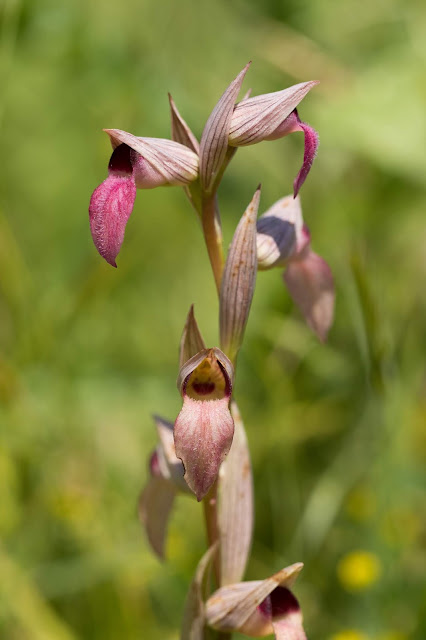
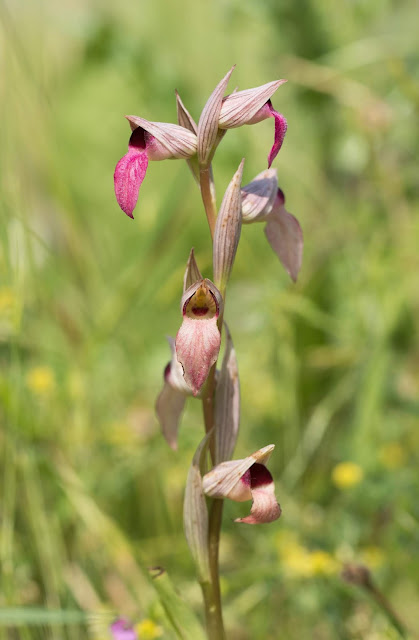
When a colony of Greater Tongue Orchids was discovered in Essex during the summer of 2017, the race was on to track the plants down and establish whether they were naturally occurring or had arrived artificially. With just a single photo of several flowering spikes in a field to go on (which was hastily removed from the Facebook page to which it was posted) several of the orchid world's enthusiasts expertly narrowed down the location, and by carefully checking the vegetation on site to that in the photo, were remarkably able to pin down the exact spot where these exotic orchids were growing.
Greater Tongue Orchid - Tiptree, Essex
Sadly, by the time they were found all but a very small handful of the plants had completely gone over, and as such, arrangements were kindly made for a number of organised visits last summer so those interested could admire these Mediterranean beauties in all their glory.

Therefore, at the beginning of June last year, me and my Dad made the long journey down to Essex and were met on site by local resident Jonathan who showed us the exact location in the meadows where this small cluster of orchids were growing, thankfully in prime condition despite the scorching sun and allowing for excellent photographic opportunities (despite some tripod issues!).
Greater Tongue Orchid - Tiptree, Essex
v
Greater Tongue Orchid - Tiptree, Essex
With around 36 plants in flower last year, the number was slightly down on 2017's showing, but luckily each delicate maroon flowering spike was in top condition (I had actually been away in America the previous week so was a bit concerned the flowers may have been past their best by the time I got there) and the colony had been carefully marked out with several small canes to prevent trampling by unaware dog walkers.
Greater Tongue Orchid - Tiptree, Essex
However, despite the excitement of such a remarkable botanical find, the question remains: are the Tiptree Greater Tongue Orchids naturally occurring or did they arrive through artificial means?

With orchid seed being particularly fine and easily carried by the wind, there is of course every possibility that seed from the continent had blown over naturally, with the nearest populations occurring in France, Spain and Italy. However, a number of other circumstances need to be considered before determining whether these continental plants really did make it over here without a little bit of human help.

A single specimen could easily have been planted out by a keen botanist or gardener many years ago, reproducing year on year to result in the small colony seen now (the plants were all restricted to a tiny area about a metre squared in size and found nowhere else on the meadows as you would expect from plants in a natural continental setting). Likewise, seed blown artificially from plants growing in a pot in a nearby garden could have easily kick started a colony.

However, this would be an odd site for a deliberate planting, and no pot grown specimens are growing nearby to our knowledge - even if they were, the Greater Tongue Orchids natural pollinator is not known to occur in Britain, making seed set very unlikely without assistance. 

Upon talking to Jonathan, he explained that decades ago the meadows were used as strawberry fields alongside a plant nursery that amongst other things was known to grow tropical orchids. This therefore creates an entirely feasible scenario of Tongue Orchid seed being accidentally imported - getting in to the mix of soil, clippings and cuttings discarded on site and germinating, eventually becoming established and naturalised - in my opinion the most likely origin.
Greater Tongue Orchid - Tiptree, Essex
This is not the first occurrence of Greater Tongue Orchid in the UK however, with a small well-known colony of Greater Tongue Orchids situated at Wakehurst Place in Sussex alongside the introduced Loose-flowered Orchids (never proven but very unlikely to be of natural origin as a consequence). Three flower spikes were also discovered near to the coast in Kingsbridge, south Devon back in 1998, but once again, their origins were never proven - some suspecting seed had come from an artificial source such as a nearby plant collection or agricultural seed mix. 

Small-flowered Tongue Orchids have also previously gotten a very shallow toehold on British soil in the past with individuals cropping up near Rame Head in SE Cornwall, having first been discovered there in 1989, but sadly disappearing in the early 2000s. With seed suspected to have blown in from the continent as opposed to a deliberate planting due to the remote location, it's entirely probable these were the result of natural colonisation from across the channel.

It’s likely that we’ll never know for certain the origins of the Tiptree plants, but whatever their background, the Tongue Orchids have clearly been on site for a number of years now, vegetatively reproducing to increase in number each year and creating a naturalised and self-sustaining population in the process. 
Greater Tongue Orchids - Tiptree, Essex
The Tongue Orchids have reproduced vegetatively to cover a small patch of ground in the meadow
Greater Tongue Orchids - Tiptree, Essex
Spot the Tongue Orchid! The small patch where the orchids were growing
Unfortunately despite being the only known 'natural' colony in Britain, the Tiptree Tongue Orchids face an uncertain future, with developers knocking on the door eager to build on the site despite the protestations of residents and orchid enthusiasts alike. This year, due to the sensitivities of the site, visitors are also being asked to keep away. Hopefully some sort of compromise can be found, where the future of the orchids is secured and many more people can get to enjoy them for years to come - it would be a real shame indeed if these fascinating plants were to be lost almost as quickly as they were found.
Greater Tongue Orchid - Tiptree, Essex
Greater Tongue Orchids - Tiptree, Essex
Greater Tongue Orchid Meadow - Tiptree, Essex
The meadow in Tiptree, Essex where the Greater Tongue Orchids were found

Monday, 17 September 2018

Green-winged Orchids at Muston Meadows NNR, Leicestershire!

Not having a DSLR camera back in 2009 when I first saw Green-winged Orchids at Durlston CP down in Dorset, I decided to head over to Muston Meadows NNR in Leicestershire this spring in an attempt to get some better photos of this charming species of orchid. 
Green-winged Orchid - Muston Meadows, Leicestershire
Often described as one of the finest lowland meadows in England with thousands of Green-winged Orchids growing amongst a plethora of other botanical delights, after a quick stop off at the nearby tearooms for a bacon sandwich we arrived at Muston just before lunch, eventually finding the entrance to the reserve tucked away in the hedges (after getting slightly lost in several of the nearby crop fields!)
Muston Meadows, Leicestershire
Muston Tearooms
Bacon toastie - prime orchid hunting fuel!
With the black rain clouds on the horizon ominously threatening rain, we set to work exploring this hidden gem of a nature reserve in an effort to find the best flowering specimens for photography and to admire the many different colour variations of Green-winged Orchid that can be found on site here.
Green-winged Orchid - Muston Meadows, Leicestershire
Pollination in action!
Green-winged Orchid - Muston Meadows, Leicestershire
Thankfully the rain held off and we were able to appreciate the myriad of colour forms that occur, from the pretty pale rose pink varieties and the dainty almost pure white plants, to the more regular deep wine purple flowers that are the norm.
Green-winged Orchid - Muston Meadows, Leicestershire
An especially pale plant
Rather sadly, Muston Meadows has seen a reduction in size somewhat dramatically over recent years, with almost 30 hectares de-declared from being an NNR and losing protection, leaving just a few fields secure. Thankfully it is here that the Green-winged Orchids thrive, and Muston Meadows is still one of the best sites on the northern edge of its range in which to see these dainty orchids, boasting an impressive colony of over 10,000 plants. 
Muston Meadows, Leicestershire
The meadow was full of thousands of orchids
Even sadder still, with the destruction and drainage of many unimproved grassland pastures that Green-winged Orchids previously called home, the population in Britain has crashed, declining by almost 50% from the numbers seen only 50 years ago. As a result, Green-winged Orchids are now listed as Near Threatened in England, so it was fantastic to see them occurring in such good numbers at Muston - hopefully they will continue to thrive here for the foreseeable future. 
Green-winged Orchid - Muston Meadows, Leicestershire
Muston Meadows, Leicestershire

Getting to Muston Meadows

Muston Meadows NNR can be found just west of Grantham in north east Leicestershire. We parked on the corner of Woolsthorpe Lane (NG13 0FE) at the southern end of the village of Muston, then walked down the small lane heading west. The style entrance to the reserve could be found towards the end of the lane on the left hand side nestled within the hedge. 

Flowering is usually in late April through to May (earlier in the southern counties), and we visited Muston during the second week of May when the orchids were in their prime.
Green-winged Orchid map - Muston Meadows, Leicestershire
Map of Muston Meadows NNR

Monday, 26 June 2017

Man Orchids at Copper Hill, Lincolnshire!

Man Orchids are one of my favourite species of British orchid, and having last seen them flowering nearly ten years ago, I thought it was time I made a trip back to take another look and get some improved photos of these fantastic plants.
Man Orchid - Copper Hill, Lincolnshire
With Man Orchids enjoying a decidedly southerly bias in terms of distribution in Britain, I returned to the same site I visited in 2009 to see them – the botanically rich roadside verges of the Copper Hill reserve in Lincolnshire and the most northerly site in Britain where Man Orchid occurs. 
Copper Hill - Lincolnshire
The Copper Hill roadside verge
Situated just outside Ancaster, the roadside verges that fall under the reserve’s boundary are protected under Lincolnshire’s Protected Roadside Verge Scheme, and as such a particularly rich and diverse mixture of limestone flora is allowed to thrive, including the endangered in Britain Man Orchid.
Man Orchid - Copper Hill, Lincolnshire
Benefitting from an escape from the vastly overused council lawnmowers, the Man Orchids, along with a whole smorgasbord of other wildflowers, seem to be doing exceptionally well here, and we counted at least 34 spikes of these unusual orchids along the short stretch of the eastern verge (although the Wildlife Trust volunteers counted an exceptional 50 spikes a few days earlier!). 
Man Orchid - Copper Hill, Lincolnshire
Man Orchids are one of the most fascinating species of orchid in Britain (along with the rest of the often-extravagantly decorated Orchis genus) and a closer inspection of the flower spike reveals a column of delicate banana coloured human shaped flowers washed with a delightful rich red and bronze hue, each one impressively mimicking a tiny little man. 
Man Orchid - Copper Hill, Lincolnshire
Apparently the flowers also give off the scent of fried onions, although I didn’t sniff them to confirm whether or not this is just a rumour! 
Man Orchid - Copper Hill, Lincolnshire
Man Orchids are one of the taller species of orchid in Britain, often growing to around 30cm high
With our native wildflowers in decline over here in the UK, it would certainly be good practice to allow all of our roadside verges to flourish like is the case at Copper Hill, instead of the current trend for our councils to be obsessed with neat and tidy short-mown grass, completely bare and devoid of any floral character at all. 
Man Orchid - Copper Hill, Lincolnshire
Man Orchid in situ!
Copper Hill Reserve - Lincolnshire
The tank the Man Orchids are next to
Man Orchid - Copper Hill, Lincolnshire
Man Orchids in situ!
Copper Hill Reserve - Lincolnshire
Parking at Copper Hill reserve is off King Street (NG32 3PY), and the end of May/beginning of June is the best time to visit.