A tale of nature, wildlife and birding from Cheshire, North Wales and across the globe....

A tale of nature, wildlife and birding from Cheshire, North Wales and across the globe....
Showing posts with label Pallid Harrier. Show all posts

Wednesday, 10 January 2018

Birding round up of the year 2017!

After the rollercoaster of a ride that was the British birding scene in 2016 (where firsts for Britain were turning up at a rate of knots), 2017 in comparison turned out to be a little bit of a damp squib. The majority of new birds and “uber” megas turned up on the remote offshore islands, while the year’s unquestionable star bird – North Ronaldsay’s fine adult male Siberian Blue Robin - was only seen by a handful of extremely lucky observers!
Siberian Blue Robin - North Ronaldsay

Nevertheless the year still held a few welcome surprises – Britain’s first DNA confirmed record of Elegant Tern down on the south coast was a huge bonus, while individuals of Red-breasted Goose, White-billed Diver and Rock Thrush ensured that 2017 held some grip backs at least!
Elegant Tern - Pagham Harbour, West Sussex
Elegant Tern (honest!) - Pagham Harbour, West Sussex
Red-breasted Goose - Cockerham, Lancashire
White-billed Diver - Woodhall Spa, Lincolnshire
Rock Thrush - Gwent, Wales
Not every bird was gettable however – the Amur Falcon down in Cornwall – the first twitchable one of its kind – proved frustratingly out of reach during the working week, while the year’s Red-winged Blackbird, American Redstart, Cedar Waxwing and Yellow-breasted Bunting all proved to be just a touch too far away on remote islands to tempt us, especially having already seen 3 out of the 4 in large quantities over in America before.  
Red-winged  Blackbird - New York
Red-winged  Blackbird in New York
American Redstart - New York
American Redstart in New York
Cedar Waxwing - New York
Cedar Waxwing in New York
However, for me, our trips birding abroad stole the show for 2017. Mallorca and Tenerife provided some welcome European birding in stunning scenery and fantastic climes, while our once in a lifetime trip to Queensland Australia during the summer created some lifelong memories that will never be forgotten. A male Golden Bowerbird at his bower deep in the heart of the Australian mountains, the flashy colours of Fairywrens and Boatbills and the imposing majesty of the fierce and iconic Cassowary just mere feet away are all experiences that will live on in years to come. 
Green Turtle - Australia
Green Turtle
Likewise our snorkelling expeditions exploring the Great Barrier Reef and the accompanying helicopter ride above one of the greatest wonders of the world created lasting memories of an experience of a lifetime.
The Great Barrier Reef, Australia
The Great Barrier Reef
And so to the top birds of 2017….

In joint 3rd place are the diver duo of the Northumberland Pacific Diver and the Lincolnshire White-billed Diver – turning up on the same weekend and both affording absolutely unbeatable views. Having seen the returning Cornish Pacific Diver as a distant dot miles away through a scope, a chance to see this mega species of diver in Britain so close proved irresistible, and we soon found ourselves gazing eye to eye with this fearless individual mere feet away.
Pacific Diver - Northumberland
Meanwhile news was breaking of another rare species of diver giving phenomenal views further south with a White-billed Diver having been discovered fishing on a river in rural Lincolnshire 20 miles inland. In a remarkable coincidence, this mirrored the only other British record of an inland White-billed Diver to date, occurring on the very same stretch of river back in March 1996. Having had to wait a whole week before making the journey down to Lincolnshire it was a relief to finally connect with this stunning arctic visitor, finally putting to rest the regrets of not travelling to Devon/Dorset for the popular Brunnich’s Guillemot and Brixham White-billed Diver duo a few years ago.
White-billed Diver - Lincolnshire
In second place, while not strictly a lifer, is the beautiful male Pallid Harrier that graced the hillsides at the Forest of Bowland earlier in the year. Living in England, male Harriers are not something I see all that often, so it was an honour to be able to watch on as this ghostly displaying male skydanced his way over the moors in an effort to attract a mate. Sheer beauty, and to have a male Pallid Harrier skydancing over your head is a thing of enchanting magic. Without a doubt this was one of the most exquisite birds I’ve seen, and to watch him perform was an absolute privilege.
Pallid Harrier - Lancashire
In first place, rather surprisingly, was Durham’s very own Scops Owl – found roosting in a small elder bush one morning in September where it proceeded to stay for the next few days much to the delight of the growing crowd of birders coming to admire it. This quirky, angry looking miniature bird of prey has always been a firm favourite of mine when visiting falconry exhibits, and having only seen Scops Owls abroad in Spain before, in near pitch black at that, this was a species that I was especially keen to see in Britain, seeming such an unlikely visitor from the continent. 
Scops Owl - Durham
Scops Owl - Durham
Thankfully the Scops was still in place when we arrived, tucked up against the trunk of its spindly elder and giving cracking views as it kept a watchful eye on the crowd, blending in perfectly with the gnarled bark. With 84 accepted records in Britain to date this is by no means a “mega mega” but it was still an absolutely superb bird that was most definitely worth travelling for and a bird on my personal wish list for Britain.
Scops Owl - Durham
With 2018 now in full swing who knows what avian delights await us – a wintering Wallcreeper is most definitely long overdue and is sure to whet the appetite of almost every birder in Britain, while a scattering of American warblers in the autumn would be most welcome, especially if a male Blackburnian was amongst them. With Far Eastern sprites also coming ever closer to our shores over the past few years, who knows what "First for Britain" oriental goodies might just be carried over on the easterly winds… Whatever the case, fingers crossed for a good bird-filled year! 
Wallcreeper
Coming soon to a south coast cliff near you... we hope! 

Thursday, 4 May 2017

Skydancer - Pallid Harrier at the Forest of Bowland

Living in England, male Hen Harriers are not a sight I get to see very often. Driving along a stretch of grassy meadows sadly doesn’t yield a floating figure quartering over the fields as it does in Spain and other European countries, and instead numbers have now been depleted to just a few upland breeding sites – if they can cling on amongst the gunfire that besieges them that is. My first ever male Hen Harrier was an individual at Parkgate Marshes many years ago, a ghostly figure hunting distantly on the horizon, no more than a grey spec on the far away skyline. Fast forward several years and I haven’t seen another male Hen Harrier in England since – a very sad sign of the times indeed.

Therefore when a male Pallid Harrier (even more stunning than a male Hen Harrier) was reported as being present at the Forest of Bowland in Lancashire just before the bank holiday weekend - observed displaying and even nest building - it was simply too good of an opportunity to be missed to catch up with this impressive individual. Having seen a juvenile Pallid Harrier down in Somerset a few years ago, this wasn’t a new bird for either myself or Alex, but with only a very small handful of male Pallid Harriers making it over to our shores compared to juveniles, we couldn’t resist going to see this graceful beauty for ourselves.
Pallid Harrier - Forest of Bowland, Lancashire
Making the gruelling 4km treck to the best viewing spot along the winding hillside, we were immediately met by a hauntingly pale figure quartering over the moors, swooping down and gliding swiftly along the valley bottom, white wings shining out as he twisted and turned in the air. Glorious, and the tiring journey up to the moors was soon forgotten as we watched him perform.
Pallid Harrier - Forest of Bowland, Lancashire
Over the course of the next two hours the crowd watched on in awe as our ghostly visitor completed several circuits over the hillside, often sat perched preening on the fence posts for periods at a time as well as bringing small sticks back to the nest site on several occasions, spindly twigs held tightly in his bright yellow feet.
Pallid Harrier - Forest of Bowland, Lancashire
With a pattern soon emerging of crossing over the road to our right and swooping back overhead, eventually the moment happened that his captive audience had been waiting for, and to appreciative woops and gasps our male Pallid Harrier begun to skydance. Tumbling through the air with extreme grace and speed, wings twisting in a remarkable butterfly-esque style while his trilling call echoed out over the valley, he had the crowd of 30 or so birders completely mesmerised and hooked on his every move.

Sheer beauty, and to have a male Pallid Harrier skydancing over your head is a thing of enchanting magic. Without doubt this was one of the most exquisite birds I’ve seen, and to watch him perform was an absolute privilege. For anyone thinking of going, but hasn’t yet got around to it or who may be put off by the long walk – go! You won’t regret it!
Pallid Harrier - Forest of Bowland, Lancashire
Hopefully the amount of attention the Pallid Harrier is receiving will save him from the unwelcome persecution from gamekeepers in the area - indeed, it’s lucky that it was a birdwatcher that discovered him before the guns did. Sadly though, his aerial acrobatics will most probably be in vain, as the lack of Hen Harriers (and raptors in general) during our walk in the Forest of Bowland area was startling. With the likelihood of a female Pallid Harrier stumbling upon his airtime show almost nil, it seems the chances of a female Hen Harrier joining him at the nest (as was the case in Orkney in 1995) are just as depressingly slim.
Forest of Bowland, Lancashire
Emperor Moth
Emperor Moth
Male Emperor Moth!! What an amazing creature!
With the added bonus of our first ever Emperor moth causing excitement on the moors, as well as a supporting cast of Dipper, Common Sandpipers and Grey Wagtails on the brook, we were exceptionally glad we made the effort to head up to Lancashire to see this incredible bird and endure the tiring 5 mile round walk - although our aching legs and weary feet were nothing a tasty sausage batch once home couldn’t sort out!

For information on where is best to view the Pallid Harrier from, check out the directions page from the RSPB.

Monday, 22 February 2016

Norfolk Birding - Shore Larks, Rough-legged Buzzards, Bean Geese and the Golden Pheasant of Wolferton

Me and Alex decided to take a New Year’s trip to Norfolk in order to catch up with all the birding goodies that were on offer in what is surely one of the most productive of counties for birds. With a wealth of species concentrated in a small area near Kings Lynn, we had three days to connect with an impressive line-up of great birds.

Staking out Flitcham that afternoon for the resident Pallid Harrier unfortunately drew a blank (although we had already seen an individual last autumn in Somerset) but we were rewarded with a beautiful flock of feeding Bramblings, a hunting Merlin and a pair of gaudy Egyptian Geese as consolation prizes.
Brambling, Flitcham
Phone-scoped shot of one of the Bramblings
The next day saw an early rise and the obligatory trip to the now famous Wolferton Triangle in order to catch up with the resident Lord of the Estate – the legendary Golden Pheasant himself, before heading over to Choseley Drying Barns to try and spot one of the two Rough-legged Buzzards that have been calling this area home. 
Golden Pheasant, Wolferton Triangle
After eventually finding the right location and after a fair bit of driving and scanning fields, I managed to pick out a pale coloured Buteo heading over the ridge with pronounced black carpal patches and a white upper tail – our target bird.

Enjoying brief views, we drove over to the field in question and after some careful scanning, I picked up our sought after Buzzard, this time perched in the field next to us. Taking flight and being harassed by two persistent crows, we both got excellent views as this majestic raptor flew along the edge of the field, the white inner tail above distinctive along with the much paler wings and characteristic markings.

With the Rough-legged Buzzard now out of sight and perched in a distant tree, we headed over to Cley for our final stop of the day in an attempt to catch up with one of the four Bean Geese that had been present on the reserve associating with the regular Pink Feet. Travelling past many farm fields, it was a refreshing change to see coveys of both Grey and Red-legged Partridges in large numbers as we drove through Norfolk, with both species being plentiful.
Grey Partridges, Norfolk
Arriving at Cley, we immediately locked on to a Barn Owl gracefully quartering the reeds in the afternoon sun, while several Marsh Harriers patrolled the reserve.  Entering the hides, the Bean Geese were extremely difficult to pick out amongst the large flock of Pink Feet, and after some careful scanning it wasn't until the other birders in the next hide along pointed them out to me that I was able to pick them out. Extremely similar to Pink Footed Geese, the good views really enabled us to note the subtle differences - their orange bills really stood out from the pink bills of the Pink Feet. Having only ever seen one Bean Goose before at Telford a few years ago, this was a great opportunity to really get my eye in on these two confusion species.
Bean Geese, Cley
Two orange billed Bean Geese interspersed with the Pink Feet
A quick check on the fields further up the track resulted in us also trying to pick out the Black Brant that had been present in the Brent goose flock for several weeks. Alex eventually managed to pick it up in what was becoming fast fading light, and we both admired this attractive American subspecies - my first in the UK. 
Black Brant, Cley
Black Brant, Cley
Differing from our Brent Geese by sporting a complete white neck collar and having much bolder white markings on the sides, once we had our eye in we could easily pick out this American stray amongst the hundreds of Dark-bellied Brents
Dark-bellied Brent Geese, Cley
The Dark-bellied Brent Geese - Black Brant at the bottom left!
With the light now disappearing, we headed back to the hotel for a feast of pizza and pasta before our final day in Norfolk and what would be our first birds of 2016. 

With New Year’s Day dawning and just one full day left, we decided to head over to Thornham Harbour where 3 Shore Larks had been present on the shingle beach next to the estuary mouth. One of my favourite small shore birds and a species I don’t often come across in the North West, I was keen to catch up with these delightful Bumble Bee patterned larks.

Stopping to admire the flock of around 30 Twite that had been feeding amongst the salt marsh plants right next to the car park and giving excellent views, we headed off in to the dunes to locate the Shore Larks.

With an ever present stream of New Year’s Day birders having scopes set up watching the birds, they weren't hard to find, and we were soon enjoying close views as the three birds fed along the tide line in the debris washed up by the waves.
Shore Lark, Thornham Harbour
Having only ever seen the Rossall Point bird last winter, it was great to admire these brightly coloured birds as they went about their business and it was a fantastic end to what had been a hugely successful trip to Norfolk.

Thursday, 6 November 2014

Cornish Road Trip Part 2

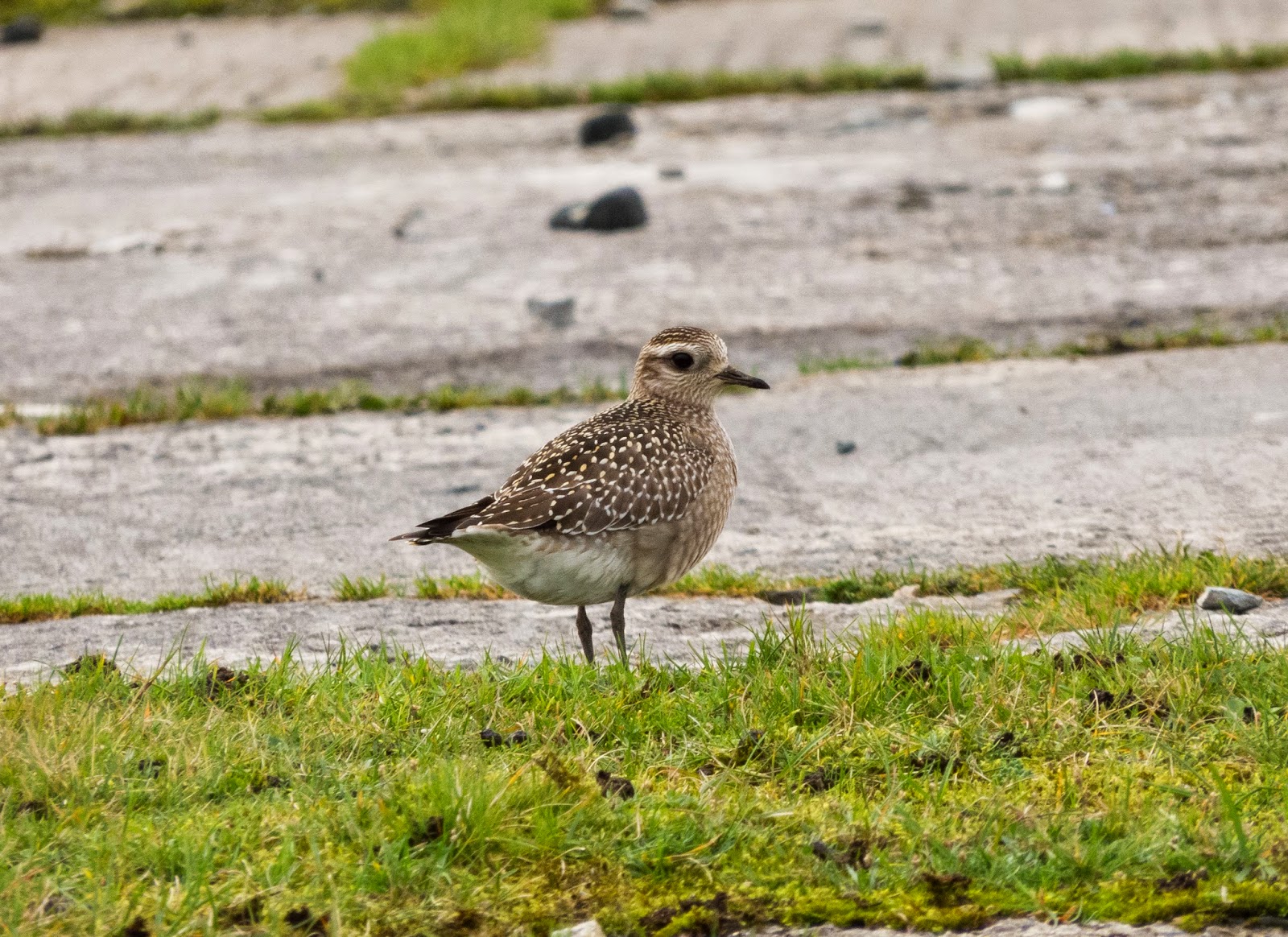
After heading to Davidstow Airfield in the morning to track down the American Golden Plover that had taken up residence there (it was clearly in no hurry to move on from its new found home, having been present for over a week), it was rather frustrating that we couldn’t relocate it next to its usual haunt of the small pool next to the windsock. After driving around for about an hour checking the surrounding grassy fields, with no sign of the bird anywhere, we were just about to give up (another lifer seemingly slipping out of our grasp) when Alex made an absolutely cracking find, spotting the bird right next to the car hidden in the centre of the runway! It had evidently proven hard to spot for everyone, as 4 other cars had driven past it already whilst we were there, the bird blending perfectly in to the concrete surroundings and completely undeterred by the trail of cars moving slowly down the runway in search of it. We quickly alerted the other cars looking, and stopped to admire this beautiful looking American wader.

American Golden Plover

American Golden Plover

Though rather bleak looking and containing few pools, Davidstow Airfield has surprisingly attracted its fair share of American waders over the past 5 years, with White-rumped, Baird’s and Semipalmated Sandpipers, as well as several Buff-breasted Sandpipers all recorded amongst the abandoned and eerie runways.

We sat and watched the AGP for a good while, the bird positioned right outside my passenger door allowing for some excellent photo opportunities and showing fantastically well at such a close range. This allowed us to really take note of the golden and silver speckles on the plumage and admire it as it happily foraged for worms in a small patch of grass.


As a juvenile, it was distinguishable from our resident Golden Plovers by the prominent white supercillium and overall greyer and duller colouration – illustrated perfectly at such a close proximity.

American Golden Plover

American Golden Plover

American Golden Plover

 After getting our fill of the plover, we then headed back up north to Somerset to try and catch up with the reliable juvenile Pallid Harrier that had taken up residence at the newly created Steart WWT reserve. Upon arrival, we were told we had just missed it showing well by 5 minutes (shouldn’t have stopped at that service station en-route!) so we stuck it out by the hide waiting for it to reappear, entertained by one of two Great White Egrets present mooching around in front of us.

After half an hour or so, the cries went up, and it had indeed taken off from the marsh and was gliding smoothly across the reeds. Whilst distant, the orange colouration could just be made out (my favourite plumage type for Pallid Harriers) and we watched the bird for around 5 minutes before it was lost to view in the marsh again. Deciding that the other path offered much closer views, we headed off that way, and whilst sat scanning our surroundings, amazingly, by sheer chance, both me and Alex had our scopes independently on the exact patch of reeds to coincide with the moment the bird took off again – providing close prolonged views and allowing us to see the distinctive features a lot better.
Seart WWT
The saltmarsh the harrier was favouring.
Pallid Harriers have much slimmer and narrower wings than Hen Harriers, and the juveniles can be told apart by the unmarked bare orange undersides lacking any of the streaking that is usually found on Hen Harriers. The distinct pale collar on the neck and solid dark boa pattern also separates them from the extremely similar Montagu’s Harrier, and this coupled with the contrast between the solid dark secondaries and pale primaries are the best ways to tell the two species apart.


After deciding to head back down south that evening to Hampshire for the Siberian Stonechat that was showing at Titchfield Haven, we made the 2 and a half hour journey to our next stopover in Southampton to rest up and enjoy a delicious meal of crispy lamb and chilli fried chicken (some of the best food I’ve had out in ages so most definitely worth a mention) and the prefect remedy for getting stuck in the tedious and unexplainable hour long delay we encountered near Wiltshire!