A tale of nature, wildlife and birding from Cheshire, North Wales and across the globe....

A tale of nature, wildlife and birding from Cheshire, North Wales and across the globe....
Showing posts with label American Golden Plover. Show all posts

Monday, 12 October 2015

Autumn weekend at Spurn

A two day trip to the fantastic coastal spot that is Spurn this weekend resulted in the expected scattering of east coast migrants as well as a lifer in the form of a Richard’s Pipit in one of the fields opposite West Mere Farm at Kilnsea.

Having not been seen for a good hour when I got to the field in question and with only 2 other birders staking out the grass where it was last spotted, it soon turned in to a waiting game and a test of perseverance. With Alex checking the nearby hedgerows for migrants, I stuck it out in the hope of connecting, and sure enough, after ten minutes or so, the only other remaining birder had it in his scope, the pipit giving good views as it hopped out in to the open in front of the water trough.

Much larger than a Meadow Pipit, with extremely long legs and an almost thrush like facial profile due to the head shape and bill, this distinctive pipit was a much awaited lifer for me after not counting a bird seen very briefly on the Great Orme 3 years ago having just got a fleeting glimpse of the top of a bird’s head!

After calling Alex back, we both got nice scope views as the pipit moved through the long grass, only becoming visible when it popped its head up to stop and scan around, standing upright with its neck outstretched. Despite moving quite a way across the field, we still managed to track the bird through the grass, occasionally coming right out in to the open so we could really admire the bird in full. At one point, it even flew up and came closer, giving a first-hand opportunity to hear that characteristic flight call – quite similar to that of a sparrow.

Satisfied with our views of the Richard’s Pipit, we stopped by to admire the cracking male Black Redstart that had been frequenting the garden of the house opposite, before heading to Kilnsea Wetlands where an American Golden Plover had just been found. Despite having already seen one in Cornwall at extremely close quarters last year, it was still nice to catch up with another bird, and we were all incredibly surprised when a second individual dropped by to join it! Despite the plumage differences between the two (with both birds seeming to be at opposite ends of the scale in terms of variation) when the birds stood next to each other it was clear they were both exactly the same size, and not an AGP and a Grey Plover like some had suggested. 
American Golden Plovers - Kilnsea Wetlands
When both birds eventually flapped their wings to reveal dusky tones and no hint of any solid black armpit patches, the ID was settled beyond doubt. Around 20 Brent Geese, a whole field of Hares and two fantastic hunting Barn Owls in the fading light were a great end to the day.
Having stayed overnight in Hull, we returned early the next morning to see what migrants may have been brought in on the easterly winds during the night. Despite every single bush positively heaving with Goldcrests everywhere you looked (thousands must have been present at Spurn and Kilnsea alone) other migrants were seemingly thin on the ground, and it was hard work to produce anything of note.

Two Bramblings in the Crown and Anchor car park were a nice find, while a 1w/female type Redstart caused some debate as to whether it was of the eastern form samamisicus, or Ehrenberg’s Redstart as it is known, with some white on the wing panel hinting to this eastern form. Despite the relatively distant views as it worked a hedge at the far end of a field, some photos were obtained, although personally I’m struggling to assign it to anything other than a normal Common Redstart.

A cracking Yellow-browed Warbler in the third paddock at Sammy’s Point rounded off our second day nicely, giving brief but great views and calling loudly as it hopped from bush to bush – a true sound of Autumn and one I’ll never tire of hearing.

Sadly, the Pallas’s Warbler on Humber Side Lane in Easington didn’t play ball to the amassed crowd, and two visits failed to pay off, as the bird remained highly elusive as it presumably undertook a circuit around the cottages and fields, only being seen twice that afternoon.

With a Red-flanked Bluetail and a Dusky Warbler both being found at Spurn this morning, things are clearly on the move, and what has so far been a quiet Autumn looks to finally be getting some life injected in to it. With several weeks of October and the beginning of November left to produce the goods, there is still time yet for that much sought after Siberian beauty to materialise – a Rubythroat would look especially welcome perched nicely on the Cliff Farm entrance stone or hopping though Church Field! 
Spurn

Thursday, 6 November 2014

Cornish Road Trip Part 2

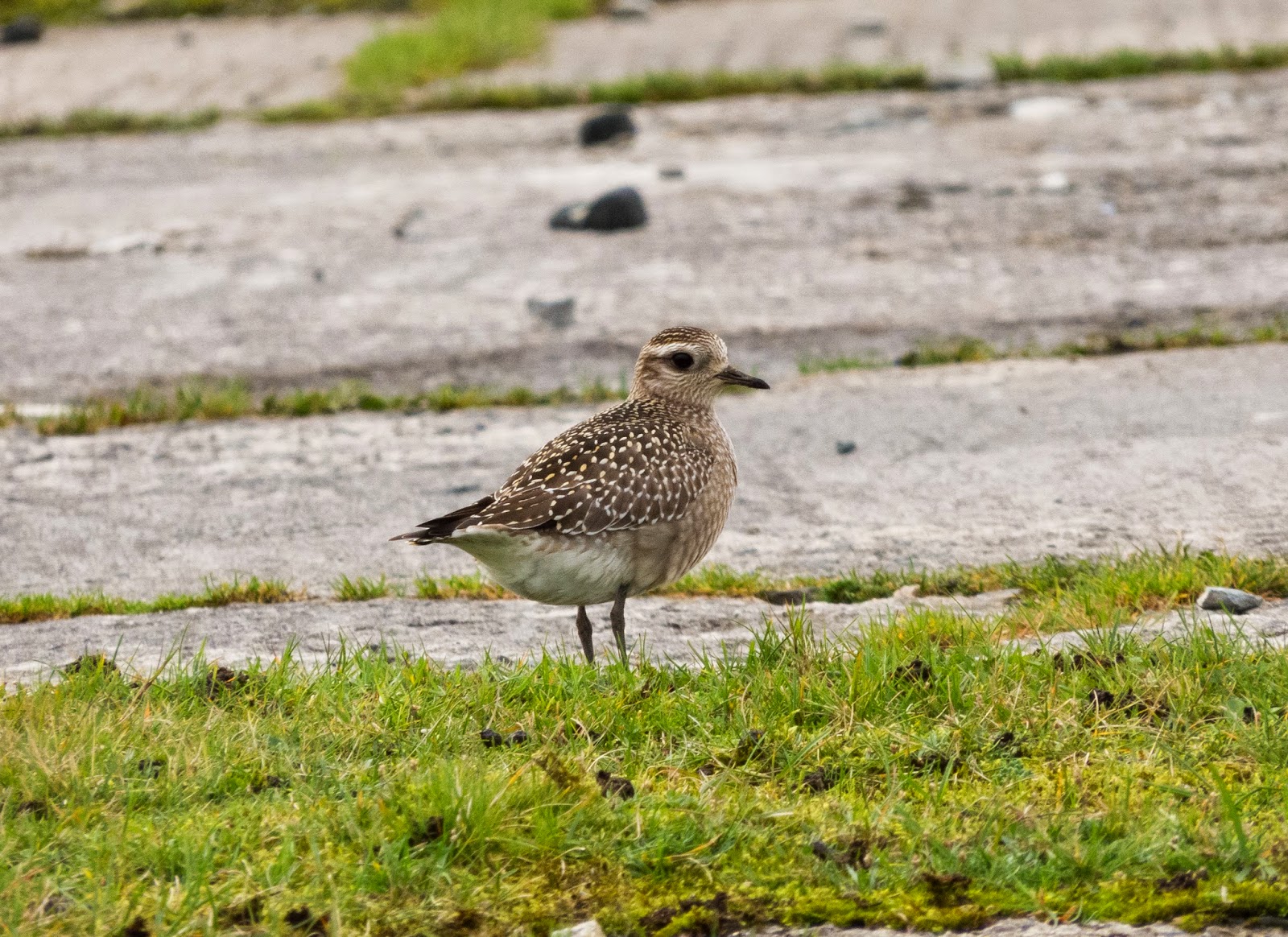
After heading to Davidstow Airfield in the morning to track down the American Golden Plover that had taken up residence there (it was clearly in no hurry to move on from its new found home, having been present for over a week), it was rather frustrating that we couldn’t relocate it next to its usual haunt of the small pool next to the windsock. After driving around for about an hour checking the surrounding grassy fields, with no sign of the bird anywhere, we were just about to give up (another lifer seemingly slipping out of our grasp) when Alex made an absolutely cracking find, spotting the bird right next to the car hidden in the centre of the runway! It had evidently proven hard to spot for everyone, as 4 other cars had driven past it already whilst we were there, the bird blending perfectly in to the concrete surroundings and completely undeterred by the trail of cars moving slowly down the runway in search of it. We quickly alerted the other cars looking, and stopped to admire this beautiful looking American wader.

American Golden Plover

American Golden Plover

Though rather bleak looking and containing few pools, Davidstow Airfield has surprisingly attracted its fair share of American waders over the past 5 years, with White-rumped, Baird’s and Semipalmated Sandpipers, as well as several Buff-breasted Sandpipers all recorded amongst the abandoned and eerie runways.

We sat and watched the AGP for a good while, the bird positioned right outside my passenger door allowing for some excellent photo opportunities and showing fantastically well at such a close range. This allowed us to really take note of the golden and silver speckles on the plumage and admire it as it happily foraged for worms in a small patch of grass.


As a juvenile, it was distinguishable from our resident Golden Plovers by the prominent white supercillium and overall greyer and duller colouration – illustrated perfectly at such a close proximity.

American Golden Plover

American Golden Plover

American Golden Plover

 After getting our fill of the plover, we then headed back up north to Somerset to try and catch up with the reliable juvenile Pallid Harrier that had taken up residence at the newly created Steart WWT reserve. Upon arrival, we were told we had just missed it showing well by 5 minutes (shouldn’t have stopped at that service station en-route!) so we stuck it out by the hide waiting for it to reappear, entertained by one of two Great White Egrets present mooching around in front of us.

After half an hour or so, the cries went up, and it had indeed taken off from the marsh and was gliding smoothly across the reeds. Whilst distant, the orange colouration could just be made out (my favourite plumage type for Pallid Harriers) and we watched the bird for around 5 minutes before it was lost to view in the marsh again. Deciding that the other path offered much closer views, we headed off that way, and whilst sat scanning our surroundings, amazingly, by sheer chance, both me and Alex had our scopes independently on the exact patch of reeds to coincide with the moment the bird took off again – providing close prolonged views and allowing us to see the distinctive features a lot better.
Seart WWT
The saltmarsh the harrier was favouring.
Pallid Harriers have much slimmer and narrower wings than Hen Harriers, and the juveniles can be told apart by the unmarked bare orange undersides lacking any of the streaking that is usually found on Hen Harriers. The distinct pale collar on the neck and solid dark boa pattern also separates them from the extremely similar Montagu’s Harrier, and this coupled with the contrast between the solid dark secondaries and pale primaries are the best ways to tell the two species apart.


After deciding to head back down south that evening to Hampshire for the Siberian Stonechat that was showing at Titchfield Haven, we made the 2 and a half hour journey to our next stopover in Southampton to rest up and enjoy a delicious meal of crispy lamb and chilli fried chicken (some of the best food I’ve had out in ages so most definitely worth a mention) and the prefect remedy for getting stuck in the tedious and unexplainable hour long delay we encountered near Wiltshire!