A tale of nature, wildlife and birding from Cheshire, North Wales and across the globe....

A tale of nature, wildlife and birding from Cheshire, North Wales and across the globe....
Showing posts with label lancashire. Show all posts

Thursday, 4 May 2017

Skydancer - Pallid Harrier at the Forest of Bowland

Living in England, male Hen Harriers are not a sight I get to see very often. Driving along a stretch of grassy meadows sadly doesn’t yield a floating figure quartering over the fields as it does in Spain and other European countries, and instead numbers have now been depleted to just a few upland breeding sites – if they can cling on amongst the gunfire that besieges them that is. My first ever male Hen Harrier was an individual at Parkgate Marshes many years ago, a ghostly figure hunting distantly on the horizon, no more than a grey spec on the far away skyline. Fast forward several years and I haven’t seen another male Hen Harrier in England since – a very sad sign of the times indeed.

Therefore when a male Pallid Harrier (even more stunning than a male Hen Harrier) was reported as being present at the Forest of Bowland in Lancashire just before the bank holiday weekend - observed displaying and even nest building - it was simply too good of an opportunity to be missed to catch up with this impressive individual. Having seen a juvenile Pallid Harrier down in Somerset a few years ago, this wasn’t a new bird for either myself or Alex, but with only a very small handful of male Pallid Harriers making it over to our shores compared to juveniles, we couldn’t resist going to see this graceful beauty for ourselves.
Pallid Harrier - Forest of Bowland, Lancashire
Making the gruelling 4km treck to the best viewing spot along the winding hillside, we were immediately met by a hauntingly pale figure quartering over the moors, swooping down and gliding swiftly along the valley bottom, white wings shining out as he twisted and turned in the air. Glorious, and the tiring journey up to the moors was soon forgotten as we watched him perform.
Pallid Harrier - Forest of Bowland, Lancashire
Over the course of the next two hours the crowd watched on in awe as our ghostly visitor completed several circuits over the hillside, often sat perched preening on the fence posts for periods at a time as well as bringing small sticks back to the nest site on several occasions, spindly twigs held tightly in his bright yellow feet.
Pallid Harrier - Forest of Bowland, Lancashire
With a pattern soon emerging of crossing over the road to our right and swooping back overhead, eventually the moment happened that his captive audience had been waiting for, and to appreciative woops and gasps our male Pallid Harrier begun to skydance. Tumbling through the air with extreme grace and speed, wings twisting in a remarkable butterfly-esque style while his trilling call echoed out over the valley, he had the crowd of 30 or so birders completely mesmerised and hooked on his every move.

Sheer beauty, and to have a male Pallid Harrier skydancing over your head is a thing of enchanting magic. Without doubt this was one of the most exquisite birds I’ve seen, and to watch him perform was an absolute privilege. For anyone thinking of going, but hasn’t yet got around to it or who may be put off by the long walk – go! You won’t regret it!
Pallid Harrier - Forest of Bowland, Lancashire
Hopefully the amount of attention the Pallid Harrier is receiving will save him from the unwelcome persecution from gamekeepers in the area - indeed, it’s lucky that it was a birdwatcher that discovered him before the guns did. Sadly though, his aerial acrobatics will most probably be in vain, as the lack of Hen Harriers (and raptors in general) during our walk in the Forest of Bowland area was startling. With the likelihood of a female Pallid Harrier stumbling upon his airtime show almost nil, it seems the chances of a female Hen Harrier joining him at the nest (as was the case in Orkney in 1995) are just as depressingly slim.
Forest of Bowland, Lancashire
Emperor Moth
Emperor Moth
Male Emperor Moth!! What an amazing creature!
With the added bonus of our first ever Emperor moth causing excitement on the moors, as well as a supporting cast of Dipper, Common Sandpipers and Grey Wagtails on the brook, we were exceptionally glad we made the effort to head up to Lancashire to see this incredible bird and endure the tiring 5 mile round walk - although our aching legs and weary feet were nothing a tasty sausage batch once home couldn’t sort out!

For information on where is best to view the Pallid Harrier from, check out the directions page from the RSPB.

Thursday, 2 February 2017

A wild (Red-breasted Goose) chase!! To Norfolk, Lancashire and back!

Some birds seem to be much trickier to catch up with than others and rather surprisingly, this winter’s Red-breasted Goose decided it was going to be one of the awkward ones. Having already travelled down to Norfolk at the end of December in an attempt to twitch it over the New Year period, thick fog rather hampered our success, and despite Alex getting brief views through the mist upon our arrival, the Red-breasted Goose rather disastrously wasn’t seen again! A gruelling following two days endlessly searching the surrounding fields and trawling through tens of thousands of geese in the biting cold drew a blank (hours and hours of searching and staring at geese resulted in me even seeing them in my sleep!), and with no further sightings of the Red-breasted Goose at all in Norfolk, it seemed we’d mis-timed our visit with it moving on to pastures new.
Red-breasted Goose - Cockerham, Lancashire
Goose! A total menace! 
Fast forward a few days and rather remarkably (or frustratingly depending on how you look at it!) what is presumed to be the same goose was refound on the marsh at RSPB Marshside in Lancashire on the 4th January (an hour away from home), before once more moving on to Cockerham Moss four days later. Despite going mysteriously missing for a week a couple of days later, it now seems to have struck up a pattern and can reliably be found grazing in the surrounding fields in the area amongst the thousands of Pinkfeet.

Alex's Red-breasted Goose video!

Heading up ourselves on the Sunday morning, we rather foolishly expected to rack up and enjoy great views of this colourful species feeding in one of the regular fields. How wrong we were….. 6 hours later and there was no trace of our goose, and with now freezing cold feet and a form of goose depression setting in, we were left pondering just why this one goose seemingly hated us…
Cockerham, Lancashire
The goose field - minus any Red-breasted ones!
Luckily though we persevered, and with several large flocks flying in from further north presumably to roost, we drove over to the main feeding field to trawl through yet more Pinkfeet in the hope that our Red-breasted had landed with them.

Joining the assembled birders and having not even got my scope set up yet, it was a case of “right place, right time” as in what was one of the most casual announcements of spotting a bird ever (second only to a French birders deadpan “I have eet” proclamation of finding our much sought after Dupont’s Lark in Spain) a lady exclaimed that she thought she had found “the red one”.
Red-breasted Goose - Cockerham, Lancashire
The "Red One"
With panic ensuing and almost in disbelief that after 4 whole days of searching our target had finally been found, there were a tense few frantic moments when there were no available scopes to look through – if it had flown off at this point I would have cried!

Luckily Alex soon found it amongst the flock and getting my own scope set up and on it we were finally able to enjoy prolonged views of this beautiful, petite goose. With no fog to obscure our vision and remaining out of the way of any bustling Pinkfeet, it was great to finally savour the sweet taste of success – Red-breasted Goose in the bag.
Red-breasted Goose - Cockerham, Lancashire
After around 10 minutes of it feeding in the field, our goose eventually took flight, presumably heading off in to the next field with a large group of Pinkfeet and unfortunately timing it’s departure at the same moment the other birders in the area arrived to try and connect…. it seems the goose certainly hadn’t lost its frustratingly mischievous trait where doing a vanishing act was concerned!

So, the big question… is it gen?

With Red-breasted Geese breeding in far north Russia – in the same area as Bean, White-fronted and Brent Geese, despite being amongst a large Pink-footed Goose flock we can presume that this particular bird arrived with the several White-fronted Geese that have been mixed in with the Pinkfeet.
Pink-footed Geese
Migrating Pinkfeet
Migrating south for the winter, once the Beans or White-fronts hit northern Europe they can mingle with the hundreds of thousands of Pink-footed Geese migrating in the same direction, often getting carried over to Britain with their host flocks. Indeed, several White-fronted and Bean Geese were present at both Cockerham and down in Norfolk, with the Red-breasted Goose regularly choosing to associate itself with the White-fronted Geese in particular when feeding.
White-fronted Geese
Photo by Alex Jones
Bean Goose
Both White-fronted and Bean Geese were present with the Red-breasted Goose
With several large Brent Goose flocks also overwintering down in Norfolk, an alternative theory is that the Red-breasted Goose may have travelled across to Britain with the Brent Geese before getting mixed in with the Pink-footed Goose flocks, preferring the food source of the grassy fields as opposed to the saltwater marshes favoured by Brent Geese. We did in fact actually see several Brent Geese mixed in with the Pink-footed Goose flocks down in Norfolk, showing that the two species do mingle.
Brent Geese - Norfolk
The Norfolk Brent Geese
It was also interesting to discover that the Pink-footed Goose flocks in Norfolk regularly make the journey up to Lancashire each year, and with the Todd’s Canada Goose in Norfolk also being spotted up at Cockerham, there is no doubt that these birds are all part of the same flock that have made the journey north – the Red-breasted Goose included.

Despite many Red-breasted Geese in Britain being of dubious origin having escaped from captivity, this individual’s wild tendencies, migratory patterns and association with carrier species (both Bean and White-fronted Geese were present with it in Norfolk and at Cockerham) are enough to earn it the benefit of the doubt for me.
Red-breasted Goose - Cockerham, Lancashire
Having given us the run-around for almost a month and sending us on a wild goose chase half way across the country and back, it was a weight off the shoulders to finally nail this (elusive for us!) individual! Great work on Alex’s part driving to both Norfolk and Lancashire for me to track down my goose – this almost makes up for him doing a runner to see a White Stork without me in August… almost!

Finding the Goose:

The Red-breasted Goose seems to favour a particular set of fields adjacent to Cockerham Marsh, running alongside the A588 from Cockerham to Stake Pool. The main flocks congregate between Braides and Sand Villa Farm (postcode LA2 0EW) but we also found substantial flocks along Horse Park Lane and Backsands Lane. Several birders have also been successful further north at Upper Thurnham off the A588 layby just south of Moss Lane, while we found a large flock at the end of Slack Lane on the other side of the Marsh. The most recent sighting came from Eagland Hill and Nateby, slightly further south. 


Monday, 14 September 2015

Wryneck at Fairhaven Lake, Lancashire

With a Wryneck having been present at Fairhaven Lake in Lancashire since last Thursday (along with 2 Barred Warblers that have sadly now departed) we paid a visit to see if we could catch up with what is usually a rare migrant here on the West Coast. 

Arriving at the pumping station compound to the right hand side of the lake where the Wryneck had been favouring for the duration of its stay, we joined the rest of the crown in anticipation of it showing and looking forward to seeing only my second of these delightful woodpeckers. 

After a spot of lunch while we waited, what must have been the quietest announcement ever that a bird was showing went up, and the crowds eventually realised someone had spotted the Wryneck, cryptically camouflaged as ever in the tops of one of its favoured Rose Hip bushes. Incredibly hidden and matching the bark to perfection, the (dreadful) record shot below exhibits perfectly the difficulty in picking out these masters of disguise!
Wryneck - Fairhaven Lake, Lancashire
With the bird only showing every hour or so when it chooses to perch in one of its preferred bushes or gorse, the Wryneck instead spent the majority of its time feeding on the ground and out of sight, taking advantage of the many ants on the sandy soil and abundance of grasshoppers in the area. Having previously seen my first and only Wryneck on the east coast at Spurn last autumn, it was great to catch up with this relatively local bird not too far from home.
Fairhaven Lake, Pumping Station Compound
Perfect scrubby habitat for a Wryneck to hide out in!
After the Wryneck had disappeared back in to the depths of the gorse thicket, we tried to find the now resident drake Scaup that had been present on Fairhaven Lake for several months, but even a 15 minute scout around the lake in one of the motor boats for hire failed to turn him up!

A quick stop at Preston Marina on the way home for the long staying 2nd winter Ring-billed Gull luckily resulted in success when I found it on the opposite jetty, putting an end to a string of dips for Ring-billed Gull this year in both Cornwall and Scotland! Much bulkier and larger than the Black-headed and Common Gulls, and with the black ring on the bill standing out even at a distance, there was certainly no mistaking this individual.
Ring-billed Gull, Preston Marina
 A great end to a fantastic day out in Lancashire! 


Friday, 24 July 2015

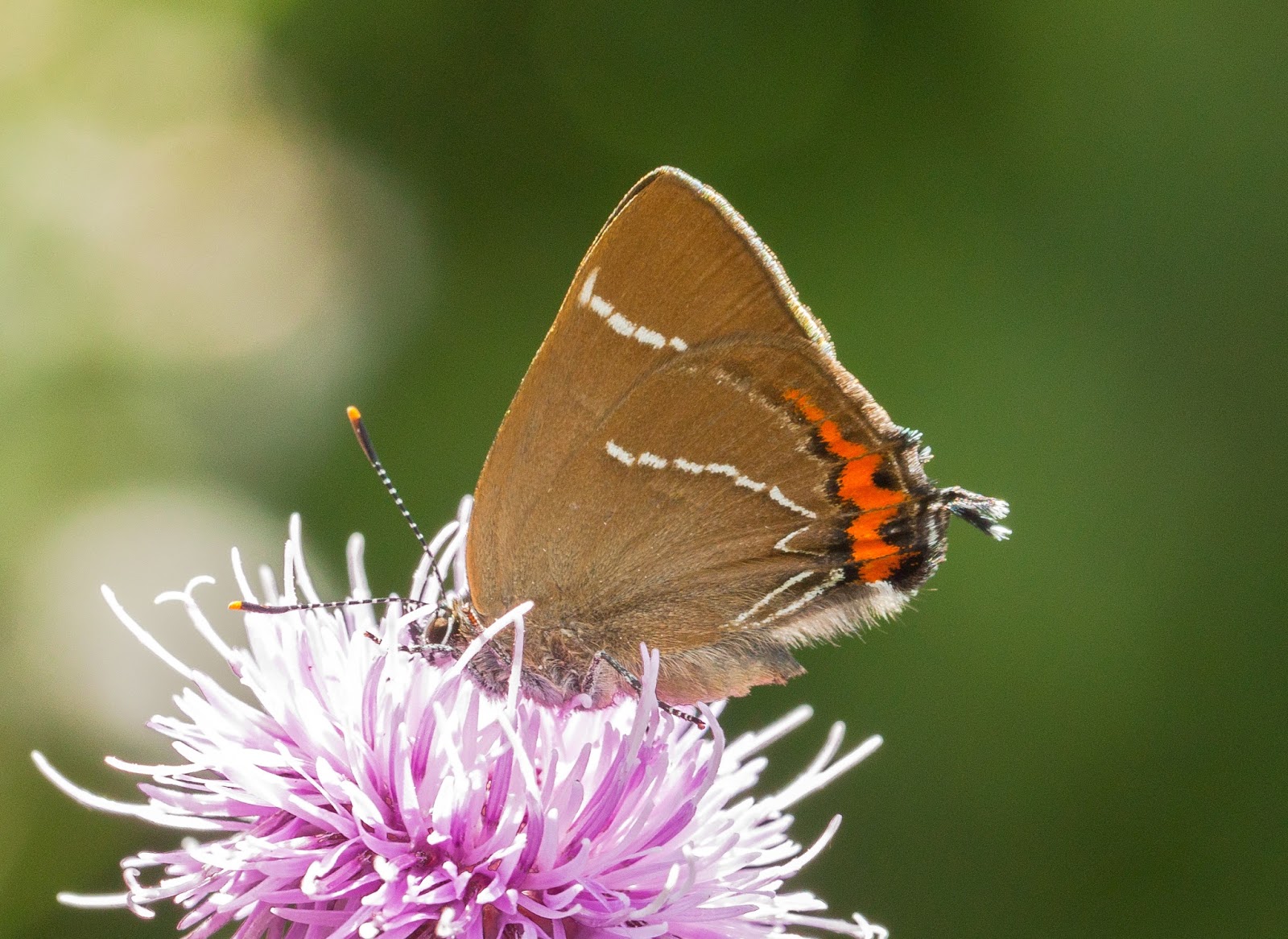
White-letter Hairstreaks - Brockholes, Lancashire

White-letter Hairstreak is a butterfly that despite being readily recorded in both Hartford and Leftwich, I hadn’t as of yet managed to catch up with. Often residing high up in the treetop canopy where they can be seen tumbling through the sky, I decided to seek out this often elusive butterfly at Brockholes Nature Reserve in Lancashire. Here the colony can be found on a large bramble bush next to the path, where individuals can give great low down views as they nectar on the flowers.

Arriving at Brockholes just after lunch, we headed straight for the bramble bush in question at the entrance to Boilton Woods and immediately discovered that this small patch of vegetation was a small haven for butterflies - Meadow Browns, Gatekeepers and Ringlets were all in abundance whilst several showy Commas and Red Admirals settled on the flowers to feed.

With no sign of any White-letter Hairstreaks fluttering around either the top of the solitary Elm tree or the brambles below, we decided to stick it out and wait until we spotted one (whilst getting absolutely bitten alive by the Horse Flies – not putting on insect repellent was a huge mistake!)

Luckily another enthusiast also on a mission to find the Hairstreaks arrived, and after phoning his local contact we heard they had been favouring a patch of thistles just a few feet further down the slope. Staking this area out, sure enough within a few minutes our companion had spotted one, happily nectaring on the purple flowers. 
White-letter Hairstreak - Brockholes, Lancashire
Getting closer to admire this stunning butterfly in more detail (and getting severely nettled in the process!) we could clearly see the diagnostic orange band on the underwings and the delicately marked white ‘W’ alongside. Unlike the Black Hairstreaks I saw at the beginning of the month, there were no black spots running along the edge of the wing – the key point in separating these two similar butterflies.
White-letter Hairstreak - Brockholes, Lancashire
After a while, the butterfly fluttered off in to the air, and within seconds had completely vanished, making it impossible to track its whereabouts.

Throughout the afternoon, several more individuals were spotted on the large bramble bush, with another perched out of reach on a nearby tree, only visible through binoculars. With the thistles offering the best vantage point photography wise, I decided to stake it out here for the rest of the afternoon. Sure enough, another (possibly the same) individual landed in the thistles, again allowing a fantastically close approach.
White-letter Hairstreak - Brockholes, Lancashire
In addition to the abundance of butterflies, several dragonflies patrolled the area, with Southern Hawkers and Common Darters flying around the small patch of brambles, as well as a fantastic Emperor Dragonfly we spotted resting on a perch in the middle of the bush.
Southern Hawker - Brockholes, Lancashire
As Elm is the sole foodplant for White-letter Hairstreaks, there were fears this secretive species may have become extinct in Britain due to the catastrophic effect of Dutch Elm disease in the 1970’s and early 1980’s. Thankfully surviving colonies were sought out to gain a greater understanding of their distribution, and several new colonies were discovered in the process. With an effort to find disease resistant Elms that are able to support the Hairstreak caterpillars, there is considerable hope for the future. Luckily, Wych Elm (the Hairstreaks favoured species) seems to be the most resistant to the disease.

Colonies can also be extremely small, sometimes consisting of just a few dozen individuals, and may even be contained on just the one tree (often on the outer edge of a wood) like the population at Brockholes.  With White-letter Hairstreaks resting in the tops of the trees during the day, early morning and late afternoon is the best time to these dainty butterflies as they come down to the ground to feed on their favoured thistles and brambles.


A fantastic butterfly to finally see and one which means I have now seen all species of Hairstreak in the UK!

Wednesday, 8 July 2015

Gull-billed Tern at Burton Mere RSPB, Cheshire

It’s not often that an alert pops up informing me of a bird just half an hour before I’m due to finish work (it’s usually mid-morning, meaning I then have to endure the rest of the day wondering if it will stick around!) so it was a nice change when ‘Gull-billed Tern’ popped up on my phone at half 3 on the Friday afternoon. It was an even nicer change to then see that it was local – being just under an hour away at Burton Mere RSPB.

A quick phone call home and we were soon well on our way, and although the bird had made a brief visit to reception pool, it now seemed quite settled on the pool in front of the Inner Marsh Farm hide - those leaving and on their way back all informing me it was happily roosting on the island.

On entering the hide the tern wasn’t immediately apparent, nestled amongst the Black-headed Gulls and facing away from the crowd with its back to us. However, it soon moved its head and the chunky black bill was instantly noticeable, much shorter and thicker than that of a Sandwich Tern and lacking the yellow tip, while the long wings projected well beyond the tail.
Gull-billed Tern, Burton Mere - Cheshire
Gull-billed Tern, Burton Mere RSPB - Cheshire
The long wings were really apparent
After watching it for around ten minutes, my dad finally entered the hide – just as the tern had took off and was swiftly flying past the window and away from the pool! In a mad scramble to the window I managed to get him on it as the bird made a speedy exit – highlighting just how every second really can count and can ultimately make the difference on whether you see a bird or dip a bird on a twitch!
Gull-billed Tern, Burton Mere - Cheshire
Luckily, the tern flew back in ten minutes later, giving great views of the wings as it flew past and clearly showing the diagnostic thick black bar on the trailing edge of the wings (which is not present on Sandwich Terns).
Gull-billed Tern, Burton Mere - Cheshire
Breeding in Southern Europe, Gull-billed Tern was actually my number one target on my world list on BUBO, and after not seeing any in Spain on our visits last year and not being able to catch up with the recent Yorkshire bird, it was great to finally see this rare visitor – made even better that it was totally unexpected and out of the blue!

With a bird seen at Ynys-hir RSPB the day before, and a bird at the Hayle Estuary in Cornwall on Wednesday, it is highly likely that this individual has been following the coast around. Departing from Burton Mere at 8:40pm on the Friday evening when it flew off towards the estuary and with no sign since, it is anyone’s guess as to where it will turn up next!
Gull-billed Tern Map - early July
Gull-billed Tern sightings over the three days - a route along the coast is clear to see
5 beautiful summer plumaged Spotted Redshank were a nice bonus at Reception Hide, and with their jet black colours and star spangled white flecks, they are without doubt one of my favourite wader species and definitely deserved of a mention.

Remarkably, a second rare tern appeared locally at the weekend in the form of a White-winged Black Tern at Leighton Moss RSPB in Lancashire. Even though I caught up with the bird at Cemlyn Bay in Anglesey last year, me and Alex decided to take my mum up to Leighton Moss to see the individual that had been present there for two days.
White-winged Black Tern - Leighton Moss, Lancashire
Arriving at the reserve, we entered Lower Hide to find this stunning Eastern European visitor hawking over the pool for insects, flashing its gorgeous white and black wings for us all to admire – truly a beautiful sight. Often perching on the posts submerged in the water, we got great views of this fantastic bird – it’s always worth making the effort when such stunning individuals turn up locally.
White-winged Black Tern - Leighton Moss, Lancashire
Record shots of the wings in all their glory
White-winged Black Tern - Leighton Moss, Lancashire
A Great White Egret, Marsh Tit, a pair of Garganey and 4 Marsh Harriers (including witnessing the spectacle of a food pass between the male and a female) completed the day, and a special thanks to Alex for driving us up there.

Monday, 27 April 2015

Pied-billed Grebe in Gloucestershire

With news of a Pied-billed Grebe breaking in Gloucestershire early on the Friday morning, I left work an hour early and made the journey down to the South West in the hope of connecting that evening. The bird had been spotted floating on the Severn Estuary near Berkeley Powerstation where it had remained loyal to the spot for the whole day, relatively close to the shore and showing exceptionally well to onlookers during the high tide at midday.

After a walk of about a mile or so down the winding public footpath through the fields, I eventually arrived at the spot. Unfortunately, the now low tide meant the bird wasn’t as close as it had been previously, although I was just pleased that the grebe had stayed and I was able to connect! Initially difficult to pick out, the bird had actually left the water before I arrived and was sat resting on a sandbank, effectively camouflaged with the surrounding boulders and looking like a large pebble!
Pied-billed Grebe, Gloucestershire
Phonescoped record shot of the Pied-billed Grebe
It eventually perked up and waddled over to the water shuffling comically – it’s legs more suited to swimming and diving than for walking on land! The grebe then pottered around for the rest of my stay, diving occasionally and favouring the shelter of the seaweed and rocks around the sandbank.
Pied-billed Grebe, Gloucestershire
Looking fine in its spring plumage, the black band on the thick bill and the white circle around the eye were really distinctive through the scope, and it was great to finally catch up with a Pied-billed Grebe in the UK after not going for the long-staying Ham Wall male in 2013 or the local Manchester bird back in 2010 – despite going to Uni nearby!

With individuals found nearly every 2-3 years between 1975 and 2002, there was a relatively long gap of 8 years before the Manchester bird, although records annually every year since may indicate that this American vagrant is becoming more predicable again in its frequency of making it over to Britain.
Pied-billed Grebe, Gloucestershire
Looking exceptionally lost and out of place in the estuary on the Friday evening, it was no surprise that there was no sign the following morning, although I don’t think anyone could have predicted it would be refound from Lower Hide at Leighton Moss in Lancashire late on the Saturday afternoon! Night time migrants, the grebe had evidently undertaken a journey of nearly 170 miles from Gloucestershire to Lancashire during the night, following a straight line directly north and making landfall at the RSPB reserve – remarkable to imagine a small grebe completing such a feat!
Pied-billed Grebe flight map
Map showing the route taken by the grebe! (red line)
With a reputation of staying considerable amounts of time at a suitable site, and with great habitat and pools available at Leighton Moss, hopefully the grebe will stick around up north and enjoy its new home!

For anyone visiting, the grebe is reportedly favouring Lower Hide, which is accessed from the public footpath leading down from the road – although it occasionally ventures closer to Public Hide.

Special thanks to my mum for driving to Gloucestershire – we didn’t get back until gone half 12 due to the excessive roadworks that now seem to plague our motorways – although she did enjoy a delicious Beefeater tea of Gammon and Apple Crumble for her trouble!  

Tuesday, 27 January 2015

Poms and Larks in Lancs

With a Pomarine Skua having been present on the saltmarsh at Pilling for several days and the beautiful Shore Lark still mooching around at Rossall Point, me and Alex headed up to the Fylde to catch up with them both – the Pom actually being a lifer for myself.

Upon arriving at Preesall Sands, I spotted the Pom immediately, just right of the small building and happily feasting on one of the many grisly carcasses that had been left, presumably by photographers to entice the bird in to providing exceptionally close views. 

Pomarine Skua

We approached the bird slowly, and it soon became apparent that it was suffering from a possible broken wing – several of the feathers were looking very untidy with the wing jutting out at an odd angle. I’ve since seen shocking photos showing dog walkers allowing their Dalmatians to attack the bird in its vulnerable state, although the latest reports and photos seem to show the bird is on the mend, with the wing seeming to have healed a little. Whilst we were on site, the Skua did have a little bit of difficulty flying, shuffling along the grass before finally alighting, only to drop down again a short way away on the beach. Fingers crossed it's able to make a full recovery and continue on with its journey!

Pomarine Skua
The damaged wing is clearly visible
Obviously brought in by the recent storms, this unseasonable sighting was completely unexpected and I was blown away to get such close views of an often difficult to identify bird, which in most cases can be a distant dot miles out to sea! Having until recently only experienced Skua species as far away specs in a scope, the Pilling Pom now completes my set of UK Skuas, having experienced close-up and satisfactory views of all 4 species in the space of a year, with a stream of fantastic Arctic Skuas passing by extremely close to the shore at Porthgwarra and a lucky fly-over-the-head moment at Spurn as we jammed in to a juv Long-tailed Skua this autumn.

I personally find Skua species very difficult to identify in flight, often on the backdrop of a stormy and wind battered sea, so it was great to get the rare opportunity to see one both on the deck and at such close quarters (I’ve only ever previously seen the Audenshaw Bonxie on the deck before).

Pomarine Skua

This particular individual was a dark morph juvenile, larger than the very similar Arctic Skua and displaying all the typical features of Pom ID – thicker neck, head and bill, as well as the overall bulkier appearance when compared to the much slimmer Arctics. The barring of the undertail coverts was also apparent – not seen in dark morph juv Arctics. Quite how useful this will be when assessing a fast moving dot in the scope on future seawatches has yet to be seen!

Pomarine Skua
The barred undertail covers can just be seen
With the much-loved Shore Lark still present at the picnic area at Rossall Point, I couldn’t resist going back for second helpings, and sure enough after an accidental locking-in the car and the horn pipping that resulted, we were both admiring extremely close views of this winter wonder as it happily hopped along the grass in front of us. These were much better views than the last time we visited, and it was great to see this little bird enjoying itself and bumbling around for everyone to admire. Truly one of my all-time favourites!

Shore Lark

Shore Lark

Shore Lark

Shore Lark