A tale of nature, wildlife and birding from Cheshire, North Wales and across the globe....

A tale of nature, wildlife and birding from Cheshire, North Wales and across the globe....
Showing posts with label Wallcreeper. Show all posts

Wednesday, 10 January 2018

Birding round up of the year 2017!

After the rollercoaster of a ride that was the British birding scene in 2016 (where firsts for Britain were turning up at a rate of knots), 2017 in comparison turned out to be a little bit of a damp squib. The majority of new birds and “uber” megas turned up on the remote offshore islands, while the year’s unquestionable star bird – North Ronaldsay’s fine adult male Siberian Blue Robin - was only seen by a handful of extremely lucky observers!
Siberian Blue Robin - North Ronaldsay

Nevertheless the year still held a few welcome surprises – Britain’s first DNA confirmed record of Elegant Tern down on the south coast was a huge bonus, while individuals of Red-breasted Goose, White-billed Diver and Rock Thrush ensured that 2017 held some grip backs at least!
Elegant Tern - Pagham Harbour, West Sussex
Elegant Tern (honest!) - Pagham Harbour, West Sussex
Red-breasted Goose - Cockerham, Lancashire
White-billed Diver - Woodhall Spa, Lincolnshire
Rock Thrush - Gwent, Wales
Not every bird was gettable however – the Amur Falcon down in Cornwall – the first twitchable one of its kind – proved frustratingly out of reach during the working week, while the year’s Red-winged Blackbird, American Redstart, Cedar Waxwing and Yellow-breasted Bunting all proved to be just a touch too far away on remote islands to tempt us, especially having already seen 3 out of the 4 in large quantities over in America before.  
Red-winged  Blackbird - New York
Red-winged  Blackbird in New York
American Redstart - New York
American Redstart in New York
Cedar Waxwing - New York
Cedar Waxwing in New York
However, for me, our trips birding abroad stole the show for 2017. Mallorca and Tenerife provided some welcome European birding in stunning scenery and fantastic climes, while our once in a lifetime trip to Queensland Australia during the summer created some lifelong memories that will never be forgotten. A male Golden Bowerbird at his bower deep in the heart of the Australian mountains, the flashy colours of Fairywrens and Boatbills and the imposing majesty of the fierce and iconic Cassowary just mere feet away are all experiences that will live on in years to come. 
Green Turtle - Australia
Green Turtle
Likewise our snorkelling expeditions exploring the Great Barrier Reef and the accompanying helicopter ride above one of the greatest wonders of the world created lasting memories of an experience of a lifetime.
The Great Barrier Reef, Australia
The Great Barrier Reef
And so to the top birds of 2017….

In joint 3rd place are the diver duo of the Northumberland Pacific Diver and the Lincolnshire White-billed Diver – turning up on the same weekend and both affording absolutely unbeatable views. Having seen the returning Cornish Pacific Diver as a distant dot miles away through a scope, a chance to see this mega species of diver in Britain so close proved irresistible, and we soon found ourselves gazing eye to eye with this fearless individual mere feet away.
Pacific Diver - Northumberland
Meanwhile news was breaking of another rare species of diver giving phenomenal views further south with a White-billed Diver having been discovered fishing on a river in rural Lincolnshire 20 miles inland. In a remarkable coincidence, this mirrored the only other British record of an inland White-billed Diver to date, occurring on the very same stretch of river back in March 1996. Having had to wait a whole week before making the journey down to Lincolnshire it was a relief to finally connect with this stunning arctic visitor, finally putting to rest the regrets of not travelling to Devon/Dorset for the popular Brunnich’s Guillemot and Brixham White-billed Diver duo a few years ago.
White-billed Diver - Lincolnshire
In second place, while not strictly a lifer, is the beautiful male Pallid Harrier that graced the hillsides at the Forest of Bowland earlier in the year. Living in England, male Harriers are not something I see all that often, so it was an honour to be able to watch on as this ghostly displaying male skydanced his way over the moors in an effort to attract a mate. Sheer beauty, and to have a male Pallid Harrier skydancing over your head is a thing of enchanting magic. Without a doubt this was one of the most exquisite birds I’ve seen, and to watch him perform was an absolute privilege.
Pallid Harrier - Lancashire
In first place, rather surprisingly, was Durham’s very own Scops Owl – found roosting in a small elder bush one morning in September where it proceeded to stay for the next few days much to the delight of the growing crowd of birders coming to admire it. This quirky, angry looking miniature bird of prey has always been a firm favourite of mine when visiting falconry exhibits, and having only seen Scops Owls abroad in Spain before, in near pitch black at that, this was a species that I was especially keen to see in Britain, seeming such an unlikely visitor from the continent. 
Scops Owl - Durham
Scops Owl - Durham
Thankfully the Scops was still in place when we arrived, tucked up against the trunk of its spindly elder and giving cracking views as it kept a watchful eye on the crowd, blending in perfectly with the gnarled bark. With 84 accepted records in Britain to date this is by no means a “mega mega” but it was still an absolutely superb bird that was most definitely worth travelling for and a bird on my personal wish list for Britain.
Scops Owl - Durham
With 2018 now in full swing who knows what avian delights await us – a wintering Wallcreeper is most definitely long overdue and is sure to whet the appetite of almost every birder in Britain, while a scattering of American warblers in the autumn would be most welcome, especially if a male Blackburnian was amongst them. With Far Eastern sprites also coming ever closer to our shores over the past few years, who knows what "First for Britain" oriental goodies might just be carried over on the easterly winds… Whatever the case, fingers crossed for a good bird-filled year! 
Wallcreeper
Coming soon to a south coast cliff near you... we hope! 

Wednesday, 22 April 2015

Northern Spain Trip Report (13th-17th April 2014) - Species List and Locations

Day 1 – Barcelona to Zaragoza


Monk Parakeet – 13th AprilBarcelona city centre (Placa de les Heroines de Girona)

Purple Heron –13th April Route from Barcelona to Zaragoza (two flying over)

White Stork – 13th AprilRoute from Barcelona to Zaragoza (flying over)

Fan-Tailed Warbler – 13th AprilSmall track off roundabout off LL11, Lleida (displaying in fields by the side of the track)

Spotless Starling – 13th AprilSmall track off LL11, Lleida (In trees by small building by the side of the track)

Crested Lark – 13th AprilSmall track off roundabout off LL11, Lleida (on the wall by the side of the track)

Serin – 13th AprilN240, Lleida (in small courtyard by abandoned warehouse)

Penduline Tit – 13th AprilAvinguda President Josep, Tarradellas, off the N240, Lleida (in small reedbed by the side of the road)

Bee-eater – 13th April - N211, opposite Calle la Via, Torrente de Cinca, Huesca, near the Rio Cinca (flying overhead and on wires)

Griffon Vulture – 13th AprilRoute from Barcelona to Zaragoza, around Mequinenza (circling overhead)

Sardinian Warbler – 13th AprilN211, Mequinenza, Zaragoza, near the Rio Segre (in shrubs by the side of the road)

Crag Martin – 13th AprilN211, Mequinenza, Zaragoza, near the Rio Segre (flying along mountains by side of the road)

Red-rumped Swallow – 13th April - N211, Mequinenza, Zaragoza, near the Rio Segre (flying over the river)

Short-toed Treecreeper – 13th AprilCar park off N211 overlooking the Rio Segre near Mequinenza (in trees off footpath by the river)

Southern Grey Shrike – 13th AprilN211 on the way to Caspe from Lleida (sitting in a shrub by the side of the road)

Calandra Lark – 13th AprilN232, Zaragoza (flying by the side of road in fields)

Montagu’s Harrier – 13th AprilRoad from Belchite to Codo (flying across ridge by side of the road)

Bee-eaters, Northern Spain

Day 2 – Zaragoza to Loporzano


Dupont’s Lark – 14th AprilNear Codo and Belchite, Zaragoza (8 individuals showing well and singing)

Lesser Short-toed Lark – 14th April - Near Codo and Belchite, Zaragoza (in muddy field at the side of path)

Thekla Lark – 14th April - Near Codo and Belchite, Zaragoza (numerous individuals showing well)

Black-eared Wheatear – 14th April - Near Codo and Belchite, Zaragoza (two flying and perching in large muddy fields down the track)

Pin-Tailed Sandgrouse – 14th April - Near Codo and Belchite, Zaragoza (three walking in the fields down the track)

Black-bellied Sandgrouse –14th April - Near Codo and Belchite, Zaragoza (two flying and walking in the fields down the track)

Rock Sparrow – 14th AprilAntiguo Belchite off the A-222 Belchite, Zaragoza (on bombed church ruins)

Blue Rock Thrush – 14th April - Antiguo Belchite off the A-222 Belchite, Zaragoza (on bombed church ruins)

Black Wheatear – 14th April - Antiguo Belchite off the A-222 Belchite, Zaragoza (on bombed church ruins)

Black Kite – 14th April - Route from Zaragoza to Loporzano – A23 Zaragoza

Booted Eagle – 14th AprilRoute from Zaragoza to Loporzano – A23 Zaragoza (circling by the side of the road)

Western Bonelli’s Warbler – 14th April - Embalse de la Sotonera, Huesca (In shrubby trees by the side of the lake)

Cirl Bunting – 14th AprilEmbalse de la Sotonera, Huesca (In shrubby trees by the side of the lake)

Duponts Lark - Northern Spain

Day 3 – Valle de Hecho - Pyranees


Egyptian Vulture – 15th AprilRoute from Loporzano to Valle de Hecho – A132 (soaring over mountains)

Alpine Chough – 15th April - Parque Natural de los Valles Occidentales - Valle de Hecho, Huesca (Flying overhead over the mountains)

Crested Tit – 15th April - Parque Natural de los Valles Occidentales - Valle de Hecho, Huesca (in trees by cliff face)

Lammergeier – 15th AprilParque Natural de los Valles Occidentales - Valle de Hecho, Huesca (Flying overhead on trail)

Wallcreeper – 15th April - Parque Natural de los Valles Occidentales - Valle de Hecho, Huesca (On cliff face, calling and showing well)

Rock Bunting – 15th April - Parque Natural de los Valles Occidentales - Valle de Hecho, Huesca (On rocks on trail down to waterfall)

Scops Owl – 15th AprilIn trees in the park off Calle Rioja, Huesca city centre (showing in tree near gates)

Wallcreeper - Northern Spain

Day 4 – Loporzano to Zaragoza


Subalpine Warbler – 16th April - Viewpoint on A1603 near Santa Cruz de la Seros (showing well in trees by the side of the road)

Black Woodpecker – 16th AprilViewpoint at Monasterio de San Juan de la Pena (Monestario alto)

Citril Finch – 16th AprilOn the road up to the car park at Monasterio de San Juan de la Pena (feeding on the road)

Citril Finch - Northern Spain

Day 5 – Zaragoza to Barcelona


Greater Flamingo – 17th AprilTwo on the lake at Laguna de Gallocanta


Additional Birds


Great Crested Grebe
Cormorant
Little Egret
Great White Egret
Grey Heron
Mute Swan
Shelduck
Mallard
Golden Eagle
Red Kite
Marsh Harrier
Common Buzzard
Kestrel
Peregrine
Merlin
Red-Legged Partridge
Coot
Common Crane
Avocet
Black-winged Stilt
Little Ringed Plover
Lapwing
Common Sandpiper
Redshank
Common Snipe
Black-headed Gull
Yellow-legged Gull
Feral Pigeon
Wood Pigeon
Collared Dove
Great-spotted Cuckoo
Common Swift
Hoopoe
Green Woodpecker - (sharpei)
Great Spotted Woodpecker
Skylark
Sand Martin
Barn Swallow
House martin
Water pipit
Pied wagtail
Yellow wagtail - (iberiae)
Grey Wagtail
Dunnock
Robin
Black Redstart
Wheatear
Whinchat
Stonechat
Song Thrush
Mistle Thrush
Blackbird
Blackcap
Lesser Whitethroat
Cetti’s Warbler
Willow Warbler
Firecrest
Pied Flycatcher
Great Tit
Blue Tit
Coal Tit
Long-tailed Tit
Woodchat Shrike
Magpie
Jay
Chough
Carrion Crow
Raven
Starling
House Sparrow
Tree Sparrow
Chaffinch
Linnet
Goldfinch
Greenfinch
Bullfinch
Yellowhammer
Corn Bunting

Birds that were heard only:


Orphean Warbler – 14th April - Embalse de la Sotonera, Huesca (In shrubby trees by the side of the lake)
  
Quail
Chiffchaff

Friday, 17 April 2015

Northern Spain Trip Report - Day 3

Day 3 - Tuesday 15th April 2014

Day 3 saw us rise bright and early to begin our treck in to the Pyrenean mountains, heading north to Valle de Hecho to commence our search for the star species of the trip and the one I was most looking forward to connecting with – Wallcreeper. We’d been informed by the lady at Boletas Birdwatching Centre that a male had been regularly observed on a cliff face in the valley, so the journey began through the incredible mountain landscape, admiring the gushing crystal clear rivers on route that seemed to follow the road around and carved through the rocky terrain with ease. 
Pyrenees - Northern Spain
Griffon Vultures soared overhead, whilst a stop to admire a mountain lake revealed two Egyptian Vultures flying high over one of the ridges. Separated from the much more common Griffons by their bold white and black underwings, the differences were clear to see and we watched the pair gliding effortlessly over the trees until they disappeared out of view.
Egyptian Vulture - Spain
Pyrenees - Northern Spain
Heading through the quaint alpine villages, we stopped to scan over one of the larger mountains by the side of the road – towering over us with a clear thermal in action as large numbers of vultures used the warm air to their advantage. 
Pyrenees - Northern Spain
The mountain ridge the vultures were loving
Alpine Choughs joined them high above the mountains, while a pale looking eagle was just too distant to ID. No Lammergeiers had put in an appearance yet (another personal key target species) but this was ideal habitat and they were well known in the area, as the many accommodation residences with Lammergeiers adorning their signs would testify.

We soon arrived at the Wallcreeper site, and immediately headed off on the alpine trail towards the cliff in question, the abundance of dainty alpine plants and flowers surrounding the pathways creating a beautiful carpet to admire as we walked up. The air here was undeniably fresh, and as we climbed higher, patches of clean white snow started to appear on the trail – a real magical alpine environment to experience. 
Pyrenees - Northern Spain
Reaching the cliff that the Wallcreeper had been favouring, we were joined by a small group of Goldcrests and Firecrests, whilst several Crested Tits foraged in the pine needles for snacks of tiny spiders and insects.
Crested Tit - Spain
Before long, the shout of “Wallcreeper!” from Chris cut through the still air, and sure enough, a small grey bird flew along the length of the cliff, that characteristic fluttering butterfly flight and echoing “peeeweeeeee” call unmistakable. Vanishing round the side of the rocks, we followed suit, heading up the trail in the direction it had flown in. With no sign around the corner, we waited for it to make a reappearance as we ate lunch, enjoying much better views of Alpine Choughs as they played and tumbled above the mountains, their yellow bills clear to see.
Pyrenees - Northern Spain
The Wallcreeper cliff!
Then, “Lammergeier!” - Chris was pointing high above, and sure enough that most majestic of vultures was slowly drifting towards us from across the valley. Passing overhead before it disappeared over the ridge, we all had excellent views of this bearded wonder. Having always wanted to a Lammergeier after studying the pages in my Collins guide, it was surreal to actually see one in the flesh – an incredible moment and one of the star birds of the trip.
Lammergeier - Spain
Pyrenees - Northern Spain
After an hour or so of craning our necks, our ears pricked up as that familiar and almost eerie “Peeeweeee” call echoed across the cliff face. With a quick search of the rocks above us, sure enough, there was the Wallcreeper, busy probing amongst the rocks with that remarkable long bill and fluttering from crevice to crevice. 
Wallcreeper - Spain
Wallcreeper - Spain
Wallcreeper - Spain
The beautiful butterfly-like pattern of deep crimson red on the wings was mesmerising to watch as he flittered his wings hopping from perch to perch, and we viewed for a good while at a considerably close range as he fed in front of us, completely unaware of his captivated admirers, before we moved on and left him in peace.
Wallcreeper - Spain
Wallcreeper - Spain
Wallcreeper - Spain
The Crimson on the wings was stunning!
We continued further along the track, Chris and Alex deciding to ignore the possible bear scat they had discovered near the Wallcreeper cliff, following the trail along the river. Here a smart looking Rock Bunting gave great views, singing and dashing from rock to rock in front of us.
Rock Bunting - Spain
The waterfalls and landscape here was absolutely stunning, and it was incredibly relaxing to listen to the gushing of the waterfalls crashing over the huge boulders and the roar of the river flowing below.
Pyrenees - Northern Spain
We picked up the call of a Black Woodpecker on one of the slopes, and leaving Chris with all our gear, we scrambled up the steep bank in pursuit. Sadly the sound was heading further and further away from us quicker than we could climb, and we lost the trail. A loud crashing through the trees below us had us remembering the bear scat from earlier, and a sudden awareness that a large carnivore could be roaming towards us left us a little apprehensive! Turns out it was just Chris, climbing the impossibly steep and thick tree covered slope to join us, carrying not one but THREE sets of heavy rucksacks and scopes on his shoulders! No easy feat indeed.
Pyrenees - Northern Spain
Later that evening we made the drive in to Huesca to try and track down the Scops Owls that reside in the city centre. Still a little early in the year, we were a tad unsure if any would have returned yet. A walk around the streets drew a blank, but after around half an hour and near to one of the parks, we heard that distinctive “BONG!” - Scops Owl!

We hurried over to the park and eventually managed to pinpoint the group of trees that the owls were calling from – although actually spotting any of the birds was far easier said than done. Judging by the calls, it appeared that they were flying around in a circle, but in the pitch black of the park it was impossible to pick anything out – even with all the street lighting illuminating the buildings nearby.

Eventually I narrowed down a calling individual to one of the trees lining the path in front of the gates, and several minutes of craning our necks and squinting resulted in me picking out the small owl perched next to the trunk on one of the branches. Success!


We could just make out its tiny shape and features, with two beady eyes looking back down at us, and I must admit this was probably my best spot to date considering just how hard they were to pin down! After some time, the owl began to fly from branch to branch, making it far easier to pick out in the darkness. Never has one bird been so difficult to locate, and it felt that these tiny owls were most definitely giving us the run-around that evening!
Casa Boletas - Loporzano
Boletas Birdwatching Centre

Sunday, 1 February 2015

A (very) belated round-up of the year!

With my computer setting on fire over Christmas, I never had a chance to do a round up of the year and list my favourite birds of 2014. Although it's a month late, without further a do, here are the best birds from the year that was...

Narrowly missing out on the top ten were the Great Spotted Cuckoo in Pembrokeshire back in March, the White-winged Black Tern that dropped in at Cemlyn Bay and the Bridled Tern up in the Farnes. The Farne islands were one of the best birding experiences I’ve ever had and it was great to see the sea birds in abundance along with the classic view of Puffins complete with sandeels in their beaks! Cattle Egret, Ross’s Gull at Leighton Moss, the Black-winged Pratincole that gave us the run around all summer and the male Red-breasted Flycatcher at Beachy Head, Sussex were also all noteworthy additions and great to see.

White-winged Black Tern
Record shot of the White-winged Black Tern at Cemlyn Bay, Anglesey
Bridled Tern
The Bridled Tern on the rocks by the Jetty upon landing on the Farne Islands
Cattle Egret
Distant pic of the Cattle Egret living up to its name...
Red-breasted Flycatcher
The Red-breasted Flycatcher at Beachy Head was truly stunning
Also deserving of a mention was the Snow Goose up in Lancashire. Derived by some and nastily accused of being “plastic” this bird was absolutely 100% legit and it managed to capture a spot in my heart despite the haters….

Snow Goose
Snow Goose!

And now on to the best....

In 10th place for the year was the ever-loved Ring-billed gull down at Gosport Marine Lake in Hampshire. Returning for its remarkable 13th winter, this individual provided close quarter views, offering me an opportunity to really admire his plumage. Having dipped a first winter a couple of years back on an Asda roof in Liverpool, it felt much better to catch up with this cracking adult bird instead.
Ring-billed Gull
"Waldo" as he is known.... I refuse to call him that!

In 9th position were the Cirl Buntings at Prawle Point in Devon. These deserve a mention as this was my first solo birding visit ever (I always prefer to have some company) and it was great to find them on the Clifftop fields with very few people around. Showing well, I timed it just right – ten minutes later a Sparrowhawk dived after the flock which scattered and weren’t seen again!
Cirl Bunting
The Cirl Buntings were little beauties

Coming up in 8th was the Wryneck seen at Spurn during the Autumn. Having never seen one, this was a key target for the year and when told there was one showing really well just down the road whilst we were searching for a Barred Warbler, we legged it down. After giving us the run around for ten minutes, it eventually flew out of the nearby garden and perched in the hedge right in front of me – breath-taking views and great to finally nail one!

7th place belongs to the drake King Eider (affectionately known as ‘Kingy’) up in the Ythan Estuary near Aberdeen. Flying up to Scotland for the weekend this was a completely relaxed long-distance twitch – a complete change to the usual far away goodies. ‘Chequebook Birding’ it may be to some, but this was one of my favourite twitches to date, with the drake showing really well on the sand in front of us for the couple of hours we were there. Complete with the absolutely hundreds of close in Common Eiders, seals, terns and waders, this will be a twitch that will remain firmly in the memory.
King Eider
Kingy chillin' on the beach 

6th place for the year was the Parrot Crossbills at Budby Common right at the start of the year. Arriving as part of an influx, we tracked them down to a tree amongst the heathland. I definitely wasn’t expecting what happened next, as the whole flock of birds landed in the group of trees underneath where I was standing, proceeding to flit almost over my head at eye level, completely surround me, with many even going as far as to take drinks from the puddle in which I was standing. This went on for a good ten minutes, and was a truly amazing birding experience I will never forget.
Parrot Crossbill
The Parrot Crossbills provided a great start to 2014
In 5th position was the absolutely majestic White-tailed Sea Eagle on Mull from our long weekend up there at the beginning of June. Having never been before it was fantastic to see the wildlife up there – Corncrakes, Mountain Hares and Golden Eagles all adding to the magic. Arriving at a well known eagle car park in front of a favourite perch tree by the loch, we were disappointingly told the eagle had just flown off. However, no more than two minute later I turned to see a huge shape soaring low down over the car park to our right, gliding effortlessly along and back in to the tree all the scopes were trained on. A truly amazing and breath-taking sight, and one of my favourite in birding.
White-tailed Sea Eagle
Showing just how huge the wingspan actually is

4th place for the year goes to the Surf Scoters at Pensarn back at the end of January. Having failed to connect with these for FOUR winters, it was about time I broke the curse of the Surf Scoter. Having been promised views by a certain individual who failed to deliver (TWICE!) I went with my Dad on the third attempt of the New Year, in perfect calm and bright conditions. A local birder from Chester managed to find two drakes and got me on them – and just like that the curse was broken – Surf Scoter – FINALLY!! I even managed to pick them out and show them to someone else myself later in the afternoon!
Scoter flock
The dreadful view of distant scoters in the scope...

In bronze position (somewhat ironically given the name) and 3rd in the best birds of the year was the majestic Golden Pheasant at the Wolferton Triangle just before Christmas. Arriving in the pitch black ready for a dawn vigil on the quiet Norfolk Lane, it was looking bleak until 9am when we spotted him at the side of the road feeding on the seed we had laid out the previous night. Relief – he was there!! Showing right in front of us for 10 minutes, it was great to see him in all his fiery glory – a real high!


Golden Pheasant
He was there. 

The runner up and achieving second place was the brilliant Shore Lark that rocked up at Rossall Point in Lancs for the winter. Having wanted to see one since my childhood and with it being my ‘most needed bird’ according to BUBO, nothing was going to stop me, and within minutes of arriving we were enjoying views of this charming little horned wonder on the shingle beach in front of us. A long anticipated bird and one that was well worth the wait!


Shore Lark
Shore Lark!!!! 

Claiming the top spot and the unquestionable bird of the year without a shadow of a doubt was the remarkable Short-toed Eagle in Dorset. The first twitchable mainland bird ever coupled with the individual in question going to roost in a pine tree on the day it was found meant an overnight drive down to Morden Bog in Dorset and me arriving at the car park at around 4am. Approaching the site in the dense mist, seeing the silent figures of a steady line of twitchers all heading to the ridge had a complete air of magic about it, and is something I will never forget. With daylight revealing the shape of the bird in its pine tree as the mist slowly cleared, the views got better and better throughout the morning, with the bird remaining sat until around 11:30am when it eventually alighted and displayed its magnificent wingspan for the assembled crowd to admire, before disappearing off in to the distance. If this bird hadn’t been relocated in Hampshire (and later Sussex) and become twitchable for the best part of a month, then this would truly have had the potential to be one of the all-time greats and one of the best British birds of all time.
Short-toed Eagle
The magnificent eagle
Eagle Crowd
Waiting for the mist to clear
Eagle Crowd
The Eagle crowd - this photo really doesn't portray just how many people were there!

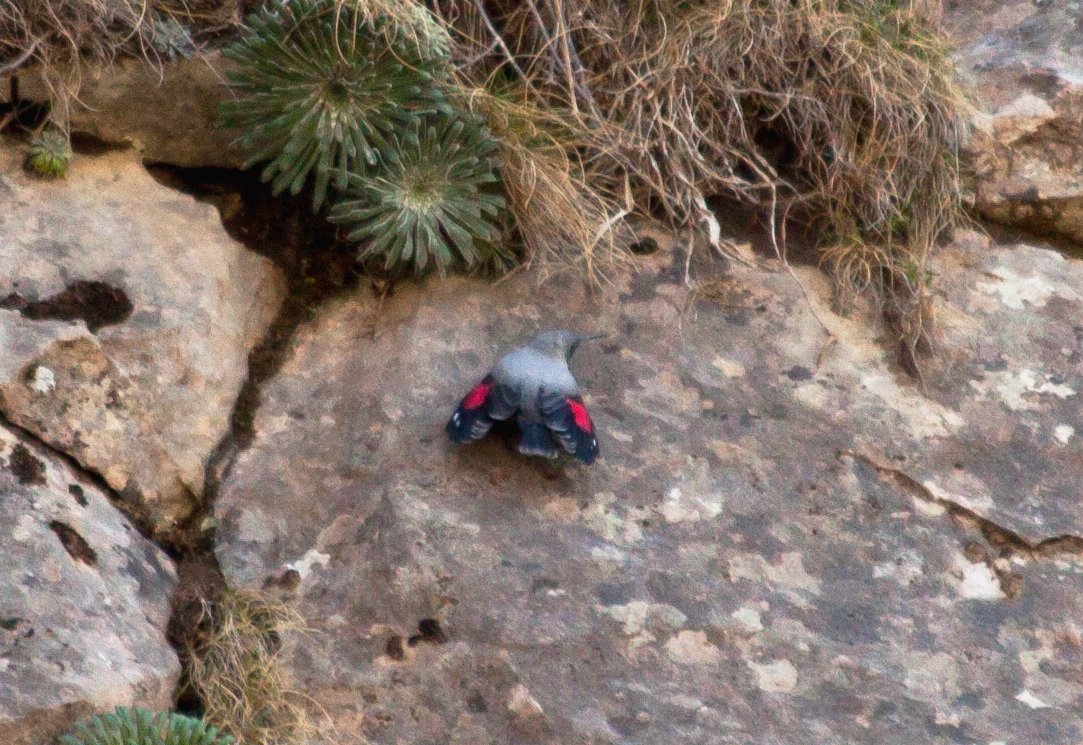
My international bird of the year was without doubt the Wallcreeper in the high Pyrenees. The ultimate birding highlight to date and in the breath-takingly beautiful settings of the Spanish mountains, we were incredibly lucky to track down a male that had set up home on the rock face in mid-April. After a scenic treck along the mountain trail we arrived at the cliff face, and before long Chris had spotted the bird flying across the rocks, leaving that magnificent call of     in its wake. After another fly-by, we located the bird further on, busy feeding on the rocks and affording amazing views relatively low down in front of us. We watched in awe for a good 20 minutes as the bird went about its business, often showing off the amazing crimson butterfly-like wing patterns and admiring the remarkable long curved bill. In such beautiful surroundings and with an accompanying cast of Lammergeiers, Griffon Vultures and Rock Buntings amid the stunning settings of crystal clear rivers and waterfalls, pure white snow and delicate alpine flora, this was one of the best days birding ever and will stick in the memory for years to come. 


Wallcreeper


Wallcreeper
The Wallcreeper - best bird I have ever seen!
Lammergeier
Lammergeier!
Griffon Vulture
Griffon Vulture
Rock Bunting
Rock Bunting
The beautiful view
Absolutely beautiful view in the Pyrenees 
A perfect trip