A tale of nature, wildlife and birding from Cheshire, North Wales and across the globe....

A tale of nature, wildlife and birding from Cheshire, North Wales and across the globe....
Showing posts with label Lammergeier. Show all posts

Thursday, 29 December 2016

Birding round-up of the Year 2016!

There’s no doubt about it, 2016 has been a truly exceptional year in the world of birding! Back in January nobody would have predicted that 12 months later we would have experienced an autumn knee deep in Siberian Accentors, that a Red-footed Booby would have been gallivanting on a shingle beach in Sussex no less, or perhaps most miraculously of all, that most doomed and mythical of American vagrants - the notorious Black-billed Cuckoo - would not only survive for more than a few days(!) but would give itself up for the twitching masses to enjoy, unblocking decades worth of anguish. To imply that 2016 has been uneventful would be a downright injustice to say the least!
Siberian Accentor - Easington, Yorkshire
The now famous Easington Siberian Accentor
Red-footed Booby - Sussex (Credit: East Sussex WRAS)
The Red-footed Booby taken in to care in Sussex (Credit: East Sussex WRAS)
Black-billed Cuckoo - North Uist
North Uists very own Black-billed Cuckoo
Naturally, long-held records have tumbled, blockers have been banished and year lists shattered in what was a truly eventful year. The Eastern Kingbird on Barra broke hearts as it flew off high in to the clouds not once, but twice, the bona-fide first for Britain Western Swamphen(/chicken) amused visitors at Minsmere RSPB as it strutted around the reedy pools, while the aforementioned Red-footed Booby set pulses racing for a short while as questions were asked as to whether this Caribbean seabird, a long way from home, would be released in British waters after its recovery (it was eventually flown over to the Cayman Islands to continue rehabilitation there).
Western Swamphen - Minsmere, Suffolk
Minsmere's Purple Swamphen/chicken - aka "Hen"
Several other less convincing ‘firsts’ were also tracked across the country – the arrival of a Dalmatian Pelican in Cornish airspace caused absolute chaos as birders from across the country raced down to the south west tip of Britain to tick this giant visitor, thought by many to be the real deal from Poland until a bit of detective work and digging revealed several free-flying escapes now make their home in Western Europe…
Plastic Fantastic - the Cornish Dalmatian Pelican
Equally as ‘untickable’ was the West Country Lammergeier – the video of an immature seen flying off from rocks on the Severn Estuary quickly went viral and the chase was on to track its movements and whereabouts along the west coast counties. Proving extremely elusive and often vanishing in to the depths of the Devon hills to the despair of many, the question remains as to just what category this British bonecrusher will fall under – reintroduction and captive breeding projects in Europe are unfortunately the most likely source, and several other young birds from these conservation initiatives have also been seen to range up in to northern Europe in the past few years.


Meanwhile the first Forster’s Tern in British seas for 13 years was a welcome addition to many lists, the Great Knot showing well on the beach at Titchwell proved that not all visitors of this species follow the rules of being “Great Dots”, while only the second ever Pale-legged Leaf Warbler crashed in to a window on St Agnes, meeting an untimely end and making those on the island wish they’d paid a little bit more attention to that bright looking Arctic Warbler the day before. The East coast’s flyby Black-browed Albatross both delighted those lucky enough cross paths with it and left others cursing as it gave them the run around in equal measures, while Eyebrowed, Whites, Dusky and Black-throated Thrushes all on the mainland reminded us all exactly what could be lurking out there just waiting to be found over the winter….
Dusky Thrush - Beeley, Derbyshire
Beeley's overwintering Dusky Thrush
Eyebrowed Thrush - Northumberland (Ross Moore)
The Northumberland Eyebrowed Thrush photographed by Ross Moore in December
While narrowly missing out on the top five, there were still a whole host of awe-inspiring species that made the year memorable. The Suffolk Cliff Swallow in the dying embers of the year was a huge grip back after the disappointment of the just slightly too far away St Mary’s bird on Scilly a couple of months previous, as was the Kent ‘Meena’ Oriental Turtle Dove, a species I’ve long rued not going for after the famous Chipping Norton bird. The Aberdeen White-winged Scoter was a bird I had personally wanted to see for a good while, being just the 2nd for Britain to boot, while it doesn’t get much better than a mega just 20 minutes away from your door in the form of the May White-crowned Sparrow at Woolston Eyes.
Cliff Swallow - what a grip back!
Rufous Turtle Dove - Kent
It is an Oriental Turtle Dove...honest!
White-winged Scoter - Aberdeenshire
Digiscoped White-winged Scoter!
White-crowned Sparrow - Woolston Eyes, Cheshire
David Bowman's photo of the Woolston Eyes White-crowned Sparrow in the hand
Several trips abroad during 2016 also resulted in absolutely breath-taking birds – the kaleidoscope of colour that is a male Painted Bunting, the bright burst of salmon pink underparts as a flock of remarkable Scissor-tailed Flycatchers take off from the wires and the elegant, ever graceful Swallow-tailed Kites soaring over the Florida everglades are all truly unforgettable memories.
Painted Bunting - Florida
Painted Bunting - aka "Male" 
Scissor-tailed Flycatcher - Florida
Scissor-tailed Flycatcher
Swallow-tailed Kite - Florida
One of the best birds in the world - the Swallow-tailed Kite

And so, to the best birds that 2016 had to offer….

5th place for the year goes to the completely unexpected and out of the blue record of the Connah’s Quay Little Auk back in January. A lifer for me, having never previously seen these adorable looking arctic alcids, we had great views as this usually ocean bound seabird paddled around just feet away in the small pools and inlets of the reserve. A truly amazing birding experience, and I for one was exceptionally glad that my first encounter with a Little Auk was so ‘up close and personal’ as opposed to being a distant dot making its way across a stormy sea.
Little Auk - Connah's Quay
In 4th place has to be one of the most elusive and enigmatic seabirds encountered in British waters – the Wilson’s Storm-petrel. Having endured over 30 hours of seasickness in our quest to catch up with this enchanting tubenose as well as braving 40mph gales and towering walls of crashing water, we finally struck it lucky on our third and final Scilly pelagic of the summer, with no fewer than 4 individuals performing their ocean acrobatics at close range as they danced over the waves. An unforgettable experience and one I’d highly recommend to anyone who’s yet to head out to sea on one of Bob Flood and the team’s now famous voyages.
Wilson's Storm-petrel - Scilly Isles
3rd position is of course the Brunnich’s Guillemot that made Anstruther harbour in Fife its home back in September. With not going down for the Portland bird being a huge regret, I was doubtful another opportunity to see this mega auk in British waters would come along soon, so when news broke that one was providing extremely close views around the boats and appeared to be in full moult (indicating it wouldn’t be going anywhere fast!) we made the long journey up to the east coast of Scotland in an attempt to connect. Swimming to within mere feet away, it’s true that the closest birding encounters are usually the most memorable, and despite the true to form Scottish weather trying to dampen proceedings, it was great to get such fantastic views of the Brunnich’s diving for fish in front of us. Sadly however, as was expected due to its rather peaky looking demeanour and poor feather condition throughout the week, the Brunnich’s was found to have died by Saturday morning, presumably exhausted and representing a tragic end to a top little bird.
Brunnich's Guillemot - Anstruther Harbour, Fife
Brunny!
Brunnich's Guillemot - Anstruther, Fife

Some birds have a mythical, almost legendary status on the British twitching scene, generating a certain level of excitement whenever whispers of news surrounding their arrival surface – Wallcreeper, Rubythroat, and almost any mega American Warbler or Siberian waif from far away all fall in to that category. Another, is of course, the Black-billed Cuckoo – perhaps the most doomed of all American vagrants - absent from British records since the 1980’s and early 90’s, apart from a brief flyby appearance on Orkney two years ago. It seemed an almost impossible feat that this monster cuckoo would be making its way on to any modern lists any time soon….. But, as the saying goes, anything is possible in the world of birding, and news of one photographed sitting on a fencepost on North Uist happily tucking in to caterpillars sent the twitching community in to a spin.  2nd position and narrowly missing out on the top spot is of course none other than North Uist’s cracking Black-billed Cuckoo, the first spring adult of its kind to grace UK shores and an absolutely stonker of a specimen.
Black-billed Cuckoo - North Uist
Black-billed Cuckoo - narrowly missing out on top spot...
Found late on the Sunday evening and with Coccyzus cuckoos in Britain usually having an expiry date of around 2 days, it was therefore a huge ask for the bird to last a whole week and stay until the following weekend. But stay it did, and Friday evening saw us make the mammoth treck up to Uig on the Isle of Skye to catch the ferry over to Lochmaddy the next day. With an almost heart-breaking sat-nav miscalculation and a frantic drive to the ferry terminal soon forgotten as we sailed over to this beautiful outcrop of Scottish scenery, we finally clapped eyes on our prize – one remarkable adult Black-billed Cuckoo. Our most adventurous twitch to date having never travelled to the far flung Scottish islands in pursuit of one bird before, the trip felt like a personal achievement and just goes to show that those who do make the effort really do reap the rewards. An incredible bird, surrounded by breath-taking scenery in a beautiful location, it really doesn’t get much better than that!
Black-billed Cuckoo - North Uist

Despite all this, 2016 will go down in birding history for one thing – the invasion of a certain golden patterned accentor from the east on an unprecedented scale that many are touting as the birding event of the century so far. Generating interest across the country, providing a spectacle never seen before in Europe let alone on British soil and causing even long-retired twitchers to dust off their bins, in top spot, is of course, the widespread invasion of Siberian Accentors that took Britain by storm this autumn.
Siberian Accentor - Easington, Yorkshire
Number one for 2016 - the Siberian Accentor at Easington
When news broke that perhaps the most widely anticipated first for Britain had finally made landfall on Shetland (where else?!) the entire British birding community collectively lost their minds as one. With photos surfacing depicting this golden sprite showing mind-bogglingly well by a small quarry up in the deepest wilderness of Shetland, it seemed nigh on impossible that the vast majority would ever get this special bird on their lists, instead having to settle for gazing at the many jaw-dropping photographs flooding the net. Fast forward just a matter of days however, and Thursday afternoon saw the news break that stopped all twitchers in their tracks – “Siberian Accentor: Easington, Yorkshire. One by the school”. A mainland Siberian Accentor – the stuff birding dreams are made of. One mad dash later and we were gazing upon this tiny piece of Russian gold for ourselves, hopping around on the now famous mossy covered drive alongside the equally as famous yellow skip. Mind-blowing. 
Siberian Accentor - Easington, Yorkshire
Easington Siberian Accentor Twitch
The famous skip!
For me, this tiny Russian visitor was without doubt the bird of the year, a species I’d never imagined I’d ever see in the world, let alone in Britain. Watching it forage around in the leaf litter alongside Dunnocks and Robins was completely surreal, none the wiser to the absolute chaos, stress and above all excitement its arrival had caused. A magical bird and a worthy winner of the crown for Best Bird of 2016.
Siberian Accentor - Easington, Yorkshire
With 2017 just around the corner, who knows what avian delights await us over the next 12 months – perhaps an overwintering Rubythroat or mega Siberian Thrush, a smattering of brightly coloured American warblers come the autumn or perhaps even that most sought after and ever hoped for modern day twitchable British Wallcreeper. Fingers crossed! 
Wallcreeper!
Best wishes for 2017!

Wednesday, 22 April 2015

Northern Spain Trip Report (13th-17th April 2014) - Species List and Locations

Day 1 – Barcelona to Zaragoza


Monk Parakeet – 13th AprilBarcelona city centre (Placa de les Heroines de Girona)

Purple Heron –13th April Route from Barcelona to Zaragoza (two flying over)

White Stork – 13th AprilRoute from Barcelona to Zaragoza (flying over)

Fan-Tailed Warbler – 13th AprilSmall track off roundabout off LL11, Lleida (displaying in fields by the side of the track)

Spotless Starling – 13th AprilSmall track off LL11, Lleida (In trees by small building by the side of the track)

Crested Lark – 13th AprilSmall track off roundabout off LL11, Lleida (on the wall by the side of the track)

Serin – 13th AprilN240, Lleida (in small courtyard by abandoned warehouse)

Penduline Tit – 13th AprilAvinguda President Josep, Tarradellas, off the N240, Lleida (in small reedbed by the side of the road)

Bee-eater – 13th April - N211, opposite Calle la Via, Torrente de Cinca, Huesca, near the Rio Cinca (flying overhead and on wires)

Griffon Vulture – 13th AprilRoute from Barcelona to Zaragoza, around Mequinenza (circling overhead)

Sardinian Warbler – 13th AprilN211, Mequinenza, Zaragoza, near the Rio Segre (in shrubs by the side of the road)

Crag Martin – 13th AprilN211, Mequinenza, Zaragoza, near the Rio Segre (flying along mountains by side of the road)

Red-rumped Swallow – 13th April - N211, Mequinenza, Zaragoza, near the Rio Segre (flying over the river)

Short-toed Treecreeper – 13th AprilCar park off N211 overlooking the Rio Segre near Mequinenza (in trees off footpath by the river)

Southern Grey Shrike – 13th AprilN211 on the way to Caspe from Lleida (sitting in a shrub by the side of the road)

Calandra Lark – 13th AprilN232, Zaragoza (flying by the side of road in fields)

Montagu’s Harrier – 13th AprilRoad from Belchite to Codo (flying across ridge by side of the road)

Bee-eaters, Northern Spain

Day 2 – Zaragoza to Loporzano


Dupont’s Lark – 14th AprilNear Codo and Belchite, Zaragoza (8 individuals showing well and singing)

Lesser Short-toed Lark – 14th April - Near Codo and Belchite, Zaragoza (in muddy field at the side of path)

Thekla Lark – 14th April - Near Codo and Belchite, Zaragoza (numerous individuals showing well)

Black-eared Wheatear – 14th April - Near Codo and Belchite, Zaragoza (two flying and perching in large muddy fields down the track)

Pin-Tailed Sandgrouse – 14th April - Near Codo and Belchite, Zaragoza (three walking in the fields down the track)

Black-bellied Sandgrouse –14th April - Near Codo and Belchite, Zaragoza (two flying and walking in the fields down the track)

Rock Sparrow – 14th AprilAntiguo Belchite off the A-222 Belchite, Zaragoza (on bombed church ruins)

Blue Rock Thrush – 14th April - Antiguo Belchite off the A-222 Belchite, Zaragoza (on bombed church ruins)

Black Wheatear – 14th April - Antiguo Belchite off the A-222 Belchite, Zaragoza (on bombed church ruins)

Black Kite – 14th April - Route from Zaragoza to Loporzano – A23 Zaragoza

Booted Eagle – 14th AprilRoute from Zaragoza to Loporzano – A23 Zaragoza (circling by the side of the road)

Western Bonelli’s Warbler – 14th April - Embalse de la Sotonera, Huesca (In shrubby trees by the side of the lake)

Cirl Bunting – 14th AprilEmbalse de la Sotonera, Huesca (In shrubby trees by the side of the lake)

Duponts Lark - Northern Spain

Day 3 – Valle de Hecho - Pyranees


Egyptian Vulture – 15th AprilRoute from Loporzano to Valle de Hecho – A132 (soaring over mountains)

Alpine Chough – 15th April - Parque Natural de los Valles Occidentales - Valle de Hecho, Huesca (Flying overhead over the mountains)

Crested Tit – 15th April - Parque Natural de los Valles Occidentales - Valle de Hecho, Huesca (in trees by cliff face)

Lammergeier – 15th AprilParque Natural de los Valles Occidentales - Valle de Hecho, Huesca (Flying overhead on trail)

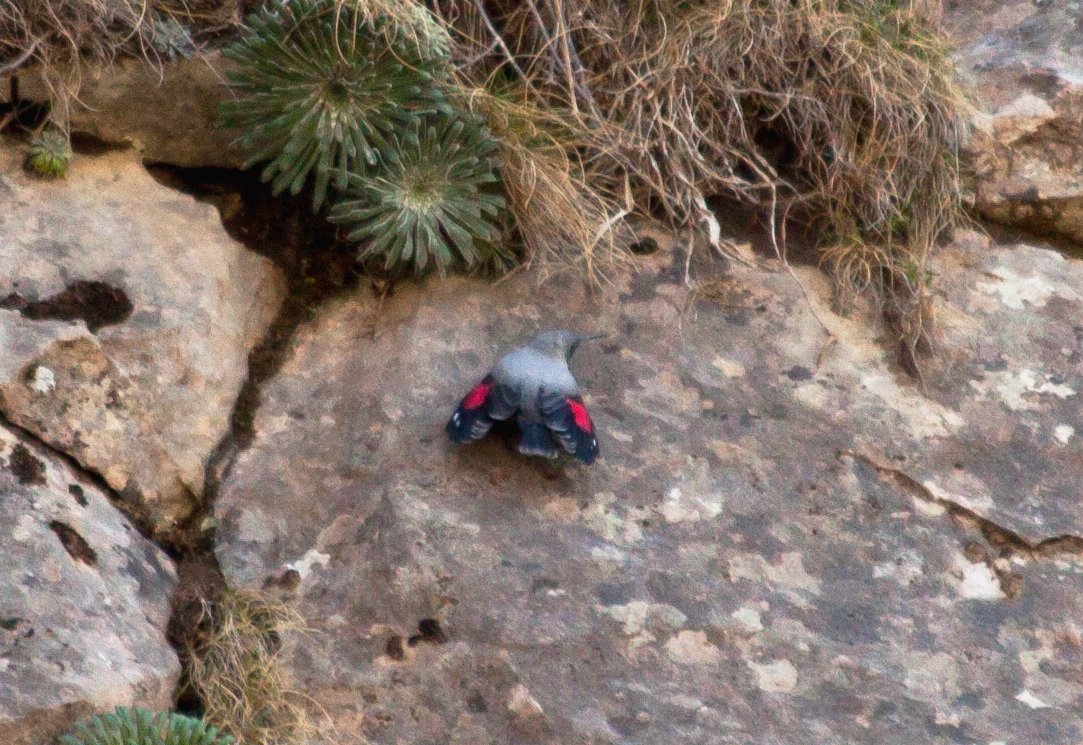
Wallcreeper – 15th April - Parque Natural de los Valles Occidentales - Valle de Hecho, Huesca (On cliff face, calling and showing well)

Rock Bunting – 15th April - Parque Natural de los Valles Occidentales - Valle de Hecho, Huesca (On rocks on trail down to waterfall)

Scops Owl – 15th AprilIn trees in the park off Calle Rioja, Huesca city centre (showing in tree near gates)

Wallcreeper - Northern Spain

Day 4 – Loporzano to Zaragoza


Subalpine Warbler – 16th April - Viewpoint on A1603 near Santa Cruz de la Seros (showing well in trees by the side of the road)

Black Woodpecker – 16th AprilViewpoint at Monasterio de San Juan de la Pena (Monestario alto)

Citril Finch – 16th AprilOn the road up to the car park at Monasterio de San Juan de la Pena (feeding on the road)

Citril Finch - Northern Spain

Day 5 – Zaragoza to Barcelona


Greater Flamingo – 17th AprilTwo on the lake at Laguna de Gallocanta


Additional Birds


Great Crested Grebe
Cormorant
Little Egret
Great White Egret
Grey Heron
Mute Swan
Shelduck
Mallard
Golden Eagle
Red Kite
Marsh Harrier
Common Buzzard
Kestrel
Peregrine
Merlin
Red-Legged Partridge
Coot
Common Crane
Avocet
Black-winged Stilt
Little Ringed Plover
Lapwing
Common Sandpiper
Redshank
Common Snipe
Black-headed Gull
Yellow-legged Gull
Feral Pigeon
Wood Pigeon
Collared Dove
Great-spotted Cuckoo
Common Swift
Hoopoe
Green Woodpecker - (sharpei)
Great Spotted Woodpecker
Skylark
Sand Martin
Barn Swallow
House martin
Water pipit
Pied wagtail
Yellow wagtail - (iberiae)
Grey Wagtail
Dunnock
Robin
Black Redstart
Wheatear
Whinchat
Stonechat
Song Thrush
Mistle Thrush
Blackbird
Blackcap
Lesser Whitethroat
Cetti’s Warbler
Willow Warbler
Firecrest
Pied Flycatcher
Great Tit
Blue Tit
Coal Tit
Long-tailed Tit
Woodchat Shrike
Magpie
Jay
Chough
Carrion Crow
Raven
Starling
House Sparrow
Tree Sparrow
Chaffinch
Linnet
Goldfinch
Greenfinch
Bullfinch
Yellowhammer
Corn Bunting

Birds that were heard only:


Orphean Warbler – 14th April - Embalse de la Sotonera, Huesca (In shrubby trees by the side of the lake)
  
Quail
Chiffchaff

Monday, 20 April 2015

Northern Spain Trip Report - Day 4

Day 4 - Wednesday 16th April 2014

The next morning saw us head further north still through the beautiful alpine villages to reach our destination of the Astun Ski resort, where Snow Finch and Alpine Accentor are regular visitors throughout the winter months. 
Astun - Northern Spain
A walk around produced several Crag Martins nesting underneath the rooftops of the buildings, and they provided great views as they swooped along the banks collecting mud and returning to the nest sites. 
Crag Martin - Northern Spain
A cracking summer plumaged Water Pipit was great to watch foraging on the banks heading towards the slope – colours I’m not used to seeing them in being just a winter visitor to the UK. April was slightly too late to observe any Snow Finches or Alpine Accentors in the car parking area however, so a trip up the mountain was on the cards. A slightly hairy moment when me and Alex didn’t realise we had to put the ski-lift safety barrier down on the way up the slope was in all in vain however, as there was no sign of either species at the halfway cafĆ©.
Astun - Northern Spain
The trip back down resulted in us having to then climb all the way back up the snowy slope by foot after Chris thought he had picked up the song of an Alpine Accentor whilst in the ski-lift on the journey back. Closer reflection and it turned that what he had actually heard was the squeaking of the ski-lift as the chairs passed over a joint.
Astun - Northern Spain
Later in the afternoon we headed off to a site I found through google whilst waiting on the mountainside, the Monasterio de San Juan de la Pena, which has a good reputation for Black Woodpecker sightings.
Northern Spain
Stopping off to admire the simply amazing views the twisting roads offered, a warbler singing in the surrounding trees eventually revealed itself to be a fine male Subalpine Warbler. Flitting from branch to branch, despite its close proximity, it took a good ten minutes to nail the ID of this skulking individual, the white moustachial stripe and red eye separating it from the similar Spectacled Warbler.

Driving up the heavily pine forested road to the monastery, we noticed several small birds feeding on the tarmac, mostly Chaffinches and Greenfinches, before a small yellow bird on its own caught our eye. Excited exclamations from the back of the car and shouts of “It’s a Citril Finch!” from Chris confirmed that it was indeed this hard to come by Alpine finch – completely unexpectedly and totally out of the blue. 
Citril Finch - Northern Spain
We watched it busy feeding before it flitted up and away in to the canopy – magical. We had spent some time earlier in the week searching at another location for these charismatic finches, but after drawing a blank we had resigned ourselves to not catching up with one on the trip!
Monasterio de San Juan de la Pena - Spain
Testing out my long buried Spanish skills at the monastery’s visitor shop (Donde estan los picos negros por favour?!) we headed up the steep slope to the viewpoint where I was told they could be found. Here more Griffon Vultures soared overhead, framed by the brilliant, cloudless blue skies and some individuals flying exceptionally low around us – our elevated position putting us at their level. Soon the shout went up of Lammergeier, and our second individual of the trip made its way over our heads, showing the distinctive diamond shaped tail and orangey belly that separates it from the other vultures.
Monasterio de San Juan de la Pena - Spain
In the distance, we could hear the call of a Black Woodpecker that came steadily closer as the time went by, leading to an absolutely phenomenal spot by Chris as he located it half hidden behind a trunk and completely obscured by branches in the valley below – whether this was by eagle eyed eyesight or by pure luck, I was still blown away that he had managed to locate it.

A tense few seconds ensued when despite the scope pointing directly at the bird, I just couldn’t see it, showing just how completely camouflaged it really was! I eventually caught sight of a large yellow eye peering back at me framed by jet black feathers, with that vibrant vermillion red crest on the top of the head standing out against the foliage. 
Monasterio de San Juan de la Pena - Spain
The three of us after woodpecker success
Europe’s largest woodpecker species, this was one of the highlights of the trip for me, and even though we only saw the top half of the birds body as it clung silently to the trunk, it was a truly amazing thing to be watching this magnificent woodpecker. Incredibly still and clinging close to the trunk, I appreciated just how lucky we were to see it – a Black Woodpecker needle-in-a-haystack amongst hundreds and hundreds of trees!

Monasterio de San Juan de la Pena - Spain
Panoramic view of the area
Completely satisfied with our day and two tricky targets seen, we headed back to Zaragoza, thankfully avoiding the drums and cloaked figures of our previous stay!
Zaragoza - Spain

Friday, 17 April 2015

Northern Spain Trip Report - Day 3

Day 3 - Tuesday 15th April 2014

Day 3 saw us rise bright and early to begin our treck in to the Pyrenean mountains, heading north to Valle de Hecho to commence our search for the star species of the trip and the one I was most looking forward to connecting with – Wallcreeper. We’d been informed by the lady at Boletas Birdwatching Centre that a male had been regularly observed on a cliff face in the valley, so the journey began through the incredible mountain landscape, admiring the gushing crystal clear rivers on route that seemed to follow the road around and carved through the rocky terrain with ease. 
Pyrenees - Northern Spain
Griffon Vultures soared overhead, whilst a stop to admire a mountain lake revealed two Egyptian Vultures flying high over one of the ridges. Separated from the much more common Griffons by their bold white and black underwings, the differences were clear to see and we watched the pair gliding effortlessly over the trees until they disappeared out of view.
Egyptian Vulture - Spain
Pyrenees - Northern Spain
Heading through the quaint alpine villages, we stopped to scan over one of the larger mountains by the side of the road – towering over us with a clear thermal in action as large numbers of vultures used the warm air to their advantage. 
Pyrenees - Northern Spain
The mountain ridge the vultures were loving
Alpine Choughs joined them high above the mountains, while a pale looking eagle was just too distant to ID. No Lammergeiers had put in an appearance yet (another personal key target species) but this was ideal habitat and they were well known in the area, as the many accommodation residences with Lammergeiers adorning their signs would testify.

We soon arrived at the Wallcreeper site, and immediately headed off on the alpine trail towards the cliff in question, the abundance of dainty alpine plants and flowers surrounding the pathways creating a beautiful carpet to admire as we walked up. The air here was undeniably fresh, and as we climbed higher, patches of clean white snow started to appear on the trail – a real magical alpine environment to experience. 
Pyrenees - Northern Spain
Reaching the cliff that the Wallcreeper had been favouring, we were joined by a small group of Goldcrests and Firecrests, whilst several Crested Tits foraged in the pine needles for snacks of tiny spiders and insects.
Crested Tit - Spain
Before long, the shout of “Wallcreeper!” from Chris cut through the still air, and sure enough, a small grey bird flew along the length of the cliff, that characteristic fluttering butterfly flight and echoing “peeeweeeeee” call unmistakable. Vanishing round the side of the rocks, we followed suit, heading up the trail in the direction it had flown in. With no sign around the corner, we waited for it to make a reappearance as we ate lunch, enjoying much better views of Alpine Choughs as they played and tumbled above the mountains, their yellow bills clear to see.
Pyrenees - Northern Spain
The Wallcreeper cliff!
Then, “Lammergeier!” - Chris was pointing high above, and sure enough that most majestic of vultures was slowly drifting towards us from across the valley. Passing overhead before it disappeared over the ridge, we all had excellent views of this bearded wonder. Having always wanted to a Lammergeier after studying the pages in my Collins guide, it was surreal to actually see one in the flesh – an incredible moment and one of the star birds of the trip.
Lammergeier - Spain
Pyrenees - Northern Spain
After an hour or so of craning our necks, our ears pricked up as that familiar and almost eerie “Peeeweeee” call echoed across the cliff face. With a quick search of the rocks above us, sure enough, there was the Wallcreeper, busy probing amongst the rocks with that remarkable long bill and fluttering from crevice to crevice. 
Wallcreeper - Spain
Wallcreeper - Spain
Wallcreeper - Spain
The beautiful butterfly-like pattern of deep crimson red on the wings was mesmerising to watch as he flittered his wings hopping from perch to perch, and we viewed for a good while at a considerably close range as he fed in front of us, completely unaware of his captivated admirers, before we moved on and left him in peace.
Wallcreeper - Spain
Wallcreeper - Spain
Wallcreeper - Spain
The Crimson on the wings was stunning!
We continued further along the track, Chris and Alex deciding to ignore the possible bear scat they had discovered near the Wallcreeper cliff, following the trail along the river. Here a smart looking Rock Bunting gave great views, singing and dashing from rock to rock in front of us.
Rock Bunting - Spain
The waterfalls and landscape here was absolutely stunning, and it was incredibly relaxing to listen to the gushing of the waterfalls crashing over the huge boulders and the roar of the river flowing below.
Pyrenees - Northern Spain
We picked up the call of a Black Woodpecker on one of the slopes, and leaving Chris with all our gear, we scrambled up the steep bank in pursuit. Sadly the sound was heading further and further away from us quicker than we could climb, and we lost the trail. A loud crashing through the trees below us had us remembering the bear scat from earlier, and a sudden awareness that a large carnivore could be roaming towards us left us a little apprehensive! Turns out it was just Chris, climbing the impossibly steep and thick tree covered slope to join us, carrying not one but THREE sets of heavy rucksacks and scopes on his shoulders! No easy feat indeed.
Pyrenees - Northern Spain
Later that evening we made the drive in to Huesca to try and track down the Scops Owls that reside in the city centre. Still a little early in the year, we were a tad unsure if any would have returned yet. A walk around the streets drew a blank, but after around half an hour and near to one of the parks, we heard that distinctive “BONG!” - Scops Owl!

We hurried over to the park and eventually managed to pinpoint the group of trees that the owls were calling from – although actually spotting any of the birds was far easier said than done. Judging by the calls, it appeared that they were flying around in a circle, but in the pitch black of the park it was impossible to pick anything out – even with all the street lighting illuminating the buildings nearby.

Eventually I narrowed down a calling individual to one of the trees lining the path in front of the gates, and several minutes of craning our necks and squinting resulted in me picking out the small owl perched next to the trunk on one of the branches. Success!


We could just make out its tiny shape and features, with two beady eyes looking back down at us, and I must admit this was probably my best spot to date considering just how hard they were to pin down! After some time, the owl began to fly from branch to branch, making it far easier to pick out in the darkness. Never has one bird been so difficult to locate, and it felt that these tiny owls were most definitely giving us the run-around that evening!
Casa Boletas - Loporzano
Boletas Birdwatching Centre