A tale of nature, wildlife and birding from Cheshire, North Wales and across the globe....

A tale of nature, wildlife and birding from Cheshire, North Wales and across the globe....
Showing posts with label Ring Ouzel. Show all posts

Wednesday, 19 October 2016

The Best of Autumn Birding at Spurn - Rustic Bunting, Dusky Warbler, Shore Lark and more!

With easterly winds dominating the weather over the past couple of weeks, we couldn't not enjoy two weekends on the bounce at one of the premier birding locations mainland Britain has to offer - Spurn in East Yorkshire. Scouring the bushes, hedgerows and trees on the hunt for Siberian Rubythroats, White's Thrushes or *insert desired mega here*, whilst we didn't strike it lucky on that front, we nevertheless had an enjoyable few days lapping up the huge number of eastern waifs that had arrived on our shores.
Dusky Warbler - Spurn, Yorkshire
Dusky Warbler
Rustic Bunting - Spurn, Yorkshire
Rustic Bunting
Without doubt, the highlight of the first weekend was most definitely a fine Rustic Bunting, originally trapped and ringed at Kew Villa on the Thursday and being seen intermittently in Church Field the following days. A relatively rare visitor, and with there not having been a twitchable one for a good number of years, it was great to jam in on this eastern bunting.
Rustic Bunting - Spurn, Yorkshire
Perching up on several trees scattered around the field through the course of around 45 minutes, we were able to get great views as it showed off to the crowds!
Rustic Bunting - Spurn, Yorkshire
Church Field - Spurn
Birders on the hunt for the Rustic Bunting in Church Field
Very similar to a Reed Bunting in winter plumage, the rusty red-brown flanks, neck and rump of the Rustic were obvious, even in flight, while the white facial spot and white wing bars (yellow-brown in Reed Buntings) also offered a handy way of separation.
Rustic Bunting - Spurn, Yorkshire
The diagnostic white facial spot
Church Field Heligoland trap - Spurn
The Heligoland trap in Church Field the Rustic Bunting was first trapped in
Spurn always seems to deliver, and along with the Rustic Bunting, we had a handful of Yellow-browed Warblers, several Redstarts, two Red-breasted Flycatchers, a nice Ring Ouzel, an Olive-backed Pipit, masses of Redwings and Goldcrests, a particularly showy Woodcock on the beach and a gorgeous Firecrest flitting through the hedges. 
Woodcock - Spurn, Yorkshire
Firecrest - Spurn, Yorkshire
Poor record shot of the Firecrest!
Olive-backed Pipit - Easington, Yorkshire
Olive-backed Pipit
Having had our fill of the gorgeous little Siberian Accentor at Easington the following weekend on our second visit to East Yorkshire (that little gem gets a whole blog post to itself), we headed over to finish the day at Spurn once again, a confiding Dusky Warbler on canal bank my second lifer of the trip. 
Dusky Warbler - Spurn, Yorkshire
With Dusky Warbler a predominately east coast bird, this had been on my radar for a good while, and it was great to finally catch up with one after relatively few records in previous years.
Dusky Warbler - Spurn, Yorkshire
A supporting cast of Pallas’s and Yellow-browed Warblers, Firecrests, Bramblings, a Woodcock and a Black Redstart were certainly not to be sniffed at, while an extremely confiding Shore Lark was also most definitely another highlight of the weekend, these Bumblebee pattered larks a firm favourite of mine. 
Shore Lark - Spurn, Yorkshire
The sheer spectacle of ongoing migration at Spurn was also a display in itself, the bushes dripping with Goldcrests while every hedgerow, field and patch of grass held masses of Robins and thrushes fresh in off the sea.
Firecrest - Spurn, Yorkshire
I can never get a decent photo of a Firecrest!!
A great couple of weekends at what is truly one of the best migration hotspots in Britain, and it was fantastic to see the spectacle of autumn migration on the east coast in action. 

Tuesday, 14 April 2015

Ring Ouzels on the Great Orme

With a huge fall of Ring Ouzels documented throughout the UK from Friday onwards, and with up to 20 birds present on the Great Orme since Saturday morning, we decided to call in on the Sunday after returning from Scotland. Despite the absolutely howling gales and driving rain (which caused the car to rock from side to side with the sheer force of it all), and with the helpful directions from Alex’s friend Steve Culley, I eventually picked up 2 birds in flight and calling near the Copper Mines. I soon located a lot more birds further down the slope, all actively feeding in the same ivy tree, and despite the far from perfect conditions we counted 7+ birds.
Ring Ouzel - The Great Orme
A record shot of the male Ouzel
Ring Ouzel - The Great Orme
I was especially pleased to track down these birds as I haven’t had great views of Ring Ouzels before, merely a quick fleeting glimpse on a fence before a pair flew away on a visit to Moel-y-parc a few years ago, and a female by the side of the road whilst driving in Cheshire being my only other sightings, so it was great to watch these large thrushes going about their business at leisure, despite the absolutely horrific weather.
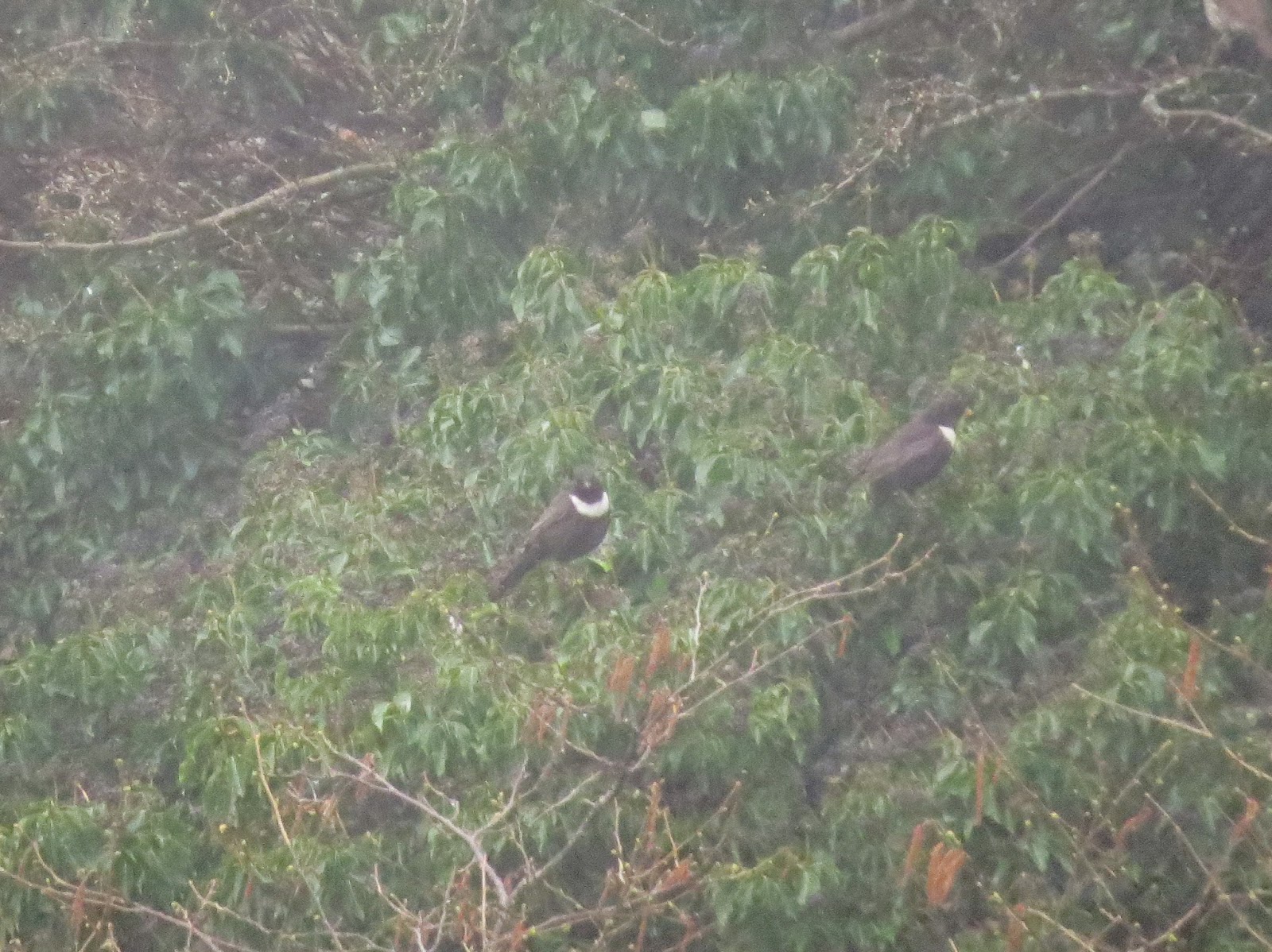
Ring Ouzels - The Great Orme
The driving rain made it hard to get even record shots!
Ring Ouzel - The Great Orme
Interestingly, Ring Ouzels haven’t been picked up from this side of the Orme before, with birds usually getting found on the opposite side in the sheep fields. However, the fields and patches of grass surrounding the Copper Mines and over towards the nearby houses seemed the perfect habitat for these migrants, and it was clear why they had all congregated in this one patch of trees – this sheltered spot offered a welcome respite from the harsh winds and abysmal weather.
Ring Ouzels - The Great Orme
All the birds had congregated in one tree - 4 can be seen in this one shot alone with another just to the left out of frame
The row of ivy trees in particular at the back of the donkey field next to the rubble track appeared to be the most favourable, and this little sheltered spot seems like it would pose an attractive area for migrants in the spring and autumn months – definitely an area to watch more closely in the future!