A tale of nature, wildlife and birding from Cheshire, North Wales and across the globe....

A tale of nature, wildlife and birding from Cheshire, North Wales and across the globe....
Showing posts with label Essex. Show all posts

Tuesday, 4 June 2019

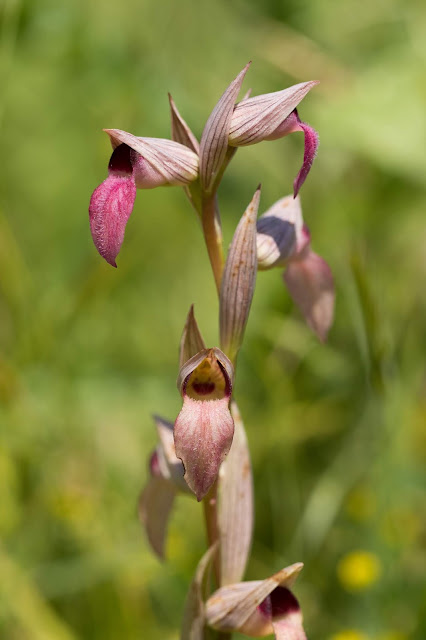
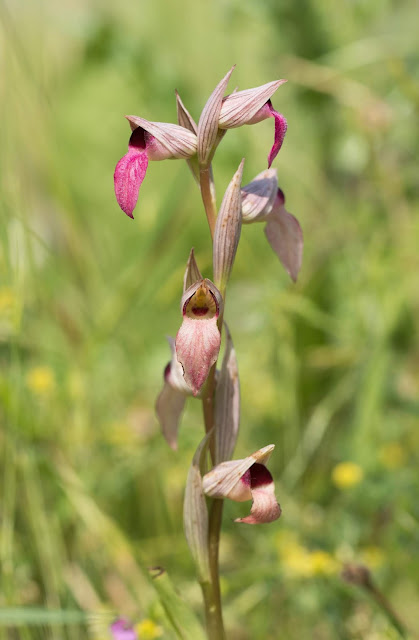
Greater Tongue Orchids - Tiptree, Essex!

When a colony of Greater Tongue Orchids was discovered in Essex during the summer of 2017, the race was on to track the plants down and establish whether they were naturally occurring or had arrived artificially. With just a single photo of several flowering spikes in a field to go on (which was hastily removed from the Facebook page to which it was posted) several of the orchid world's enthusiasts expertly narrowed down the location, and by carefully checking the vegetation on site to that in the photo, were remarkably able to pin down the exact spot where these exotic orchids were growing.
Greater Tongue Orchid - Tiptree, Essex
Sadly, by the time they were found all but a very small handful of the plants had completely gone over, and as such, arrangements were kindly made for a number of organised visits last summer so those interested could admire these Mediterranean beauties in all their glory.

Therefore, at the beginning of June last year, me and my Dad made the long journey down to Essex and were met on site by local resident Jonathan who showed us the exact location in the meadows where this small cluster of orchids were growing, thankfully in prime condition despite the scorching sun and allowing for excellent photographic opportunities (despite some tripod issues!).
Greater Tongue Orchid - Tiptree, Essex
v
Greater Tongue Orchid - Tiptree, Essex
With around 36 plants in flower last year, the number was slightly down on 2017's showing, but luckily each delicate maroon flowering spike was in top condition (I had actually been away in America the previous week so was a bit concerned the flowers may have been past their best by the time I got there) and the colony had been carefully marked out with several small canes to prevent trampling by unaware dog walkers.
Greater Tongue Orchid - Tiptree, Essex
However, despite the excitement of such a remarkable botanical find, the question remains: are the Tiptree Greater Tongue Orchids naturally occurring or did they arrive through artificial means?

With orchid seed being particularly fine and easily carried by the wind, there is of course every possibility that seed from the continent had blown over naturally, with the nearest populations occurring in France, Spain and Italy. However, a number of other circumstances need to be considered before determining whether these continental plants really did make it over here without a little bit of human help.

A single specimen could easily have been planted out by a keen botanist or gardener many years ago, reproducing year on year to result in the small colony seen now (the plants were all restricted to a tiny area about a metre squared in size and found nowhere else on the meadows as you would expect from plants in a natural continental setting). Likewise, seed blown artificially from plants growing in a pot in a nearby garden could have easily kick started a colony.

However, this would be an odd site for a deliberate planting, and no pot grown specimens are growing nearby to our knowledge - even if they were, the Greater Tongue Orchids natural pollinator is not known to occur in Britain, making seed set very unlikely without assistance. 

Upon talking to Jonathan, he explained that decades ago the meadows were used as strawberry fields alongside a plant nursery that amongst other things was known to grow tropical orchids. This therefore creates an entirely feasible scenario of Tongue Orchid seed being accidentally imported - getting in to the mix of soil, clippings and cuttings discarded on site and germinating, eventually becoming established and naturalised - in my opinion the most likely origin.
Greater Tongue Orchid - Tiptree, Essex
This is not the first occurrence of Greater Tongue Orchid in the UK however, with a small well-known colony of Greater Tongue Orchids situated at Wakehurst Place in Sussex alongside the introduced Loose-flowered Orchids (never proven but very unlikely to be of natural origin as a consequence). Three flower spikes were also discovered near to the coast in Kingsbridge, south Devon back in 1998, but once again, their origins were never proven - some suspecting seed had come from an artificial source such as a nearby plant collection or agricultural seed mix. 

Small-flowered Tongue Orchids have also previously gotten a very shallow toehold on British soil in the past with individuals cropping up near Rame Head in SE Cornwall, having first been discovered there in 1989, but sadly disappearing in the early 2000s. With seed suspected to have blown in from the continent as opposed to a deliberate planting due to the remote location, it's entirely probable these were the result of natural colonisation from across the channel.

It’s likely that we’ll never know for certain the origins of the Tiptree plants, but whatever their background, the Tongue Orchids have clearly been on site for a number of years now, vegetatively reproducing to increase in number each year and creating a naturalised and self-sustaining population in the process. 
Greater Tongue Orchids - Tiptree, Essex
The Tongue Orchids have reproduced vegetatively to cover a small patch of ground in the meadow
Greater Tongue Orchids - Tiptree, Essex
Spot the Tongue Orchid! The small patch where the orchids were growing
Unfortunately despite being the only known 'natural' colony in Britain, the Tiptree Tongue Orchids face an uncertain future, with developers knocking on the door eager to build on the site despite the protestations of residents and orchid enthusiasts alike. This year, due to the sensitivities of the site, visitors are also being asked to keep away. Hopefully some sort of compromise can be found, where the future of the orchids is secured and many more people can get to enjoy them for years to come - it would be a real shame indeed if these fascinating plants were to be lost almost as quickly as they were found.
Greater Tongue Orchid - Tiptree, Essex
Greater Tongue Orchids - Tiptree, Essex
Greater Tongue Orchid Meadow - Tiptree, Essex
The meadow in Tiptree, Essex where the Greater Tongue Orchids were found

Friday, 2 October 2015

Wilson's Phalarope at Vange Marsh, Essex

With a potential first for Britain in the form of an Acadian Flycatcher at Dungeness last week sadly out of reach due to work commitments, me and Alex decided to make up for the loss by travelling to Essex for the reliable Wilson’s Phalarope that had settled at Vange Marsh RSPB.

Being a little further away than we would normally travel for anything outside of mega status, we were glad for the change of scene and being a species we were both still in need of, Alex drove us both down to the south east, having only been to Essex one before for the Serins back in March. Arriving nearly 4 hours later, we made the short treck under the A13 and over the railway line, before following the trail through the meadows to view the water.

A marauding Marsh Harrier flushing all the birds as soon as we arrived was a little concerning (4 hours for nothing?!), but Alex soon expertly picked the Wilson’s up in flight and thankfully tracked it through the scope until it landed.
Wilson's Phalarope - Vange Marsh, Essex
A (very) record shot of the Wilson's Phal
Present on the flash now for over a week, despite the distance (a factor that had been putting me off) we still got good scope views of this American Phalarope as it fed and span around in the water, dainty in comparison to the nearby Ruffs and Redshank, but still evidently larger than our more familiar Grey or Red-necked Phalaropes.
Wilson's Phalarope - Vange Marsh, Essex
It could be anything.... it is a Wilson's Phalarope.... honest!
With a much greyer head lacking a distinct mask, as well as an elongated slender neck and long needle fine pointed bill, we could still pick up the subtle key features even at a distance, Alex even observing the yellow legs in flight. Now advancing in to winter plumage, there was still just the faint hint of colour visible along the neck.

Whilst not as close as previous birds in recent times in terms of both views and distance travelled, and nowhere near as spectacular as the gorgeous female summer plumaged stunner on the Isle of Wight a couple of years ago, it was still great to see what is an almost annual rarity to the British Isles and a species I have been hoping to catch up with after deciding the Cleveland bird back in 2011 was a touch too far (despite probably being an hour less than what we travelled last weekend!)

With a fine supporting cast of waders including Spotted Redshank, Ruff, a Little Stint and both a Green and Wood Sandpiper, it is a shame that the water is so far away for viewing – a small bridge and hide provided by the RSPB could really open up the potential for this clear wader magnet, perhaps even allowing the UK’s next Red-necked or Long-toed Stint to be unearthed….

Wilson's Phalarope - Vange Marsh, EssexTo visit: Park at end of Chestnut Road (TQ733876, SS16 4XJ), walk under the A13 and over the railway crossing, then walk right along the meadow path and left to view the water.
View of the flash - very distant!

Friday, 13 March 2015

Serins at Gunner's Park - Essex

With the Lady Amherst’s Pheasants wrapped up by half 10 and the Essex Serins at Gunner’s Park being just an hour and a half away from Bedford, after a quick pit stop back at the hotel we were soon on our way!

Arriving at Gunner’s Park car park, I immediately clocked on to a group of birders with scopes and cameras  at the far end – clearly the Serins were nearby. Joining the group, they told us the pair had just flown in to a weedy scrubby patch of grass and were still presumably in there – they hadn’t been seen to fly away so it was just a matter or waiting and watching for them to appear.


Looking desperately for a few minutes, the birds remained hidden in the grass – were they still there even? Then, suddenly, one popped up on a dead plant in front of us, actively foraging amongst the seed. 

Serin, Gunner's Park, Essex

Serin, Gunner's Park, Essex
It gave good views before taking off high and flying round in a circle, later relocated in one of the alder trees surrounding the large pond. We followed the Serins for a good hour in the early afternoon sunshine, the birds returning to their favoured patch of grass at the far end of the car park by the houses, feeding amongst the grass and weeds and happily tolerating their many admirers.
Serin, Gunner's Park, Essex

Serin, Gunner's Park, Essex

Serin, Gunner's Park, Essex
It was great to catch up with these two birds, the 4 hour journey from Cheshire was just a little bit too far for me, but with the time cut down to under 2 hours from Bedfordshire, it was the ideal opportunity. Serins are always a bird that I’ve struggled to catch up with nearby – a brief report of one from the Wirral a couple of years ago was the closest near me, and the vast majority reported are often flyovers. It’s really unusual to get such a twitcher-friendly bird providing such great views, especially a gorgeous male – let alone two! I’ve seen Serins before whilst in Spain, but even then we didn’t have as good views as the two in Essex provided.
Serin, Gunner's Park, Essex

Serin, Gunner's Park, Essex
Overshooting from Europe, we get a scattering of records a year, and it was great to seize the opportunity to finally see these two at Gunner’s Park. Present for over a month now, originally they proved difficult to catch up with when they first arrived, elusive and only present briefly before disappearing for hours at a time as they presumably headed off over the adjacent houses. However, they seem to have settled in to a reliable pattern now, favouring their little scrubby grass patch on the car park opposite the row of houses, as well as the trees surrounding the large pond at the far end. Easily identified by their bright yellow colouration and characteristic yellow rump, it would be well worth learning the call to latch on to any flyovers that might occur in the future!
The Serins were busy feeding the whole time
This was a great opportunity to really admire these birds up close and they seemed totally unfased by our presence – I’m really glad I made the journey down! 

Serins at Gunner's Park, Essex
A map showing the locations the Serins favour near the car park at Gunner's Park