A tale of nature, wildlife and birding from Cheshire, North Wales and across the globe....

A tale of nature, wildlife and birding from Cheshire, North Wales and across the globe....

Tuesday, 15 October 2019

Michigan Birding Trip Report - Day 2 (Saturday 26th May 2018)

Leaving Detroit and the hustle and bustle of the city behind, our second day saw us heading much further north to the rather promising looking Haughton Boardwalk, an extensive reedbed supposedly home to a plethora of rails, soras and wrens. Upon arrival at the turn off and with no signposts in sight, we headed down the small wooded driveway slightly baffled at the lack of reeds – instead finding ourselves in woodland and scrub. Nevertheless, the area still seemed relatively birdy, and several Veery singing their distinctive flutey yet somewhat mournful sounding song were a welcome surprise - eliminating the heartbreak at failing to find them on territory in New York three years prior as they gave brief views in the treetops. 
Haughton Boardwalk - Michigan, USA
The reedbed at Haughton Boardwalk
Parking up in a small clearing also yielded good results where our first calling empid of the trip was able to be nailed down as an Alder Flycatcher while a stunning Golden-winged Warbler (a prize very high up on our target list) gave brief but mouth-watering views before flitting off. 
Alder Flycatcher - Haughton Boardwalk, Michigan, USA
Alder Flycatcher - identified through sound recordings from the similar Willow Flycatcher
With an ominous looking storm approaching and having located the hidden entrance to the boardwalk on to the reeds, navigating the many invading thorns and brambles blocking the path we made our way on to the reedbed before the rumbling thunder came too close, gingerly stepping over the many slimy flooded sections and avoiding the thick pipe that ran all along the wooden frames. 

Despite the abundance of records for this site, Haughton Boardwalk unfortunately remained relatively unproductive during our visit, most probably due to the baking hot sun keeping the birds hiding in the cool shelter of the reeds. A handful of Swamp Sparrows and Marsh Wrens kept us entertained (though neither of them lifers), but in the hour or so walking the boardwalk we had not so much of a sniff of our target Sedge Wrens. It was also relatively quiet on the rail front, with no sign of our hoped for Soras and only a brief flight view of a flushed Virigina Rail our only consolation. 
Blandling's Turtle - Haughton Boardwalk, Michigan, USA
A chance encounter with a Blandling's Turtle crossing the driveway
Heading back to the car before the thunderstorm finally hit, a brief stop on the drive to admire a Blandling’s Turtle (itself a species of special concern in Michigan due to being endangered in much of its US range) also resulted in a chance encounter when a Ruffed Grouse crossed the road in front of us. A species that we had thought we would see with relative ease during the trip, this turned out to be our only individual, so all in all an incredibly lucky encounter!
Monarch - Mickelson Landing, Michigan, USA
Monarch Butterfly - always a favourite
A brief stop at the nearby Mickelson Landing during a break in the weather resulted in nothing much of note bar a pair of American Black Terns and a docile Monarch showing off its underwing, so we cut our losses and headed up to Grayling – our base for the next few days.
Wild Turkey - Michigan, USA
Our first Wild Turkeys of the trip were seen en route to Grayling
With a hint of light still left we decided to explore the first of two well-known roads in the Grayling Forest, but with the sun setting it was now far too late for any singing warblers. 
Grayling Forest, Michigan, USA
Dusk on one of the Grayling Forest tracks
A small handful of Vesper Sparrows preparing for roost were our first of the trip, the pale spots on their cheek distinctive even in the poor light, as were a number of Brewers Blackbirds lining up in the dead trees at the side of the road. A Rose-breasted Grosbeak added a splash of colour to proceedings while a Porcupine slumped lazily on a thick tree branch was an unexpected bonus of what was our first encounter with this bizarre creature.
Vesper Sparrow - Grayling Forest, Michigan, USA
Vesper Sparrow - one of a handful of birds heading to roost
Brewer's Blackbird - Grayling Forest, Michigan, USA
Brewer's Blackbird
Porcupine - Grayling Forest, Michigan, USA
Porcupine!
With Grayling Forest a hotspot for nocturnal birds such as Nighthawks and Whip-poor-wills, as the last of the light started to fade it suddenly clicked that the high pitched screeching we’d been hearing for the past ten minutes was in fact 3 Common Nighthawks gliding high above our heads, starting their evening breakfast and providing an aerial display above the trees. Not having any experience with nighthawks apart from a single bird accidentally flushed during the day from the Dry Tortugas in Florida, we were expecting a flight style similar to Nightjars back in the UK, swooping low down over vegetation as opposed to soaring high above the treetops. Once we were locked on to their presence however we were treated to amazing views as they fed above us, amazing scenes and a top moment of the trip. 
Common Nighthhawk - Grayling Forest, Michigan, USA
Common Nighthawk
With the light now having all but disappeared, after a well-earned pit stop of pepperoni pizza at the nearby Pizza Hut, we were soon back in the forest – this time on a different track on the hunt for Eastern Whip-poor-wills. Much smaller than the Nighthawks and with a different style altogether, we had barely driven down the road before we heard our first individual, calling softly beside us next to a small row of houses. 
Grayling Forest, Michigan, USA
A favoured perch of the Whip-poor-wills. Sadly we weren't fast enough to get a photo!
Getting out of the car and using our torch to try and locate it proved all but impossible, but after a frustrating few minutes we eventually scored as a whip-poor-will came powering towards us to investigate, displaying above our heads with the flashing white on its outer tail and matching throat shining in the torchlight. In a remarkable hour or so and not having to venture very far down the road at all, we managed to hear another 13 or so birds, several sat at the side of the road, their huge saucer-like eyes shining in the car headlights and getting further outstanding views as birds flew around the car, passing right next to us on occasion. For me this was a real highlight of the trip and an incredible experience to see these fascinating birds so close. Leaving the whip-poor-wills in peace we headed back to the hotel happy for a much needed rest ready for the main event the next morning…when our quest for Kirtland’s Warblers would begin!
Grayling Forest, Michigan, USA

Monday, 7 October 2019

Michigan Birding Trip Report - Day 1 (Friday 25th May 2018)

The American Great Lakes, a vast expanse of tranquil water bodies, sprawling pine forests and extensive Spruce bogs, all home to a range of exciting breeding birds and wildlife. With the endangered Kirtland’s Warblers of the Michigan Jack Pine plantations the main reason for our trip, the upper states hold a variety of breeding birds that can much easily be found here than on migration elsewhere, and as such, despite two prior visits to the east coast of the US during spring passage, we still had a respectable list of targets to try and aim for. 
Kirtland's Warbler - Michigan, USA
Kirtland's Warbler - the star bird of Michigan
Jack Pines - Michigan, USA
Young Jack Pines - prime Kirtland's habitat
Great Lakes - Michigan, USA
The Great Lakes!
Upper Peninsula Bog - Michigan, USA
A classic Michigan bog - plus mosquitoes! 
Whilst primarily staying in Michigan for our visit, we did also venture in to Ohio on two occasions, to look for the locally uncommon Lark Sparrow on breeding territory and to experience the world famous Magee Marsh in all its glory during the peak of spring migration.

Housekeeping

Our trip to Michigan involved travelling from Detroit and exploring the Lower Peninsula, with a focus around the Grayling area in particular. We also spent some time in the Upper Peninsula (only venturing as far as Trout Lake and Pickford) while during the trip we made two visits in to Ohio. Our specific targets for the trip were Kirtland’s Warbler, Golden-winged Warbler and Evening Grosbeak plus a number of sparrows, flycatchers and grouse species that we had missed elsewhere in the Eastern US. 37 lifers and 136 species in total were seen during our 9 days in Michigan and Ohio, covering the 24th May – 2nd June 2018.
Golden-winged Warbler - Michigan, USA
Golden-winged Warbler - a target we had missed previously in New York
Evening Grosbeak - Michigan, USA
The sublime Evening Grosbeak
We hired a car for the duration of the trip from Hertz and flights were direct return from Manchester Detroit. Our route consisted of an initial stop at Magee Marsh in Ohio before heading back north in to Michigan and towards Grayling and Gaylord for a few days. We then headed up in to the Upper Peninsula exploring the areas near to Trout Lake, Pickford and Rudyard before heading back down in to the Lower Peninsula again with a second stop off at Grayling (as back up in case we failed on the Kirtland’s Warblers the first time). From here we ventured down to Oak Openings Preserve in Ohio (stopping of at a number of sites en-route) before finishing back up in Detroit. Journey times were kept relatively short, the longest of which were the extensive drives from Detroit up to Grayling and vice versa, taking just over 3 hours.
Airplane view
The view from the air of Greenland and the Labrador Sea on route to Michigan
Magee Marsh - Ohio, USA
The world famous Magee Marsh!
Haughton Boardwalk - Michigan, USA
Haughton Boardwalk
Trout Lake - Michigan, USA
Trout Lake
Oak Openings Preserve - Ohio, USA
Oak Openings Preserve
We stayed in a total of 4 different hotels during the trip – the excellent Hampton Inn Detroit/Southgate was by far the best of the bunch, while our Super 8 and Baymont in Grayling and Gaylord respectively both did what they said on the tin. Birch Lodge & Motel at Trout Lake was a little more old fashioned (with an abundance of mosquitos hijacking the room) although the lakeside setting was incredibly peaceful, and with accommodation in that area hard to come by this was the best pick of a very limited selection. Food selection, surprisingly for America was not particularly great, and we were thankful for the local Pizza Huts on more than one occasion. As ever, Applebees proved to be a reliable and tasty option, but overall, the standard of eateries during the trip left much to be desired. 

Daily Diary

Our first day in Michigan dawned hot, bright and sunny (much warmer than usual for the time of year) and hitting the road we were on site at Magee Marsh by early morning, just as migrant activity was starting to peak. Situated just over the border in Ohio and around an hours drive from our base in Detroit, Magee Marsh is famous the world over as a stopover point for migrants on their long journey north and as such is a key location for any trip in this part of America.
Magee Marsh - Ohio, USA
A mind-boggling array of colourful American Warblers awaits
Before we had even approached the car park, the birds were materialising thick and fast, the bright sunshine yellow of a male Prothonotary Warbler popping out at us from the hedgeline while an abundance of Yellow Warblers called all around. A pair of Yellow-billed Cuckoos dashed through the thicket of marshy trees in hot pursuit of one another, while a cacophony of Red-winged Blackbirds trilled noisily from the reeds in every direction.  
Yellow Warbler - Magee Marsh, Ohio, USA
Yellow Warbler
Red-winged Blackbird - Magee Marsh, Ohio, USA
Red-winged Blackbird
Arriving in the car park and approaching the famous boardwalk from the eastern side, surprisingly the birds seemed to slow down a little, far from the abundance of colourful warblers that we had envisaged would be surrounding us. A smart Swainson’s Thrush on the boardwalk was our only one of the trip, while the only species at this side of the marsh in any abundance were the many Yellow Warblers calling from every branch.
Lake Erie - Ohio, USA
The adjoining Lake Erie
With very little action on the eastern portion of the marsh we headed over to the western end to see if our luck could improve, and finding a small cluster of birds it soon became apparent that this area was much more productive. Two House Wrens were busy holding territory alongside a skulky Grey Catbird, while singles of Canada Warbler, American Redstart, Yellowthroat and another Prothonotary Warbler flitted through the tree canopy in quick succession. Two Blackpoll Warblers busied themselves amongst the leaves alongside a female Magnolia Warbler, while exploring the watchtower a little way along the path revealed our first Blackburnian Warbler of the trip (a personal favourite of mine), although this was a slightly duller female, lacking the fiery burning glow only the males exude.
Grey Catbird - Magee Marsh, Ohio, USA
Grey Catbird
The chiming of Cedar Waxwings overhead revealed a small flock of around 20 birds blending in to the branches above, while the flutey notes of several singing male Baltimore Orioles carried through the trees.
Red-eyed Vireo - Magee Marsh, Ohio, USA
Red-eyed Vireo
Warbling Vireo - Magee Marsh, Ohio, USA
Warbling Vireo
Regardless of the increase in activity at this side of the marsh, we had still yet to score on any of our targets however. Despite an abundance of both Red-eyed and Warbling Vireos, the lemon buff of a Philadelphia Vireo eluded us all day, and so far there was no sign of either the Wilson’s, Mourning or Connecticut Warblers that had been reported a few days prior. Our luck eventually changed as a cryptically camouflaged American Woodcock foraging in the undergrowth became our first new bird of the day – a species we weren’t entirely sure we would catch up with on our trip, watching on as it continued to probe unfazed in the soft ground just metres away. 
American Woodcock - Magee Marsh, Ohio, USA
American Woodcock - a slightly scruffy individual! 
American Woodcock - Magee Marsh, Ohio, USA
Tearing ourselves away and armed with new information from some of the local birders, we explored one of the loop trails of the boardwalk where the Wilson’s Warbler had previously been seen.  Eventually, after an abundance of Yellow Warblers, one individual had the sooty black cap of a Wilson’s, perched on one of the gnarly branches for a matter of seconds before disappearing in to the marshy thicket. Despite our best efforts we just couldn’t relocate it, and with lunchtime approaching we cut our losses and headed back to the car for a bite to eat and to try and locate some of the Trumpeter Swans that make the area their home. 
Bald Eagle - Magee Marsh, Ohio, USA
Bald Eagles nest in the trees above the main car park at Magee Marsh
With none present on the large lake next to the visitor centre, we decided to check another of the large waterbodies we had passed on our way down – Ottawa National Wildlife Refuge. The small lake next to the road was teeming with waterbirds, as Wood Ducks, Blue-winged Teals and Canada Geese all drifted on the water’s surface, while Egrets, Great Blue and Green Herons stalked stealthily amongst the lily pads. Thankfully though, the white figures of two Trumpeter Swans soon came in to view, dabbling for morsels amongst the vegetation and displaying their large, dark black wedge shaped bills.
Ottawa National Wildlife Refuge - Ohio, USA
Ottawa National Wildlife Refuge
Ottawa National Wildlife Refuge - Ohio, USA
Trumpeter Swan - Ottawa National Wildlife Refuge, Ohio, USA
Trumpeter Swan
Trumpeter Swan - Ottawa National Wildlife Refuge, Ohio, USA
Canada Geese - Ottawa National Wildlife Refuge, Ohio, USA
Wild Canada Geese!
With Trumpeter Swan now safely in the bag but with the afternoon still left ahead of us, we decided to head back to Magee Marsh for another crack at trying to get a photo of the Wilson’s Warbler. Unfortunately, they proved to be incredibly elusive and impossible to photograph once more as they flited amongst the tangle of branches, and a few glimpses was all we could muster. 

Another much more skulking warbler soon caught our eye as we approached the car park, creeping along the water’s edge amongst the mossy trunks as it unobtrusively foraged at our feet. Analysing our photos and assessing the behaviour in the field we eventually had it nailed down as a female Mourning Warbler, a decent bird for the site and in reality our only individual of the trip. 
Mourning Warbler - Magee  Marsh, Ohio, USA
Female Mourning Warbler - a sooty all grey head and throat led us to rule out Nashville and Connecticut
Mourning Warbler - Magee  Marsh, Ohio, USA
Experiencing mixed levels of success on our first day, whilst we had seen good numbers and quantities of birds, only four of these were new species, and a lot of the birds we had seen hadn’t proved to be particularly photogenic, which I in particular found somewhat frustrating. Heading back to Detroit a tad disheartened, some Red Lobster chicken and mozzarella bread hit the spot after a long day in the field, with our hopes higher for a more successful day tomorrow. 
Magee Marsh, Ohio, USA

Tuesday, 4 June 2019

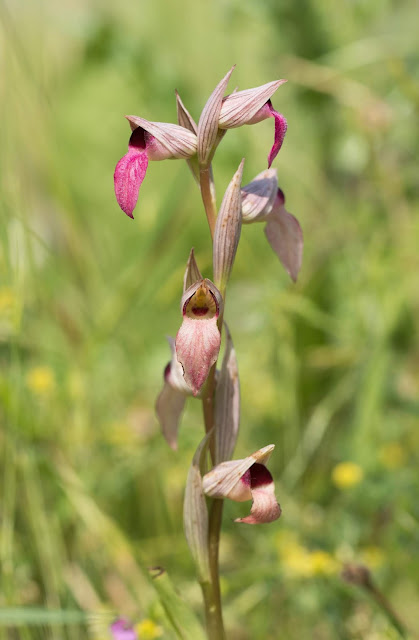
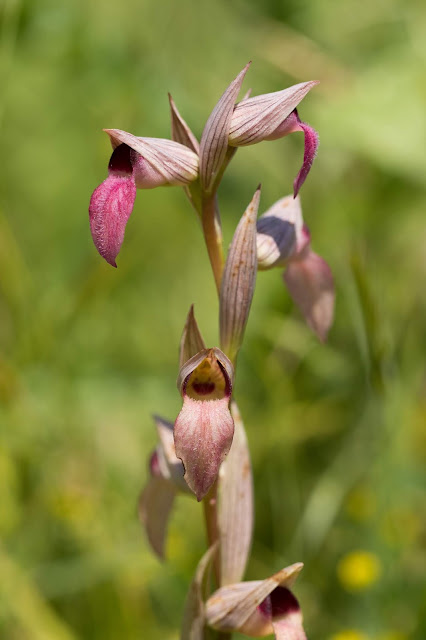
Greater Tongue Orchids - Tiptree, Essex!

When a colony of Greater Tongue Orchids was discovered in Essex during the summer of 2017, the race was on to track the plants down and establish whether they were naturally occurring or had arrived artificially. With just a single photo of several flowering spikes in a field to go on (which was hastily removed from the Facebook page to which it was posted) several of the orchid world's enthusiasts expertly narrowed down the location, and by carefully checking the vegetation on site to that in the photo, were remarkably able to pin down the exact spot where these exotic orchids were growing.
Greater Tongue Orchid - Tiptree, Essex
Sadly, by the time they were found all but a very small handful of the plants had completely gone over, and as such, arrangements were kindly made for a number of organised visits last summer so those interested could admire these Mediterranean beauties in all their glory.

Therefore, at the beginning of June last year, me and my Dad made the long journey down to Essex and were met on site by local resident Jonathan who showed us the exact location in the meadows where this small cluster of orchids were growing, thankfully in prime condition despite the scorching sun and allowing for excellent photographic opportunities (despite some tripod issues!).
Greater Tongue Orchid - Tiptree, Essex
v
Greater Tongue Orchid - Tiptree, Essex
With around 36 plants in flower last year, the number was slightly down on 2017's showing, but luckily each delicate maroon flowering spike was in top condition (I had actually been away in America the previous week so was a bit concerned the flowers may have been past their best by the time I got there) and the colony had been carefully marked out with several small canes to prevent trampling by unaware dog walkers.
Greater Tongue Orchid - Tiptree, Essex
However, despite the excitement of such a remarkable botanical find, the question remains: are the Tiptree Greater Tongue Orchids naturally occurring or did they arrive through artificial means?

With orchid seed being particularly fine and easily carried by the wind, there is of course every possibility that seed from the continent had blown over naturally, with the nearest populations occurring in France, Spain and Italy. However, a number of other circumstances need to be considered before determining whether these continental plants really did make it over here without a little bit of human help.

A single specimen could easily have been planted out by a keen botanist or gardener many years ago, reproducing year on year to result in the small colony seen now (the plants were all restricted to a tiny area about a metre squared in size and found nowhere else on the meadows as you would expect from plants in a natural continental setting). Likewise, seed blown artificially from plants growing in a pot in a nearby garden could have easily kick started a colony.

However, this would be an odd site for a deliberate planting, and no pot grown specimens are growing nearby to our knowledge - even if they were, the Greater Tongue Orchids natural pollinator is not known to occur in Britain, making seed set very unlikely without assistance. 

Upon talking to Jonathan, he explained that decades ago the meadows were used as strawberry fields alongside a plant nursery that amongst other things was known to grow tropical orchids. This therefore creates an entirely feasible scenario of Tongue Orchid seed being accidentally imported - getting in to the mix of soil, clippings and cuttings discarded on site and germinating, eventually becoming established and naturalised - in my opinion the most likely origin.
Greater Tongue Orchid - Tiptree, Essex
This is not the first occurrence of Greater Tongue Orchid in the UK however, with a small well-known colony of Greater Tongue Orchids situated at Wakehurst Place in Sussex alongside the introduced Loose-flowered Orchids (never proven but very unlikely to be of natural origin as a consequence). Three flower spikes were also discovered near to the coast in Kingsbridge, south Devon back in 1998, but once again, their origins were never proven - some suspecting seed had come from an artificial source such as a nearby plant collection or agricultural seed mix. 

Small-flowered Tongue Orchids have also previously gotten a very shallow toehold on British soil in the past with individuals cropping up near Rame Head in SE Cornwall, having first been discovered there in 1989, but sadly disappearing in the early 2000s. With seed suspected to have blown in from the continent as opposed to a deliberate planting due to the remote location, it's entirely probable these were the result of natural colonisation from across the channel.

It’s likely that we’ll never know for certain the origins of the Tiptree plants, but whatever their background, the Tongue Orchids have clearly been on site for a number of years now, vegetatively reproducing to increase in number each year and creating a naturalised and self-sustaining population in the process. 
Greater Tongue Orchids - Tiptree, Essex
The Tongue Orchids have reproduced vegetatively to cover a small patch of ground in the meadow
Greater Tongue Orchids - Tiptree, Essex
Spot the Tongue Orchid! The small patch where the orchids were growing
Unfortunately despite being the only known 'natural' colony in Britain, the Tiptree Tongue Orchids face an uncertain future, with developers knocking on the door eager to build on the site despite the protestations of residents and orchid enthusiasts alike. This year, due to the sensitivities of the site, visitors are also being asked to keep away. Hopefully some sort of compromise can be found, where the future of the orchids is secured and many more people can get to enjoy them for years to come - it would be a real shame indeed if these fascinating plants were to be lost almost as quickly as they were found.
Greater Tongue Orchid - Tiptree, Essex
Greater Tongue Orchids - Tiptree, Essex
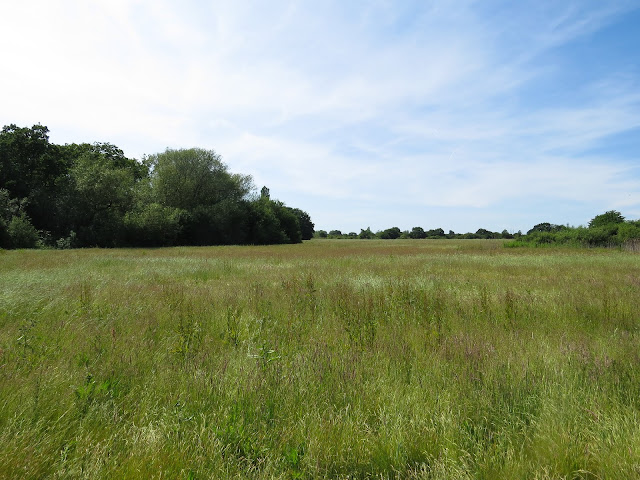
Greater Tongue Orchid Meadow - Tiptree, Essex
The meadow in Tiptree, Essex where the Greater Tongue Orchids were found