A tale of nature, wildlife and birding from Cheshire, North Wales and across the globe....

A tale of nature, wildlife and birding from Cheshire, North Wales and across the globe....

Monday, 13 July 2015

Black Hairstreaks in Oxfordshire!

Whilst visiting the Red Helleborine in Buckinghamshire, the warden informed me of a nearby colony of Black Hairstreaks, a species of butterfly I had yet to see and one which has a stronghold down in the Chilterns. With numerous individuals often found at Whitecross Green Woods in Oxfordshire and armed with instructions as to their favourite haunts on the reserve, we headed off to try and catch up with this rarest of hairstreaks. With an exceptionally short flight season consisting of the last two weeks in June and the first week in July, we were nearing the end of when they would be active, but I was still hopeful that we would be able to spot some individuals, with the butterfly having apparently had a good year in 2015.

The weather wasn’t perfect - overcast with a slight breeze - although this can often work favourably whilst searching for hairstreaks, which venture lower down in these types of conditions and can often be found sheltering at eye level as opposed to fluttering manically in the treetops.

Despite the clouds, the reserve was absolutely alive with butterflies - Meadow Browns and Ringlets darted through the grass whilst Small and Large Skippers buzzed from flower to flower. Stalking the Blackthorn bushes along the edge of the main ride however revealed nothing apart from several bees taking advantage of a clear glut of nectar. I was determined there must be a Black Hairstreak still active in amongst the Blackthorn bushes so headed back, keeping a sharp look out for any movement.

Focusing on a low down branch I spotted a shade of brown – and sure enough upon looking closer, there as clear as day and sat perfectly on a leaf was a pristine Black Hairstreak, completely in the open and almost waiting to be found.
Black Hairstreak - Whitecross Green Woods, Oxfordshire
Very similar to White-letter Hairstreaks, Black Hairstreaks can be told apart by the row of distinctive black spots running along the inside of the orange band on the underside of the hindwing, which are absent in White-letter Hairstreaks. The White-letter Hairstreaks also have a more prominent white line on the hindwing which forms the letter ‘W’, and this is far less pronounced in Black Hairstreaks where the line is relatively straight. In flight and darting around the treetops however, it is nearly impossible to separate the two, so I was extremely glad our butterfly was settled and still.
Black Hairstreak - Whitecross Green Woods, Oxfordshire
One of our rarest species of butterfly, Black Hairstreaks have a very restricted distribution, occurring only in a corridor running from Oxfordshire to Cambridgeshire. Whilst the population is currently stable, the future of this fragile butterfly undoubtedly lies in appropriate habitat management and protection which will ensure its ongoing survival.

Watching my prized find and calling others who were searching over, their movement sadly flushed it from its resting spot. Thankfully it only fluttered a few metres away to the next tree, and posing with the classic position of the wings closed, we watched as it slowly turned, angling its wings towards the sun to make the most of the warmth.
Black Hairstreak - Whitecross Green Woods, Oxfordshire
Eventually, the Hairstreak tired of our attention and fluttered gracefully over the leaves, spiralling higher up before eventually becoming lost in the tangle of Blackthorn.

An abundance of Marbled Whites proved to be another attraction at this reserve, flitting amongst the purple flowerheads and jostling for position over the best spikes. With no Marbled Whites in Cheshire, this is a butterfly I rarely get to see often, so I relished the opportunity to observe them in such large numbers. Having a tendency to fly strongly and constantly move whilst nectaring, I always find them a difficult subject photographic wise, so spent a good while getting up close to them – one even landed on my shoe!
Marbled White - Whitecross Green Woods, Oxfordshire
The Chilterns really is one of my favourite places, and the beautiful purring of a Turtle Dove drifting on the breeze was a perfect soundtrack to the afternoon. It wasn’t long before one burst through the trees and flew swiftly overhead, the diagnostic diamond shaped black tail clear to see before it landed on a nearby wire to put on a fantastic show as it purred happily above our heads. 
Turtle Dove - Oxfordshire
It’s really sad to think that this once abundant farmland dove is in such a steep decline (up to 96% in some areas - making it one of the fastest declining British birds) and that one day we might sadly lose this enigmatic summer visitor from our shores entirely.
Turtle Dove - Oxfordshire
A successful trip with Red Helleborines and Black Hairstreak the stars of the show, it was a fantastic way to spend the day in a truly beautiful area and a day-off from work well spent! 

Thursday, 9 July 2015

Little Bittern at Old Moor RSPB - Yorkshire

With a Little Bittern being present at Old Moor RSPB reserve in Yorkshire since the Tuesday and having missed the Elton Reservoir bird last May through being away in Ireland, I was quite keen to see this dainty Heron in the UK. Proving to be quite elusive during its stay with sightings usually the most frequent in the early morning, it wasn’t until the weekend that we could really do anything about it.

With some birders dipping on multiple occasions and others having put in hard slogs of 30 hours or more before a sighting, I was slightly apprehensive when there had been no sign on the Friday since around 10:45am. However, after an early start involving loose horses and driving in heavy fog, we arrived at the reserve in good time and were thankfully met with the news on RBA that the Little Bittern had been seen again that morning perched in a tree in front of Bittern Hide.
Old Moor RSPB, Yorkshire
The view from Bittern hide
Old Moor RSPB, Yorkshire
With the majority of sightings coming from the aptly named ‘Bittern hide’ and the nearby Reedbed screen, we arrived at the hide in good time just before half 8. With the Little Bittern favouring that section of reeds, it was now just a matter of waiting….

With several birders having walkie-talkies and being spread out over the area, updates came through that the bird was calling from a patch of reeds in front of the trees, but just wasn’t visible. Our luck was in however, as around 15 minutes later the shout went up that it was flying. It really was a “blink and you’ll miss it” kind of moment, and for the first 5 seconds I just couldn’t spot the bird. Apparently heading right over the reedbed and panicking slightly that it would dip behind the reeds and out of sight, I thankfully managed to pick it up as it flew behind a blue metal pump, surprisingly owl-like when flying and the contrasting cream and black wings now standing out even at a distance.

I watched it bank around over the reeds before it dipped below behind the trees and was lost to view. Incredible! Extremely glad we’d both managed to get on it and thankful that we wouldn’t have to sit in the hide for several more hours (memories of the Little Crake still haunt me!) although distant, we were both satisfied with our views, having seen Little Bitterns showing well in the reeds at close quarters in Spain before.
Little Bittern - Spain
My dodgy Spanish Little Bittern Record shot!
Little Bittern - Spain
Little Bittern in Spain -  A much better photo by Alex Jones
The rain and mist gradually worsened, and happy with our flight views we headed off to explore the rest of the reserve. A Black-necked Grebe was new in for the day, most probably moved on from its previous haunt by the overnight flooding, and that along with an unseasonal Goldeneye were the highlights. A smart Green Sandpiper made for a nice distraction after the American Wigeon at Wath Ings hide decided not to play ball - disappearing off in to the willows for the entire duration we were there -only coming out and showing well an hour after we had left. Still I’d glad it was the American Wigeon that gave us the run around as opposed to the Little Bittern (like has happened to many birders that have tried to connect!)
Green Sandpiper - RSPB Old Moore, Yorkshire
Old Moor RSPB, Yorkshire
With Little Bitterns already breeding at Ham Wall RSPB in Somerset over the past few years, and with several records already this year of this tiny Mediterranean Heron, it is only a matter of time before they become much more frequent in the UK. With plenty of suitable reedbed habitat just waiting to be colonised, it would be great to have them as a much more regular breeder in Britain - following the successful movement north of both Little and Great White Egrets. With Purple Herons, Night Herons and even Squaccos seen much more frequently, it is great to see these rare herons expanding in range and becoming a more familiar sight on our shores. 

Wednesday, 8 July 2015

Gull-billed Tern at Burton Mere RSPB, Cheshire

It’s not often that an alert pops up informing me of a bird just half an hour before I’m due to finish work (it’s usually mid-morning, meaning I then have to endure the rest of the day wondering if it will stick around!) so it was a nice change when ‘Gull-billed Tern’ popped up on my phone at half 3 on the Friday afternoon. It was an even nicer change to then see that it was local – being just under an hour away at Burton Mere RSPB.

A quick phone call home and we were soon well on our way, and although the bird had made a brief visit to reception pool, it now seemed quite settled on the pool in front of the Inner Marsh Farm hide - those leaving and on their way back all informing me it was happily roosting on the island.

On entering the hide the tern wasn’t immediately apparent, nestled amongst the Black-headed Gulls and facing away from the crowd with its back to us. However, it soon moved its head and the chunky black bill was instantly noticeable, much shorter and thicker than that of a Sandwich Tern and lacking the yellow tip, while the long wings projected well beyond the tail.
Gull-billed Tern, Burton Mere - Cheshire
Gull-billed Tern, Burton Mere RSPB - Cheshire
The long wings were really apparent
After watching it for around ten minutes, my dad finally entered the hide – just as the tern had took off and was swiftly flying past the window and away from the pool! In a mad scramble to the window I managed to get him on it as the bird made a speedy exit – highlighting just how every second really can count and can ultimately make the difference on whether you see a bird or dip a bird on a twitch!
Gull-billed Tern, Burton Mere - Cheshire
Luckily, the tern flew back in ten minutes later, giving great views of the wings as it flew past and clearly showing the diagnostic thick black bar on the trailing edge of the wings (which is not present on Sandwich Terns).
Gull-billed Tern, Burton Mere - Cheshire
Breeding in Southern Europe, Gull-billed Tern was actually my number one target on my world list on BUBO, and after not seeing any in Spain on our visits last year and not being able to catch up with the recent Yorkshire bird, it was great to finally see this rare visitor – made even better that it was totally unexpected and out of the blue!

With a bird seen at Ynys-hir RSPB the day before, and a bird at the Hayle Estuary in Cornwall on Wednesday, it is highly likely that this individual has been following the coast around. Departing from Burton Mere at 8:40pm on the Friday evening when it flew off towards the estuary and with no sign since, it is anyone’s guess as to where it will turn up next!
Gull-billed Tern Map - early July
Gull-billed Tern sightings over the three days - a route along the coast is clear to see
5 beautiful summer plumaged Spotted Redshank were a nice bonus at Reception Hide, and with their jet black colours and star spangled white flecks, they are without doubt one of my favourite wader species and definitely deserved of a mention.

Remarkably, a second rare tern appeared locally at the weekend in the form of a White-winged Black Tern at Leighton Moss RSPB in Lancashire. Even though I caught up with the bird at Cemlyn Bay in Anglesey last year, me and Alex decided to take my mum up to Leighton Moss to see the individual that had been present there for two days.
White-winged Black Tern - Leighton Moss, Lancashire
Arriving at the reserve, we entered Lower Hide to find this stunning Eastern European visitor hawking over the pool for insects, flashing its gorgeous white and black wings for us all to admire – truly a beautiful sight. Often perching on the posts submerged in the water, we got great views of this fantastic bird – it’s always worth making the effort when such stunning individuals turn up locally.
White-winged Black Tern - Leighton Moss, Lancashire
Record shots of the wings in all their glory
White-winged Black Tern - Leighton Moss, Lancashire
A Great White Egret, Marsh Tit, a pair of Garganey and 4 Marsh Harriers (including witnessing the spectacle of a food pass between the male and a female) completed the day, and a special thanks to Alex for driving us up there.

Saturday, 4 July 2015

Southern Spain Trip Report (12th August-17th August 2014) - Species List and Locations


Day 1 – Malaga to Alcaidesa

Pallid Swift – 12th August - Route from Malaga to Jimena de la Frontera off the A-2100 near Castellar de la Frontera, Cadiz. (Large flock flying in the valley by the side of the road)

Alpine Swift – 12th August - Route from Malaga to Jimena de la Frontera off the A-2100 near Castellar de la Frontera, Cadiz. (One flying over the valley by the side of the road amongst the Pallid Swifts and another seen later on Gibraltar)

White-rumped Swift – 12th August - Alcaidesa, near San Roque, Cadiz. (One flying with large swift flock over the roads, showing exceptionally well)

Alcaidesa


Day 2 – Gibraltar

Audouin’s Gull – 13th August - Europa Point, Gibraltar (Several flying over the lighthouse)


Gibraltar


Day 3 – Tarifa and Las Mesas de Chullera

Iberian Chiffchaff 14th August - Woodland near Tarifa, Cadiz (Two showing very well in the trees next to the path)

Western Olivaceous Warbler 14th August - Woodland near Tarifa, Cadiz (Showing very well in the trees next to the path. Another at Laguna de Fuente de Piedra)

Kentish Plover 14th August - Playa de los Lances, near Tarifa, Cadiz (Several on the beach and dune pools)

Short-toed Lark 14th August - Playa de los Lances, near Tarifa, Cadiz (One on the fields next to the beach)

Red-necked Nightjar – 14th August - Site near Manilva (One fly-by and an individual showing very well sitting on the dirt track and flying in to near-by scrub, illuminated by the car headlights)


Kentish Plover - Spain
Photo by Alex Jones


Day 4 – Alcaidesa to Jerez

White-headed Duck – 15th August - Bonanza Pools, near Bonanza, Cadiz (Several birds on pool 2 next to the road)

Purple Swamphen 15th August - Bonanza Pools, near Bonanza, Cadiz (Two individuals near the reeds at the edge of pools 2 and 3)

Little Bittern 15th August - Bonanza Pools, near Bonanza, Cadiz (One individual in the reeds surrounding pool 2)

Slender-billed Gull 15th August - Bonanza Salt Pans, near Bonanza, Cadiz (Several birds on the pools)

Common Waxbill – 15th August - Laguna de Tarelo, near Bonanza, Cadiz (Small flock in the conifer trees leading up to the pool)

Marbled Duck 15th August - Laguna de Tarelo, near Bonanza, Cadiz (Several at the back of the pool, though distant)

Whiskered Tern 15th August - Laguna de Tarelo, near Bonanza, Cadiz (One flying round the pool)


White-headed Ducks - Spain


Day 6 – Sevilla to Malaga

Lesser Flamingo – 17th August - Laguna de Fuente de Piedra, near Fuente de Piedra. On the route back from Sevilla to Malaga. (Three individuals seen within the Greater Flamingo flock, showing well)

Lesser Flamingo - Spain


Also of note: Two Gibraltar Buzzards seen (hybrid Common Buzzard x Long-legged Buzzard) One seen at Lagunas de Espera, near Espera, Cadiz on the 16th August, with another seen off the small tracks by the SE-715, near Osuna, Sevilla on the 17th August.


Additional birds:

Mallard
Gadwall
Shoveler*
Pochard*
Red-crested Pochard*
Ferruginous Duck*
Red-legged Partridge
Black-necked Grebe
Little Grebe
Great Crested Grebe
Night Heron
Cattle Egret
Squacco Heron
Little Egret
Grey Heron
White Stork
Glossy Ibis
Greater Flamingo
Cormorant
Griffon Vulture
Short-toed Eagle
Booted Eagle
Red Kite*
Black Kite
Marsh Harrier
Montagu’s Harrier
Common Buzzard
Honey Buzzard
Kestrel
Moorhen
Coot
Avocet
Black-winged Stilt
Little Ringed Plover
Ringed Plover
Grey Plover
Sanderling
Turnstone
Dunlin
Little Stint
Green Sandpiper
Common Sandpiper
Redshank
Spotted Redshank
Black-tailed Godwit
Whimbrel
Black-headed Gull
Yellow-legged Gull
Lesser Black-backed Gull
Little Tern
Caspian Tern
Feral Pigeon
Wood Pigeon
Collared Dove
Turtle Dove
Common Swift
Little Swift
Hoopoe
Kingfisher
Bee-eater
Roller
Crested Lark
Thekla Lark
Lesser short-toed Lark
Sand Martin
Crag Martin
Barn Swallow
Red-rumped Swallow
House Martin
Pied Wagtail
Yellow Wagtail
Grey Wagtail
Nightingale*
Stonechat
Blackbird
Blackcap
Sardinian Warbler
Subalpine Warbler
Fan-tailed Warbler
Cetti’s Warbler*
Reed Warbler
Western Bonelli’s Warbler
Spotted Flycatcher
Great Tit
Blue Tit
Penduline Tit
Woodchat Shrike
Jackdaw
Raven
Spotless Starling
Golden Oriole*
House Sparrow
Tree Sparrow
Chaffinch
Linnet
Goldfinch
Greenfinch
Serin
Corn Bunting
Monk Parakeet

(* birds not seen by myself)

Birds that were heard only:

Robin
Wren
Dartford Warbler
Woodlark

Friday, 3 July 2015

Southern Spain Trip Report - Day 6

Day 6 - Sunday 17th August 2015


Our final full day was upon us, and with no further sites for Red-knobbed Coots on our journey back down to Malaga, we decided to check out the fields and towns near Osuna on the off chance any Bustards would be present. Checking several Sparrow flocks for any Spanish Sparrows sadly drew a blank, and every single Kestrel we encountered was frustratingly a female! There had been several reports of Lesser Kestrels near Osuna, where after a while we eventually encountered a male Kestrel perched on a pole – could this be my much sought after Lesser?!
Common Kestrel - Spain
Photo by Alex Jones
With Chris initially identifying the bird as a Lesser Kestrel, happiness soon turned to disappointment after a closer look at Alex’s record shots revealed a speckled front and back! As the bird flew off this became much more obvious – it was another Common Kestrel.

A fantastic pair of Montagu's Harriers flying overhead provided spectacular views of these amazing raptors - their thin wings clear to see against the brilliant blue sky, whilst a juvenile Woodchat Shrike proved to be very showy in a nearby shrub. 

Montagu's Harrier - Spain
Juvenile Woodchat Shrike - Photo by Alex Jones
Sadly (though not unexpectedly) no Bustards were present in any of the fields (this was a wintering site more than anything) and the only other bird of note was incredibly a second Gibraltar Buzzard (Chris’s words on spotting it were “Oh no not again…”)

Our final stop of the trip was to the Laguna de Fuente di Piedra to try and locate the Lesser Flamingos that were reported from the site during the summer. Extremely rare in Europe and originating from Africa, several individuals have been joining the breeding flocks of Greater Flamingos at Laguna de Fuente di Piedra over the years, and are deemed to be of wild origin having joined up with migrating flocks of Greater Flamingos.

We arrived at the visitor centre and proceeded on to the reserve, where before long the huge pool full of Greater Flamingos came in to view – hundreds of birds feeding as one in a massive flock. With any of the much smaller Lesser Flamingos impossible to distinguish from the larger birds at this distance, we headed closer to gain a better vantage point, Chris and Alex setting up their scopes whilst I scanned though my binoculars.
Laguna de Fuente di Piedra
Photo by Alex Jones
Knowing what I was looking for, but expecting a long hard slog of trawling though every individual bird (my task made even harder through the lack of a scope) I was therefore astounded when as soon as I raised my bins to my eyes to begin checking, miraculously one of the first birds I set eyes on was a Lesser Flamingo!!
Lesser Flamingo - Spain
Excitedly getting Chris and Alex’s scopes on the bird in question, the three of us took in the differences between this smaller species of Flamingo. Almost half the size of the Greaters, with much shorter legs and a smaller body and neck, the facial pattern was also distinctive, with a much darker eye and a deeper dark red and black bill.
Lesser Flamingo - Spain
The smaller size is really apparent!
Scanning further, we spotted another two birds mixed in with the flock, indicating that there were at least 3 present on the pool, and they came ever closer to the side allowing some great record shots.
Lesser Flamingo - Spain
Lesser Flamingo - Photo by Alex Jones
With the afternoon pressing on, we headed back to the car, stopping to admire a nice Western Olivaceous Warbler (only the second of our trip) showing well by the side of the pool and feasting on a large dragonfly.
Western Olivaceous Warbler - Spain
Arriving in Malaga we were greeted by absolutely thousands of people –apparently a week-long festival called the Malaga Fair was in full swing - and the streets were absolutely packed with people which resulted in utter chaos when trying to find our hotel. Managing to eventually find somewhere safe to park, we were then faced with a simple ten minute walk to the hotel turning in to an hour long struggle through the streets as we heaved our suitcases through the bodies and past discarded drinks, litter and I dread to think what else. After what can only be described as a complete nightmare, we eventually found our apartment – when we were then faced with a half hour wait for the owner to arrive from across the other side of the city! Never again!

After the streets calmed down slightly in the evening, we thankfully enjoyed a nice final night’s dinner of paella in the restaurant opposite to celebrate the end of our trip.
Paella
Our final day approached and with several hours before our flight back to Manchester we enjoyed a nice leisurely visit to the beach on Malaga seafront for some ice cream and cool pineapple juice (my staple drink in Spain). Several Monk Parakeets perched in the palm trees above and the area was thankfully 1000 times quieter than the chaos of the night before!
Malaga Beach
Having achieved several of our main target species (even the outside chance Lesser Flamingo) with White-tailed Swift, Red-necked Nightjar, White-headed Duck and Marbled Teal all seen, we had missed just the elusive Red-knobbed Coots – clearly one for another trip! Thanks to Alex for doing the majority of the driving during the week, and with some great scenery, food and fantastic company throughout, we had enjoyed what was a hugely successful and entertaining trip exploring Southern Spain. 
Southern Spain

Southern Spain Trip Report - Day 5

Day 5 - Saturday 16th August 2015


The next day dawned as scorching as ever, and we started off on our quest for Red-knobbed Coots – our main target for the day. Laguna de Medina, once a stronghold for this species, unfortunately turned up nothing despite the abundance of Common Coots, with several hundred birds present on the large lake. A close Little Bittern was great to see, offering much less obscured views than our first bird at Bonanza Pools, whilst a Purple Swamphen in the reeds to the left of the hide was another bonus. Several newly fledged Penduline Tits danced their way across the bulrushes in front of the hide, but with the heat now reaching even greater heights, we moved on to our next site of Lagunas de Espera hoping for some better luck.
Little Bittern - Photo by Alex Jones
Penduline Tit - Photo by Alex Jones
The sun was now absolutely stifling and vast becoming unbearable, so I was extremely grateful for the small amount of shade offered by the welcome building (which unfortunately was closed). The first pool was disappointingly nearly bone dry with no sign of any Red-knobbed Coots inhabiting it, although a low flying Griffon Vulture flying at eye level just a metre or so in front of us was absolutely breath-taking, the sheer size of these magnificent birds never more apparent as it landed on the swaying branch of a nearby tree with a crash.

Ever the observant, Chris then announced he had an odd looking raptor in the scope, and aligning Alex’s to get the bird in view I was met by a large Buzzard species. With Chris having experience of African and European birding he was strongly reminded of Long-legged Buzzard, although checking my Collins guide I wasn’t convinced – something just wasn’t right plumage wise. As the bird circled closer and with scopes still trained, we watched as incredibly it came lower before landing in a bush on the opposite hill. Alex had managed to reel of some distant record shots, and we piled back in to the car and drove up to where the bird had landed in the middle of one of the barren fields. The heat haze made viewing exceptionally difficult, and with me staying in the car and taking more photos, Alex and Chris approached closer to get more details on the plumage through the scopes.
Gibraltar Buzzard - Spain
With Alex and Chris approaching the small shrub, I watched as the bird arose and managed a number of snaps, which along with Alex’s from earlier gave us a great range of plumage details from the bird in a variety of positions.
Gibraltar Buzzard - Spain
My field notes from the time: Prominent white patch on the back of the head, dark black tail, black tips to the wings, long, yellow legs, white underneath wings, buzzard like in pattern, black carpal patches on wings.
Gibraltar Buzzard - Spain
Carefully analysing what we had obtained, we were still very much in the dark. Chris was still certain we had a Long-legged Buzzard, while the white markings on the back had me thinking there may have been some Bonelli’s Eagle influence. The face however was distinctly buzzard like, as were the underwings, and we were still none the wiser as to the identity of our mystery bird.

Getting back to the UK I did some research to try and solve the mystery, and came across an interesting paper detailing the emergence of Gibraltar Buzzards – a hybrid between Common Buzzards and Atlas Long-legged Buzzards (the paper in question). First originating near Gibraltar where naturally the two species have the highest chance of meeting, these hybrids have now spread over Southern Spain, even as far north as Seville. With Long-legged Buzzards only very rarely recorded in Spain, it was highly unlikely that we would encounter two on our journey (we spotted a second individual near Osuna a day later). This coupled with the highly irregular plumage details we encountered meant that the birds were most probably “Gibraltar Buzzards” – unfortunately hybrids and not a true species in their own right.

With the afternoon pressing on, we continued down the track to a small parking area, before heading out on foot to the second and third pools at Laguna de Espera, hoping Red-knobbed Coots could be found on at least one! The heat was now completely unbearable, and having drank all my juice supplies I was without a source of hydration – not a good mix! Having made it to the first hide and despite it being well covered, for some reason the birds all inexplicably flushed! An otter seen later running across the track may have been the culprit, but we now had an even trickier task as the birds were much further away.
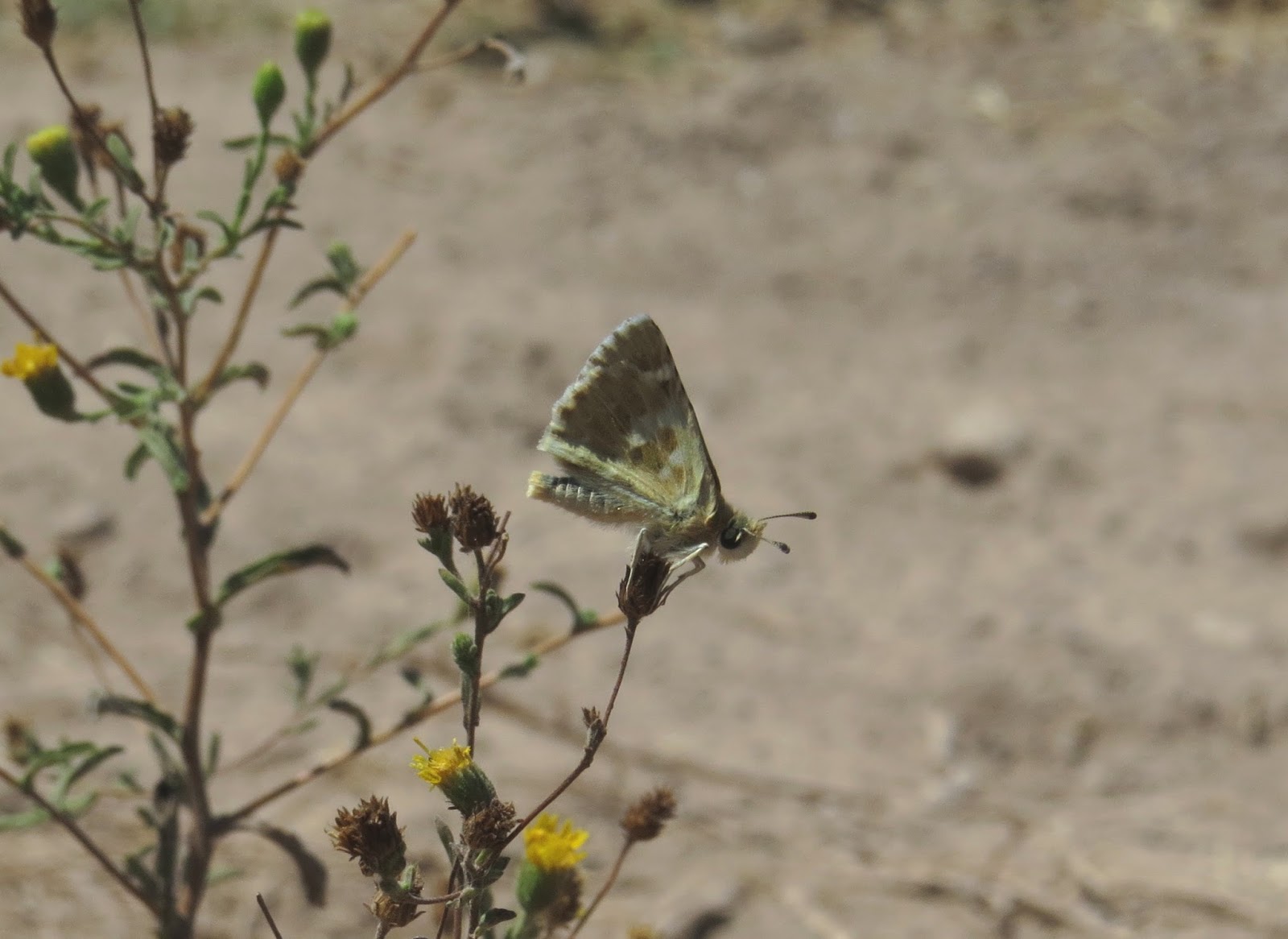
Sage Skipper - Photo by Alex Jones
Alex had a pair of Ferruginous Ducks in flight, whilst Red-crested Pochard, Mallards, Shovelers and Gadwall were all present. With the huge distance between us and the birds it was going to prove exceptionally hard to pick out any Red-knobbed Coots, so we headed on to the third lagoon. This proved to be some distance away, and when we reached a fork in the path the heat just proved too much. Telling Alex and Chris to go on ahead and that I’d stay under the shade of a tree, they weren’t having any of it, and we thankfully headed back to the car as a team, stopping at regular intervals in the shade to stop any dehydration setting in. Thanks to both of them for looking after me and making sure I was ok!

With the heat still scorching hot and not abating in the slightest, we headed to our penultimate night’s stay in the beautiful city of Seville, (where our hotel had keys replaced with James Bond style fingerprint scanners!) and we enjoyed a delicious dinner of tapas after taking in the sights. 
Fingerprint door opener!


Seville