A tale of nature, wildlife and birding from Cheshire, North Wales and across the globe....

A tale of nature, wildlife and birding from Cheshire, North Wales and across the globe....
Showing posts with label European Birding. Show all posts

Saturday, 4 July 2015

Southern Spain Trip Report (12th August-17th August 2014) - Species List and Locations


Day 1 – Malaga to Alcaidesa

Pallid Swift – 12th August - Route from Malaga to Jimena de la Frontera off the A-2100 near Castellar de la Frontera, Cadiz. (Large flock flying in the valley by the side of the road)

Alpine Swift – 12th August - Route from Malaga to Jimena de la Frontera off the A-2100 near Castellar de la Frontera, Cadiz. (One flying over the valley by the side of the road amongst the Pallid Swifts and another seen later on Gibraltar)

White-rumped Swift – 12th August - Alcaidesa, near San Roque, Cadiz. (One flying with large swift flock over the roads, showing exceptionally well)

Alcaidesa


Day 2 – Gibraltar

Audouin’s Gull – 13th August - Europa Point, Gibraltar (Several flying over the lighthouse)


Gibraltar


Day 3 – Tarifa and Las Mesas de Chullera

Iberian Chiffchaff 14th August - Woodland near Tarifa, Cadiz (Two showing very well in the trees next to the path)

Western Olivaceous Warbler 14th August - Woodland near Tarifa, Cadiz (Showing very well in the trees next to the path. Another at Laguna de Fuente de Piedra)

Kentish Plover 14th August - Playa de los Lances, near Tarifa, Cadiz (Several on the beach and dune pools)

Short-toed Lark 14th August - Playa de los Lances, near Tarifa, Cadiz (One on the fields next to the beach)

Red-necked Nightjar – 14th August - Site near Manilva (One fly-by and an individual showing very well sitting on the dirt track and flying in to near-by scrub, illuminated by the car headlights)


Kentish Plover - Spain
Photo by Alex Jones


Day 4 – Alcaidesa to Jerez

White-headed Duck – 15th August - Bonanza Pools, near Bonanza, Cadiz (Several birds on pool 2 next to the road)

Purple Swamphen 15th August - Bonanza Pools, near Bonanza, Cadiz (Two individuals near the reeds at the edge of pools 2 and 3)

Little Bittern 15th August - Bonanza Pools, near Bonanza, Cadiz (One individual in the reeds surrounding pool 2)

Slender-billed Gull 15th August - Bonanza Salt Pans, near Bonanza, Cadiz (Several birds on the pools)

Common Waxbill – 15th August - Laguna de Tarelo, near Bonanza, Cadiz (Small flock in the conifer trees leading up to the pool)

Marbled Duck 15th August - Laguna de Tarelo, near Bonanza, Cadiz (Several at the back of the pool, though distant)

Whiskered Tern 15th August - Laguna de Tarelo, near Bonanza, Cadiz (One flying round the pool)


White-headed Ducks - Spain


Day 6 – Sevilla to Malaga

Lesser Flamingo – 17th August - Laguna de Fuente de Piedra, near Fuente de Piedra. On the route back from Sevilla to Malaga. (Three individuals seen within the Greater Flamingo flock, showing well)

Lesser Flamingo - Spain


Also of note: Two Gibraltar Buzzards seen (hybrid Common Buzzard x Long-legged Buzzard) One seen at Lagunas de Espera, near Espera, Cadiz on the 16th August, with another seen off the small tracks by the SE-715, near Osuna, Sevilla on the 17th August.


Additional birds:

Mallard
Gadwall
Shoveler*
Pochard*
Red-crested Pochard*
Ferruginous Duck*
Red-legged Partridge
Black-necked Grebe
Little Grebe
Great Crested Grebe
Night Heron
Cattle Egret
Squacco Heron
Little Egret
Grey Heron
White Stork
Glossy Ibis
Greater Flamingo
Cormorant
Griffon Vulture
Short-toed Eagle
Booted Eagle
Red Kite*
Black Kite
Marsh Harrier
Montagu’s Harrier
Common Buzzard
Honey Buzzard
Kestrel
Moorhen
Coot
Avocet
Black-winged Stilt
Little Ringed Plover
Ringed Plover
Grey Plover
Sanderling
Turnstone
Dunlin
Little Stint
Green Sandpiper
Common Sandpiper
Redshank
Spotted Redshank
Black-tailed Godwit
Whimbrel
Black-headed Gull
Yellow-legged Gull
Lesser Black-backed Gull
Little Tern
Caspian Tern
Feral Pigeon
Wood Pigeon
Collared Dove
Turtle Dove
Common Swift
Little Swift
Hoopoe
Kingfisher
Bee-eater
Roller
Crested Lark
Thekla Lark
Lesser short-toed Lark
Sand Martin
Crag Martin
Barn Swallow
Red-rumped Swallow
House Martin
Pied Wagtail
Yellow Wagtail
Grey Wagtail
Nightingale*
Stonechat
Blackbird
Blackcap
Sardinian Warbler
Subalpine Warbler
Fan-tailed Warbler
Cetti’s Warbler*
Reed Warbler
Western Bonelli’s Warbler
Spotted Flycatcher
Great Tit
Blue Tit
Penduline Tit
Woodchat Shrike
Jackdaw
Raven
Spotless Starling
Golden Oriole*
House Sparrow
Tree Sparrow
Chaffinch
Linnet
Goldfinch
Greenfinch
Serin
Corn Bunting
Monk Parakeet

(* birds not seen by myself)

Birds that were heard only:

Robin
Wren
Dartford Warbler
Woodlark

Friday, 3 July 2015

Southern Spain Trip Report - Day 6

Day 6 - Sunday 17th August 2015


Our final full day was upon us, and with no further sites for Red-knobbed Coots on our journey back down to Malaga, we decided to check out the fields and towns near Osuna on the off chance any Bustards would be present. Checking several Sparrow flocks for any Spanish Sparrows sadly drew a blank, and every single Kestrel we encountered was frustratingly a female! There had been several reports of Lesser Kestrels near Osuna, where after a while we eventually encountered a male Kestrel perched on a pole – could this be my much sought after Lesser?!
Common Kestrel - Spain
Photo by Alex Jones
With Chris initially identifying the bird as a Lesser Kestrel, happiness soon turned to disappointment after a closer look at Alex’s record shots revealed a speckled front and back! As the bird flew off this became much more obvious – it was another Common Kestrel.

A fantastic pair of Montagu's Harriers flying overhead provided spectacular views of these amazing raptors - their thin wings clear to see against the brilliant blue sky, whilst a juvenile Woodchat Shrike proved to be very showy in a nearby shrub. 

Montagu's Harrier - Spain
Juvenile Woodchat Shrike - Photo by Alex Jones
Sadly (though not unexpectedly) no Bustards were present in any of the fields (this was a wintering site more than anything) and the only other bird of note was incredibly a second Gibraltar Buzzard (Chris’s words on spotting it were “Oh no not again…”)

Our final stop of the trip was to the Laguna de Fuente di Piedra to try and locate the Lesser Flamingos that were reported from the site during the summer. Extremely rare in Europe and originating from Africa, several individuals have been joining the breeding flocks of Greater Flamingos at Laguna de Fuente di Piedra over the years, and are deemed to be of wild origin having joined up with migrating flocks of Greater Flamingos.

We arrived at the visitor centre and proceeded on to the reserve, where before long the huge pool full of Greater Flamingos came in to view – hundreds of birds feeding as one in a massive flock. With any of the much smaller Lesser Flamingos impossible to distinguish from the larger birds at this distance, we headed closer to gain a better vantage point, Chris and Alex setting up their scopes whilst I scanned though my binoculars.
Laguna de Fuente di Piedra
Photo by Alex Jones
Knowing what I was looking for, but expecting a long hard slog of trawling though every individual bird (my task made even harder through the lack of a scope) I was therefore astounded when as soon as I raised my bins to my eyes to begin checking, miraculously one of the first birds I set eyes on was a Lesser Flamingo!!
Lesser Flamingo - Spain
Excitedly getting Chris and Alex’s scopes on the bird in question, the three of us took in the differences between this smaller species of Flamingo. Almost half the size of the Greaters, with much shorter legs and a smaller body and neck, the facial pattern was also distinctive, with a much darker eye and a deeper dark red and black bill.
Lesser Flamingo - Spain
The smaller size is really apparent!
Scanning further, we spotted another two birds mixed in with the flock, indicating that there were at least 3 present on the pool, and they came ever closer to the side allowing some great record shots.
Lesser Flamingo - Spain
Lesser Flamingo - Photo by Alex Jones
With the afternoon pressing on, we headed back to the car, stopping to admire a nice Western Olivaceous Warbler (only the second of our trip) showing well by the side of the pool and feasting on a large dragonfly.
Western Olivaceous Warbler - Spain
Arriving in Malaga we were greeted by absolutely thousands of people –apparently a week-long festival called the Malaga Fair was in full swing - and the streets were absolutely packed with people which resulted in utter chaos when trying to find our hotel. Managing to eventually find somewhere safe to park, we were then faced with a simple ten minute walk to the hotel turning in to an hour long struggle through the streets as we heaved our suitcases through the bodies and past discarded drinks, litter and I dread to think what else. After what can only be described as a complete nightmare, we eventually found our apartment – when we were then faced with a half hour wait for the owner to arrive from across the other side of the city! Never again!

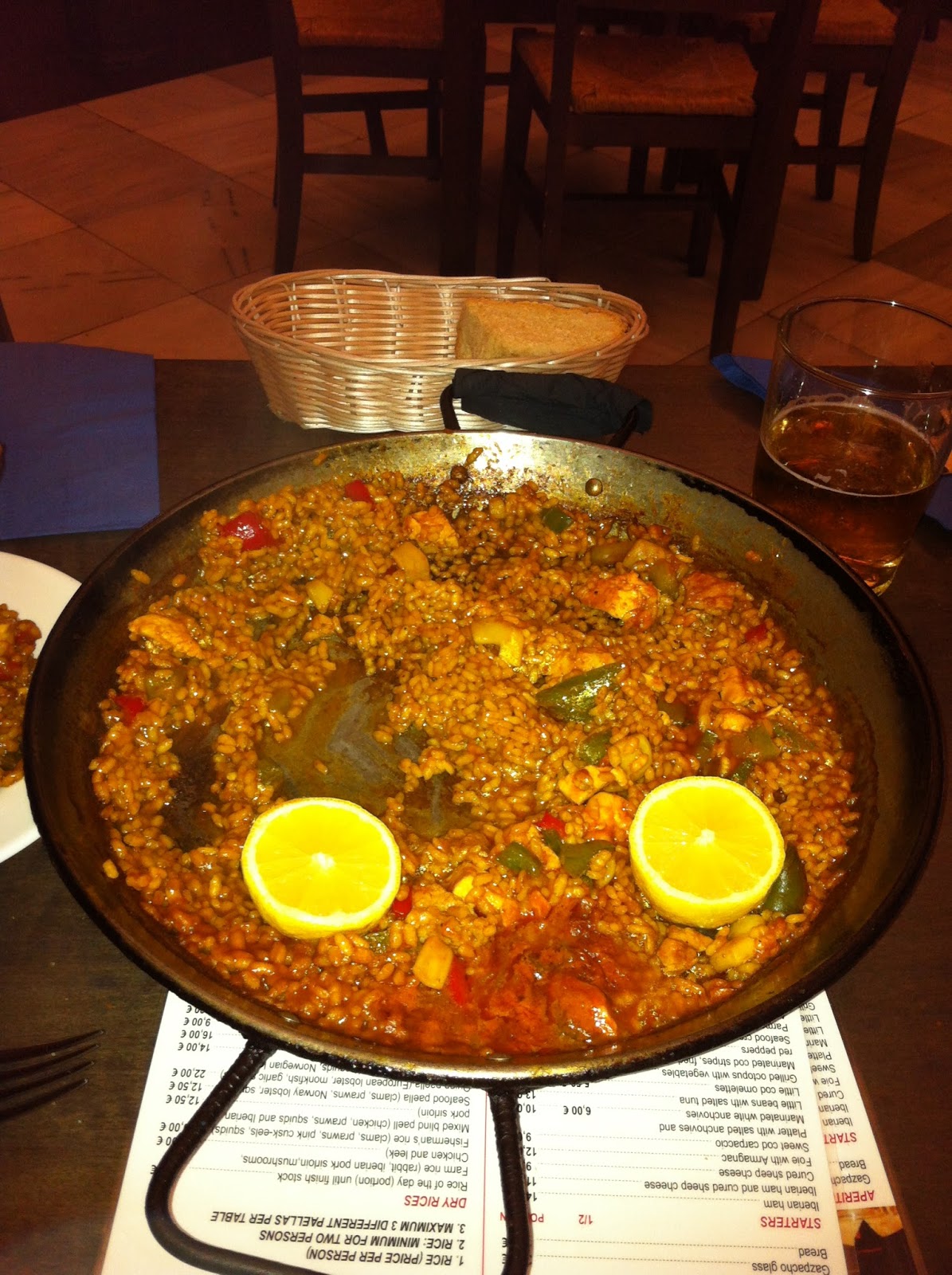
After the streets calmed down slightly in the evening, we thankfully enjoyed a nice final night’s dinner of paella in the restaurant opposite to celebrate the end of our trip.
Paella
Our final day approached and with several hours before our flight back to Manchester we enjoyed a nice leisurely visit to the beach on Malaga seafront for some ice cream and cool pineapple juice (my staple drink in Spain). Several Monk Parakeets perched in the palm trees above and the area was thankfully 1000 times quieter than the chaos of the night before!
Malaga Beach
Having achieved several of our main target species (even the outside chance Lesser Flamingo) with White-tailed Swift, Red-necked Nightjar, White-headed Duck and Marbled Teal all seen, we had missed just the elusive Red-knobbed Coots – clearly one for another trip! Thanks to Alex for doing the majority of the driving during the week, and with some great scenery, food and fantastic company throughout, we had enjoyed what was a hugely successful and entertaining trip exploring Southern Spain. 
Southern Spain

Southern Spain Trip Report - Day 5

Day 5 - Saturday 16th August 2015


The next day dawned as scorching as ever, and we started off on our quest for Red-knobbed Coots – our main target for the day. Laguna de Medina, once a stronghold for this species, unfortunately turned up nothing despite the abundance of Common Coots, with several hundred birds present on the large lake. A close Little Bittern was great to see, offering much less obscured views than our first bird at Bonanza Pools, whilst a Purple Swamphen in the reeds to the left of the hide was another bonus. Several newly fledged Penduline Tits danced their way across the bulrushes in front of the hide, but with the heat now reaching even greater heights, we moved on to our next site of Lagunas de Espera hoping for some better luck.
Little Bittern - Photo by Alex Jones
Penduline Tit - Photo by Alex Jones
The sun was now absolutely stifling and vast becoming unbearable, so I was extremely grateful for the small amount of shade offered by the welcome building (which unfortunately was closed). The first pool was disappointingly nearly bone dry with no sign of any Red-knobbed Coots inhabiting it, although a low flying Griffon Vulture flying at eye level just a metre or so in front of us was absolutely breath-taking, the sheer size of these magnificent birds never more apparent as it landed on the swaying branch of a nearby tree with a crash.

Ever the observant, Chris then announced he had an odd looking raptor in the scope, and aligning Alex’s to get the bird in view I was met by a large Buzzard species. With Chris having experience of African and European birding he was strongly reminded of Long-legged Buzzard, although checking my Collins guide I wasn’t convinced – something just wasn’t right plumage wise. As the bird circled closer and with scopes still trained, we watched as incredibly it came lower before landing in a bush on the opposite hill. Alex had managed to reel of some distant record shots, and we piled back in to the car and drove up to where the bird had landed in the middle of one of the barren fields. The heat haze made viewing exceptionally difficult, and with me staying in the car and taking more photos, Alex and Chris approached closer to get more details on the plumage through the scopes.
Gibraltar Buzzard - Spain
With Alex and Chris approaching the small shrub, I watched as the bird arose and managed a number of snaps, which along with Alex’s from earlier gave us a great range of plumage details from the bird in a variety of positions.
Gibraltar Buzzard - Spain
My field notes from the time: Prominent white patch on the back of the head, dark black tail, black tips to the wings, long, yellow legs, white underneath wings, buzzard like in pattern, black carpal patches on wings.
Gibraltar Buzzard - Spain
Carefully analysing what we had obtained, we were still very much in the dark. Chris was still certain we had a Long-legged Buzzard, while the white markings on the back had me thinking there may have been some Bonelli’s Eagle influence. The face however was distinctly buzzard like, as were the underwings, and we were still none the wiser as to the identity of our mystery bird.

Getting back to the UK I did some research to try and solve the mystery, and came across an interesting paper detailing the emergence of Gibraltar Buzzards – a hybrid between Common Buzzards and Atlas Long-legged Buzzards (the paper in question). First originating near Gibraltar where naturally the two species have the highest chance of meeting, these hybrids have now spread over Southern Spain, even as far north as Seville. With Long-legged Buzzards only very rarely recorded in Spain, it was highly unlikely that we would encounter two on our journey (we spotted a second individual near Osuna a day later). This coupled with the highly irregular plumage details we encountered meant that the birds were most probably “Gibraltar Buzzards” – unfortunately hybrids and not a true species in their own right.

With the afternoon pressing on, we continued down the track to a small parking area, before heading out on foot to the second and third pools at Laguna de Espera, hoping Red-knobbed Coots could be found on at least one! The heat was now completely unbearable, and having drank all my juice supplies I was without a source of hydration – not a good mix! Having made it to the first hide and despite it being well covered, for some reason the birds all inexplicably flushed! An otter seen later running across the track may have been the culprit, but we now had an even trickier task as the birds were much further away.
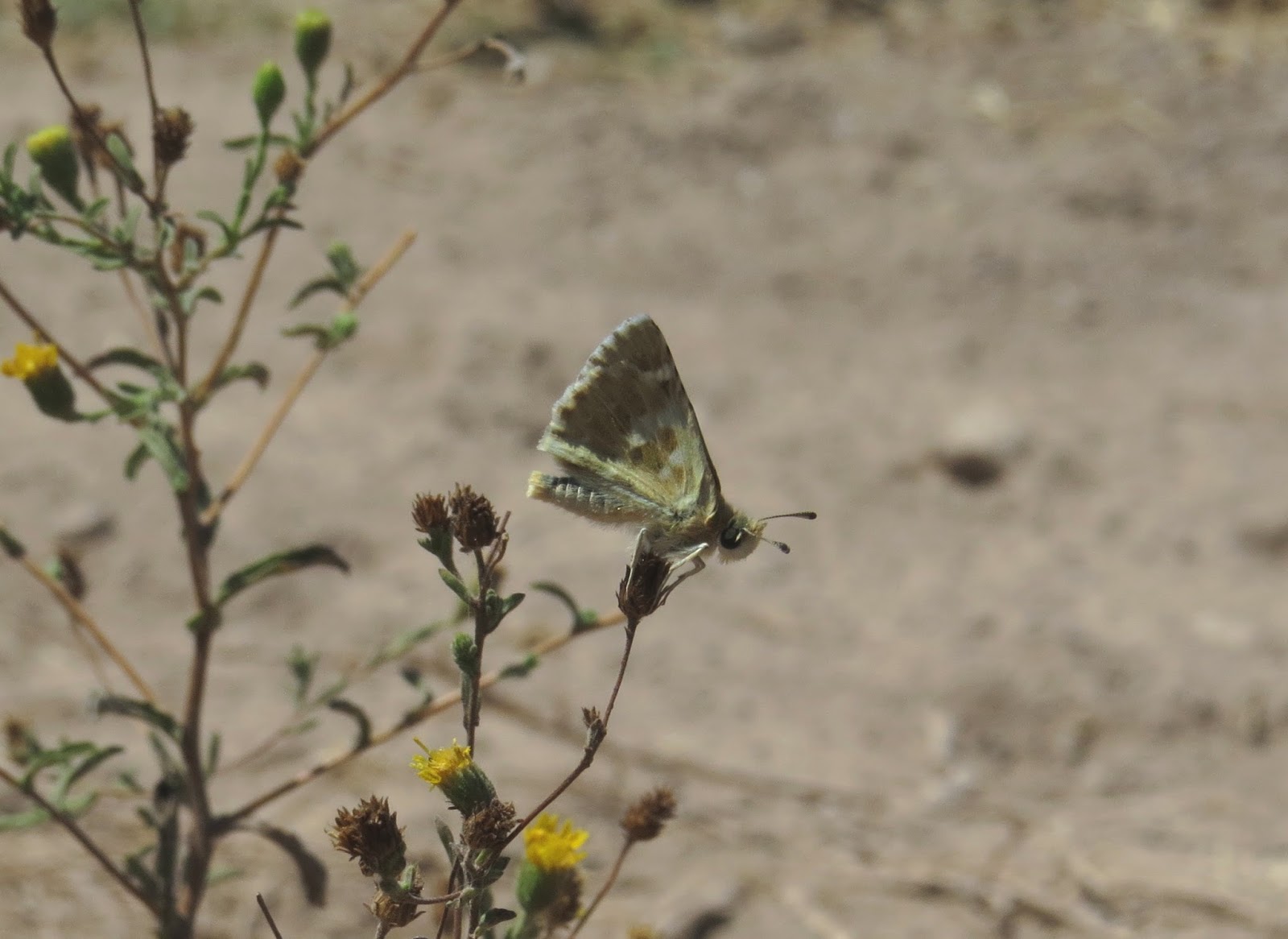
Sage Skipper - Photo by Alex Jones
Alex had a pair of Ferruginous Ducks in flight, whilst Red-crested Pochard, Mallards, Shovelers and Gadwall were all present. With the huge distance between us and the birds it was going to prove exceptionally hard to pick out any Red-knobbed Coots, so we headed on to the third lagoon. This proved to be some distance away, and when we reached a fork in the path the heat just proved too much. Telling Alex and Chris to go on ahead and that I’d stay under the shade of a tree, they weren’t having any of it, and we thankfully headed back to the car as a team, stopping at regular intervals in the shade to stop any dehydration setting in. Thanks to both of them for looking after me and making sure I was ok!

With the heat still scorching hot and not abating in the slightest, we headed to our penultimate night’s stay in the beautiful city of Seville, (where our hotel had keys replaced with James Bond style fingerprint scanners!) and we enjoyed a delicious dinner of tapas after taking in the sights. 
Fingerprint door opener!


Seville

Thursday, 2 July 2015

Southern Spain Trip Report - Day 4

Day 4 - Friday 15th August 2015


Our fourth day in Spain dawned fantastically sunny and hot yet again, and we soon hit the road to continue west with our trip towards Jerez, in the Cadiz province of Spain. Driving through the sun-baked land, we headed through the mountains and dehesa – the cork and oak plantations famous in Southern Spain – keeping watch all the while for any Bonelli’s Eagles or Black-winged Kites that may be soaring on the breeze. With no sign of either, we continued on to the plains of La Janda and Benalup, these once bird-rich flooded paddy fields sadly not as productive as in their former heyday years. A large group of Cattle Egrets converged at the side of the road, while a flock of White Storks took to the air, their huge wingspans tremendous as they circled around before landing in the next field – now completely hidden by the tall vegetation!
Cattle Egrets - Spain
Cattle Egret - Spain
White Storks - Spain
Several stops to check the sparrow flocks for any Spanish Sparrows sadly proved fruitless, as did a visit to a supposed favoured field for Little Bustard at one of the crossroads in La Janda. Deciding to press on to our next site of Bonanza Pools, we made the journey across to this excellent set of pools near the town of Bonanza, close to Jerez. The three medium sized pools here are usually a reliable site for White-headed Ducks, and pulling up at the side of the road we weren’t disappointed.
White-headed Ducks - Spain
Several birds were present on Pool 2, with a number of males and females drifting over the calm water while another few individuals dozed in the warm afternoon sun, resting their white heads under their winds as they were carried along on the slow breeze.
Bonanza Pools - Spain
Pool 2 - Bonanza Pools - Photo by Alex Jones
Calling me over, Alex excitedly told me to look through the scope as he had found a lifer for me – and sure enough a Purple Swamphen was slowly creeping along the reeds at the back of the pool! Having never seen one before, this was a bird that I had most definitely wanted to catch up with during the trip, and we watched as this bright purple individual carefully made its way in and out of the reed stems, the colourful red bill shining out like a small beacon.
Purple Swamphen - Spain
A well concealed Little Bittern was a great spot, impressively camouflaged amongst the reeds as it perched close to the water, stock still and watching for any small fish to devour for lunch. I was struck by just how tiny these birds are compared to the Bitterns in the reedbeds back in the UK, its miniscule size a strong factor as to why it took us around quarter of an hour to even realise it was there!
Little Bittern - Spain
A very well hidden Little Bittern
Turning our attention to Pool 3 on the opposite side of the road, another Purple Swamphen dashed for cover, whilst a Squacco Heron stood perfectly still on an exposed branch in the middle of the water, again evidently hunting patiently and waiting for signs of movement in the murkiness below.
Squacco Heron - Spain
Bonanza Pools - Spain
Pool 3 - Bonanza Pools - Photo by Alex Jones
With no Red-knobbed Coots present, we headed to the nearby Bonanza Salt Pans where we were greeted by an absolutely incredible selection of birds in this fantastically rich habitat. Countless waders scurried amongst the mud, with Dunlin, Little Stints and Sanderlings all feeding in the shallow poolside edges, while Black-winged Stilts waded through the water, their long, bright red legs enabling them to go slightly deeper than the other birds.
Black-winged Stilt - Spain
Hundreds of Greater Flamingos were sifting through the water filtering out any food, their gorgeous pink feathers providing a fantastic burst of colour in the sun. Having only seen two extremely distant individuals in northern Spain earlier in the year, it was fantastic to see them so close up this time and really admire the bright colours.
Greater Flamingos - Spain
Large numbers of Slender-billed Gulls foraged on the water’s surface (a lifer for me) and we watched as they span around feeding, their bright red bills standing out from a distance.
Slender-billed Gull - Spain
The sheer volume of birds present at this site was evident as we drove slowly down the mud track – Fan-tailed Warblers sprung up from the grass verges singing their hearts out while Booted Eagles and Griffon Vultures soared majestically overhead. A nice juvenile Blue-headed Wagtail perched obligingly on some nearby vegetation, while various species of larks sang beautifully from either side of the car.
Fan-tailed Warbler - Spain
Fan-tailed Warbler - photo by Alex Jones
Photo by Alex Jones
Heading towards a large lake at one end of the site, we joined several local fishermen and were greeted by fantastically close up views of a Greater Flamingo feeding in the shallows right in front of us, seemingly oblivious to our presence. A nice adult Caspian Tern patrolled the water’s surface from high above, it’s large bright red beak clear to see.
Greater Flamingo - Spain
Bonanza Salt Pans - Spain
With no Marbled Ducks present at this site, we headed to our final location of the day, Laguna de Tarelo, just a few miles from Bonanza. Walking slowly due to the heat and with Chris and Alex having gone ahead, I stopped to check a small bird in one of the bushes lining the path. Looking through my bins I was surprised to see a vermillion red bill and a red feather mask surrounding a beady eye looking back at me – a Common Waxbill

Only perched for a matter of seconds before darting in to cover, I was pleased that I had caught up with this introduced species after missing two that morning that Alex and Chris had seen fly over the pond by our apartment before leaving Alcaidesa. Catching up with the other two, I led Alex back to where I’d seen the bird to hopefully catch up with it again (Alex apparently wasn’t ‘ticking’ his flight views of the Waxbills earlier and was now slightly gripped!) and thankfully hearing their calls in some nearby conifers I got him on to 4 or 5 individuals that were happily perched amongst the pine needles.
Common Waxbill - SpainIntroduced and spreading across the Iberian Peninsula having originated from North Africa, Common Waxbills are included under Category C, and although not native I enjoyed seeing these bright additions to our trip list.

Suddenly Chris called out that he had got them (we assumed he meant our target Marbled Teals) and sure enough after running back to the small hide, Chris had two or more individuals in the scope. It wasn’t the closest views in the world as the birds were right on the opposite side of the large lake (Chris had outdone himself once again with his superb bird-spotting eyesight) and I had been hoping for them to be a lot closer like the White-headed Ducks were that morning. However there was no mistaking their small size, spotty plumage and dark eye patches even at a distance.
Marbled Duck - Spain
A very distant record shot of the Marbled Duck! - Photo by Alex Jones
Scanning the lake, several more White-headed Ducks were present including a number of males, along with a variety of other ducks including Gadwall and Mallards. Several Night and Squacco Herons also lined the reeds and branches around the edge of the pool, keeping a watchful eye out for any prey.

Scanning every single coot present for any with ‘red knobs’ on their heads, we unfortunately drew a blank once again. Several Little Terns flying over the water’s surface brought up a nice Whiskered Tern amongst them – a cracking spot by Alex and a first for me.
Laguna de Tarelo - Spain
Laguna de Tarelo - Photo by Alex Jones
Laguna de Tarelo - Spain
With the day drawing to a close we headed to our hotel for the night in Jerez, (Alex navigating the very narrow one way streets and distinct lack of parking spaces like a hero) where Chris most definitely bit off more than he could chew when ordering the biggest pizza on the menu at a local restaurant! The waiter was unfortunately proved right with his disbelief in Chris’s ability to devour the monster dish, and this time in the battle between man vs food, food most definitely came out victorious! 
Giant pizza
Giant pizza