A tale of nature, wildlife and birding from Cheshire, North Wales and across the globe....

A tale of nature, wildlife and birding from Cheshire, North Wales and across the globe....

Monday, 18 May 2015

Scottish Highlands - Day 2 (9th April 2015)

Awakening to a hearty breakfast at the B&B, we were glad we made the decision not to go for the Loch Garten Caper Watch for dawn as one of our fellow guests had spent a frustrating morning there with no sightings of these stunning Scottish birds apart from on the remote cameras!

With absolutely beautiful weather forecast, we decided to make a quick stop looking for Crested Tits again. With plenty of suitable habitat, we walked through the forest, listening out for that distinctive call and raising our bins to any small birds flitting around the tree tops. 
Red Squirrel, Scotland
Our second Red Squirrel of the trip!
The ‘chip chip’ call of a Crossbill flying overhead was the only sign of bird life, the small feeder at the side of the path deserted from any avian visitors!

Then suddenly “Caper!” Alex pointed straight ahead and we both watched in awe as a male Capercaille came flying right past us and away in to the trees!

Absolutely amazing and completely unexpected!

Even though the encounter lasted no more than 30 seconds, we both enjoyed incredible views as this turkey-like Scottish speciality noisily crashed through the forest, the white on the tail clear to see against the jet black feathers. What an experience! Completely elated, we had anticipated Capercaillie to be the hardest of the 3 to track down, but we had completely jammed in on one without even trying!

With no sign of the Crested Tits we decided to head off for bird number two of my targets – Ptarmigan. Stopping off at a roadside site for Capercaillie on route drew a blank, so we headed up the slopes to the Cairngorm ski centre car park. The views even from here were absolutely stunning, with the snow covered mountain tops shining in the sun, the glorious lochs below glistening in the light.
Cairngorms
Cairngorms
Taking the small tram up to the summit, we were met with a biting cold air and absolutely fierce winds! Battling through, we gingerly made our way up the slope, careful not to slip on any of the treacherous sheets of ice covering the rock. With Alex’s previous 3 visits up the mountain resulting in Ptarmigans straight away, we were slightly concerned as to how long it was taking us to track them down.

Large numbers of white and speckled Ptarmigan feathers scattered across the mountainside reassured us that they were here, it was just a matter of finding them!
Snow Bunting, Cairngorms
Several Snow Buntings joined us for company, then just as we had reached the top – Ptarmigan! A pair were sheepishly dodging through the rocks just below us, the male’s beautiful red eye crest shining out in the sun. We followed them down the rocks and watched as they darted out of sight, eventually heading back up the mountain slope and battling against the winds! I was struck by just how fluffy their little feet were, and it was amazing to see them at such close quarters!
Ptarmigan, Cairngorms
Battling the fierce winds on the slope!
Cairngorms
Heading carefully back down the mountain, it was a complete surprise to stumble across a second male and female! Where had they been during our hours search! These two seemed much more settled, happily pecking at the green shoots peeking out from under the snow and allowed a much closer approach. 
Ptarmigan, Cairngorms
Eyes streaming from the harsh winds, we enjoyed excellent views as the two went about their business, happy for us to get as many photos as we desired! The female in particular was especially smart, still retaining most of her winter plumage with fantastic speckles of olive and gold dappled within.
Ptarmigan, Cairngorms
Eventually tearing ourselves away from our white wonders, we headed down the rest of the slope – no way near as hardcore as the guy that passed us by wearing knee-length shorts!

After a quick lunch in the aptly named Ptarmigan café, we headed back down, enjoying views of the beautiful loch overlooking the mountain and wondering whether any snowy owls were lurking in the distant peaks….
Scotland
With Crested Tits still yet to find, we drove back to Loch Garten again, this time parking in the Loch Garten Nature Reserve Car Park and following the trail round to the small Loch Mallachie. Plenty of tits were chattering in the trees above, with Great and Coal Tits all dashing about, then Alex suddenly exclaimed “I can hear a Crestie!”. Pricking my ears and listening to the sounds of the forest, sure enough we could hear that distinctive call – coming from right above our heads!

For a few panicky moments I just couldn’t get on the bird, Alex trying his best to give better directions than “It’s on that branch” – there were lots of branches! Eventually I locked on to it, perching flat against the trunk and perfectly still, hence why I had such trouble locating it. Eventually tilting its head from side to side, the beautiful little crest was wonderful to see, and we watched as the bird proceeded to fly around the tree tops for several minutes, its call betraying its location.
Crested Tit, Scotland
I’ve seen Crested Tits in both France and Spain before, so it was great to finally catch up with these delightful little birds in the UK!

A walk to the loch revealed several Goldeneye nest boxes, but with no sign of any divers we headed back to Aviemore for a delicious tea at the Pizzeria for our final night.
Scotland

Sunday, 17 May 2015

Scottish Highlands - Day 1 (8th April 2015)

Having booked a few days off work, me and Alex headed up to Scotland during the Easter break to try and catch up with some of the Scottish specialities that can be found in the Highlands. With Crested Tit, Capercaillie and Ptarmigan all lifers for myself, I was keen to get up there and experience the wonders of the Scottish forests myself.

Stopping off at an excellent B&B in Cumbernauld on Tuesday night, this stopover broke up the mammoth journey considerably, and it was just over a 2 hour drive to the first site of the incredible Findhorn Valley. One of his favourite places, Alex was keen to target Golden Eagle here, and we travelled through the rugged terrain with our eyes peeled for any signs of large eagles taking advantage of the brilliant spring sunshine.
Findhorn Valley, Scotland
Findhorn Valley
A pair of Wheatear darting around the pebbles by the side of the huge river were the first of the year, although it was too early for our visit to coincide with the return of the areas Ring Ouzels. We spent an hours wait enjoying up to 3 Mountain Hares scampering along the opposite mountain slopes, their brilliant white winter coats giving away their location, whilst a pair of Peregrines treated us to their acrobatic movements high above. Several Buzzards mewed playfully in the breeze, and before long an eagle was spotted by the small crowd of birders gathered, soaring in the opposite valley. Despite the distance, it was unmistakeable as a majestic Golden Eagle, several white patches on the wing visible even from far away.

We admired the bird through the scope, powering through the air until it disappeared out of view behind a ridge. Content with our sightings, we headed back in the direction of Aviemore to the next site of Boat of Garten, hoping to connect with one of the Crested Tits that had been frequenting the feeders in the weeks prior, stopping only to admire a Red Squirrel on route.
Winter Mountain Hare, Scotland
A (very!) record shot of the winter plumaged Mountain Hare across the valley
Parking in the small car park and taking the short walk to the feeders, I was disappointed at the sheer lack of bird life amongst the trees, just a few Goldcrests, a pair of Great and Coal Tits and a single Chaffinch bobbing in the branches overhead. A considerable wait later and nothing had ventured to the feeders, the prospect of encountering any Crested Tits becoming increasingly bleak. The large pool opposite distracted us with several waders and ducks, although no Slavonian Grebes were present, a species that previously bred on the flash until recently.

With no luck at Boat of Garten, we headed over to the RSPB Osprey viewpoint at Loch Garten to see if any were showing there. Unfortunately, they hadn’t been seen for a few days, so instead we went to check on the newly returned Osprey on the popular nest from the viewing station, before taking a walk down the road to listen out for the trilling call of Crested Tits – sadly to no avail.

Calling it a day with these seemingly elusive birds, we stopped off for a tasty bite to eat of battered chicken at Papa Rocks in Aviemore before heading over to the Rothiemurchus Estate for the Speyside Mammal Hide experience in an attempt to catch up with the beautiful Pine Martens that are a regular feature at the hide and are guaranteed to pull in the crowds.

Joining our guide at the meeting location along with the other 10 people booked in for the visit, we quietly walked up the gravel track to the hide as dusk approached, a fantastic male Woodcock roding overhead right on cue - apparently a regular sight during the nightly walks.

Inside the cosy and heated hide, our guide gave us a brief talk about the Pine Martens that frequented the site, and after explaining that both a male and female visit the feeding station, with at least one Pine Marten being seen every single night since the winter, we became increasingly optimistic and hopeful that our luck would be in.

Sure enough, after half an hour or so waiting in the hide, the call went up that a Pine Marten had been spotted! The female quickly scampered past us below the window and proceeded to head round to the other side of the small mammal seed area, giving great views before turning round and heading to the main feeding platform at the front. Effortlessly clambering up the post, we could all admire her chocolate and cream coloured coat as she tucked in to the peanuts laid out for her, completely oblivious and unconcerned at her many admirers watching from the darkness of the hide.
Pine Marten, Scotland
After giving a good show for all those assembled for a lengthy amount of time, she artfully climbed the branch running up to the adjacent tree and on to the trunk where an egg had been lodged as a treat. Clasping it in her jaws, she hurriedly bounded down and off in to the darkness, her prize firmly secured. Before long, she was back for the second egg, again giving excellent and prolonged views for everyone watching – really an amazing experience and I couldn’t have asked for more for my first ever Pine Marten sightings!
Pine Marten, Scotland
About to take the egg!
After disappearing with her treasure, we didn’t have to wait long for the smaller male to appear. He too came around the back of the hide (apparently this is the first time the guide has known them do that) and gave fantastic views feeding on the platform munching on the peanuts, before bounding off in to the undergrowth after a good ten minutes or so.
Pine Marten, Scotland
With a supporting cast of a badger (only my second ever) and small mammals including a vole and some Wood Mice, this was an unforgettable experience and one I’d highly recommend as a must for anyone going to the Highlands! Definitely one of the highlights of my trip!  
Badger, Scotland
Badger, Scotland
Badger, Scotland

To book, visit the Speyside Wildlife website.

Friday, 15 May 2015

Citril Finch chaos hits Norfolk - 10th May Holkham Pines

Seeing that something huge had clearly broken on the internet, but with no details as to what bird, I checked my phone in anticipation, expecting a Mediterranean warbler or a rare tern.
Citril Finch RBA
Ah.

Someone once asked me what the least likely bird from Europe to turn up in Britain again would be, and after a bit of thought I’d replied Citril Finch. Sedentary and living in the high mountains of the Pyrenees and over to the Black Forest, there has only been one previous record in the UK, of a male bird on Fair Isle back in June 2008 that stayed for around 5 days. Never in my wildest dreams would I ever have thought there would be another one any time soon.

But here we were, over in Cheshire, with a Citril Finch remarkably flying around the dunes and pines of north Norfolk.

With the initial reports all being of flight views we were a little hesitant – would the bird stick around and would the vast majority connect? It was certainly a hell of a long way to go. A certain Christopher Bridge had already informed us that he was well on his way (always sneakily twitching the birds that matter!) and as countless others did the same, 2 or so hours after the initial report I finally managed to persuade Alex that we needed to set off and see this bird. Immediately.

After a relatively straightforward 4 hour drive to Holkham, we were encouraged by the fact that the bird had been showing well on the deck at intervals throughout the day – I had a good feeling about this one.

Arriving at the extortionately priced car park on Lady Anne’s Drive just before 4pm, we started the long 1 ¾ mile treck through the pines and to the western side of the trees. A steady stream of birders passed in the opposite direction, evidently having connected and heading home happy whilst we hurriedly walked on, hoping that the bird would still be around!

After what felt like FOREVER (but in reality was probably only 20 minutes or so), we turned a corner and a passing birder gave us some encouragement to spur us on – the bird was showing right now and it was only a few metres more along the path. Heading over the bank, we were greeted by a huge mass of birders, scopes and cameras, all firmly focused on the small hollow where this mega Alpine vagrant was clearly favouring.

Thankfully a kind birder let us look through his scope, and just like that, Citril Finch, in the UK. Mega. Peering through the foliage, we were greeted by great views of this delightfully bright finch, a beautiful spring male with sunshine yellow underparts and a fantastic sooty great shawl around the neck.
Citril Finch, Holkham Pines, Norfolk
Enjoying brief views as he fed contently in the sand, all of a sudden: “It’s flown. In that tree, it’s gone”. The bird must’ve decided it had had enough for the time being, and had sadly disappeared, presumably off in to the extensive dunes to the west.

Exceptionally relieved we had managed to connect, 5 minutes later and we would have missed it by moments (one toilet stop could have ruined everything!), but I was a little sad that we hadn’t managed to get a record shot – very reminiscent of our initial encounter with the Red-throated Pipit the weekend prior!

After a search in the nearby dunes, me and Alex decided the best option would be to wait back at the hollow, as the bird had been following a pattern and had been returning throughout the day. Sure enough, after around half an hour or so, the cry went up of “It’s back! In the tree with the Chaffinch”.
Holkham Pines, Norfolk
The hollow the Citril Finch was favouring
Proving exceptionally hard to see and evidently very camouflaged amongst the sun dappled leaves of the Sycamore, it took an absolute age to get on the bird (I was very glad I’d already seen it at this point, many that hadn’t must have been going out of their minds!) and the majority of us couldn’t see it until after it had flown to the floor and begun to feed again.
Citril Finch twitch - Holkham, Norfolk
Whilst the numbers had died down by the late afternoon, there was still a considerable crowd present
Enjoying great scope views for around 20 minutes or so, we watched the bird at length and I managed to take some record shots of this amazing little alpine finch as we watched it happily mooch amongst the weeds.
Citril Finch, Holkham Pines, Norfolk
There is always some speculation about rare finches and whether they may be escapees – it was only after a lot of research in to feather isotopes that the Fair Isle bird was accepted, having proved to originate from the Black Forest area in Germany. However, the absence of any rings and the fact that our bird was in the most natural habitat as possible that mirrored the alpine forests of its usual range (not a feeder in someone’s garden or anything dodgy!) really strengthens this individuals credibility of being a wild bird.

Indeed, whilst Citril Finches are largely sedentary birds and are often described as only short distance migrants, studies have shown that birds do move between breeding and wintering ranges, with the longest distance travelled by an individual bird measured at a remarkable 615km.

As Norfolk is only 732km from the Black Forest (the closest Citril Finch population to Britain) it is more than likely that this individual, like the Fair Isle bird, also originated from there, having got caught up in a weather system, Indeed, a female was similarly trapped in Finland during the spring of 1995 having been travelling amongst a flock of Siskin.
Black Forest to Holkham Map
The distance from the Black Forest in Germany to Norfolk
Having seen a Citril Finch briefly feeding on the ground on our trip to Northern Spain last April, I never would have imagined that we would be seeing one here in the UK just over a year later! A great bird for those who weren’t able to get up to Fair Isle 7 years ago and proving that you never know what can turn up!
Citril Finch, Northern Spain
Citril Finch from Northern Spain
Present until dusk and seen very briefly around 6am on Monday with no further sign since, the bird has sadly probably now moved on. With Britain’s only record of Red-breasted Nuthatch also coming from Holkham Pines, having overwintered there in 1989 through to the May of 1990, it’s anyone guess what the next mega to hit land there will be – White-crowned Black Wheatear anyone?!

Tuesday, 12 May 2015

Greater Yellowlegs - Titchfield Haven in Hampshire

When news broke of a Greater Yellowlegs at Titchfield Haven down in Hampshire at the beginning of the year, I was all the way up in Scotland having just been watching the Harlequin duck on the river Don, with no feasible way of getting down there! With no sign the following day, it was assumed this would be a one day wonder – no one could have predicted that exactly 3 months later to the date it would reappear in the same place, incredibly while I was up in Scotland again having just been watching Ptarmigans, Crested Tits and Capercaillies! Again, with no feasible way of getting down to Hampshire and the bird disappearing the following day, it wasn’t until a week or so later that it reappeared, when work and various other factors prevented us from connecting.

Luckily, I was awake bright and early when news broke for the fourth time this year that the bird had returned to Titchfield, remarkably on the same flooded field where it was first found, and after an hour or so we were well on our way down south hoping to connect with this beautiful American wader.

Arriving at the small car park next to the public footpath on Bridge Street, we made the short walk through the gorgeous fields and along the canal, serenaded by the calling calls of Cuckoos and Cetti’s Warblers whilst trout splashed in the clear water next to us. Eventually reaching Posbrook Floods, (the flooded field in question that the Greater Yellowlegs was favouring), we joined the small crowd of birders and immediately got our scopes on this rare American vagrant. Originally dozing quite distantly with a flock of Black-tailed Godwits, after a while it thankfully awoke, probing around in the vegetation and wading through the water in search of small morsels to feed on.
Greater Yellowlegs, Hampshire
Flying considerably closer to join the nearer Godwit flock, we could really see the beautiful speckled plumage in much better detail, and as it waded through the water the bright golden legs were exceptionally obvious.
Greater Yellowlegs, Hampshire
Greater Yellowlegs, Titchfield Haven
Superficially very similar to the more frequently recorded Lesser Yellowlegs, there are various subtle differences to aid identification between the two. When in mixed flocks the obvious size difference is an easy way to tell the two apart, but solitary birds can be considerably more difficult to determine, with bill size and structure the main feature to look out for. The bill on the Greater Yellowlegs is considerably longer, being roughly 1 and ½ times the length of the head, whilst the bill of the Lesser is just barely longer than the head. The Greater Yellowlegs’ bill is also quite blunt-tipped and slightly upturned compared to the straighter, sharp pointed bill of its smaller cousin. The underparts are also a good feature to make a note of, with Greater Yellowlegs having more extensive dark barring as opposed to the plainer underparts of the Lesser.
Greater Yellowlegs, Hampshire
The barring on the underparts is obvious
Watching contently for a while, the Yellowlegs then remarkably flew right in front of the assembled crowd to the edge of the pool, giving excellent views to the 20 or so people there (the majority of birders in the country had evidently already connected on one of its previous 3 visits!) We could really admire the subtly beautiful patterns on the feathers and the egg-yolk coloured legs up close, and the bird happily made its diagnostic call on several occasions for us to hear – 3-4 high pitched piercing notes. This is also a very reliable way to tell the two species apart, with Lesser Yellowlegs making a short, rapid, 2 note whistling call that is much softer.
Posbrook Flood, Titchfield Haven
With just under 50 records of Greater Yellowlegs in the UK - the last one being the well twitched individual that overwintered back in 2011/12 in Northumberland, the Loch of Strathbeg and various points in the Highlands of Scotland - it was great to finally catch up with the rarer of the two Yellowlegs, having only seen my first Lesser in Buckinghamshire only a year earlier last spring.

Going missing for such long periods, it’s clear that this American vagrant is spending its time elsewhere in the vicinity that just isn’t being birded, either on the river Meon, on a private pool somewhere or simply out of sight on one of the lagoons at Titchfield. Either way, it’s been something of a mystery - I’m just glad it gave us a second (or fourth!) chance to connect!
Greater Yellowlegs, Hampshire
The Yellowlegs with Godwits - the large size of the bird is apparent
With a Bonaparte’s gull showing well nearby in Southampton, we spent the rest of the day trying to locate it, first at Chessel Bay then on to Riverside Park near the Cobden Bridge. Unfortunately, there were only Black-headed Gulls present for the afternoon, and it wasn’t until half an hour later when we were enjoying a delicious meal of Crispy Mongolian Lamb and Chilli fried Chicken at one of my favourite restaurants in Southampton, the news came out that it was showing well on the jetty! Bad timing or what! Hopefully another North West bird will make an appearance soon that I can catch up with!!

Friday, 8 May 2015

Red-rumped Swallow at East Lane Park, Hull

Dipping Red-rumped Swallow on three previous occasions, this was becoming a bit of a personal nemesis bird for me, and one which seems to elude me every spring! Being quite hard to catch up with due to their nature of constantly being on the wing, birds often tend to drift off high or have a habit of disappearing overnight after seemingly going to roost! I’ve regretted not going for the Leasowe individual that was present all afternoon back in May 2011, and me and Alex had made it a personal mission to see one here in the UK this spring!

With news coming out just after 10 of one being found over the lake at East Lane Park in Hull, we weren’t sure whether this was just a flyover or whether it was sticking around for the day – their reputation for not hanging around long firmly in our minds.

However, after checking out the local Marston fishing pools for lingering Black Terns and receiving news that the swallow was still present over the lake at just after 12, we decided to make the 2 and a bit hour journey up to Hull and hopefully finally nail this elusive species!

Arriving at the park and eventually finding the bridge and lake in question, it became clear that the bird was doing some sort of circuit, disappearing for long periods of time and reappearing over the water only at certain intervals. We set up on the bridge and kept a watchful eye out, grilling any hirundines that crossed our line of view and constantly alert for anything that looked like a pale rump. I was initially concerned as the bird apparently hadn’t been seen since just after lunch and had only been showing distantly near the Poplar trees on some occasions, not ideal in trying to get a confirmed sighting!
East Lane Park, Hull
After about an hour’s wait with not many hirundines about bar the odd Sand or House Martin, we were encouraged somewhat by the sudden onset of a largeish flock above our heads, as well as several swallows flitting about near the water. With everyone looking towards the water, I turned around and clocked on to two swallows flying relatively close overhead. Thinking how great it’d be if one was our target, I raised my bins to be greeted with an exceptionally buff bellied coloured bird with an all dark tail flying directly over me. Looking suspiciously like our much sought after Red-rumped, I was in disbelief that I might have spotted it – especially after all these years of searching!
Red-rumped Swallow, Hull
Photographing it was especially difficult!

With its upper wings facing away from us, I needed to get a clear view of the rump to see that distinctive white and red patch. Luckily it banked in the sky exposing it’s back and…..oh my god. It’s white. “That’s it!”
Red-rumped Swallow, Hull
Hardly daring to believe my eyes, it was amazing to know that we had finally caught up with our ultimate nemesis! We enjoyed great views for around ten minutes or so as it swooped and soared around the sky - sometimes getting higher up and almost out of sight but always returning to the bridge and the water.
Red-rumped Swallow, Hull
You can clearly see the all black tail and pale head
Red-rumped Swallow, Hull
It was great to watch the aerial acrobatics in action, and the red rusty underparts and the strawberry and cream rump really stood out from the Barn Swallows and House Martins present. After swooping down low to the water to presumably get a welcome sip of water, it banked off high over the trees and out of sight – amazing!
Red-rumped Swallow, Hull
Really poor record shots showing the rump!
Red-rumped Swallow, Hull
Present for the following days and showing at intervals since our encounter on the Monday, it was really saddening to learn that our bird had been taken by a Hobby early on the Thursday morning! A really sad end to a truly fantastic bid, and one that I’m especially glad that I finally managed to catch up with (just in time it seems!) RIP little swallow – we certainly won’t be forgetting you in a hurry! 

Wednesday, 6 May 2015

Red-throated Pipit - Ludworth Moor (Derbyshire/Manchester)

With an alert popping up mid-morning on the Sunday telling us there was a Red-throated Pipit showing in a field up near Manchester on Ludworth Moors, it was a no brainer to take the trip to try and catch up with this local mega, hoping it would stay the course and remain loyal to the site for the rest of the day.

With records usually emanating from the Scilly Isles or as flyover individuals, Red-throated Pipits are notoriously hard to twitch, so it was all systems go heading down the motorway! Usually less than an hour from my house, it was rather unfortunate that we were based in Wales for the night, but we made good progress and managed to arrive on site just after lunch.

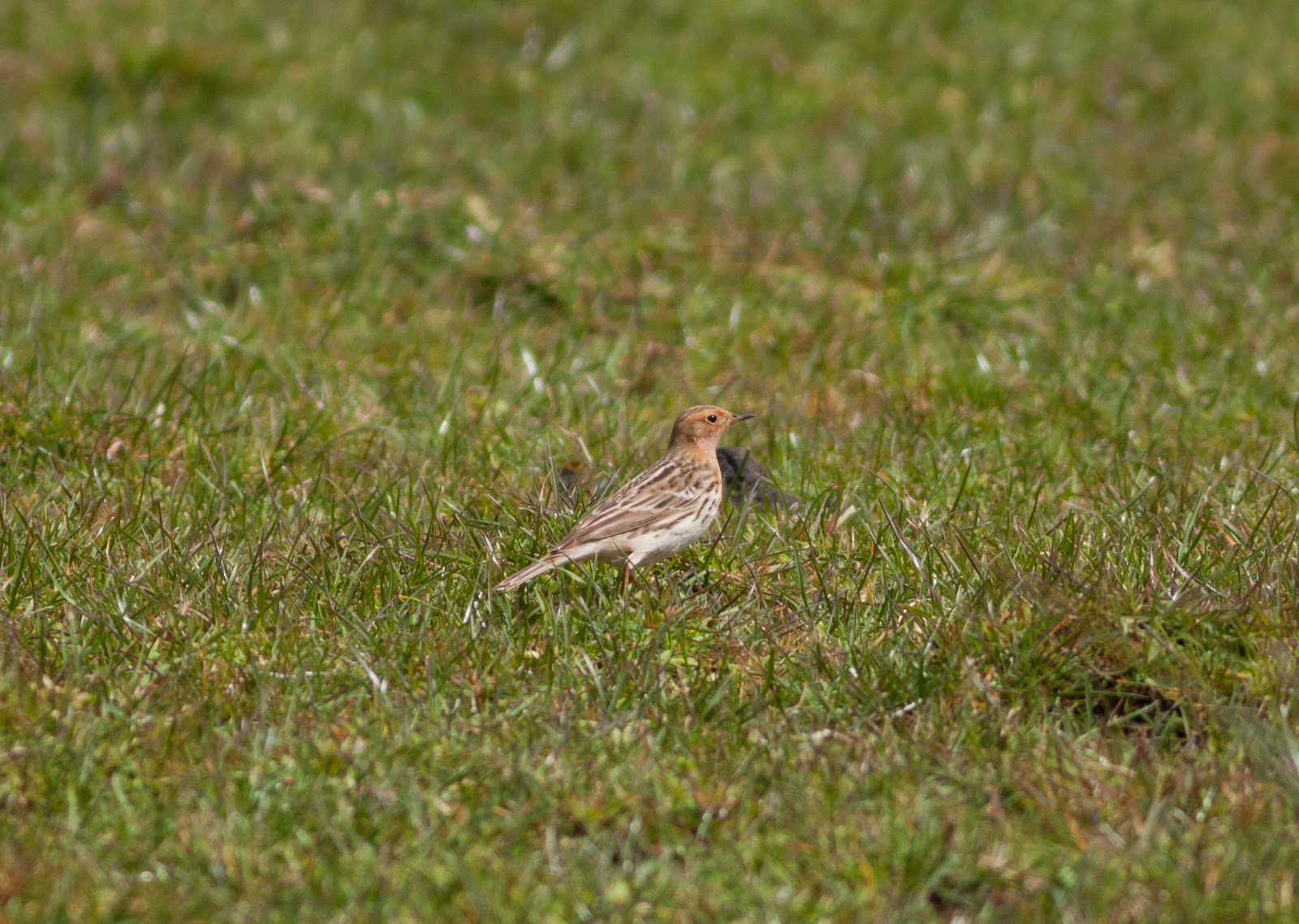
With the bird showing well as soon as we arrived, the assembled birders luckily got us on it through their scopes, and we enjoyed great views for all of about 5 seconds before it took high to the air and flew off over in the distance! Would that be it?! A short, sweet and very jammy encounter?!
Red-throated Pipit - Ludworth Moor
Luckily the pipit had flown only as far as the field across the track, and after 5 minutes or so it took to the sky again, flying directly over our heads and landing in the original sheep field. Making its distinctive flight call once as it did so, this was a great opportunity to experience the call in the field, and ideal to help nail the ID on any possible flyover Red-throated Pipits in the future.

Walking back to the road, we were able to look over the stone wall across to where the pipit had landed, and after emerging from the tussock it treated us to excellent views on the deck as it fed amongst the grass and sheep poo – taking advantage of the abundance of small insects present. Parading around in front of us, we took in the rich red throat and head, an exceptionally bright bird and standing out from the accompanying Meadow Pipits by a mile.
Red-throated Pipit - Ludworth Moor
One of the rarer pipits on the British list, the bright red colouration of the head and throat were distinctive in these circumstances, but with drabber plumage and standing out much less, autumn individuals can usually be identified by the whitish mantle stripes, streaked  back and lack of any broad white wing bars.
Red-throated Pipit - Ludworth Moor
The whitish mantle stripes can be seen in this shot
It’s not often that we get Red-throated Pipits in this plumage, with first winter birds in the autumn seen most often, so it was a rare opportunity to study this beautiful pipit up close. With very few twitchable mainland records in the past 10 years, this was a fantastic bird to catch up with and even better that it was so local!

Being in the area, we also popped in to Pennington Flash to catch up with one of the many Black Terns that had been grounded in the UK by the poor weather overnight, and we enjoyed distant views of this beautiful tern, the stunning smoky black plumage really standing out from the accompanying Common Tern flock. A nice Willow Tit gathering nesting material was also a nice surprise outside Teal Hide, having not seen any at the regular feeding station when we stopped by.
Willow Tit - Pennington Flash
A trip to Meols to end the day failed to turn up the 3 Dotterel that had amazingly been showing on the beach that afternoon – a crazy sighting - but a gorgeous summer plumaged Curlew Sandpiper and flyover Grey Plover were both nice consolations! 

Tuesday, 5 May 2015

Montagu's Harriers - Blacktoft Sands RSPB

Hearing that a pair of Montagu’s Harriers had set up territory at RSPB Blacktoft Sands in Yorkshire, and with the reserve making the news public last Monday, a trip to the east coast was in order to try and catch up with these beautiful raptors.

One of the UK’s rarest breeding birds, their survival is jeopardised by illegal hunting both here in Britain and whilst on migration, as well as from egg collectors and thieves, and it is for these reasons that the nest is thankfully being guarded 24-7 under the protection from wardens.
Blacktoft Sands RSPB
Arriving at Singleton Hide where the birds have been showing over the reedbed, we didn’t have to wait long before the shout went up from one of the assembled birders to alert us that the female had taken to the air to fend off an approaching Marsh Harrier.

Chasing off the larger intruder from her territory, the difference in size and structure was especially apparent, the female Monties much smaller and streamlined, with the long, thin, sickle shaped wings in clear contrast to the Marsh Harriers thick-set and sturdy shape.
Montagu's Harrier - Blacktoft Sands RSPB
We happily watched her quartering over the reedbed several times before dropping back down in to the dense cover of the reeds, arising again over several intervals to survey her surroundings and providing a great show to all those watching.
Montagu's Harrier - Blacktoft Sands RSPB
Before long, another shout went up that the male was approaching having returned from a hunting trip, and sure enough, a pale, ghostly figure could be seen appearing from the trees on the far left, gliding over to the nest site and where the female was waiting. With her taking to the air to greet him, it was apparent that a feeding pass was going to take place, and sure enough the two met up in the air as a small parcel of prey was exchanged. Absolutely amazing to watch and the pair showed much better than I’d ever imagined as they bonded and played in the air, providing a great spectacle for all those watching.
Montagu's Harrier - Blacktoft Sands RSPB
Very similar to the much more familiar Hen Harriers, the Montagu’s differ by their much thinner wings and overall slimmer structure, and the distinctive two black bands on the upperside of the wings on the male was apparent even from a distance.
Montagu's Harrier - Blacktoft Sands RSPB
The black bars on the wings show up well
Having not seen any in Norfolk at the regular site, and failing to see what is presumably this same pair on their breeding grounds just slightly further away from the reserve at their nest site last year, it was great to finally catch up with them, and despite seeing both male and female Monties before in Spain, this was a much wanted bird for me in the UK!
Montagu's Harrier - Spain
The male Monties from Spain
Montagu's Harrier - Blacktoft Sands RSPB
Record shots were all that was possible from the hide :)
With an assembled cast of a great flyover Spoonbill (that found the water too deep for it’s liking to land), a late Pink-footed Goose and a nice Bearded Tit that Alex spotted mooching about the reeds, it was all in all a great day at the reserve – despite not being able to track down a pair of elusive Garganey at Xerox hide!!
Spoonbill - Blacktoft Sands RSPB
I’d highly recommend a visit to Blacktoft for anyone wanting to get views of this species in the UK, as at present the pair are extremely reliable with sightings each day. The reserve also provides the perfect opportunity to see Montagu’s Harriers without posing any risk of disturbance to nesting pairs - here’s hoping they have a successful breeding season and continue to return to Blacktoft for many years to come!