The summer holidays are always a tricky time when it comes to twitching, especially as Alex has six weeks of freedom while I’m stuck at work, and as such I always dread the mega alert going off during July and August…
Sooty Tern! Not the most expected of summer megas!
Typically, no more than 3 days (!) into the holiday the mega alert sounded in to action once again, this time signalling the relocation of the Sooty Tern that had been flirting with the east coast for the past few weeks, finally getting pinned down at none other than the Ythan Estuary, home of the long staying and famous King Eider that now calls the beaches and river mouth its home. Groan. On a Monday this was probably the worst time for a bird to appear, and meant I had 4 days to endure before I could make the trip up (while Alex went dashing up to the Ythan without me…)
Alex's views of the Sooty Tern.... without me!
Originally spotted off Brownsman Island on the Farnes at the start of July, with a gap of two weeks before it was seen again flying past Inner Farne (and later landing briefly at Long Nanny in Northumberland for a few hours) the Sooty Tern had actually been seen fleetingly at the Ythan on the Friday evening, but with no sign at all over the weekend it wasn’t until 5pm on the Monday that it was re-found on the mussel beds, performing well all evening for those initial observers.
The mussel beds on the Ythan Estuary where the Sooty Tern set up home
Showing well all week since, treating onlookers at the famous tin hut to fantastic fly-bys and perching obligingly on the rocky shore, it was somewhat disheartening to see the “no sign” reports come trickling through on Friday morning, carrying on in to lunchtime. With a tricky decision to make and a potential dip on the cards after a long drive of 6+ hours, it may have seemed risky to press on with no sign, but it was a case of definitely NOT seeing a Sooty Tern sat at home as the only alternative, so leaving work at lunchtime, me and my Dad made the long journey north in what initially seemed like a bit of a doomed mission from the get go.
The weather was absolutely ATROCIOUS (this was not night!)
Arriving as darkness approached in absolutely torrential rain and with lightning so close it practically shook the car, there had still been no sign of the Sooty Tern all day. Never the less we made a quick attempt to scope out from Inch Road (standing in a tin hut in a lighting storm didn’t seem like the best of ideas) but with darkness soon closing in and the tern colony just a touch too distant in fading light, we failed to make out a Sooty Tern amongst the wheeling flock of white.
Thankfully, despite heavy rain forecast all weekend, Saturday morning dawned with a refreshing break in the weather and dry skies, and on checking my phone the impossible seemed to have happened – the Sooty Tern was back. Luckily our hotel was only a ten minute drive from the Ythan, and after a rather tense wait of an hour or so when the bird had gone missing out at sea, thankfully the cry went up as one stately Sooty Tern came swooping in to view.
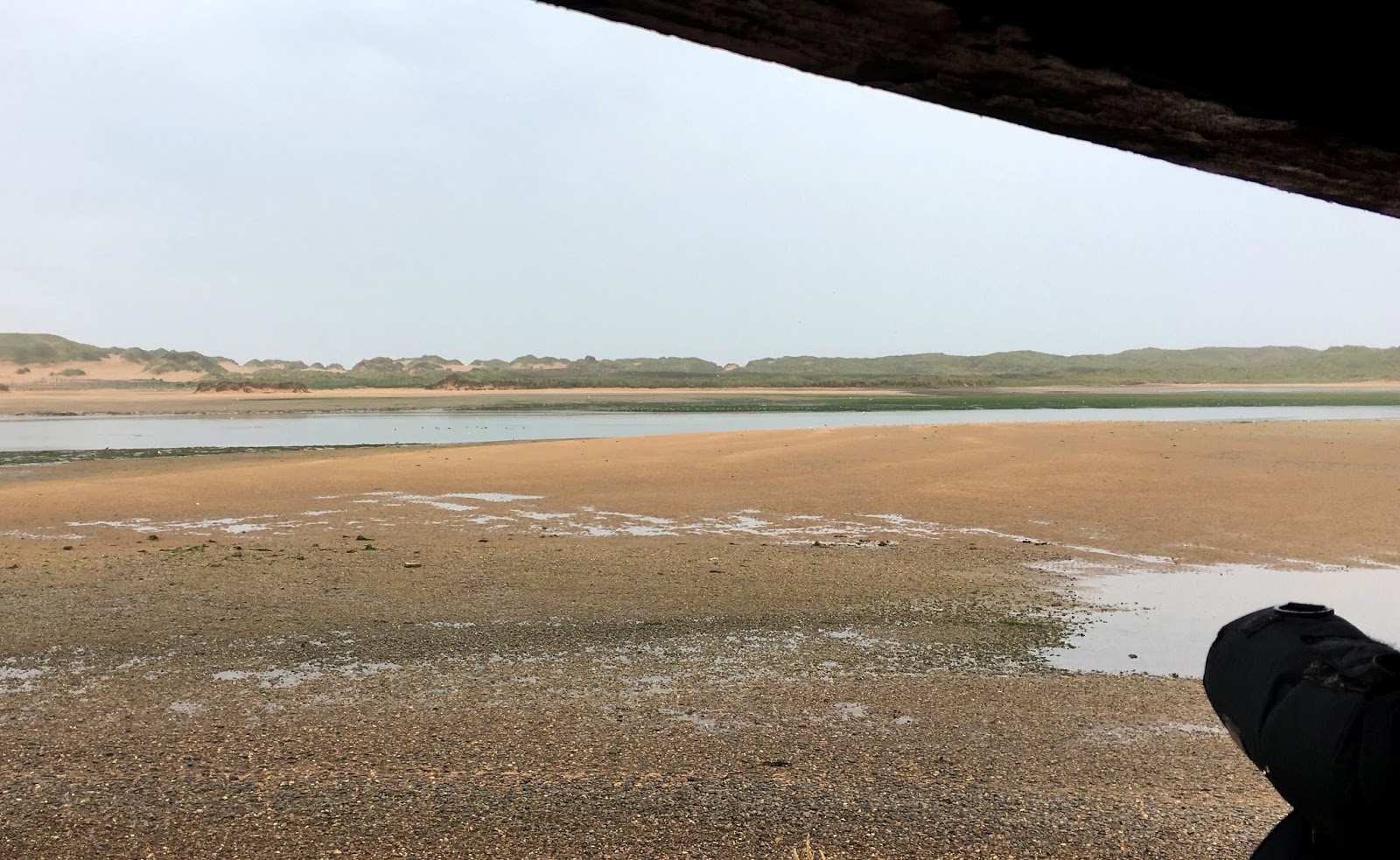
Waiting for the Sooty...the view from the famous tin hut!
Much larger than the assorted Commic Terns, with jet black wings and giving off a distinctive Skua-like silhouette, the Sooty was truly unmistakeable, and we watched as it gave further fly-pasts before continuing left down to Inch Road before settling down distantly on the algae clad rocks with a handful of Sandwich Terns.
Sooty in the rain....
Zoomed in....when I say distant I really mean distant!
Deciding that heading back to the car and driving to Inch Road instead of walking along the now soaking wet dunes would be the best option (it was now starting to rain quite heavily) we raced back to the car and nipped round to the car park at Inch, the Sooty Tern conveniently perched right in front of us and providing great views despite the now torrential downpour. Brollies in one hand and camera in the other I was able to reel off some record shots before the Sooty alighted once more, circling round to the tin hut and back before powering off up the river upstream and lost to view as a distant spec. Excellent timing and Sooty Tern well and truly in the bag!
Despite having seen Sooty Terns before at the Dry Tortugas islands off Florida and Michelmas Cay in Australia, I was still struck by just how large the Sooty was compared to our resident tern species (Common, Arctic, Sandwich, Little and Black were all present on the Ythan during our visit, making it a 6 tern day!) and it really was unmistakable when flying among the swirling masses of white.
The Farne Islands Bridled Tern back in 2014. Sooty Terns differ from the very similar Bridled Terns by their larger size and much darker, uniform black back and upperwings compared to a Bridled Tern’s lighter grey.
Usually found in tropical seas around Australia and the Caribbean, this Aberdeenshire bird was realistically only the third twitchable record in recent years (following on from the widely twitched and popular bird that frequented the Skerries off Anglesey and Cemlyn Bay during July 2005 and the moribund bird found on a Northamptonshire gravel pit back in 1980) so I was especially keen not to miss this opportunity – who knows how long it will be before the next twitchable Sooty in Britain!
Our views of Sooty Tern on Michelmas Cay last summer
Despite seeming like a no hope situation when setting off on the Friday, this was most definitely a case of “he who dares wins” and I’m glad I followed my usual mantra of persevering with a planned twitch even if negative news surfaces while en-route – thankfully this time the gamble paid off!
Brünnich's Guillemot: probably
the one bird above all others that I regret not going to see. Having no car and
not knowing any other birders at the time who could provide a lift, I had no
other option but to sit and watch as the images came flooding in of the 2013
Portland bird, the first twitchable individual of its kind and more than likely
seen by thousands of birders. Fast forward nearly 3 years, and it was therefore
a huge surprise on late Sunday afternoon to see the report flash up on my phone
– Brünnich's Guillemot: Anstruther, Fife – One showing well in the harbour.
Safe in the knowledge that the
Portland Brünnich's (which also hung around in a harbour) stuck around for the
last 6 days of December, I was relatively hopeful that the Fife bird would
follow suit, doing the decent thing and making itself accessible for anyone
that wanted to visit.
Still being present in the
harbour the next day, it soon became apparent that this particular bird
wouldn’t be going anywhere far, looking to be in full moult and having significant
feather damage, possibly caused by oiling. Indeed, the photos showed a
particularly raggedy individual, often pictured with its eyes half closed and
looking in an extremely sorry state. Instead of hoping it wouldn’t swim off and
leave the harbour, it now seemed more of a question of whether it would last
the night!
With the bird’s longevity now
in jeopardy, I decided to book a day off work, me and my Dad heading up to
Cumbernauld on Tuesday night and making our way to Anstruther the following
morning. Arriving at the harbour in good time and having already received the
news that the Brünnich's was still there, before we had even got out of the car
we could see a small black and white shape floating in the water amongst the
boats – Brünnich's in the bag!
Spot the Brünnich's! The favoured spot between the boats
Heading over to the opposite
wall and setting up the scope, we were treated to excellent views of this
arctic alcid, bobbing quietly in front of the moored boats and most definitely
looking a bit on the peaky side. Staying this way for the first half an hour,
it was therefore a surprise to see it come alive in the afternoon, scooting
over to the jetty surrounding the harbour and constantly diving down in the
hunt for fish and other crustaceans.
Showing no fear as is the case
with many other high arctic species, the Brünnich's often came to within 6
feet, drifting over towards the assembled birders and seemingly oblivious to
the small crowd it had attracted.
Looking closer at the photos
and with the bird being at such close range, the poor condition of the feathers
was obvious, the wings reduced to small matted stubs and showing patches of raw
pink skin on the edges. The feathers also appeared to be coated in an oily
substance, and the normally white belly was stained a slight browny-yellow.
The dreadful condition of the wings was obvious whenever the Brünnich's flapped or preened
Despite its shortcomings in
the looks department, it was still fantastic to see the bird so close up –
always my favourite way to see a new bird and something we’ll remember for a
good while yet!
Sadly however, come Friday
morning, news filtered through that the Brünnich's had unfortunately not
survived its visit to the Scottish coastline, being found dead first thing in
the morning washed up on the beach by the harbour. This fate, judging by the
bird’s poor condition, seemed inevitable, and its behaviour, demeanour and
all-round peaky look was reminiscent of the storm-wrecked inland Red-throated
Diver on Fairhaven Lake a few years ago which too met a tragic end. A sad end
to a super bird – RIP Brunny!
The Brünnich's looked quite peaky when floating on the water
While the ID of this
particular bird was in doubt by some birders, mainly due to the extensive white
above the bill, a number of other features all pointed firmly to Brünnich's;
the thick short bill complete with white gape line – a diagnostic feature of Brünnich's, the dark pattern on the head
extending past the eye and the general body shape and structure. Several
experts in the arctic more familiar with Brünnich's, particularly during
plumages unfamiliar to us such as in moult, were also happy with the ID, but
now the body has been recovered testing can be undertaken to rule out the
(relatively slim) chance of hybridisation and eliminate any doubts.
The white gape line on the bill was obvious, as was the lack of flank streaking, the pronounced gonydeal angle and the white coming to a sharp point on the foreneck. The pale tip to the bill is also a pro Brünnich's feature.
With Brünnich's usually
occurring up in the high arctic seas of Canada, Greenland and Iceland, there
have been 44 past records of these arctic alcids in Britain. Despite this high
number of occurrences, the Anstruther bird was only the second truly twitchable
record, with the majority of others being either one day birds, being found
washed up dead on the shore, or occurring off Fair Isle, Shetland and Orkney.
Anstruther Harbour - complete with Brünnich's
A fantastic bird to finally
grip back after the Dorset individual, and a bird I’m extremely glad I took the
day off to go and see!
White-winged Scoter is one
exceptionally good looking bird. Ever since seeing the pictures of a drake
photographed off Musselburgh back in 2013, I wanted to see one for myself – the
extravagant flick of bold white eyeliner contrasting against the midnight black
tones and striking pink bill elevating them a cut above the rest in Scoter
terms. Yes, Velvet Scoters are attractive, but White-winged Scoters are in a
whole different league.
Record shot of the American White-winged Scoter
With very few records of
either race (Deglandi or Stejnegeri) occurring in British seas (just one record
of Deglandi from Aberdeen in 2011 and one record of Stejnegeri photographed in
Lothian in 2013 – but not actually seen at the time) White-winged Scoters are a
truly rare bird in Britain indeed, so when reports surfaced of an adult drake Deglandi
type mixed in with the regular Scoter flock off Murcar Links Golf Course in
Aberdeen, it was a no brainer to get up there.
Chequered Skipper was a species of butterfly I was still yet to see in Britain, and being up in Fort William during the height of their flight season thanks to the Black-billed Cuckoo twitch provided the perfect opportunity to catch up with this charismatic species.
After a delicious cooked breakfast at the B&B (overlooking the beautiful scenery of Loch Linnhe) we made the 40 minute journey along the twisting loch-side roads to Glasdrum Wood NNR, a well-known hotspot for Chequered Skippers and one of the most popular sites in Britain for this species.
Confined to just the North West of Scotland and with a distribution centred largely around Fort William, Chequered Skippers are a true Scottish speciality, and I was especially looking forward to catching up with them having not had time to stop when we visited Mull two years ago when they were on the wing. With glorious sunshine and perfect blue skies the conditions weather-wise were perfect, and after parking up in the car park we were soon making our way up the grassy slope in pursuit of this Highland gem.
Before long we had successfully located several individuals, buzzing through the grass and often landing on any exposed branches or leaves in front of us. Rather frustratingly (perhaps due to the hot midday sun) the skippers rarely opened their wings when they landed, instead choosing to perch with them shut tight and displaying only the underside patterns.
Eventually though we managed to find some obliging individuals with their wings flat out, allowing us to get some photos of their distinctive gold and brown checked wings.
With at least two calling cuckoos and a range of other butterfly delights including several Small Pearl-bordered Fritillaries (which sadly never landed for me to get any photos) and a lone Green Hairstreak, Glasdrum Wood was a fantastic reserve to visit in a truly beautiful setting. The only possible downside was the sudden discovery of a large number of ticks hitching a lift on our shirts and socks – resulting in a swift exit from the site and a thorough checking over and change of clothes before leaving!
With such a limited distribution, conservation efforts are underway to secure the long-term future of this species and to hopefully expand its at present rather restricted range. Once also occurring in central England, Chequered Skippers were sadly declared extinct there in the 70’s, rendering this species as a true Highland speciality.
Getting there and seeing the butterflies:
Glasdrum Wood can be found off the small road to Inver after turning east off the A828 roundabout just after the Loch Creran Bridge. The post code to the car park is PA38 4BQ, and the entrance will be on the left hand side.
The Chequered Skippers are easy to locate at Glasdrum in good weather, and are a short 5 minute walk from the car park. Follow the footpath up the hill to the power lines before turning left along the well-trodden track along the slope, following the power lines across. The skippers are all along this track, along with Pearl and Small Pearl-bordered Fritillaries. We visited at the very end of May/start of June when the skippers were in their prime. Watch out for ticks!! For more information, visit the Scotland's NNR Glasdrum Wood website.
Come the evening of Sunday 22nd
May I don’t know what blew my mind more – the fact that the Birdguides app mega
alert sound was in fact the call of a Black-billed Cuckoo (check out Xeno Canto
for those that don’t know!) or the fact that there was an actual Black-billed
Cuckoo sat on a fence in far-away North Uist, happily feeding on caterpillars
and being twitched by a handful of very lucky birders! The photographs that
soon surfaced showing a fine, healthy, pristine spring adult gobbling juicy
green caterpillars were even more mind blowing.
The Uist Black-billed Cuckoo - an absolutely crazy record!
Before now, all previous
records of Black-billed Cuckoo in Britain have been of autumn juveniles, each
having the same sad glimmer of despair in the eyes and resigned to the
inevitable fate that was waiting for them here on this side of the Atlantic –
none have lasted longer than 3 days, with American cuckoos being notorious for
perishing after making the crossing. Turning up in Britain it seems results in
certain death as far as Coccyzus cuckoos are concerned.
With news breaking late on the
Sunday night, the chances of it sticking until the following weekend, especially
going on the past unfortunate history of this species, may have at first glance
appeared extremely slim and approaching zero. This bird however was unchartered
territory – never before had a spring individual made it across to these
shores, and certainly not a healthy adult. Could it do the unthinkable and
stick around for a whole week? Surely not….
As the days slowly ticked by
the news remained positive - each day boat and plane loads of birders happily
connected and reported the bird as still present and showing well. Plans
started to form, and with confirmation that the cuckoo was still in its
favoured gardens come Friday morning, I sprang into action and hastily booked
us some accommodation for our trip. An overnight stop in Fort William would
break up the daunting 9 hour drive after work, with the last 2 ¾ hours to our
ferry at Uig on Skye undertaken the following morning. Seemingly simple?
Things started to unravel as
we neared Glasgow. An ominous silence on the Cuckoo’s whereabouts since near
midday was broken by negative news late on in the evening – the bird hadn’t
been seen all afternoon and was last reported as “disappearing over the top of
a hill”. This was not good. As another birder had put it, a bird seemingly
‘doing one’ over the top of a hill has never resulted in anything positive when
twitching is concerned! Never the less, we ploughed on to Fort William, dodging
deer on the way and feeling somewhat disheartened at the fact we were seemingly
driving towards a dip.
The heart-stopping Birdguides report whilst driving up through Glasgow!
After a much needed night’s
sleep in the Travelodge I came out of the shower to be met with the welcome
news that the cuckoo was back in the gardens…. twitch on! It transpired that
the previous report had been slightly lost in translation, as the bird had
simply dropped down in to vegetation between the two houses on the slope and
had disappeared from view – not flying away over a hill as we had all feared!
Fort William
Luckily, we decided to leave
the Travelodge that morning with the aim of getting to the ferry terminal at
Uig in good time – 2 hours early to be precise. This proved to be one of the
best decisions we’d ever made, as arriving at Mallaig ferry terminal after an
hour’s drive, the devastating reality dawned on us – the sat-nav had planned
the route to Skye via a small island ferry crossing at Mallaig instead of over
the bridge at the Kyle of Lochalsh. This was a disaster, and I’ve never felt
more crushed on a twitch (not even the time when we actually dipped the
Yellow-billed Cuckoo in Cornwall after a 7 hour drive through the night). With
the next Mallaig ferry not until after 11am and only being offered a standby
place, we were well and truly stuck. We were now over an hour away from where
we had started off this morning at Fort William, with a further 2 ¾ hours on
top of that, and time was fast slipping away. After coming all this way it
seemed we had fallen at the final hurdle – we simply weren’t going to make it.
With no guaranteed place on
the crossing we made the decision to try and get to Uig – last boarding was at
1:30pm and our sat navs arrival time predicted 1:52pm – a huge feat to try and
make up half an hour on the winding mountain roads complete with their caravan
induced tailbacks. With Alex driving like an absolute hero and watching our
arrival time get steadily shorter, as I eyed the sat-nav dial move down to
1:37pm I started to think we might be in with a chance…..
Remarkably, we eventually made
it to Uig at 1:24pm, although no ferry in sight as we were driving down the
hill towards the pier convinced me we had somehow come to the wrong port in the
absolute cruellest twist of fate – had we messed up again?! We were relieved
therefore to pull in to the terminal and be met with a jumble of birders,
scopes and tripods. Relief took over – we had somehow made it!
In a sheer stroke of luck, the
ferry had been delayed from its departure on Uist and wasn’t due in until
quarter to 2, allowing us plenty of time to purchase our tickets, park, unload
the car and somehow be one of the first ones on board!
Enjoying the ferry crossing,
we were finally able to relax and take in the beautiful scenery and wildlife
that Scotland has to offer. A pair of Golden Eagles drifted distantly over the
hillside, while a White-tailed Eagle eyrie on the distant Skye cliffs was just
about visible through binoculars. Several Black Guillemots – one of my
favourite birds – joined the other auks during the crossing, while the occasional
summer plumaged Great Northern Divers showed off their spectacular black and
white patterns. Two Arctic Skuas bombed past the side of the boat, while both
Harbour Porpoises and a distant pod of Bottlenose Dolphins kept us entertained
as they took advantage of the rich pickings the Scottish seas produce food
wise.
With Dan Pointon getting word
that the cuckoo was still present during the 2 hour journey across, once we had
docked into Lochmaddy there was a mad scramble to pick up hire cars. With the
ferry fully booked for cars on the Saturday sailings seemingly weeks in advance,
the majority of birders (us included) were foot passengers, and we were
thankfully offered a lift around the island by local Marbury birder Mal and his
wife – life savers and we were eternally grateful!
15 minutes later we were on
site and the search was on. The cuckoo had apparently disappeared an hour
earlier in the gardens down the hill and had yet to be located, and as more and
more birders arrived we spread out and covered the surrounding area. Having
favoured the same couple of gardens since its arrival a week earlier, the
cuckoo had recently become a lot more mobile over the last couple of days,
ranging across Loch Sandary in to a number of gardens. With absolutely glorious
weather on Uist I was soon regretting wearing my woolly walking boots and thick
coat as the sun beat down – for an island up on the northern edges of Britain
it was surprisingly warm!
As the time passed there was
still a sense of optimism that the cuckoo would be found – it was undoubtedly
still in the area and with around 40 or so birders looking it was only a matter
of time before someone located it. Serenaded by a soundtrack of the rasping
notes of Corncrakes hiding deep in the Irises and with several Common Cuckoos
calling and making occasional flights harassed by a mob of Meadow Pipits, after
around an hours searching, Alex suddenly pointed ahead of us – “Look, what’s
that flying towards us?!”.
It was of course, the cuckoo -
flying straight ahead of us and attempting to land on the roof of a nearby
house before doubling back and diving straight in to a thick patch of scrub.
Familiar with Coccyzus cuckoos in flight after seeing Yellow-billed in America,
we knew instantly that we had our prize.
Immediately getting the attention of
the birders nearby and shouting over that we had it, word soon spread, and
before long a steady stream of birders could be seen sprinting up the track,
hoping to get a glimpse of this most magical of birds.
Happy twitchers!
Showing well for the next 45
minutes or so, everyone present was able to enjoy fantastic views of this
almost mythical American vagrant as it flitted between the houses and patches
of vegetation in the immediate area, perching obligingly at the top of bushes
and fence posts and allowing us all to get stunning views of that deep dark
curved bill and striking crimson eye ring.
Relatively mobile and
constantly being harassed by a pair of Meadow Pipits, the cuckoo eventually
dropped down in to a large bush and out of sight. It was easy to see how the
bird could get lost in this remote habitat for long periods of time, and
without large numbers of birders searching the area it could easily go
undetected.
The gardens the cuckoo was favouring
With the cuckoo off show and
with everyone ecstatic about connecting with this truly monstrous bird (some
birders even cracked open bottles of Malt Whisky on site to celebrate) we
headed back to our accommodation for the evening, taking in the beautiful
surroundings that North Uist has to offer and elated that we had managed to
pull off what was a truly epic twitch.
The view from our accommodation - gorgeous!
With just 15 records in the UK
to date, Black-billed Cuckoo is one of those birds that has a near mythical
status on British birders lists. With the fact that individuals rarely last
more than a day and with no records in the last 25 years bar an individual seen
briefly by a handful of people on Orkney back in 2014, this was a species that
no one expected to get on their lists any time soon – and most certainly not
this spring! Long gone are the heydays of the 80’s (when remarkably four in one
year were recorded in 1982) and coupled with an apparent decline of this
species in their natural range in America, the prospects of Black-billed Cuckoo
occurring in Britain, let alone being twitchable, looked increasingly bleak.
The eventual stay of 10 days
by the North Uist Black-billed Cuckoo before its apparent departure on the
following Wednesday also finally put to bed the rumours that have long been
doing the rounds that British caterpillars are toxic to American cuckoos (and
are the cause of death after they make it over here). Rather, it is far more
likely that autumn juveniles just cannot cope with the Atlantic crossing (often
in huge debilitating storms) and simply succumb to exhaustion or lack of food. The
fact that the Uist bird was an adult, as
well as there perhaps being a greater abundance of caterpillars in the spring
compared to the autumn may have set it apart from the rest and ensured its
chance of survival.
Another mystery is when and
exactly where the cuckoo arrived this side of the Atlantic. While it is
possible that it made its way across this spring and made landfall straight on
North Uist, there is an alternative scenario that it instead arrived on the
back of the huge autumnal storms last October somewhere else in Europe or in
Africa, before overwintering on the continent and making a parallel migration
north once May approached. Regardless of its arrival, this was an absolutely
phenomenal bird that I for one certainly didn’t expect to be seeing any time
soon!
Seconds after I took the top photo, Alex spotted an Otter in the exact spot! The small brown squiggle under the gull may quite possibly be it!
Despite the huge distance up to Uist (Alex heroically did all the driving single-handedly) I always find island twitches to be some of the most enjoyable. The incredibly scenery and wildlife in Scotland (I even saw my first wild Otter) is always a joy to behold, and we both had a fantastic and enjoyable weekend twitching a bird that is sure to live on in the memory for years to come. As they say – he who dares, wins – and we most certainly did on this occasion.
Alex's video of the Black-billed Cuckoo in all it's glory!