A tale of nature, wildlife and birding from Cheshire, North Wales and across the globe....

A tale of nature, wildlife and birding from Cheshire, North Wales and across the globe....
Showing posts with label Alpine. Show all posts

Friday, 15 May 2015

Citril Finch chaos hits Norfolk - 10th May Holkham Pines

Seeing that something huge had clearly broken on the internet, but with no details as to what bird, I checked my phone in anticipation, expecting a Mediterranean warbler or a rare tern.
Citril Finch RBA
Ah.

Someone once asked me what the least likely bird from Europe to turn up in Britain again would be, and after a bit of thought I’d replied Citril Finch. Sedentary and living in the high mountains of the Pyrenees and over to the Black Forest, there has only been one previous record in the UK, of a male bird on Fair Isle back in June 2008 that stayed for around 5 days. Never in my wildest dreams would I ever have thought there would be another one any time soon.

But here we were, over in Cheshire, with a Citril Finch remarkably flying around the dunes and pines of north Norfolk.

With the initial reports all being of flight views we were a little hesitant – would the bird stick around and would the vast majority connect? It was certainly a hell of a long way to go. A certain Christopher Bridge had already informed us that he was well on his way (always sneakily twitching the birds that matter!) and as countless others did the same, 2 or so hours after the initial report I finally managed to persuade Alex that we needed to set off and see this bird. Immediately.

After a relatively straightforward 4 hour drive to Holkham, we were encouraged by the fact that the bird had been showing well on the deck at intervals throughout the day – I had a good feeling about this one.

Arriving at the extortionately priced car park on Lady Anne’s Drive just before 4pm, we started the long 1 ¾ mile treck through the pines and to the western side of the trees. A steady stream of birders passed in the opposite direction, evidently having connected and heading home happy whilst we hurriedly walked on, hoping that the bird would still be around!

After what felt like FOREVER (but in reality was probably only 20 minutes or so), we turned a corner and a passing birder gave us some encouragement to spur us on – the bird was showing right now and it was only a few metres more along the path. Heading over the bank, we were greeted by a huge mass of birders, scopes and cameras, all firmly focused on the small hollow where this mega Alpine vagrant was clearly favouring.

Thankfully a kind birder let us look through his scope, and just like that, Citril Finch, in the UK. Mega. Peering through the foliage, we were greeted by great views of this delightfully bright finch, a beautiful spring male with sunshine yellow underparts and a fantastic sooty great shawl around the neck.
Citril Finch, Holkham Pines, Norfolk
Enjoying brief views as he fed contently in the sand, all of a sudden: “It’s flown. In that tree, it’s gone”. The bird must’ve decided it had had enough for the time being, and had sadly disappeared, presumably off in to the extensive dunes to the west.

Exceptionally relieved we had managed to connect, 5 minutes later and we would have missed it by moments (one toilet stop could have ruined everything!), but I was a little sad that we hadn’t managed to get a record shot – very reminiscent of our initial encounter with the Red-throated Pipit the weekend prior!

After a search in the nearby dunes, me and Alex decided the best option would be to wait back at the hollow, as the bird had been following a pattern and had been returning throughout the day. Sure enough, after around half an hour or so, the cry went up of “It’s back! In the tree with the Chaffinch”.
Holkham Pines, Norfolk
The hollow the Citril Finch was favouring
Proving exceptionally hard to see and evidently very camouflaged amongst the sun dappled leaves of the Sycamore, it took an absolute age to get on the bird (I was very glad I’d already seen it at this point, many that hadn’t must have been going out of their minds!) and the majority of us couldn’t see it until after it had flown to the floor and begun to feed again.
Citril Finch twitch - Holkham, Norfolk
Whilst the numbers had died down by the late afternoon, there was still a considerable crowd present
Enjoying great scope views for around 20 minutes or so, we watched the bird at length and I managed to take some record shots of this amazing little alpine finch as we watched it happily mooch amongst the weeds.
Citril Finch, Holkham Pines, Norfolk
There is always some speculation about rare finches and whether they may be escapees – it was only after a lot of research in to feather isotopes that the Fair Isle bird was accepted, having proved to originate from the Black Forest area in Germany. However, the absence of any rings and the fact that our bird was in the most natural habitat as possible that mirrored the alpine forests of its usual range (not a feeder in someone’s garden or anything dodgy!) really strengthens this individuals credibility of being a wild bird.

Indeed, whilst Citril Finches are largely sedentary birds and are often described as only short distance migrants, studies have shown that birds do move between breeding and wintering ranges, with the longest distance travelled by an individual bird measured at a remarkable 615km.

As Norfolk is only 732km from the Black Forest (the closest Citril Finch population to Britain) it is more than likely that this individual, like the Fair Isle bird, also originated from there, having got caught up in a weather system, Indeed, a female was similarly trapped in Finland during the spring of 1995 having been travelling amongst a flock of Siskin.
Black Forest to Holkham Map
The distance from the Black Forest in Germany to Norfolk
Having seen a Citril Finch briefly feeding on the ground on our trip to Northern Spain last April, I never would have imagined that we would be seeing one here in the UK just over a year later! A great bird for those who weren’t able to get up to Fair Isle 7 years ago and proving that you never know what can turn up!
Citril Finch, Northern Spain
Citril Finch from Northern Spain
Present until dusk and seen very briefly around 6am on Monday with no further sign since, the bird has sadly probably now moved on. With Britain’s only record of Red-breasted Nuthatch also coming from Holkham Pines, having overwintered there in 1989 through to the May of 1990, it’s anyone guess what the next mega to hit land there will be – White-crowned Black Wheatear anyone?!

Friday, 17 April 2015

Northern Spain Trip Report - Day 3

Day 3 - Tuesday 15th April 2014

Day 3 saw us rise bright and early to begin our treck in to the Pyrenean mountains, heading north to Valle de Hecho to commence our search for the star species of the trip and the one I was most looking forward to connecting with – Wallcreeper. We’d been informed by the lady at Boletas Birdwatching Centre that a male had been regularly observed on a cliff face in the valley, so the journey began through the incredible mountain landscape, admiring the gushing crystal clear rivers on route that seemed to follow the road around and carved through the rocky terrain with ease. 
Pyrenees - Northern Spain
Griffon Vultures soared overhead, whilst a stop to admire a mountain lake revealed two Egyptian Vultures flying high over one of the ridges. Separated from the much more common Griffons by their bold white and black underwings, the differences were clear to see and we watched the pair gliding effortlessly over the trees until they disappeared out of view.
Egyptian Vulture - Spain
Pyrenees - Northern Spain
Heading through the quaint alpine villages, we stopped to scan over one of the larger mountains by the side of the road – towering over us with a clear thermal in action as large numbers of vultures used the warm air to their advantage. 
Pyrenees - Northern Spain
The mountain ridge the vultures were loving
Alpine Choughs joined them high above the mountains, while a pale looking eagle was just too distant to ID. No Lammergeiers had put in an appearance yet (another personal key target species) but this was ideal habitat and they were well known in the area, as the many accommodation residences with Lammergeiers adorning their signs would testify.

We soon arrived at the Wallcreeper site, and immediately headed off on the alpine trail towards the cliff in question, the abundance of dainty alpine plants and flowers surrounding the pathways creating a beautiful carpet to admire as we walked up. The air here was undeniably fresh, and as we climbed higher, patches of clean white snow started to appear on the trail – a real magical alpine environment to experience. 
Pyrenees - Northern Spain
Reaching the cliff that the Wallcreeper had been favouring, we were joined by a small group of Goldcrests and Firecrests, whilst several Crested Tits foraged in the pine needles for snacks of tiny spiders and insects.
Crested Tit - Spain
Before long, the shout of “Wallcreeper!” from Chris cut through the still air, and sure enough, a small grey bird flew along the length of the cliff, that characteristic fluttering butterfly flight and echoing “peeeweeeeee” call unmistakable. Vanishing round the side of the rocks, we followed suit, heading up the trail in the direction it had flown in. With no sign around the corner, we waited for it to make a reappearance as we ate lunch, enjoying much better views of Alpine Choughs as they played and tumbled above the mountains, their yellow bills clear to see.
Pyrenees - Northern Spain
The Wallcreeper cliff!
Then, “Lammergeier!” - Chris was pointing high above, and sure enough that most majestic of vultures was slowly drifting towards us from across the valley. Passing overhead before it disappeared over the ridge, we all had excellent views of this bearded wonder. Having always wanted to a Lammergeier after studying the pages in my Collins guide, it was surreal to actually see one in the flesh – an incredible moment and one of the star birds of the trip.
Lammergeier - Spain
Pyrenees - Northern Spain
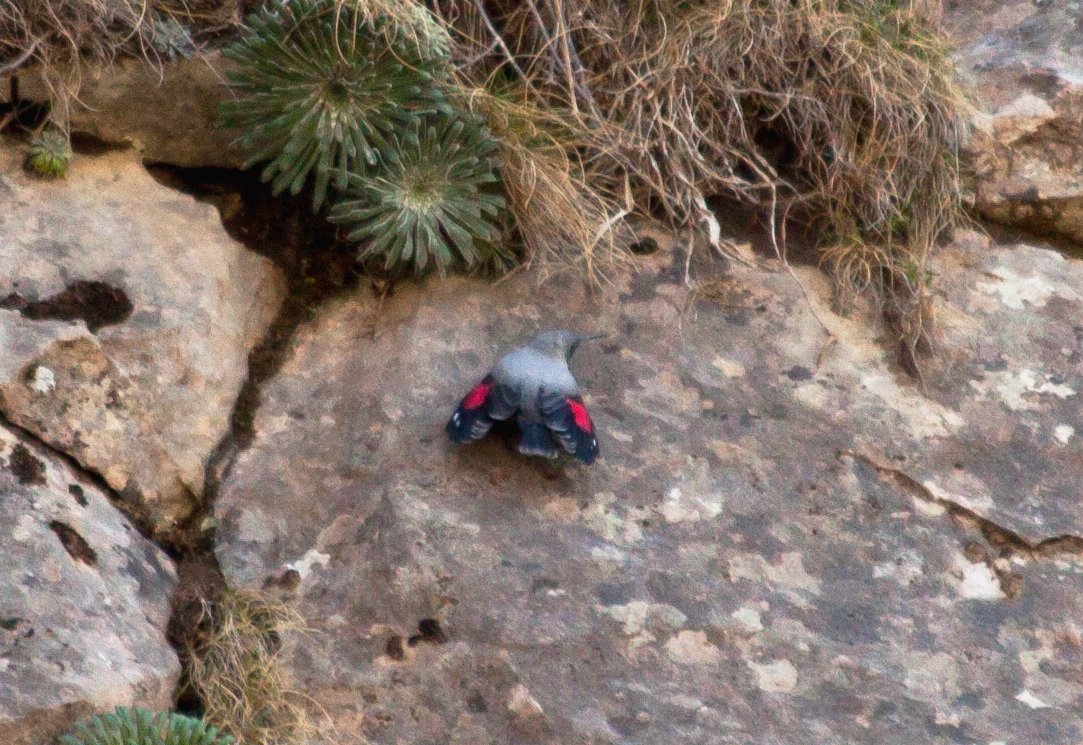
After an hour or so of craning our necks, our ears pricked up as that familiar and almost eerie “Peeeweeee” call echoed across the cliff face. With a quick search of the rocks above us, sure enough, there was the Wallcreeper, busy probing amongst the rocks with that remarkable long bill and fluttering from crevice to crevice. 
Wallcreeper - Spain
Wallcreeper - Spain
Wallcreeper - Spain
The beautiful butterfly-like pattern of deep crimson red on the wings was mesmerising to watch as he flittered his wings hopping from perch to perch, and we viewed for a good while at a considerably close range as he fed in front of us, completely unaware of his captivated admirers, before we moved on and left him in peace.
Wallcreeper - Spain
Wallcreeper - Spain
Wallcreeper - Spain
The Crimson on the wings was stunning!
We continued further along the track, Chris and Alex deciding to ignore the possible bear scat they had discovered near the Wallcreeper cliff, following the trail along the river. Here a smart looking Rock Bunting gave great views, singing and dashing from rock to rock in front of us.
Rock Bunting - Spain
The waterfalls and landscape here was absolutely stunning, and it was incredibly relaxing to listen to the gushing of the waterfalls crashing over the huge boulders and the roar of the river flowing below.
Pyrenees - Northern Spain
We picked up the call of a Black Woodpecker on one of the slopes, and leaving Chris with all our gear, we scrambled up the steep bank in pursuit. Sadly the sound was heading further and further away from us quicker than we could climb, and we lost the trail. A loud crashing through the trees below us had us remembering the bear scat from earlier, and a sudden awareness that a large carnivore could be roaming towards us left us a little apprehensive! Turns out it was just Chris, climbing the impossibly steep and thick tree covered slope to join us, carrying not one but THREE sets of heavy rucksacks and scopes on his shoulders! No easy feat indeed.
Pyrenees - Northern Spain
Later that evening we made the drive in to Huesca to try and track down the Scops Owls that reside in the city centre. Still a little early in the year, we were a tad unsure if any would have returned yet. A walk around the streets drew a blank, but after around half an hour and near to one of the parks, we heard that distinctive “BONG!” - Scops Owl!

We hurried over to the park and eventually managed to pinpoint the group of trees that the owls were calling from – although actually spotting any of the birds was far easier said than done. Judging by the calls, it appeared that they were flying around in a circle, but in the pitch black of the park it was impossible to pick anything out – even with all the street lighting illuminating the buildings nearby.

Eventually I narrowed down a calling individual to one of the trees lining the path in front of the gates, and several minutes of craning our necks and squinting resulted in me picking out the small owl perched next to the trunk on one of the branches. Success!


We could just make out its tiny shape and features, with two beady eyes looking back down at us, and I must admit this was probably my best spot to date considering just how hard they were to pin down! After some time, the owl began to fly from branch to branch, making it far easier to pick out in the darkness. Never has one bird been so difficult to locate, and it felt that these tiny owls were most definitely giving us the run-around that evening!
Casa Boletas - Loporzano
Boletas Birdwatching Centre