A tale of nature, wildlife and birding from Cheshire, North Wales and across the globe....

A tale of nature, wildlife and birding from Cheshire, North Wales and across the globe....

Tuesday, 12 May 2015

Greater Yellowlegs - Titchfield Haven in Hampshire

When news broke of a Greater Yellowlegs at Titchfield Haven down in Hampshire at the beginning of the year, I was all the way up in Scotland having just been watching the Harlequin duck on the river Don, with no feasible way of getting down there! With no sign the following day, it was assumed this would be a one day wonder – no one could have predicted that exactly 3 months later to the date it would reappear in the same place, incredibly while I was up in Scotland again having just been watching Ptarmigans, Crested Tits and Capercaillies! Again, with no feasible way of getting down to Hampshire and the bird disappearing the following day, it wasn’t until a week or so later that it reappeared, when work and various other factors prevented us from connecting.

Luckily, I was awake bright and early when news broke for the fourth time this year that the bird had returned to Titchfield, remarkably on the same flooded field where it was first found, and after an hour or so we were well on our way down south hoping to connect with this beautiful American wader.

Arriving at the small car park next to the public footpath on Bridge Street, we made the short walk through the gorgeous fields and along the canal, serenaded by the calling calls of Cuckoos and Cetti’s Warblers whilst trout splashed in the clear water next to us. Eventually reaching Posbrook Floods, (the flooded field in question that the Greater Yellowlegs was favouring), we joined the small crowd of birders and immediately got our scopes on this rare American vagrant. Originally dozing quite distantly with a flock of Black-tailed Godwits, after a while it thankfully awoke, probing around in the vegetation and wading through the water in search of small morsels to feed on.
Greater Yellowlegs, Hampshire
Flying considerably closer to join the nearer Godwit flock, we could really see the beautiful speckled plumage in much better detail, and as it waded through the water the bright golden legs were exceptionally obvious.
Greater Yellowlegs, Hampshire
Greater Yellowlegs, Titchfield Haven
Superficially very similar to the more frequently recorded Lesser Yellowlegs, there are various subtle differences to aid identification between the two. When in mixed flocks the obvious size difference is an easy way to tell the two apart, but solitary birds can be considerably more difficult to determine, with bill size and structure the main feature to look out for. The bill on the Greater Yellowlegs is considerably longer, being roughly 1 and ½ times the length of the head, whilst the bill of the Lesser is just barely longer than the head. The Greater Yellowlegs’ bill is also quite blunt-tipped and slightly upturned compared to the straighter, sharp pointed bill of its smaller cousin. The underparts are also a good feature to make a note of, with Greater Yellowlegs having more extensive dark barring as opposed to the plainer underparts of the Lesser.
Greater Yellowlegs, Hampshire
The barring on the underparts is obvious
Watching contently for a while, the Yellowlegs then remarkably flew right in front of the assembled crowd to the edge of the pool, giving excellent views to the 20 or so people there (the majority of birders in the country had evidently already connected on one of its previous 3 visits!) We could really admire the subtly beautiful patterns on the feathers and the egg-yolk coloured legs up close, and the bird happily made its diagnostic call on several occasions for us to hear – 3-4 high pitched piercing notes. This is also a very reliable way to tell the two species apart, with Lesser Yellowlegs making a short, rapid, 2 note whistling call that is much softer.
Posbrook Flood, Titchfield Haven
With just under 50 records of Greater Yellowlegs in the UK - the last one being the well twitched individual that overwintered back in 2011/12 in Northumberland, the Loch of Strathbeg and various points in the Highlands of Scotland - it was great to finally catch up with the rarer of the two Yellowlegs, having only seen my first Lesser in Buckinghamshire only a year earlier last spring.

Going missing for such long periods, it’s clear that this American vagrant is spending its time elsewhere in the vicinity that just isn’t being birded, either on the river Meon, on a private pool somewhere or simply out of sight on one of the lagoons at Titchfield. Either way, it’s been something of a mystery - I’m just glad it gave us a second (or fourth!) chance to connect!
Greater Yellowlegs, Hampshire
The Yellowlegs with Godwits - the large size of the bird is apparent
With a Bonaparte’s gull showing well nearby in Southampton, we spent the rest of the day trying to locate it, first at Chessel Bay then on to Riverside Park near the Cobden Bridge. Unfortunately, there were only Black-headed Gulls present for the afternoon, and it wasn’t until half an hour later when we were enjoying a delicious meal of Crispy Mongolian Lamb and Chilli fried Chicken at one of my favourite restaurants in Southampton, the news came out that it was showing well on the jetty! Bad timing or what! Hopefully another North West bird will make an appearance soon that I can catch up with!!

Friday, 8 May 2015

Red-rumped Swallow at East Lane Park, Hull

Dipping Red-rumped Swallow on three previous occasions, this was becoming a bit of a personal nemesis bird for me, and one which seems to elude me every spring! Being quite hard to catch up with due to their nature of constantly being on the wing, birds often tend to drift off high or have a habit of disappearing overnight after seemingly going to roost! I’ve regretted not going for the Leasowe individual that was present all afternoon back in May 2011, and me and Alex had made it a personal mission to see one here in the UK this spring!

With news coming out just after 10 of one being found over the lake at East Lane Park in Hull, we weren’t sure whether this was just a flyover or whether it was sticking around for the day – their reputation for not hanging around long firmly in our minds.

However, after checking out the local Marston fishing pools for lingering Black Terns and receiving news that the swallow was still present over the lake at just after 12, we decided to make the 2 and a bit hour journey up to Hull and hopefully finally nail this elusive species!

Arriving at the park and eventually finding the bridge and lake in question, it became clear that the bird was doing some sort of circuit, disappearing for long periods of time and reappearing over the water only at certain intervals. We set up on the bridge and kept a watchful eye out, grilling any hirundines that crossed our line of view and constantly alert for anything that looked like a pale rump. I was initially concerned as the bird apparently hadn’t been seen since just after lunch and had only been showing distantly near the Poplar trees on some occasions, not ideal in trying to get a confirmed sighting!
East Lane Park, Hull
After about an hour’s wait with not many hirundines about bar the odd Sand or House Martin, we were encouraged somewhat by the sudden onset of a largeish flock above our heads, as well as several swallows flitting about near the water. With everyone looking towards the water, I turned around and clocked on to two swallows flying relatively close overhead. Thinking how great it’d be if one was our target, I raised my bins to be greeted with an exceptionally buff bellied coloured bird with an all dark tail flying directly over me. Looking suspiciously like our much sought after Red-rumped, I was in disbelief that I might have spotted it – especially after all these years of searching!
Red-rumped Swallow, Hull
Photographing it was especially difficult!

With its upper wings facing away from us, I needed to get a clear view of the rump to see that distinctive white and red patch. Luckily it banked in the sky exposing it’s back and…..oh my god. It’s white. “That’s it!”
Red-rumped Swallow, Hull
Hardly daring to believe my eyes, it was amazing to know that we had finally caught up with our ultimate nemesis! We enjoyed great views for around ten minutes or so as it swooped and soared around the sky - sometimes getting higher up and almost out of sight but always returning to the bridge and the water.
Red-rumped Swallow, Hull
You can clearly see the all black tail and pale head
Red-rumped Swallow, Hull
It was great to watch the aerial acrobatics in action, and the red rusty underparts and the strawberry and cream rump really stood out from the Barn Swallows and House Martins present. After swooping down low to the water to presumably get a welcome sip of water, it banked off high over the trees and out of sight – amazing!
Red-rumped Swallow, Hull
Really poor record shots showing the rump!
Red-rumped Swallow, Hull
Present for the following days and showing at intervals since our encounter on the Monday, it was really saddening to learn that our bird had been taken by a Hobby early on the Thursday morning! A really sad end to a truly fantastic bid, and one that I’m especially glad that I finally managed to catch up with (just in time it seems!) RIP little swallow – we certainly won’t be forgetting you in a hurry! 

Wednesday, 6 May 2015

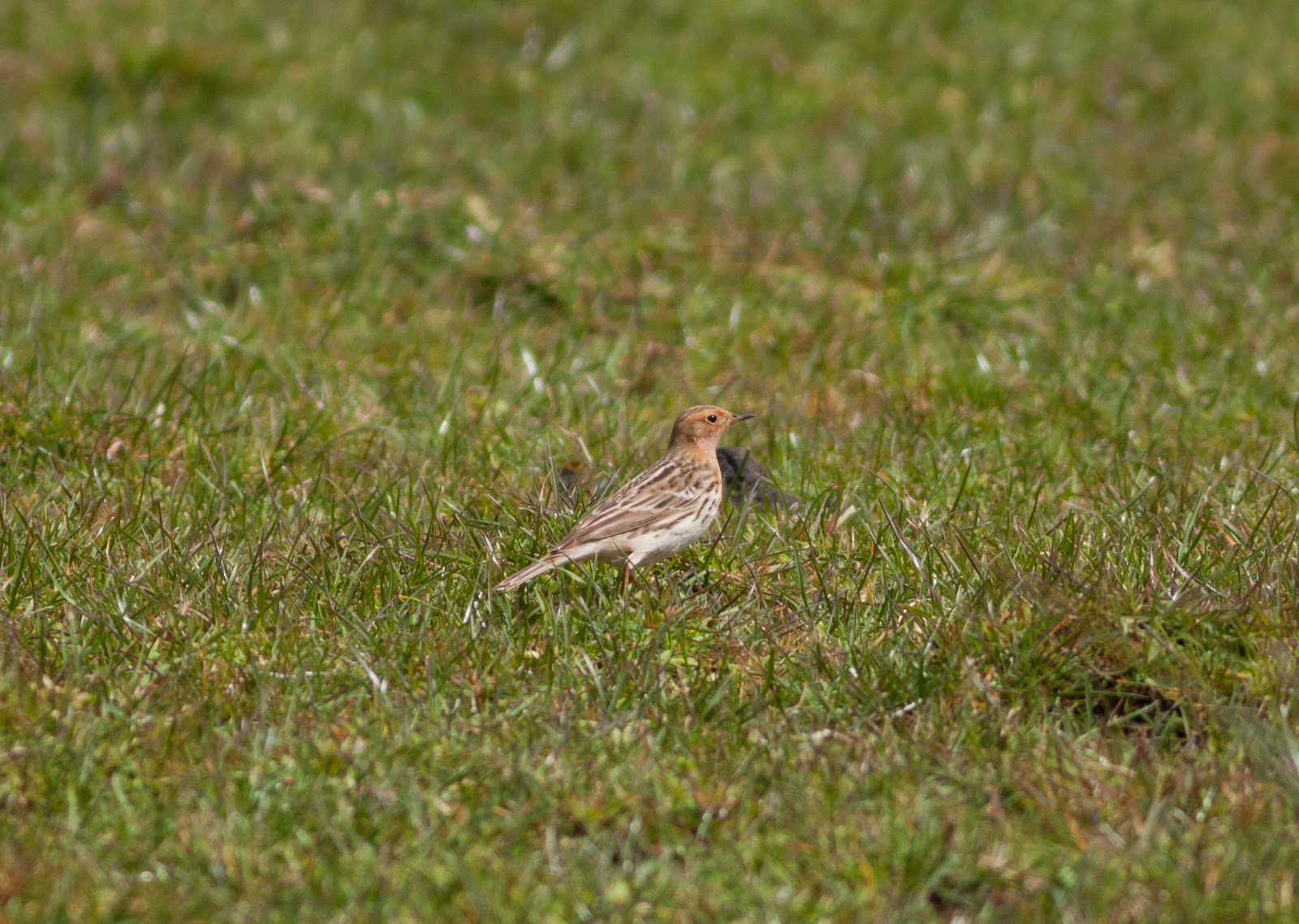
Red-throated Pipit - Ludworth Moor (Derbyshire/Manchester)

With an alert popping up mid-morning on the Sunday telling us there was a Red-throated Pipit showing in a field up near Manchester on Ludworth Moors, it was a no brainer to take the trip to try and catch up with this local mega, hoping it would stay the course and remain loyal to the site for the rest of the day.

With records usually emanating from the Scilly Isles or as flyover individuals, Red-throated Pipits are notoriously hard to twitch, so it was all systems go heading down the motorway! Usually less than an hour from my house, it was rather unfortunate that we were based in Wales for the night, but we made good progress and managed to arrive on site just after lunch.

With the bird showing well as soon as we arrived, the assembled birders luckily got us on it through their scopes, and we enjoyed great views for all of about 5 seconds before it took high to the air and flew off over in the distance! Would that be it?! A short, sweet and very jammy encounter?!
Red-throated Pipit - Ludworth Moor
Luckily the pipit had flown only as far as the field across the track, and after 5 minutes or so it took to the sky again, flying directly over our heads and landing in the original sheep field. Making its distinctive flight call once as it did so, this was a great opportunity to experience the call in the field, and ideal to help nail the ID on any possible flyover Red-throated Pipits in the future.

Walking back to the road, we were able to look over the stone wall across to where the pipit had landed, and after emerging from the tussock it treated us to excellent views on the deck as it fed amongst the grass and sheep poo – taking advantage of the abundance of small insects present. Parading around in front of us, we took in the rich red throat and head, an exceptionally bright bird and standing out from the accompanying Meadow Pipits by a mile.
Red-throated Pipit - Ludworth Moor
One of the rarer pipits on the British list, the bright red colouration of the head and throat were distinctive in these circumstances, but with drabber plumage and standing out much less, autumn individuals can usually be identified by the whitish mantle stripes, streaked  back and lack of any broad white wing bars.
Red-throated Pipit - Ludworth Moor
The whitish mantle stripes can be seen in this shot
It’s not often that we get Red-throated Pipits in this plumage, with first winter birds in the autumn seen most often, so it was a rare opportunity to study this beautiful pipit up close. With very few twitchable mainland records in the past 10 years, this was a fantastic bird to catch up with and even better that it was so local!

Being in the area, we also popped in to Pennington Flash to catch up with one of the many Black Terns that had been grounded in the UK by the poor weather overnight, and we enjoyed distant views of this beautiful tern, the stunning smoky black plumage really standing out from the accompanying Common Tern flock. A nice Willow Tit gathering nesting material was also a nice surprise outside Teal Hide, having not seen any at the regular feeding station when we stopped by.
Willow Tit - Pennington Flash
A trip to Meols to end the day failed to turn up the 3 Dotterel that had amazingly been showing on the beach that afternoon – a crazy sighting - but a gorgeous summer plumaged Curlew Sandpiper and flyover Grey Plover were both nice consolations! 

Tuesday, 5 May 2015

Montagu's Harriers - Blacktoft Sands RSPB

Hearing that a pair of Montagu’s Harriers had set up territory at RSPB Blacktoft Sands in Yorkshire, and with the reserve making the news public last Monday, a trip to the east coast was in order to try and catch up with these beautiful raptors.

One of the UK’s rarest breeding birds, their survival is jeopardised by illegal hunting both here in Britain and whilst on migration, as well as from egg collectors and thieves, and it is for these reasons that the nest is thankfully being guarded 24-7 under the protection from wardens.
Blacktoft Sands RSPB
Arriving at Singleton Hide where the birds have been showing over the reedbed, we didn’t have to wait long before the shout went up from one of the assembled birders to alert us that the female had taken to the air to fend off an approaching Marsh Harrier.

Chasing off the larger intruder from her territory, the difference in size and structure was especially apparent, the female Monties much smaller and streamlined, with the long, thin, sickle shaped wings in clear contrast to the Marsh Harriers thick-set and sturdy shape.
Montagu's Harrier - Blacktoft Sands RSPB
We happily watched her quartering over the reedbed several times before dropping back down in to the dense cover of the reeds, arising again over several intervals to survey her surroundings and providing a great show to all those watching.
Montagu's Harrier - Blacktoft Sands RSPB
Before long, another shout went up that the male was approaching having returned from a hunting trip, and sure enough, a pale, ghostly figure could be seen appearing from the trees on the far left, gliding over to the nest site and where the female was waiting. With her taking to the air to greet him, it was apparent that a feeding pass was going to take place, and sure enough the two met up in the air as a small parcel of prey was exchanged. Absolutely amazing to watch and the pair showed much better than I’d ever imagined as they bonded and played in the air, providing a great spectacle for all those watching.
Montagu's Harrier - Blacktoft Sands RSPB
Very similar to the much more familiar Hen Harriers, the Montagu’s differ by their much thinner wings and overall slimmer structure, and the distinctive two black bands on the upperside of the wings on the male was apparent even from a distance.
Montagu's Harrier - Blacktoft Sands RSPB
The black bars on the wings show up well
Having not seen any in Norfolk at the regular site, and failing to see what is presumably this same pair on their breeding grounds just slightly further away from the reserve at their nest site last year, it was great to finally catch up with them, and despite seeing both male and female Monties before in Spain, this was a much wanted bird for me in the UK!
Montagu's Harrier - Spain
The male Monties from Spain
Montagu's Harrier - Blacktoft Sands RSPB
Record shots were all that was possible from the hide :)
With an assembled cast of a great flyover Spoonbill (that found the water too deep for it’s liking to land), a late Pink-footed Goose and a nice Bearded Tit that Alex spotted mooching about the reeds, it was all in all a great day at the reserve – despite not being able to track down a pair of elusive Garganey at Xerox hide!!
Spoonbill - Blacktoft Sands RSPB
I’d highly recommend a visit to Blacktoft for anyone wanting to get views of this species in the UK, as at present the pair are extremely reliable with sightings each day. The reserve also provides the perfect opportunity to see Montagu’s Harriers without posing any risk of disturbance to nesting pairs - here’s hoping they have a successful breeding season and continue to return to Blacktoft for many years to come!

Tuesday, 28 April 2015

Hudsonian Godwit - Meare Heath, Somerset!

Hoping to catch up with the Blue-winged Teal at Donna Nook for Zac and Alex, I was awake bright and early on the Saturday morning, ready to make the 3 hour journey over to Lincolnshire with them. However, checking my phone after breakfast, I was stunned to see a MEGA alert at 7:30am telling me there was a Hudsonian Godwit present down at Meare Heath in Somerset!!! What on earth?!! All thoughts of the teal were hastily forgotten, and by 9am just after the report was confirmed again on Birdguides we were on our way down the M6 hoping to connect with this special American mega!

Making good time and luckily not becoming ensnared in any of the previous night’s congestion, we arrived on site just after 12, buoyed by the stream of reports coming through twitter and on RBA to reassure us of the birds presence and thankful that there were enough car parking spaces in the newly built car park to hold the masses that would be arriving throughout the day. Special thanks to Alex who got us there in good time, complete with dodgy overtaking moves along the way!

Arriving at the small flash just a short walk down the path from the car park, the birds location was soon betrayed by the absolutely HUGE line of birders assembled along the path watching it – one of the biggest twitches I’ve been at to date – perhaps only behind the Short-toed Eagle in Dorset on the first morning and the Little Bustard at Fraisthorpe on New Year’s Day.  
Hudsonian Godwit Twitch 2015
The crowds stretched all down the path...
Hudsonian Godwit Twitch 2015
....and down the other side!
We joined the 400 or so others and soon locked on to the bird, looking extremely settled and roosting happily with the Black-tailed Godwits just over the bank. It was immediately recognisable though the scope – much darker than the accompanying Godwits with a more dusky coloured plumage due to the heavy barring -  a lot more distinctive than I’d anticipated and easily distinguishable! Occasionally it awoke, showing the long two toned bill briefly, before tucking it away underneath the wing again. It was EXTREMELY fortunate that this hadn’t turned up where viewing was only from a hide – I can only imagine the sheer chaos and pandemonium a scenario like that would have caused!
Hudsonian Godwit - Somerset
Eventually, our rare visitor awoke, and wading through the flock the differences in comparison to the Black-tailed Godwits were even more striking. The fractionally smaller body and longer bill were evident, the latter of which was distinctly orange toned, completely different to the pinkish wash of the Black-tailed Godwits. 
Hudsonian Godwit - Somerset
Every now and again the Hudsonian would flap and flick it’s wings revealing the jet black colouration underneath– the key identifying feature – and the crowd reacted with admiring “ooohs” every time! An aberrant Black-tailed Godwit with a particularly well marked white head got pulses racing back in 2012 at the local Frodsham Marsh, although after some speculation, the white underwing covets seen the next day completely ruled out Hudsonian even though the head and bill looked spot on – proving just how vital getting good views of the underwings is in nailing this species.
Hudsonian Godwit - Somerset
Alex's video grab of the black underwings!
Hudsonian Godwit - Somerset
The barring on the plumage was really apparent
The Hudsonian departed from the reserve shortly after 4pm with a third of the flock of Godwits, and flying off high to the west there was no sign since that day – a great surprise for the weekend. This mega American wader was definitely NOT on my radar and was most certainly not a bird that I was expecting to see any time soon – it just goes to show in the world of birding that all it takes is one bird to unexpectedly unblock a species not seen in Britain for nearly 30 years. Thankfully the stars aligned this weekend to provide the perfect twitch – if it had turned up on a weekday then it would have been an entirely different scenario for many filled with stress and panic! The bird had actually previously been spotted the evening before roosting with the Godwit flock, but it wasn’t until early the next morning that the observer clinched the ID and alerted the masses!
Hudsonian Godwit - Somerset
The darker colouration stood out even from a distance
There have only been two previous records of Hudsonian Godwit accepted in the UK, usually found in Central America on migration and only occasionally making it over this side of the Atlantic.  With the most recent being a flyover record in Aberdeenshire back in 1988, the only other bird was a well twitched individual that was first found at Blacktoft Sands in Yorkshire in the autumn of 1981, before being relocated down in Devon where it subsequently spent the winter. Remarkably, the same individual was seen again back at Blacktoft a year later in the spring of 1983! With this in mind, there is every chance that the Godwit could get refound elsewhere in the country.
Godwit Flock - Somerset
The reserve itself was a great place to spend the afternoon, with a calling Wood Warbler near the car park and brief views of a skulky Garden Warbler in the Hawthorns lining the path – its location given away by the beautiful melodious song coming from between the leaves. A Bittern booming in the reeds behind us provided the perfect soundtrack, and the soaring Marsh Harriers, Hobbies and chattering Cetti’s Warblers were my first of the year. We also caught sight of two Cranes circling high overhead -  a reminder of the success of the Great Crane Reintroduction Project in the levels, as well as numerous flyover Great White Egrets – surely a sign of breeding on the reserve again this year. With the breeding Little Bitterns at Ham Wall, it will be great to return to this fantastic little reserve again in the summer months.

Blue-winged Teal at Donna Nook

Sunday saw us head over to Donna Nook on the east coast in Lincolnshire so Alex could catch up with the drake Blue-winged Teal that had been present there for a couple of weeks now. Arriving at the main car park we were met with considerable negativity, with a group of birders telling us the bird wasn’t about that morning, that the pond was extremely hard to find (with us needing to wade through thick reeds and quick sand to get to) and that the walk was horrific with the pool miles away from the car park! Not fancying our chances, we made the walk over to the pool, which in all honesty was no way near as bad as everyone made out – merely a 30 minute journey along the beach!

After following the directions we had been given, we tracked down the pool the teal had been favouring, and we joined the 4 or 5 assembled birders on the large grassy bank who had already located the bird on the island in the middle of the water just in front of us, well hidden and camouflaged in the vegetation.

Blue-winged Teal, Donna Nook
Spot the teal!
Blue-winged Teal, Donna Nook
After a while, this attractive American visitor swam out on to the open water where it proceeded to feed around the other side, venturing to the left and right of the trees and giving good views as it dabbled in the small reeds.
Blue-winged Teal, Donna Nook
Having seen a drake already at Inner Marsh Farm in Cheshire back in 2013, it was nice to catch up with a second, and with a cast of gorgeous showy Yellow Wagtails and my first Lesser Whitethroats of the season trilling happily and flitting around in the scrub, a good day’s birding was had.
Yellow Wagtail
Yellow Wagtail
For anyone going, the pool has seemed quite hard to find for some – see directions below:
Blue-winged Teal map at Donna Nook, Lincolnshire
Blue-winged Teal map at Donna Nook
Parking at Donna Nook car park (LN11 7PD) off Marsh Lane, take the walk to the right on the boardwalk and follow the gravel track past the salt marsh to Point A. Once the track runs out, turn left through the wooden fence and onto the sand, following the beach right. MOD debris and a broken down helicopter will be on your right, with a dead seal further up the beach to the left. Continue along the beach and follow the path where stated on the signs due to the MOD Firing Range. You will need to count the tall brown Quad Towers on the right hand side in the dunes – once you reach the third one at Point B, turn right in to the dunes and immediately left there is a large, rusty gate to stop the cattle leaving the field (Point C). Enter this field walking along the flat grass, then head right at Point D through the small dune scrub until you reach a large grassy bank, with a large pool and several smaller pools adjacent. The Blue-winged Teal can be found on either the large flat pool on the right, or one of the smaller pools to the left with the small shrubby islands, where it can hide in the vegetation on either side. If wanting a close approach and to cross over to the other bank on the seaward side of the pools, wellies is advisable as the surrounding mud can be quite sticky!

Monday, 27 April 2015

Pied-billed Grebe in Gloucestershire

With news of a Pied-billed Grebe breaking in Gloucestershire early on the Friday morning, I left work an hour early and made the journey down to the South West in the hope of connecting that evening. The bird had been spotted floating on the Severn Estuary near Berkeley Powerstation where it had remained loyal to the spot for the whole day, relatively close to the shore and showing exceptionally well to onlookers during the high tide at midday.

After a walk of about a mile or so down the winding public footpath through the fields, I eventually arrived at the spot. Unfortunately, the now low tide meant the bird wasn’t as close as it had been previously, although I was just pleased that the grebe had stayed and I was able to connect! Initially difficult to pick out, the bird had actually left the water before I arrived and was sat resting on a sandbank, effectively camouflaged with the surrounding boulders and looking like a large pebble!
Pied-billed Grebe, Gloucestershire
Phonescoped record shot of the Pied-billed Grebe
It eventually perked up and waddled over to the water shuffling comically – it’s legs more suited to swimming and diving than for walking on land! The grebe then pottered around for the rest of my stay, diving occasionally and favouring the shelter of the seaweed and rocks around the sandbank.
Pied-billed Grebe, Gloucestershire
Looking fine in its spring plumage, the black band on the thick bill and the white circle around the eye were really distinctive through the scope, and it was great to finally catch up with a Pied-billed Grebe in the UK after not going for the long-staying Ham Wall male in 2013 or the local Manchester bird back in 2010 – despite going to Uni nearby!

With individuals found nearly every 2-3 years between 1975 and 2002, there was a relatively long gap of 8 years before the Manchester bird, although records annually every year since may indicate that this American vagrant is becoming more predicable again in its frequency of making it over to Britain.
Pied-billed Grebe, Gloucestershire
Looking exceptionally lost and out of place in the estuary on the Friday evening, it was no surprise that there was no sign the following morning, although I don’t think anyone could have predicted it would be refound from Lower Hide at Leighton Moss in Lancashire late on the Saturday afternoon! Night time migrants, the grebe had evidently undertaken a journey of nearly 170 miles from Gloucestershire to Lancashire during the night, following a straight line directly north and making landfall at the RSPB reserve – remarkable to imagine a small grebe completing such a feat!
Pied-billed Grebe flight map
Map showing the route taken by the grebe! (red line)
With a reputation of staying considerable amounts of time at a suitable site, and with great habitat and pools available at Leighton Moss, hopefully the grebe will stick around up north and enjoy its new home!

For anyone visiting, the grebe is reportedly favouring Lower Hide, which is accessed from the public footpath leading down from the road – although it occasionally ventures closer to Public Hide.

Special thanks to my mum for driving to Gloucestershire – we didn’t get back until gone half 12 due to the excessive roadworks that now seem to plague our motorways – although she did enjoy a delicious Beefeater tea of Gammon and Apple Crumble for her trouble!