A tale of nature, wildlife and birding from Cheshire, North Wales and across the globe....

A tale of nature, wildlife and birding from Cheshire, North Wales and across the globe....
Showing posts with label Laurel Pigeons. Show all posts

Thursday, 14 June 2018

Tenerife Birding Trip Report - Day 3 (Thursday 20th April 2017)

Our third morning on Tenerife dawned slightly greyer than our previous two days, with thick cloud cover enveloping Los Cristianos and Playa de Las Américas where we were staying. Unperturbed and with Barbary Falcons to track down, we decided to head back up to the north of the island and search any likely sites where these hard to find birds of prey might be likely to occur. 
Barranco de Ruiz, Tenerife
The view from the Barranco de Ruiz
Our first point of call was the well-known Barranco de Ruiz, a small viewpoint off the side of a twisting mountain road near Las Rosas that offered extensive views of the valley below. A huge gorge dating back millions of years and sporting an impressive list of endemic flora and fauna due to the high humidity and falling fog moisture the area receives, Barranco de Ruiz is also a key site for both Bolle’s and Laurel Pigeons. Right on cue, it wasn’t long before several of the latter powered in to view, swooping lower down in the ravine and touching down in the depths of the thick tree canopy lining the rocky outcrops. 
Laurel Pigeon - Barranco de Ruiz, Tenerife
Laurel Pigeon in flight - one of many
White tails and dark bodies visible even at such a long range, we had around 8 birds in total during our visit, but yet again not a single Bolle’s – that first bird at Mirador de La Grimona had proved vital! 
Laurel Pigeon - Barranco de Ruiz, Tenerife
Barranco de Ruiz also provided us with our best views of Plain Swift to date, with hundreds of birds swirling en-masse right above our heads at the top of the steep gorge, taking advantage of the glut of insects the low cloud was bringing out, shrieking and playing manically. Impossible to photograph due to their sheer speed and close proximity, we had to make do with a memory card full of blurred dark shapes as they whizzed by! 
Plain Swift - Barranco de Ruiz, Tenerife
Plain Swift
With the usual Canary Island Chiffchaffs and Atlantic Canaries joined by a small charm of Goldfinches flitting through the trees by the car, a singing Quail was a nice surprise, its familiar “Wet my lips” call emanating from somewhere further down the rocky slope but remaining well hidden in the thick, lush vegetation. 

Once more however, it seemed that the Barbary Falcons were going to evade us yet again, a solitary Buzzard and a pair of Kestrels the only birds of prey in the area. Just as we were giving up hope and with a thick mist and clouds descending rapidly over the valley, a slightly larger pair of falcons caught our eye, circling in the far distance over the furthest cliffs bordering the ocean. Straining our eyes through our scopes they looked extremely good candidates for Barbary, but the distance was just too extreme and we failed to pick out any distinguishing features. There was therefore only one thing for it, and we were soon heading back down the mountain to the coast in an attempt to intercept and catch up with our possible Barbary Falcons.
Charco Verde, Tenerife
Charco Verde - prime Barbary Falcon habitat
Hurtling down the TF-342 to try and reach the spot it looked like they had been circling over (it was extremely hard to get our bearings from where we were looking at the top of the Barranco!) it came as a huge surprise when at the bottom of the road a mid-sized falcon came barrelling over the road just feet above our car, peachy buff undersides in plain view and with distinctive thick pointed wings reminiscent of a Peregrine - surely a Barbary. Vanishing over the small rocky crags on the opposite side of the road and out of sight, we made an emergency detour down one of the small farm tracks at Charco Verde, scouring the skies above the extensive banana plantations for further signs of our falcon. 
Charco Verde, Tenerife
Not the most picturesque of locations!
Eventually, we caught sight of it again at the end of the track overlooking the ocean, frustratingly flying out of view again over the banana plants before we could get better looks or photos. Thankfully, our luck was in, as after a few minutes not one, but two birds soared back in to view, one individual exceptionally close over the adjacent bananas and providing crippling views. 
Barbary Falcon - Charco Verde, Tenerife
Barbary Falcon - finally!
Taking a look through bins the distinguishing features were obvious, each bird sporting a rusty brown and black cap and the buff hue of the underside we saw earlier again clear to see. With Peregrines only very rarely occurring on Tenerife, but with a handful of records making it over, it felt good to positively nail the ID 100% and secure much better views – finally Barbary Falcon as a bogey bird had toppled.
Barbary Falcon - Charco Verde, Tenerife
With the afternoon ahead of us and having mopped up all our targets, we decided to head over to the nearby Charco del Viento for a spot of seawatching, stopping off at the Cepsa petrol station near the Mirador de La Grimona for a quick snack before we left and scoring an impressive 15 Laurel Pigeons swooping along the cliff face in the ten minutes we were there.
Laurel Pigeon - Cepsa Petrol Station, Tenerife
Laurel Pigeon perched outside the Cepsa petrol station
Having chosen this location due to its proximity near to Las Aguas, Charco del Viento seemed as good a spot as any to try for Barolo (Little) Shearwater, famed as being an extremely difficult species to get on Tenerife. 
Roque de Garachico, Tenerife
Roque de Garachico nearby - once the site of breeding Barolo Shearwaters
Traditionally looked for on the Tenerife – La Gomera ferry, even this failsafe option has become very hit and miss in recent years, with fewer and fewer birds seen and many visits drawing a blank. With a number of recent records emanating on the northern coast around the seaside town of Las Aguas where birds have been reported as heading out to feed towards the early evening, we set up position and waited for the sun to start to set. 
Charco del Viento, Tenerife
Two Canary Islands Chiffchaffs flitting amongst the fleshy cactus stems kept us company as we waited, while a pair of Berthelot’s Pipits surprisingly took a fancy to a crumbled up lemon muffin we’d put out optimistically, providing our best views yet of the Macronesian speciality. 
Berthelot's Pipit - Charco del Viento, Tenerife
Berthelot's Pipit enjoying a lemon muffin
Berthelot's Pipit - Charco del Viento, Tenerife
A constant stream of Cory’s Shearwaters passing by also kept us entertained, and we notched up counts of over 200 birds over the course of the afternoon. As the sun started to set, almost on cue we had our first ‘non Cory’s’ of the day that sparked our excitement – a small Manx type powering east over the waves. Just about managing to keep it in the scope as it sped past, the bird was just too fast and distant to get any of the key features expected of Barolo (the rounded wings, white face with dark eye standing out, nor the silvery-grey edges to the wings). 

Barolo Shearwaters will also usually fly low down over the waves and often raise their heads in a bobbing motion during flight, again a feature we just couldn’t make out. Over the course of the evening we counted a further 14 individuals, all following the same pattern and exhibiting the same flight style, height, colouration and size. At no point did any of the birds observed scream out “Barolo Shearwater” and at no point did we wonder If we’d got one – they all just looked like bog standard Manx Shearwaters.
Charco del Viento, Tenerife
Checking out other observers notes and observations it was clear that Manx Shearwaters are not uncommon in Canary Islands water, and without anything to suggest otherwise, we were both confident in saying that we definitely didn’t have any Barolos fly past during the evening. 
Charco del Viento, Tenerife
With the last of the blood red rays of the sun setting behind the Atlantic expanses and the hopes of finding any Barolos extinguishing with them, we decided to call it a day and head back to the hotel. Despite the disappointment on the shearwater front we were more than pleased at having scored with our Barbary Falcons, and were more than ready to tuck in to a well-earned meal of Indian spiced chicken and seafood pasta at the next door Pizzeria – delicious. With all our targets now safely under our belts this meant we could take our foot off the gas and relax for our final two days, exploring the scenery and beaches that Tenerife offers at our leisure. 
Charco del Viento, Tenerife

Friday, 8 June 2018

Tenerife Birding Trip Report - Day 2 (Wednesday 19th April 2017)

Arising early for our second day in Tenerife, we ascended once again to higher altitudes, this time in search of the two speciality pigeons that reside on the island – Bolle’s and Laurel. Tricky to connect with if you don’t have the right site information, we headed straight to the best location on the entire island for Laurel Pigeon and a place almost guaranteed to score a sighting – Mirador de La Grimona on the north coast. Quite unassuming if not in the know, this roadside location is THE place to connect with both Laurel and Bolle’s pigeons, with the birds flying across the mountainside on regular occasions throughout the day. 
Mirador de La Grimona - Tenerife
The best slope on the island to look for the endemic Laurel and Bolle's pigeons
An hour away from our hotel in the south, the clouds and mist soon appeared as we headed higher up in to the mountains, leaving behind the sparkling sunshine as our car slowly became enveloped in fine fog, the only bird of note being a fleeting glimpse of a female Chaffinch (the North African subspecies) as it flew out of the path of our oncoming vehicle.  
Tenerife
Mist - hindering our vision over the edge of the road to just a few metres
Arriving at the roadside pull in opposite the Mirador de La Grimona viewpoint, it was merely a case of sitting and waiting for our pigeon targets to appear. Several Canary Islands Chiffchaffs and African Blue Tits called from the surrounding trees to keep us entertained, while a small handful of Atlantic Canaries chattered away as they fluttered from shrub to shrub. 
Mirador de La Grimona - Tenerife
Looking up at the cliffs of Mirador de La Grimona
Keeping an eye on the cliffs, several Feral Pigeons swirling around the rocks got our pulses racing for a moment, and it was only a few minutes later that Alex called that he’d had a possible Bolle’s fly out from one of the trees. Not 100% sure if it definitely was one, we scanned the cliffs in the hope that there was more than one bird, and sure enough, the slightest of movements in the scope soon revealed itself to be a fine Bolle’s Pigeon - extremely well hidden sat amongst the branches and luckily showing well enough and at an angle where the diagnostic tail patterns were clearly visible.
Bolle's Pigeon - Mirador de La Grimona, Tenerife
Bolle's Pigeon - note the thick black band on the tail
Woodpigeon-like in coloration and sporting a three striped dark tail with a characteristic thick light grey band in the centre, this was in complete contrast to the all-white tail of a Laurel Pigeon, and we had good scope views of what actually proved to be the rarer of the two species as it sat unobtrusively on the slopes. 
Bolle's Pigeon - Mirador de La Grimona, Tenerife
Watching the Bolle’s until it eventually flew off and out of sight, we kept a lookout up the mountain, a further movement on the cliffs soon catching our eye as several all dark shapes powered in to view before disappearing in to the trees – surely Laurel Pigeons! After a few minutes wait our suspicions were proved correct as a second wave of birds broke in to the open – their all dark bodies and diagnostic thick white tails clear to see before these too disappeared out of view over the ridge. It was only a matter of time before a Laurel Pigeon landed in view however, and sure enough, after around ten minutes or so one of the birds ungainly touched down on a precariously thin twig at the top of a shrub and allowed for some very distant phonescoped record shots. 
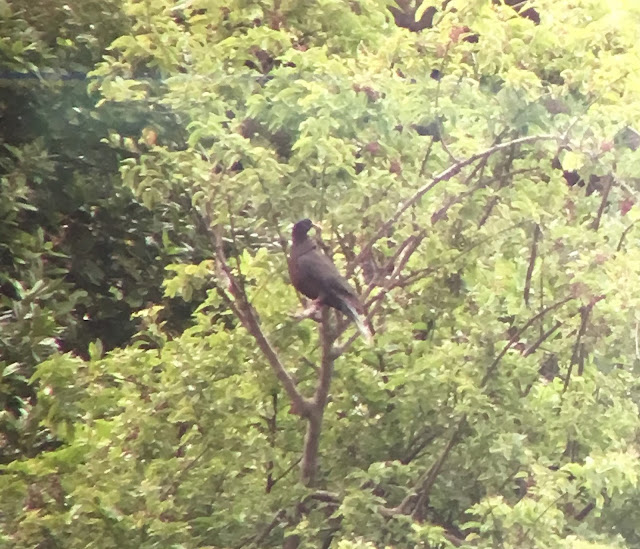
Laurel Pigeon - Mirador de La Grimona, Tenerife
Laurel Pigeon - the white tail and dark body was obvious
Enabling us to get a good look as it wobbled to and fro on a branch that was clearly not quite sturdy enough to support its hefty weight for too long, the large all white tail was especially clear even at long range, while the dark, almost black tones of the body were a much warmer and deeper shade than the Bolle’s Feral/Woodpigeon colouration. 
Laurel Pigeon - Mirador de La Grimona, Tenerife
With more Laurel Pigeons perching throughout the morning and several others flying through in small groups, we eventually had up to 10 individuals, possibly more – it was impossible to tell in some cases if it was just the same group of birds going back and to. As expected, the Bolle’s proved much harder to find, and it was extremely fortunate that we had connected with the single bird earlier on and what proved to be our only bird of the entire trip. 
Buteo buteo ssp. insularum - Mirador de La Grimona, Tenerife
The Canary Islands subspecies of BuzzardButeo buteo ssp. insularum
With several more Plain Swifts soaring over the cliffs beside the roadside, along with a female Kestrel that made us look twice for the features of Barbary Falcon, a single Cory’s Shearwater powering east during a brief spell of seawatching was the only other bird of note, and having cleaned up on both our endemic pigeons in just over an hour, we headed over to our next site of Punta del Fraile and Punta de Teno in the hopes of catching up with our final ‘realistic’ target of the trip – Barbary Falcon. Having missed these African falcons during our trip to Fuerteventura 6 months earlier, Tenerife offered a second chance to catch up with these impressive birds, and with e-bird indicating they were actually much more numerous on Tenerife, we were relatively hopeful. 

Sadly, it wasn’t to be however, and despite a lengthy search for the remainder of the afternoon at the apparent favoured spots for Barbary Falcon along the cliff lined road to the lighthouse, it was becoming clear that this particular species was turning in to a bit of a ‘bogey bird’ for us. 
Punta de Teno - Tenerife
The cliffs at the end of Punta de Teno
Despite the lack of our sought after falcon however, we nevertheless spent an enjoyable lunch feeding the resident population of West Canaries Lizards that make Punta de Teno their home, watching on as dozens of these impressive reptiles scurried over to each pringle morsel we dropped over the wall to them.
West Canaries Lizard - Punta de Teno, Tenerife
West Canaries Lizard
West Canaries Lizard - Punta de Teno, Tenerife
The lizards seemed to have a real appetite for BBQ Pringles... who knew!
West Canaries Lizard - Punta de Teno, Tenerife
With a supporting cast consisting of the usual suspects – Canary Islands Chiffchaff, Atlantic Canary, Plain Swift and Berthelot’s Pipit were all in attendance – we also caught up with our first Sardinian Warbler of the trip, an impressive male foraging in a low down coastal shrub, red eye blazing out against the soot grey plumage.

Cutting our losses with the non-existent Barbary Falcons and with large drops of rain now starting to coat our windscreen, we decided to call it a day, a picturesque and scenic drive back down to the hotel along the Masca mountain trail creating plenty of narrow hairpin bends that Alex had to expertly manoeuvre around. Several Turtle Doves perched on the wires in the mountain towns were a reminder of how times once were back in Britain, while the ever abundant Canary Islands Chiffchaffs called non-stop from the lush vegetation in the higher altitudes. 
Turtle Dove - Tenerife
Turtle Dove - sadly a rare sight now back in the UK
Turtle Dove - Tenerife
With a delicious evening meal at the local Chinese restaurant finishing the day nicely, we were able to reflect on another successful day on the island, both our target pigeons in the bag and ready for a fresh attack on finding our elusive Barbary Falcons the next day.
Punta de Teno - Tenerife

Mirador de La Grimona – parking and access

Mirador de La Grimona and the nearby Cepsa petrol station are two of the best spots on Tenerife to look for Laurel Pigeons (and in smaller numbers Bolle’s). Parking up at the layby at the Grimona and merely looking up across the road at the slopes should result in flybys of several Laurel Pigeons as they move across the mountainside. 

Stopping off for petrol at the Cepsa Petrol Station a few hundred yards west can also yield large numbers of Laurel Pigeons moving across the valley, with several birds often seen perching in the small shrubs. Indeed we had around 15 birds here in just a short ten minute period in the middle of the day. 
Cepsa Petrol near Mirador de La Grimona, Tenerife
The cliffs opposite the Cepsa Petrol station
Cepsa Petrol near Mirador de La Grimona, Tenerife
Parking at the Mirador de La Grimona consists of a small roadside lay-by off the TF-5 (just before the tunnel if heading from the west) with a larger area of gravel to view from. Be careful if driving in from the west as the TF-5 is a fast paced road and a left turn in to the layby may not be possible if traffic is busy. Indeed, we carried on to the outskirts of Los Realejos to turn around and headed back in from the east. 
Mirador de La Grimona - Tenerife
The parking layby at Mirador de La Grimona
The post code for the viewpoint layby is TF-5, 3, 38414 Los Realejos, Santa Cruz de Tenerife, Spain while the Cepsa petrol station is at Paraje El Terrero, s/n, 38410 Los Realejos, Santa Cruz de Tenerife, Spain (only accessible if travelling from the east). A simple search in Google Maps for Mirador de La Grimona will produce the exact location.