A tale of nature, wildlife and birding from Cheshire, North Wales and across the globe....

A tale of nature, wildlife and birding from Cheshire, North Wales and across the globe....
Showing posts with label Great Orme. Show all posts

Tuesday, 6 June 2017

Bird's-nest Orchids on the Great Orme, Llandudno!

Having last seen Bird’s-nest Orchids once before way back in 2010, I was keen to catch up with several plants in bloom on the Great Orme in Llandudno, handily just over an hour away from home. Not being able to get over there to see them last year, late May saw us take a trip over to this botanically rich hotspot to explore the woodlands around the base of the Orme in an effort to try and find them.
Bird's-nest Orchid - Great Orme, Llandudno
Parking up at the Happy Valley car park area and taking one of the small trails into the trees, expecting a lengthy search I was surprised at just how quickly we stumbled across our orchids – looking up the slope we were met with two distinctive caramel-brown flower spikes nestled among the Dog’s Mercury and looming out of the dark understorey gloom. 
Bird's-nest Orchid - Great Orme, Llandudno
At first glance perhaps appearing dead to the untrained eye, on closer inspection they were flowering to perfection, tiny golden florets adorning tall leafless stems in the deep shade of the woodland floor.
Bird's-nest Orchid - Great Orme, Llandudno
A quick exploration of the surrounding area also revealed a third spike hidden a little bit further up into the trees, but we were unable to spot any additional plants in the immediate vicinity. With just three spikes (there were apparently only three plants last year too) this looks to be a very small population, but with extensive woodland carrying on further up the slope it’s highly likely there could well be more in the area.

Although Bird’s-nest Orchids can often be perceived as drab, uninteresting and plain looking due to their uniform brown flowers and stems (especially compared to some of the other more extravagant orchid species), there is actually a subtle beauty to these unusual orchids, with each petal looking as if it has been brushed with a delicious coating of sticky golden honey and almost looking good enough to eat. 
Bird's-nest Orchid - Great Orme, Llandudno
Their lack of leaves and chlorophyll (hence the brown colouration) also adds to their interest, mystery and allure, going against the grain of how plants are traditionally perceived and creating an air of botanical charisma. Completely lacking the ability to photosynthesise from the sun and instead obtaining all the nutrients they need from their fungal hosts deep in the soil, this allows them to tolerate the extensive shade and darkness that other flowers simply can’t manage. 
Bird's-nest Orchid - Great Orme, Llandudno
The Bird’s-nest Orchid has a tangled mass of roots, shaped, unsurprisingly, like a bird’s nest and indicating how it gets its name
With a scattered distribution across the UK and classed as Near-threatened in Britain on the Red Data list, there are only a handful of sites for the Bird’s-nest Orchid in the North West, although the north-east Welsh woodlands appear to be a bit of a local stronghold with occurrences around Wrexham, Mold and Ruthin all in recent years. Notably, 25 plants were also recorded in a small wood just south of Abergele hospital in 2005, as well as another record in 2006 near Bryn-y-maen, south of Colwyn Bay.

Looking back at the historical records it seems Bird’s-nest Orchid was present on the Great Orme back in the 1970’s and up to 1986, but a lack of reports after this time indicates they may have disappeared at the site until recently (I’m aware they’ve been occurring here for the past three years though at least).
Bird's-nest Orchid - Great Orme, Llandudno
Bird's nest Orchid photography in action!
With at least 7 species of orchid present on this botanically rich limestone headland, hopefully the Bird’s-nest Orchids will continue to thrive here in the coming years, expanding their population and continuing to add a sparkle to the jewel in the botanical crown that is the Great Orme. 

Tuesday, 14 April 2015

Ring Ouzels on the Great Orme

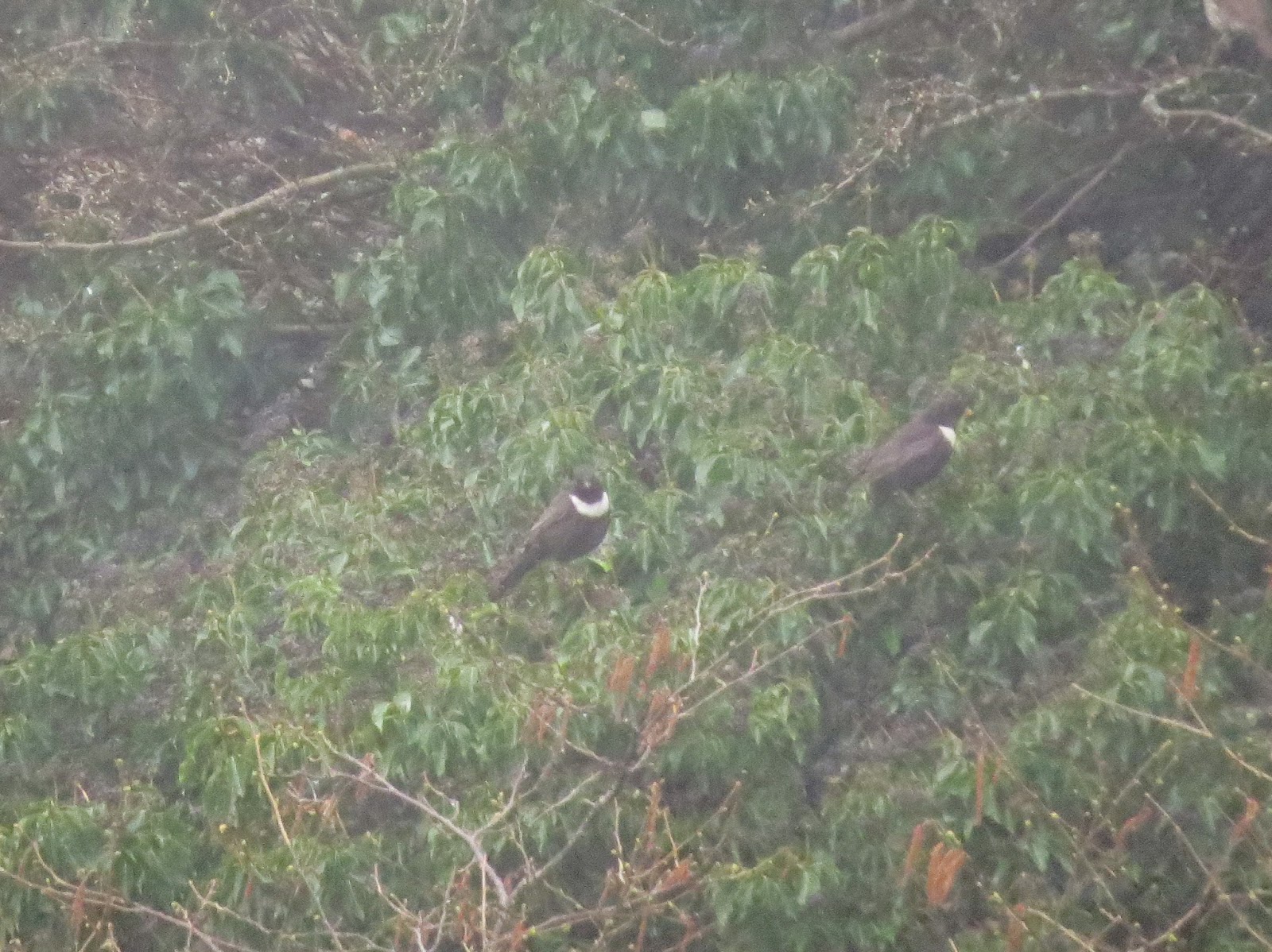
With a huge fall of Ring Ouzels documented throughout the UK from Friday onwards, and with up to 20 birds present on the Great Orme since Saturday morning, we decided to call in on the Sunday after returning from Scotland. Despite the absolutely howling gales and driving rain (which caused the car to rock from side to side with the sheer force of it all), and with the helpful directions from Alex’s friend Steve Culley, I eventually picked up 2 birds in flight and calling near the Copper Mines. I soon located a lot more birds further down the slope, all actively feeding in the same ivy tree, and despite the far from perfect conditions we counted 7+ birds.
Ring Ouzel - The Great Orme
A record shot of the male Ouzel
Ring Ouzel - The Great Orme
I was especially pleased to track down these birds as I haven’t had great views of Ring Ouzels before, merely a quick fleeting glimpse on a fence before a pair flew away on a visit to Moel-y-parc a few years ago, and a female by the side of the road whilst driving in Cheshire being my only other sightings, so it was great to watch these large thrushes going about their business at leisure, despite the absolutely horrific weather.
Ring Ouzels - The Great Orme
The driving rain made it hard to get even record shots!
Ring Ouzel - The Great Orme
Interestingly, Ring Ouzels haven’t been picked up from this side of the Orme before, with birds usually getting found on the opposite side in the sheep fields. However, the fields and patches of grass surrounding the Copper Mines and over towards the nearby houses seemed the perfect habitat for these migrants, and it was clear why they had all congregated in this one patch of trees – this sheltered spot offered a welcome respite from the harsh winds and abysmal weather.
Ring Ouzels - The Great Orme
All the birds had congregated in one tree - 4 can be seen in this one shot alone with another just to the left out of frame
The row of ivy trees in particular at the back of the donkey field next to the rubble track appeared to be the most favourable, and this little sheltered spot seems like it would pose an attractive area for migrants in the spring and autumn months – definitely an area to watch more closely in the future!