A tale of nature, wildlife and birding from Cheshire, North Wales and across the globe....

A tale of nature, wildlife and birding from Cheshire, North Wales and across the globe....
Showing posts with label Flowers. Show all posts

Monday, 17 September 2018

Green-winged Orchids at Muston Meadows NNR, Leicestershire!

Not having a DSLR camera back in 2009 when I first saw Green-winged Orchids at Durlston CP down in Dorset, I decided to head over to Muston Meadows NNR in Leicestershire this spring in an attempt to get some better photos of this charming species of orchid. 
Green-winged Orchid - Muston Meadows, Leicestershire
Often described as one of the finest lowland meadows in England with thousands of Green-winged Orchids growing amongst a plethora of other botanical delights, after a quick stop off at the nearby tearooms for a bacon sandwich we arrived at Muston just before lunch, eventually finding the entrance to the reserve tucked away in the hedges (after getting slightly lost in several of the nearby crop fields!)
Muston Meadows, Leicestershire
Muston Tearooms
Bacon toastie - prime orchid hunting fuel!
With the black rain clouds on the horizon ominously threatening rain, we set to work exploring this hidden gem of a nature reserve in an effort to find the best flowering specimens for photography and to admire the many different colour variations of Green-winged Orchid that can be found on site here.
Green-winged Orchid - Muston Meadows, Leicestershire
Pollination in action!
Green-winged Orchid - Muston Meadows, Leicestershire
Thankfully the rain held off and we were able to appreciate the myriad of colour forms that occur, from the pretty pale rose pink varieties and the dainty almost pure white plants, to the more regular deep wine purple flowers that are the norm.
Green-winged Orchid - Muston Meadows, Leicestershire
An especially pale plant
Rather sadly, Muston Meadows has seen a reduction in size somewhat dramatically over recent years, with almost 30 hectares de-declared from being an NNR and losing protection, leaving just a few fields secure. Thankfully it is here that the Green-winged Orchids thrive, and Muston Meadows is still one of the best sites on the northern edge of its range in which to see these dainty orchids, boasting an impressive colony of over 10,000 plants. 
Muston Meadows, Leicestershire
The meadow was full of thousands of orchids
Even sadder still, with the destruction and drainage of many unimproved grassland pastures that Green-winged Orchids previously called home, the population in Britain has crashed, declining by almost 50% from the numbers seen only 50 years ago. As a result, Green-winged Orchids are now listed as Near Threatened in England, so it was fantastic to see them occurring in such good numbers at Muston - hopefully they will continue to thrive here for the foreseeable future. 
Green-winged Orchid - Muston Meadows, Leicestershire
Muston Meadows, Leicestershire

Getting to Muston Meadows

Muston Meadows NNR can be found just west of Grantham in north east Leicestershire. We parked on the corner of Woolsthorpe Lane (NG13 0FE) at the southern end of the village of Muston, then walked down the small lane heading west. The style entrance to the reserve could be found towards the end of the lane on the left hand side nestled within the hedge. 

Flowering is usually in late April through to May (earlier in the southern counties), and we visited Muston during the second week of May when the orchids were in their prime.
Green-winged Orchid map - Muston Meadows, Leicestershire
Map of Muston Meadows NNR

Monday, 26 June 2017

Man Orchids at Copper Hill, Lincolnshire!

Man Orchids are one of my favourite species of British orchid, and having last seen them flowering nearly ten years ago, I thought it was time I made a trip back to take another look and get some improved photos of these fantastic plants.
Man Orchid - Copper Hill, Lincolnshire
With Man Orchids enjoying a decidedly southerly bias in terms of distribution in Britain, I returned to the same site I visited in 2009 to see them – the botanically rich roadside verges of the Copper Hill reserve in Lincolnshire and the most northerly site in Britain where Man Orchid occurs. 
Copper Hill - Lincolnshire
The Copper Hill roadside verge
Situated just outside Ancaster, the roadside verges that fall under the reserve’s boundary are protected under Lincolnshire’s Protected Roadside Verge Scheme, and as such a particularly rich and diverse mixture of limestone flora is allowed to thrive, including the endangered in Britain Man Orchid.
Man Orchid - Copper Hill, Lincolnshire
Benefitting from an escape from the vastly overused council lawnmowers, the Man Orchids, along with a whole smorgasbord of other wildflowers, seem to be doing exceptionally well here, and we counted at least 34 spikes of these unusual orchids along the short stretch of the eastern verge (although the Wildlife Trust volunteers counted an exceptional 50 spikes a few days earlier!). 
Man Orchid - Copper Hill, Lincolnshire
Man Orchids are one of the most fascinating species of orchid in Britain (along with the rest of the often-extravagantly decorated Orchis genus) and a closer inspection of the flower spike reveals a column of delicate banana coloured human shaped flowers washed with a delightful rich red and bronze hue, each one impressively mimicking a tiny little man. 
Man Orchid - Copper Hill, Lincolnshire
Apparently the flowers also give off the scent of fried onions, although I didn’t sniff them to confirm whether or not this is just a rumour! 
Man Orchid - Copper Hill, Lincolnshire
Man Orchids are one of the taller species of orchid in Britain, often growing to around 30cm high
With our native wildflowers in decline over here in the UK, it would certainly be good practice to allow all of our roadside verges to flourish like is the case at Copper Hill, instead of the current trend for our councils to be obsessed with neat and tidy short-mown grass, completely bare and devoid of any floral character at all. 
Man Orchid - Copper Hill, Lincolnshire
Man Orchid in situ!
Copper Hill Reserve - Lincolnshire
The tank the Man Orchids are next to
Man Orchid - Copper Hill, Lincolnshire
Man Orchids in situ!
Copper Hill Reserve - Lincolnshire
Parking at Copper Hill reserve is off King Street (NG32 3PY), and the end of May/beginning of June is the best time to visit.

Tuesday, 6 June 2017

Bird's-nest Orchids on the Great Orme, Llandudno!

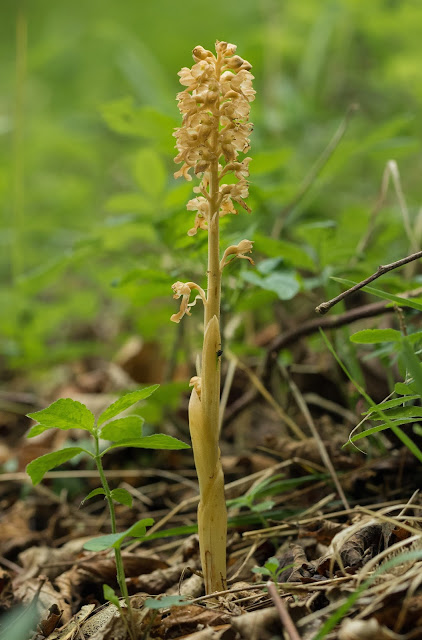
Having last seen Bird’s-nest Orchids once before way back in 2010, I was keen to catch up with several plants in bloom on the Great Orme in Llandudno, handily just over an hour away from home. Not being able to get over there to see them last year, late May saw us take a trip over to this botanically rich hotspot to explore the woodlands around the base of the Orme in an effort to try and find them.
Bird's-nest Orchid - Great Orme, Llandudno
Parking up at the Happy Valley car park area and taking one of the small trails into the trees, expecting a lengthy search I was surprised at just how quickly we stumbled across our orchids – looking up the slope we were met with two distinctive caramel-brown flower spikes nestled among the Dog’s Mercury and looming out of the dark understorey gloom. 
Bird's-nest Orchid - Great Orme, Llandudno
At first glance perhaps appearing dead to the untrained eye, on closer inspection they were flowering to perfection, tiny golden florets adorning tall leafless stems in the deep shade of the woodland floor.
Bird's-nest Orchid - Great Orme, Llandudno
A quick exploration of the surrounding area also revealed a third spike hidden a little bit further up into the trees, but we were unable to spot any additional plants in the immediate vicinity. With just three spikes (there were apparently only three plants last year too) this looks to be a very small population, but with extensive woodland carrying on further up the slope it’s highly likely there could well be more in the area.

Although Bird’s-nest Orchids can often be perceived as drab, uninteresting and plain looking due to their uniform brown flowers and stems (especially compared to some of the other more extravagant orchid species), there is actually a subtle beauty to these unusual orchids, with each petal looking as if it has been brushed with a delicious coating of sticky golden honey and almost looking good enough to eat. 
Bird's-nest Orchid - Great Orme, Llandudno
Their lack of leaves and chlorophyll (hence the brown colouration) also adds to their interest, mystery and allure, going against the grain of how plants are traditionally perceived and creating an air of botanical charisma. Completely lacking the ability to photosynthesise from the sun and instead obtaining all the nutrients they need from their fungal hosts deep in the soil, this allows them to tolerate the extensive shade and darkness that other flowers simply can’t manage. 
Bird's-nest Orchid - Great Orme, Llandudno
The Bird’s-nest Orchid has a tangled mass of roots, shaped, unsurprisingly, like a bird’s nest and indicating how it gets its name
With a scattered distribution across the UK and classed as Near-threatened in Britain on the Red Data list, there are only a handful of sites for the Bird’s-nest Orchid in the North West, although the north-east Welsh woodlands appear to be a bit of a local stronghold with occurrences around Wrexham, Mold and Ruthin all in recent years. Notably, 25 plants were also recorded in a small wood just south of Abergele hospital in 2005, as well as another record in 2006 near Bryn-y-maen, south of Colwyn Bay.

Looking back at the historical records it seems Bird’s-nest Orchid was present on the Great Orme back in the 1970’s and up to 1986, but a lack of reports after this time indicates they may have disappeared at the site until recently (I’m aware they’ve been occurring here for the past three years though at least).
Bird's-nest Orchid - Great Orme, Llandudno
Bird's nest Orchid photography in action!
With at least 7 species of orchid present on this botanically rich limestone headland, hopefully the Bird’s-nest Orchids will continue to thrive here in the coming years, expanding their population and continuing to add a sparkle to the jewel in the botanical crown that is the Great Orme. 

Sunday, 25 September 2016

Lindisfarne Helleborines!

Out of 50 species of orchid that regularly occur in Britain & Ireland and having been on a quest to see them all for the past 8 years, I had finally got down to just one species left to find – Lindisfarne Helleborine.
Lindisfarne Helleborine - Lindisfarne
Endemic to just the small island of Lindisfarne off the north Northumberland coast, this unobtrusive and at first glance relatively plain looking orchid is in fact rather special – it grows nowhere else in the world and is restricted to just a few dune slacks towards the western edge of the island. With plants quickly going over if the weather is particularly hot, as soon as I got word that the Helleborines were in flower I arranged a day off work so we could travel up to see this British speciality. Usually flowering at the start of July, the particularly wet season meant that this year they were several weeks late – just coming into their peak on the third weekend of the month.
Lindisfarne Helleborine - Lindisfarne
With Lindisfarne cut off from the mainland during high tide, we had arranged overnight accommodation nearby ready for a morning crossing, and meeting one of the wardens on site at just after 11 we were led through the dunes and to the outskirts of the colony. 
Lindisfarne Helleborine - Lindisfarne
To prevent trampling and destruction of the site due to curious orchid hunters searching for the plants, the wardens led us to a small group on the edge of the dune slacks where about 7 plants were in flower, the aim being to preserve the main colony and allowing those interested to admire and photograph the orchids to their hearts content.
Lindisfarne Helleborine - Lindisfarne
Lindisfarne Helleborines - Lindisfarne
Spot the Helleborines!
Snook - Lindisfarne
Similar to the closely related Dune Helleborine in both looks and habitat, DNA testing confirmed that Lindisfarne Helleborines are indeed separate and worthy of full species status. With around 200 flowering plants on the Snook (a section of the island) and growing nowhere else in the world, their existence could potentially be precarious - habitat degradation or severe flooding may prove disastrous for this isolated colony.
Lindisfarne Helleborine - Lindisfarne
Lindisfarne Snook
Whilst the abundant Early and Northern Marsh Orchids scattered across the dunes were already over, the Marsh Helleborines also on site were in prime condition, creating a beautiful carpet of white frilled flowers across the wetter dune slacks.
Marsh Helleborine - Lindisfarne
Marsh Helleborines - Lindisfarne
As the tide was fully in over lunchtime rendering the causeway flooded and unpassable until after 5pm, this presented an opportunity to explore the rest of the island, with several Grey seals, a colony of nesting terns across the bay and a female Eider with her fully young in tow all notable highlights as we walked to the castle.
Lindisfarne Castle - Lindisfarne
Lindisfarne Castle
Lindisfarne Priory - Lindisfarne
Lindisfarne Priory
Lindisfarne Causeway
The causeway!
With an 8 year long quest now completed and having seen and photographed all of the regular flowering orchids in Britain & Ireland, this now just leaves the almost mythical Ghost Orchid to track down deep in the Herefordshire or Chilterns woodlands – no small task by any means!
Lindisfarne Helleborine - Lindisfarne