A tale of nature, wildlife and birding from Cheshire, North Wales and across the globe....

A tale of nature, wildlife and birding from Cheshire, North Wales and across the globe....
Showing posts with label Migrants. Show all posts

Wednesday, 16 January 2019

Cyprus Birding Trip Report - Day 3 (Thursday 5th April 2018)

With our alarms jolting us awake at an ungodly hour early in the morning, bleary eyed and groggy we gathered our gear and made the journey over to the eastern side of the island, arriving at our first destination of the Cape Greco headland just after first light.
Cape Greco, Cyprus
The stunning blue waters of Cape Greco headland
Jutting out in to the Mediterranean Sea and holding the title of the most easterly point of Greek Cyprus (also the closest point to the migration mecca of Israel), Cape Greco is a migrant hotspot, well known for its impressive falls of migrant birds and rarities during the spring months. The coastal scrub that adorns the hillside holds many short staying passage migrants, and it was here that we were hoping to connect with the Ruppell’s Warblers that had so far eluded us during the trip – especially as counts of up to 18 males had been logged here just a couple of weeks prior.
Cape Greco, Cyprus
Agioi Anargyroi chapel - Cape Greco, Cyprus
The picturesque Agioi Anargyroi Chapel
Parking up beside Agioi Anargyroi chapel, we set to work exploring the nearby scrub, a pair of Cyprus Warblers giving away their location with their constant harsh chakking calls as several Chiffchaffs flitted through the gorse below. 
Cyprus Warbler - Cape Greco, Cyprus
Cyprus Warbler
The scratchy song of a male Sardinian Warbler filled the air and it wasn’t long before we had our first Masked Shrike of the trip, an impressive adult perched on one of the small pines, making several sallying flights out for small insect and reptile prey.
Masked Shrike - Cape Greco, Cyprus
Masked Shrike - Having only seen a juvenile previously (at Spurn in Yorkshire) it was nice to finally connect with an adult bird
Walking up the slope to the viewpoint at the top of the hill resulted in an all too brief perched Cretzchmar’s Bunting before it flushed out of sight, while almost every other bush seemed to hold a skulking Nightingale or Lesser Whitethroat lurking unobtrusively within.

Sadly however, after a few hours spent searching we drew a blank on the Ruppell’s front once more, and after a quick stop at the chapel we headed across to the fields next to the sea, a single female Cyprus Pied Wheatear at close range all we could unearth for our efforts.
Cape Greco, Cyprus
Cape Greco, Cyprus
Acquiring some intel from local birders at the Cape Greco Visitor Centre that the nearby pines had held some interesting migrants that morning, we decided to give it a shot, hoping to relocate the Semi-collared Flycatcher and female Ruppell’s that someone else had seen there that morning.

Sadly, despite us and another birder looking, the pines were hopelessly deserted by the time we’d got there, and after an intense search only a handful of Chiffchaffs, Blackcaps and a female Cyprus Warbler were all we unearthed (as well as a new hatred for pines). The adjoining scrubland revealed a pair of nesting Spectacled Warblers that we left in peace, while a familiar bubbling call directly overhead revealed a flock of Bee-eaters making landfall fresh in off the sea (sadly no Blue-cheeked amongst them).
Cape Greco, Cyprus
Cape Greco, Cyprus
Cape Greco, Cyprus
With Cape Greco itself being unusually quiet, we cut our losses and headed over to the next site of the day, Ayia Napa Sewage Works. Again, with a depressing pattern emerging, what is normally billed as a great site for migrants was exceptionally quiet during our visit, with just the usual Blackcaps, Chiffchaffs and Willow Warblers feeding amongst the pollen. Thankfully, our journey to the eastern side of Cyprus hadn’t been in vain, as a single Eastern Bonelli’s Warbler flitting in the willows at the side of the track salvaged what had been an entirely unsuccessful morning up until this point, the green-tinted tertials and silky white underparts differing from the assorted Chiffchaffs. 
Ayia Napa Sewage Works, Cyprus
At this point the road became decidedly more and more potholed, and it was with careful navigation that Alex manoeuvred the hire car to the end of the track unscathed. Rather less fortunate was the fact we had come to an abrupt dead end, the only route leading back to the exit road passing through the private and gated water treatment works. With a staff member having spotted us and denied all entry, we were forced to make a return drive the way we came, navigating the deep pot holes and steep water channels once more, stopping to scope several Ferruginous Ducks and Black-necked Grebes bobbing on the sewage works pools.
Ayia Napa Sewage Works, Cyprus
The gravel track surrounding the sewage works
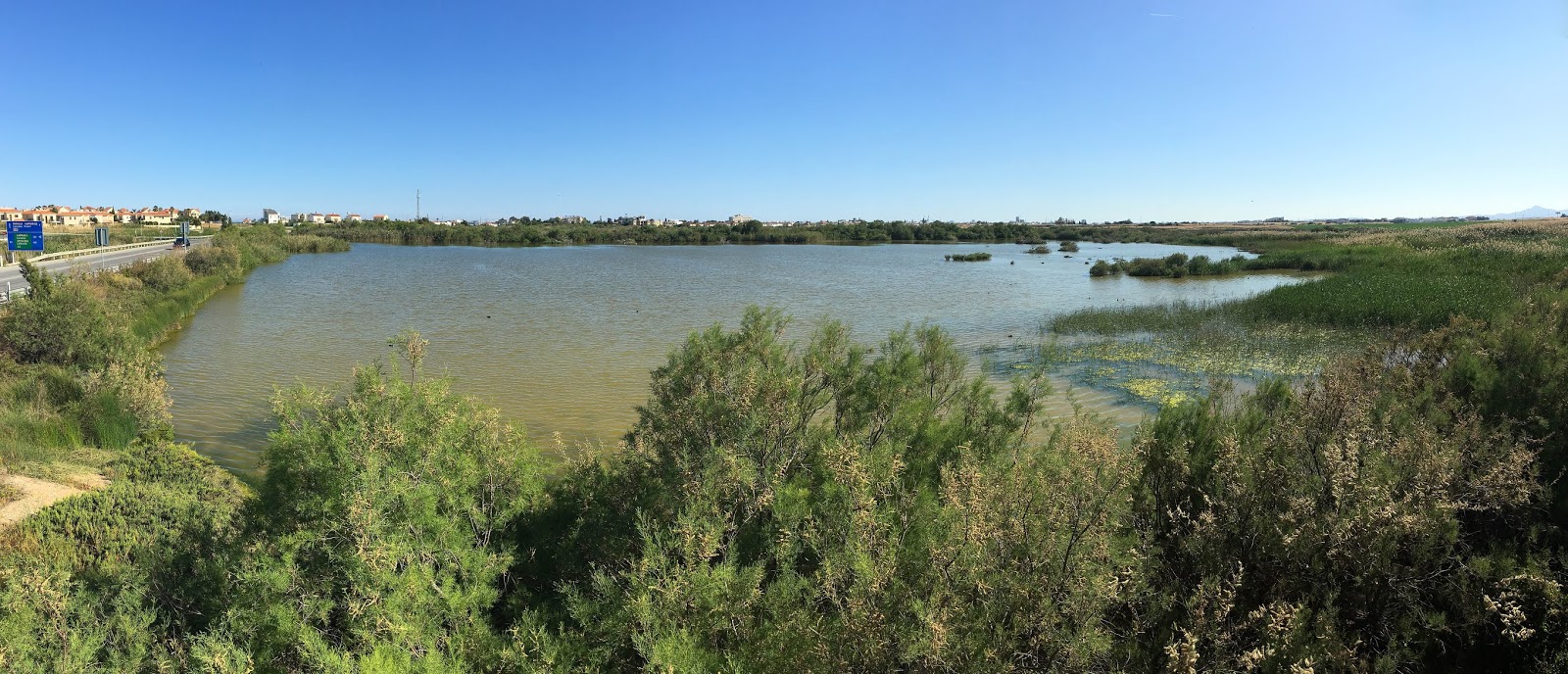
With the afternoon pressing on we headed to our final site of the day – Oroklini Lake, a fantastic reserve just north of Larnaca. Before we’d even arrived several Spur-winged Plovers showed off at the side of the road (Oroklini Lake is a hotspot for this species), while several egrets powered overhead. Checking out the hide overlooking one of the pools revealed several more Spur-winged Plovers roosting in the reeds, while a small handful of Black-winged Stilts gingerly picked their way through the mud.
Oroklini Lake, Cyprus
Scanning the water soon resulted in several new ducks for the trip with Red-crested Pochard, Garganey, Pintail, Teal and Shoveler all in attendance, while a distant Black Francolin belted out its rasping call behind us. Scanning the fields, Alex somehow managed to pick it out, stood on a low stone wall in the distance and enabling the briefest of record shots! 
Black Francolin - Oroklini Lake, Cyprus
Black Fancolin - a distant and blurry record shot!!
With the Francolin staying put and looking like it was next to the main road, we headed off in that direction in an attempt to secure better views, but upon reaching the field in question it appeared to have gone, just a lone Chukar roaming through the stubble as consolation. 
Chukar - Oroklini Lake, Cyprus
Chukar
Xrisosotiros Akanthous - Oroklini, Cyprus
Xrisosotiros Akanthous church near Oroklini
Xrisosotiros Akanthous - Oroklini, Cyprus
A pair of extremely showy Spur-winged Plovers right next to the road also gave our cameras a workout providing our best views of the trip, but with no further birds of note from the second hide we decided to make the long journey back to Paphos, just one new bird to show for our excursion. 
Spur-winged Plover - Oroklini Lake, Cyprus
Spur-winged Plover
Spur-winged Plover - Oroklini Lake, Cyprus
Never the less the Eastern Bonelli’s transpired to be the only individual we saw all trip, and despite the lack of our target birds during our visit, Cape Greco headland has huge potential to reveal some truly great birds given persistent coverage during peak migration times.
Cape Greco, Cyprus

Monday, 12 October 2015

Autumn weekend at Spurn

A two day trip to the fantastic coastal spot that is Spurn this weekend resulted in the expected scattering of east coast migrants as well as a lifer in the form of a Richard’s Pipit in one of the fields opposite West Mere Farm at Kilnsea.

Having not been seen for a good hour when I got to the field in question and with only 2 other birders staking out the grass where it was last spotted, it soon turned in to a waiting game and a test of perseverance. With Alex checking the nearby hedgerows for migrants, I stuck it out in the hope of connecting, and sure enough, after ten minutes or so, the only other remaining birder had it in his scope, the pipit giving good views as it hopped out in to the open in front of the water trough.

Much larger than a Meadow Pipit, with extremely long legs and an almost thrush like facial profile due to the head shape and bill, this distinctive pipit was a much awaited lifer for me after not counting a bird seen very briefly on the Great Orme 3 years ago having just got a fleeting glimpse of the top of a bird’s head!

After calling Alex back, we both got nice scope views as the pipit moved through the long grass, only becoming visible when it popped its head up to stop and scan around, standing upright with its neck outstretched. Despite moving quite a way across the field, we still managed to track the bird through the grass, occasionally coming right out in to the open so we could really admire the bird in full. At one point, it even flew up and came closer, giving a first-hand opportunity to hear that characteristic flight call – quite similar to that of a sparrow.

Satisfied with our views of the Richard’s Pipit, we stopped by to admire the cracking male Black Redstart that had been frequenting the garden of the house opposite, before heading to Kilnsea Wetlands where an American Golden Plover had just been found. Despite having already seen one in Cornwall at extremely close quarters last year, it was still nice to catch up with another bird, and we were all incredibly surprised when a second individual dropped by to join it! Despite the plumage differences between the two (with both birds seeming to be at opposite ends of the scale in terms of variation) when the birds stood next to each other it was clear they were both exactly the same size, and not an AGP and a Grey Plover like some had suggested. 
American Golden Plovers - Kilnsea Wetlands
When both birds eventually flapped their wings to reveal dusky tones and no hint of any solid black armpit patches, the ID was settled beyond doubt. Around 20 Brent Geese, a whole field of Hares and two fantastic hunting Barn Owls in the fading light were a great end to the day.
Having stayed overnight in Hull, we returned early the next morning to see what migrants may have been brought in on the easterly winds during the night. Despite every single bush positively heaving with Goldcrests everywhere you looked (thousands must have been present at Spurn and Kilnsea alone) other migrants were seemingly thin on the ground, and it was hard work to produce anything of note.

Two Bramblings in the Crown and Anchor car park were a nice find, while a 1w/female type Redstart caused some debate as to whether it was of the eastern form samamisicus, or Ehrenberg’s Redstart as it is known, with some white on the wing panel hinting to this eastern form. Despite the relatively distant views as it worked a hedge at the far end of a field, some photos were obtained, although personally I’m struggling to assign it to anything other than a normal Common Redstart.

A cracking Yellow-browed Warbler in the third paddock at Sammy’s Point rounded off our second day nicely, giving brief but great views and calling loudly as it hopped from bush to bush – a true sound of Autumn and one I’ll never tire of hearing.

Sadly, the Pallas’s Warbler on Humber Side Lane in Easington didn’t play ball to the amassed crowd, and two visits failed to pay off, as the bird remained highly elusive as it presumably undertook a circuit around the cottages and fields, only being seen twice that afternoon.

With a Red-flanked Bluetail and a Dusky Warbler both being found at Spurn this morning, things are clearly on the move, and what has so far been a quiet Autumn looks to finally be getting some life injected in to it. With several weeks of October and the beginning of November left to produce the goods, there is still time yet for that much sought after Siberian beauty to materialise – a Rubythroat would look especially welcome perched nicely on the Cliff Farm entrance stone or hopping though Church Field! 
Spurn

Tuesday, 25 August 2015

Booted Warbler - Gramborough Hill, Norfolk

After a great day out on the Saturday at Birdfair, news broke during the afternoon of a Booted Warbler found at Gramborough Hill in Norfolk. Being just over 2 hours away and having exhausted the stands at Birdfair, it would have been rude not to pay a visit, so me, Alex and Chris Bridge headed off over to Norfolk. With south easterlies forecast for the night and through to Sunday, this also seemed a good place to base ourselves for a fall of easterly migrants.

Making good time and arriving at around quarter to 7 (special thanks to Alex for driving to Norfolk unexpectedly!), we sprinted the short distance over the shingle and up the hill, joining the small crowd of birders stationed watching the patch of scrubby bushes the Booted Warbler had been frequenting. Having just missed an appearance by seconds (I was now regretting that toilet stop) we now faced a tense wait to see if it would reappear, especially as Chris had a train to catch at Sheringham in around an hour. Being at Birdfair also meant we were totally unprepared, with just a single pair of binoculars and scope between the three of us! Potential nightmare situation waiting to happen if the views were brief.

Luckily, I soon spotted a bird pop up on the small Sycamore tree it had last been seen around. Having no optics, I quickly told Alex to get on the bird, especially as a Pied Flycatcher was also knocking around the same bush. With the other birders now on it, it was indeed confirmed as the Booted Warbler, and with Chris managing to get on it in the scope, that just left me with eye-only views. Waiting for a reappearance and now armed with Alex’s bins, the bird thankfully reappeared after around ten minutes, allowing me to get great views as it flitted from branch to branch feeding on flies.
Booted Warbler - Gramborough Hill, Norfolk
Chris's record shot
Quite drab and brown in appearance at first glance, perching out in the open allowed us to see the most notabe features well – the strong head pattern stuck out the most to me, with a distinctive short pale supercilium and quite dark lores. Similar to both Olivaceous warblers and Sykes’s Warbler, Booted Warblers can be separated by the shorter bill, strong supercilium and darker colouration – the extremely similar but rare Sykes’s being the general colour of a milky tea and having very weak head markings in comparison.
Booted Warbler - Gramborough Hill, Norfolk
Recorded annually but with the majority of records coming from Yorkshire, Norfolk and the Scillies, Booted Warblers are not really a bird that is recorded in the North West, and with no records in the midlands, we were lucky that we didn’t have to make a mammoth journey to connect with one, especially after last year’s only mainland record being in Lothian, Scotland.

Happy with our views, this was a great bird to catch up with, that even though might fall under the category of “Little Brown Job”, is subtly beautiful in its own way. 

Tuesday, 14 April 2015

Ring Ouzels on the Great Orme

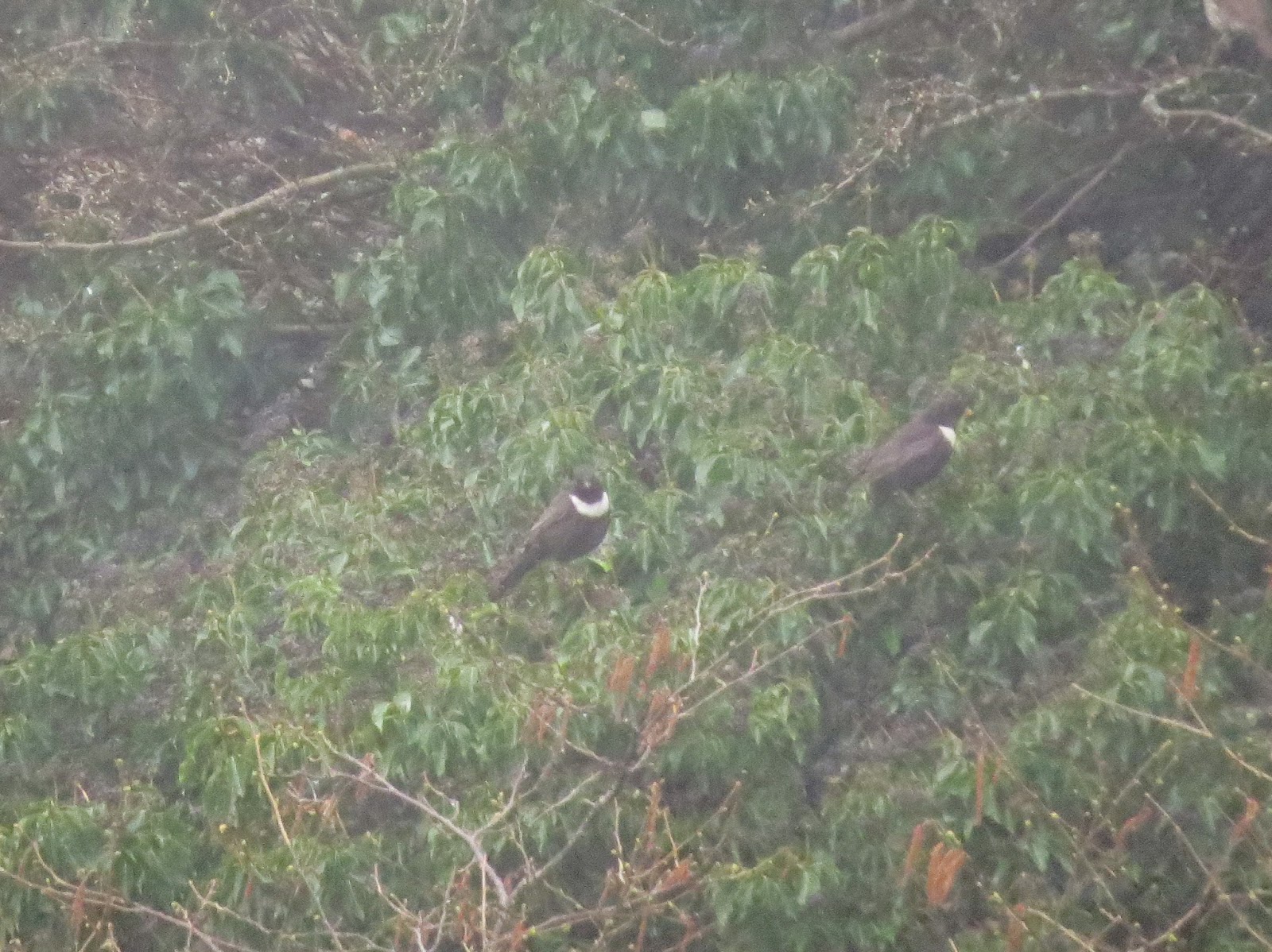
With a huge fall of Ring Ouzels documented throughout the UK from Friday onwards, and with up to 20 birds present on the Great Orme since Saturday morning, we decided to call in on the Sunday after returning from Scotland. Despite the absolutely howling gales and driving rain (which caused the car to rock from side to side with the sheer force of it all), and with the helpful directions from Alex’s friend Steve Culley, I eventually picked up 2 birds in flight and calling near the Copper Mines. I soon located a lot more birds further down the slope, all actively feeding in the same ivy tree, and despite the far from perfect conditions we counted 7+ birds.
Ring Ouzel - The Great Orme
A record shot of the male Ouzel
Ring Ouzel - The Great Orme
I was especially pleased to track down these birds as I haven’t had great views of Ring Ouzels before, merely a quick fleeting glimpse on a fence before a pair flew away on a visit to Moel-y-parc a few years ago, and a female by the side of the road whilst driving in Cheshire being my only other sightings, so it was great to watch these large thrushes going about their business at leisure, despite the absolutely horrific weather.
Ring Ouzels - The Great Orme
The driving rain made it hard to get even record shots!
Ring Ouzel - The Great Orme
Interestingly, Ring Ouzels haven’t been picked up from this side of the Orme before, with birds usually getting found on the opposite side in the sheep fields. However, the fields and patches of grass surrounding the Copper Mines and over towards the nearby houses seemed the perfect habitat for these migrants, and it was clear why they had all congregated in this one patch of trees – this sheltered spot offered a welcome respite from the harsh winds and abysmal weather.
Ring Ouzels - The Great Orme
All the birds had congregated in one tree - 4 can be seen in this one shot alone with another just to the left out of frame
The row of ivy trees in particular at the back of the donkey field next to the rubble track appeared to be the most favourable, and this little sheltered spot seems like it would pose an attractive area for migrants in the spring and autumn months – definitely an area to watch more closely in the future!