A tale of nature, wildlife and birding from Cheshire, North Wales and across the globe....

A tale of nature, wildlife and birding from Cheshire, North Wales and across the globe....

Thursday, 27 September 2018

MEGA!! Sooty Tern at the Ythan Estuary, Aberdeenshire!!

The summer holidays are always a tricky time when it comes to twitching, especially as Alex has six weeks of freedom while I’m stuck at work, and as such I always dread the mega alert going off during July and August…
Sooty Tern - Ythan Estuary, Aberdeen
Sooty Tern! Not the most expected of summer megas!
Typically, no more than 3 days (!) into the holiday the mega alert sounded in to action once again, this time signalling the relocation of the Sooty Tern that had been flirting with the east coast for the past few weeks, finally getting pinned down at none other than the Ythan Estuary, home of the long staying and famous King Eider that now calls the beaches and river mouth its home. Groan. On a Monday this was probably the worst time for a bird to appear, and meant I had 4 days to endure before I could make the trip up (while Alex went dashing up to the Ythan without me…) 
Sooty Tern - Alex Jones
Alex's views of the Sooty Tern.... without me!
Originally spotted off Brownsman Island on the Farnes at the start of July, with a gap of two weeks before it was seen again flying past Inner Farne (and later landing briefly at Long Nanny in Northumberland for a few hours) the Sooty Tern had actually been seen fleetingly at the Ythan on the Friday evening, but with no sign at all over the weekend it wasn’t until 5pm on the Monday that it was re-found on the mussel beds, performing well all evening for those initial observers.
Ythan Estuary - Aberdeen
The mussel beds on the Ythan Estuary where the Sooty Tern set up home
Showing well all week since, treating onlookers at the famous tin hut to fantastic fly-bys and perching obligingly on the rocky shore, it was somewhat disheartening to see the “no sign” reports come trickling through on Friday morning, carrying on in to lunchtime. With a tricky decision to make and a potential dip on the cards after a long drive of 6+ hours, it may have seemed risky to press on with no sign, but it was a case of definitely NOT seeing a Sooty Tern sat at home as the only alternative, so leaving work at lunchtime, me and my Dad made the long journey north in what initially seemed like a bit of a doomed mission from the get go.
Aberdeen
The weather was absolutely ATROCIOUS (this was not night!)
Arriving as darkness approached in absolutely torrential rain and with lightning so close it practically shook the car, there had still been no sign of the Sooty Tern all day. Never the less we made a quick attempt to scope out from Inch Road (standing in a tin hut in a lighting storm didn’t seem like the best of ideas) but with darkness soon closing in and the tern colony just a touch too distant in fading light, we failed to make out a Sooty Tern amongst the wheeling flock of white.  

Thankfully, despite heavy rain forecast all weekend, Saturday morning dawned with a refreshing break in the weather and dry skies, and on checking my phone the impossible seemed to have happened – the Sooty Tern was back. Luckily our hotel was only a ten minute drive from the Ythan, and after a rather tense wait of an hour or so when the bird had gone missing out at sea, thankfully the cry went up as one stately Sooty Tern came swooping in to view.
Ythan Estuary - Aberdeen
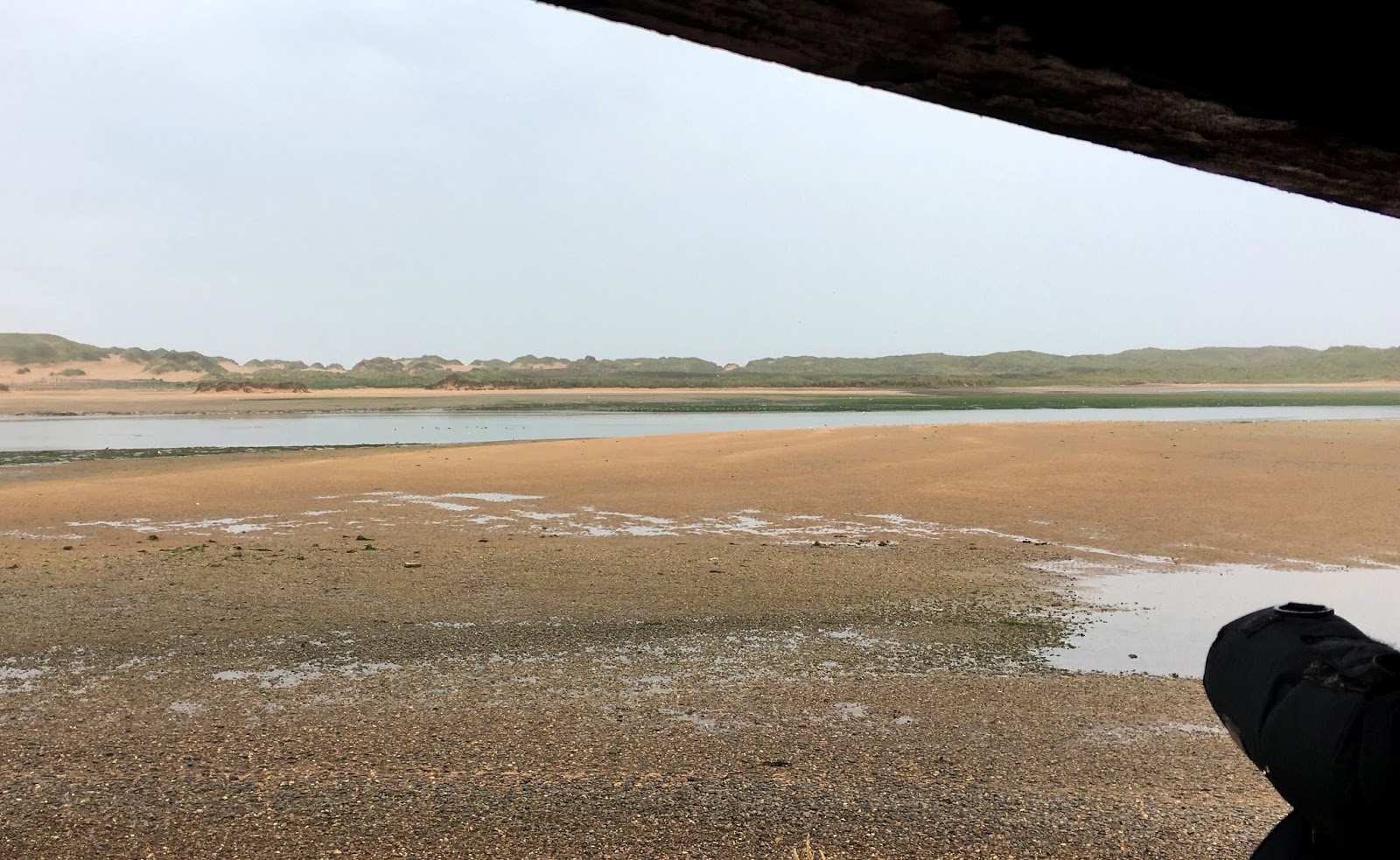
Waiting for the Sooty...the view from the famous tin hut!
Much larger than the assorted Commic Terns, with jet black wings and giving off a distinctive Skua-like silhouette, the Sooty was truly unmistakeable, and we watched as it gave further fly-pasts before continuing left down to Inch Road before settling down distantly on the algae clad rocks with a handful of Sandwich Terns.
Sooty Tern - Ythan Estuary, Aberdeen
Sooty in the rain....
Sooty Tern - Ythan Estuary, Aberdeen
Zoomed in....when I say distant I really mean distant!
Deciding that heading back to the car and driving to Inch Road instead of walking along the now soaking wet dunes would be the best option (it was now starting to rain quite heavily) we raced back to the car and nipped round to the car park at Inch, the Sooty Tern conveniently perched right in front of us and providing great views despite the now torrential downpour. Brollies in one hand and camera in the other I was able to reel off some record shots before the Sooty alighted once more, circling round to the tin hut and back before powering off up the river upstream and lost to view as a distant spec. Excellent timing and Sooty Tern well and truly in the bag!
Sooty Tern - Ythan Estuary, Aberdeen
Despite having seen Sooty Terns before at the Dry Tortugas islands off Florida and Michelmas Cay in Australia, I was still struck by just how large the Sooty was compared to our resident tern species (Common, Arctic, Sandwich, Little and Black were all present on the Ythan during our visit, making it a 6 tern day!) and it really was unmistakable when flying among the swirling masses of white.
Bridled Tern - Farne Islands
The Farne Islands Bridled Tern back in 2014. Sooty Terns differ from the very similar Bridled Terns by their larger size and much darker, uniform black back and upperwings compared to a Bridled Tern’s lighter grey. 
Usually found in tropical seas around Australia and the Caribbean, this Aberdeenshire bird was realistically only the third twitchable record in recent years (following on from the widely twitched and popular bird that frequented the Skerries off Anglesey and Cemlyn Bay during July 2005 and the moribund bird found on a Northamptonshire gravel pit back in 1980) so I was especially keen not to miss this opportunity – who knows how long it will be before the next twitchable Sooty in Britain! 
Our views of Sooty Tern on Michelmas Cay last summer
Despite seeming like a no hope situation when setting off on the Friday, this was most definitely a case of “he who dares wins” and I’m glad I followed my usual mantra of persevering with a planned twitch even if negative news surfaces while en-route – thankfully this time the gamble paid off!

Monday, 17 September 2018

Green-winged Orchids at Muston Meadows NNR, Leicestershire!

Not having a DSLR camera back in 2009 when I first saw Green-winged Orchids at Durlston CP down in Dorset, I decided to head over to Muston Meadows NNR in Leicestershire this spring in an attempt to get some better photos of this charming species of orchid. 
Green-winged Orchid - Muston Meadows, Leicestershire
Often described as one of the finest lowland meadows in England with thousands of Green-winged Orchids growing amongst a plethora of other botanical delights, after a quick stop off at the nearby tearooms for a bacon sandwich we arrived at Muston just before lunch, eventually finding the entrance to the reserve tucked away in the hedges (after getting slightly lost in several of the nearby crop fields!)
Muston Meadows, Leicestershire
Muston Tearooms
Bacon toastie - prime orchid hunting fuel!
With the black rain clouds on the horizon ominously threatening rain, we set to work exploring this hidden gem of a nature reserve in an effort to find the best flowering specimens for photography and to admire the many different colour variations of Green-winged Orchid that can be found on site here.
Green-winged Orchid - Muston Meadows, Leicestershire
Pollination in action!
Green-winged Orchid - Muston Meadows, Leicestershire
Thankfully the rain held off and we were able to appreciate the myriad of colour forms that occur, from the pretty pale rose pink varieties and the dainty almost pure white plants, to the more regular deep wine purple flowers that are the norm.
Green-winged Orchid - Muston Meadows, Leicestershire
An especially pale plant
Rather sadly, Muston Meadows has seen a reduction in size somewhat dramatically over recent years, with almost 30 hectares de-declared from being an NNR and losing protection, leaving just a few fields secure. Thankfully it is here that the Green-winged Orchids thrive, and Muston Meadows is still one of the best sites on the northern edge of its range in which to see these dainty orchids, boasting an impressive colony of over 10,000 plants. 
Muston Meadows, Leicestershire
The meadow was full of thousands of orchids
Even sadder still, with the destruction and drainage of many unimproved grassland pastures that Green-winged Orchids previously called home, the population in Britain has crashed, declining by almost 50% from the numbers seen only 50 years ago. As a result, Green-winged Orchids are now listed as Near Threatened in England, so it was fantastic to see them occurring in such good numbers at Muston - hopefully they will continue to thrive here for the foreseeable future. 
Green-winged Orchid - Muston Meadows, Leicestershire
Muston Meadows, Leicestershire

Getting to Muston Meadows

Muston Meadows NNR can be found just west of Grantham in north east Leicestershire. We parked on the corner of Woolsthorpe Lane (NG13 0FE) at the southern end of the village of Muston, then walked down the small lane heading west. The style entrance to the reserve could be found towards the end of the lane on the left hand side nestled within the hedge. 

Flowering is usually in late April through to May (earlier in the southern counties), and we visited Muston during the second week of May when the orchids were in their prime.
Green-winged Orchid map - Muston Meadows, Leicestershire
Map of Muston Meadows NNR

Thursday, 16 August 2018

Snow in June? Snowy Owl makes landfall on Anglesey!!

Snowy Owl is a bird I’ve wanted to see in Britain since I was very young, having made a small “Owls in the UK” checklist complete with little photographs to tick off each species as I saw it – Snowy Owl sitting right at the bottom with “VAGRANT” written next to it.

Fast forward several years with all owls now ticked off (even European Scops making it on to the list!) just Snowy Owl remained, with a big blank square sitting next to its name.

Having never made it to either the Cairngorms, Scilly Isles or East Anglia over recent times to twitch the long-staying birds that set up home there, it was therefore a bit of a surprise and a stroke of good luck and timing when reports of a Snowy Owl seen on Anglesey came trickling in on a Friday afternoon back in June. Showing well all afternoon on Point Lynas coastal path, as soon as the first photos of confirmation came through on Twitter I left work early to try and connect, beating the rush hour traffic and picking up Alex en-route.
Snowy Owl, Anglesey
Snowy Owl!
Snowy Owl, Anglesey
Point Lynas, Anglesey
Making good time and arriving mid-afternoon, we were unfortunately met with the news it had just this second flown over the brow of the hill and lost to view – horrendous bad luck on our part! Thankfully we didn’t have long to wait for a reappearance, as after just a tense 5 minute wait the owl was refound further along the track, being harassed by one of the local Buzzards but standing it’s ground and sitting serenely amongst the gorse.
Snowy Owl, Anglesey
Snowy Owl, Anglesey
Setting up our scopes (my ankles getting slashed to pieces in the process by the local plant life – ankle socks were NOT a good idea) we were able to get great and prolonged views as this majestic arctic owl sat peacefully on a patch of rocky ground, turning its head regularly and blinking obliviously at its small crowd of admirers.
Snowy Owl, Anglesey
Snowy Owl, Anglesey
Snowy Owl, Anglesey
Snowy Owl, Anglesey
Normally a far arctic species much more at home in the Canadian, Greenland or Russian expanses, 2018 has seen a bit of a mini influx of Snowy Owls in to the UK, with individuals of this stately owl recorded in locations such as Shetland, Orkney, the Outer Hebrides, Gwent, Gwynedd, Lincolnshire/Norfolk, the Scilly Isles and Pembrokeshire to name a few.
https://www.xeno-canto.org/species/Bubo-scandiacus
The normal range of Snowy Owls
And the latest sightings in the UK this year as per Birdguides
With the St. David’s Head bird in Pembrokeshire last seen on the 7th April, and subsequent sightings of a Snowy Owl further north in Ceredigion a day later and on Skomer Island on the 30th May, it’s entirely plausible that this could be the same female moving north. However reports of a Snowy Owl on Anglesey have been doing the rounds since the spring, with a bird reported at South Stack as far back as the 24th March and again at Rhosneigr on the 13th April, so it is equally as likely that this is a different individual altogether from Pembrokeshire bird, having set up home in the remote Welsh mountains and remaining undetected for long periods of time. Indeed, after making itself available at Point Lynas, it wasn’t until 3 weeks later that it was spotted again further west at South Stack, with another month on top of that before it was reported once more.
Point Lynas, Anglesey
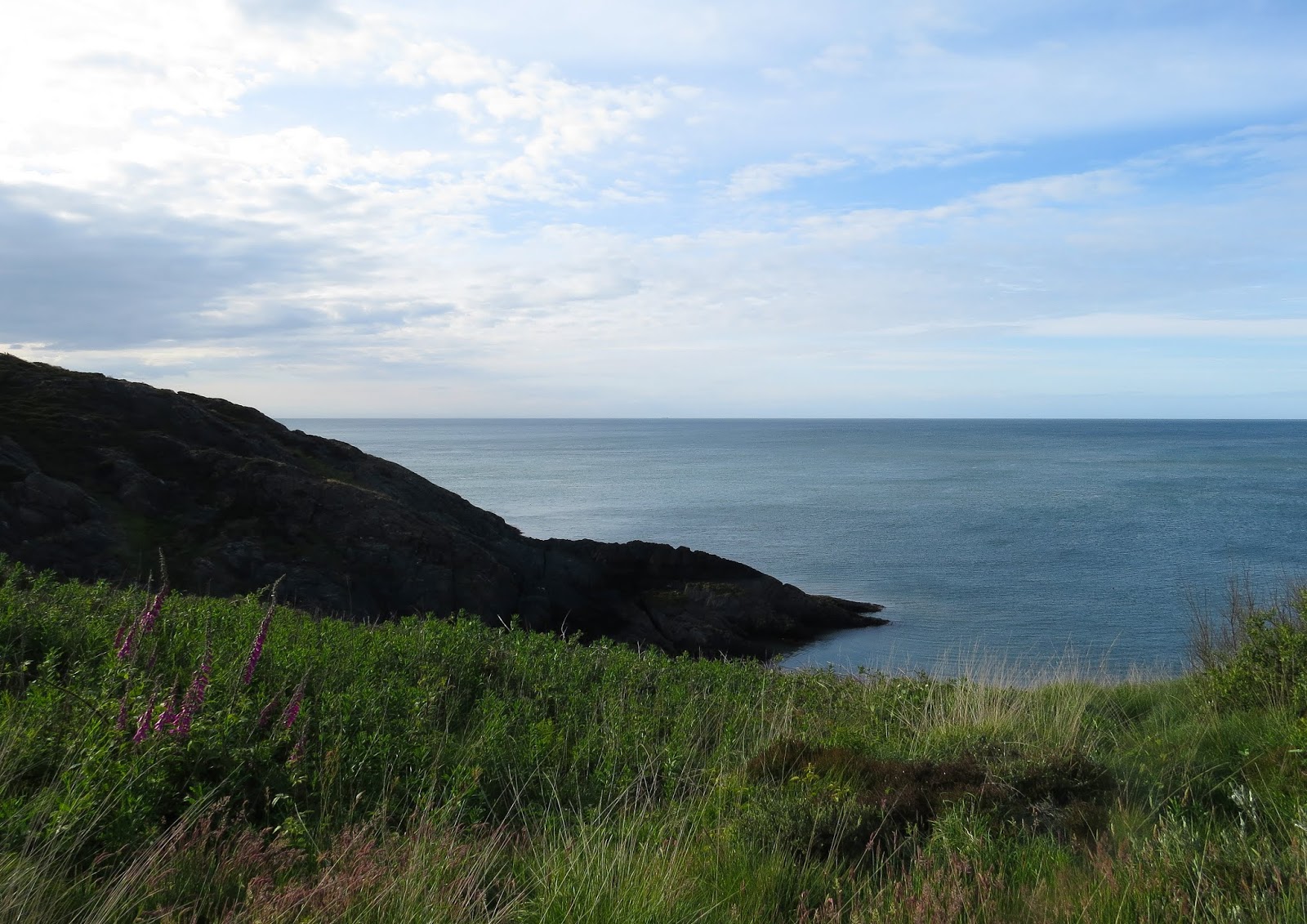
The beautiful views from the coastal path
Regardless, this was a fantastic local bird to see in a beautiful, rugged Welsh coastal setting, and a bird that means I can finally tick off that blank square on my owl checklist after all these years.

Tuesday, 19 June 2018

Tenerife Birding Trip Report (18th April - 22nd April 2017) - Species List and Locations

Day 1 – Mount Teide (18th April 2017)


Plain Swift – 18th AprilTF51 + Calle Mazape intersection in Arona (Around 30 seen on route to Mount Teide).
Tenerife Blue Chaffinch – 18th AprilLas Lajas picnic site (6 birds seen in total, with 4 males and 2 females. Birds were feeding on the picnic tables).
Atlantic Canary – 18th April – Las Lajas picnic site (Small flock feeding underneath the picnic tables).
Canary Islands Chiffchaff – 18th April – TF51 La Escalona (2 birds calling in fig trees by the side of the road and showing well).
Tenerife Blue Chaffinch - Tenerife
Tenerife Blue Chaffinch

Day 2 – Mirador de La Grimona (19th April 2017)


Laurel Pigeon – 19th April – Mirador de La Grimona Viewpoint (Around 10 seen flying across the mountain, with some perching in trees).
Bolle’s Pigeon – 19th April – Mirador de La Grimona Viewpoint (2 seen perched in the trees).
Laurel Pigeon - Tenerife
Laurel Pigeon

Day 3 – Charco Verde (20th April 2017)


Barbary Falcon – 20th April – Charco Verde (2 hunting along cliffs and showing well).
Barbary Falcon - Charco Verde, Tenerife
Barbary Falcon

Notable Species:

Nanday Parakeet – Birds seen flying around the hotel (Hotel OlĆ© Tropical Tenerife) and again at Golf Las AmĆ©ricas.
Berthelot’s Pipit – Birds seen in rocky areas around Mount Teide and at Charco del Viento.
Sardinian WarblerA small handful of birds seen in coastal scrub areas and on the mountainside.
Spectacled Warbler – One individual seen in scrub on the mountainside descending from Vilaflor.
African Blue Tit – A small handful of birds seen at Las Lajas picnic site and heard calling elsewhere on the island.
Southern Grey Shrike – A small number of birds seen perched at the side of the road and on Mount Teide.
Spanish Sparrow – Relatively common in the urban areas around Playa de las AmĆ©ricas.
Berthelot's Pipit - Tenerife
Berthelot's Pipit

Notable Canary Islands subspecies:

Common Buzzard – Frequent across the island
Common Kestrel – Abundant across the island
Great Spotted Woodpecker – Several observed at Las Lajas picnic site
Robin – A small number seen throughout the trip
Grey Wagtail – Observed in Playa de las AmĆ©ricas and Golf Las AmĆ©ricas
Canary Islands Kinglet (Goldcrest) – One seen at Las Lajas picnic site
Common Chaffinch – One seen on road on the descent to Mirador de La Grimona
Common Raven - One seen flying over at Las Lajas Picnic site
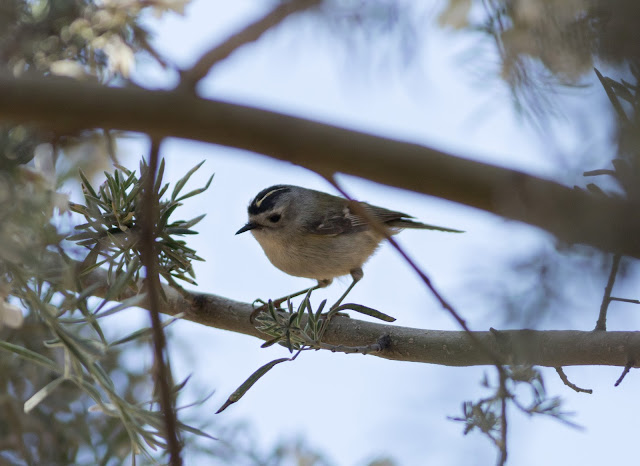
Canary Islands Kinglet - Tenerife
Canary Islands Kinglet

Additional Species


Cory’s Shearwater
Little Egret
Yellow-legged Gull
Common Tern
Feral/Rock Dove
Eurasian Collared Dove
House Martin
Blackbird
Blackcap
Wood Warbler
Common Chiffchaff
Goldfinch

Heard only:
Quail

34 Trip Total
7 Trip lifers


Butterfly List

Canary Blue – Las Lajas Picnic site
African Grass Blue – Costa Adeje
Bath White – La Escalona
Canary Red Admiral – Mount Teide Visitor Centre
Green-striped White – Mount Teide Visitor Centre
Monarch – Playa de las AmĆ©ricas
Canary Blue - Tenerife
Canary Blue

Reptile List

West Canaries Lizard
West Canaries Lizard - Tenerife
West Canaries Lizard

Sunday, 17 June 2018

Tenerife Birding Trip Report - Days 4 & 5 (Friday 21st - Saturday 22nd April 2017)

Our final two days on the island were at a much more relaxing pace than the first three - having now cleaned up on all of our realistic target species allowing us to enjoy the beauty of Tenerife at leisure. Sadly, our planned excursion to go swimming with turtles for the day in the nearby bay had been cancelled, so instead we spent our remaining time in the southern part of the island, exploring the beaches around Costa Adeje and the lushly vegetated areas at Golf Las Americas, just a short walk away from our hotel.
Costa Adeje, Tenerife
With limited birdlife in these urban settings we nevertheless spent an enjoyable morning photographing a flock of Plain Swifts as they hurtled around our hotel balcony, the clear blue skies and palm-laded horizon the perfect backdrop as they sped through the air. 
Plain Swift - Playa de las AmƩricas, Tenerife
Plain Swift
Plain Swift - Playa de las AmƩricas, Tenerife
A small flock of Nanday Parakeets making use of the hotel grounds was also a nice surprise, while the usual Spanish Sparrows busied themselves noisily around the pool area. 
Nanday Parakeet - Playa de las AmƩricas, Tenerife
Nanday Parakeet adding a touch of the exotic to the hotel grounds
Nanday Parakeet - Playa de las AmƩricas, Tenerife
Still lacking the impressive Monarch on our butterfly lists for the island, after a delicious lunch and pancakes at a little Dutch cafĆ© on the seafront we explored the many grassy and floral areas around Costa Adeje in a hunt for these winged wonders. 
Costa Adeje, Tenerife
Sadly, the abundance of flower bushes along the seaside strip drew a blank on the Monarch front, but several small African Grass Blues (a new butterfly for us) kept us occupied as we fruitlessly chased after them with our cameras on the short grass turf in the park. 
African Grass Blue - Playa de las AmƩricas, Tenerife
African Grass Blue - almost impossible to get one to keep still!
African Grass Blue - Playa de las AmƩricas, Tenerife
East Atlantic Sally Lightfoot crabs (Grapsus adscensionis) - Tenerife
East Atlantic Sally Lightfoot crabs were everywhere on the rocks nearby
East Atlantic Sally Lightfoot crabs (Grapsus adscensionis) - Tenerife
Costa Adeje, Tenerife
Keeping our eyes peeled for any of the domesticated African Collared Doves that can be found on the island, we struck upon a possible candidate in the tree-lined alleyway opposite the hotel, the under tail a striking bright white as opposed to the greyer tones of Eurasian Collared Dove. 
Collared Dove - Playa de las AmƩricas, Tenerife
Collared Dove - Eurasian or African?
Collared Dove - Playa de las AmƩricas, Tenerife
However, the mixed colouration on the wings was somewhat troubling, and possible hybridisation couldn’t be ruled out, leaving this species at least as one for another trip – preferably in their natural range!!
Collared Dove - Playa de las AmƩricas, Tenerife
After a delicious final meal of Persian chicken with rice and a good night’s sleep, our final day in Tenerife dawned beautiful and sunny, and with our flight not until later on in the evening we had a whole day left to explore the island. Leaving our bags behind in the hotel gave us the opportunity to take a look around the extremely flowery looking Golf Las Americas, once more on the lookout for any Monarchs or migrant birds stopping off on their spring journey north. 
Golf Las Americas, Tenerife
Canary Islands Chiffchaff - Golf Las Americas, Tenerife
Canary Islands Chiffchaff
The grounds were full of the usual Blackcaps and Canary Island Chiffchaffs, with a single two toned call of a Common Chiffchaff (our first of the trip) thrown in for good measure. Several more Atlantic Canaries foraging around the well hosed flowerbeds were as always nice to see, as was a Turtle Dove perched out in the open, while a single Wood Warbler, clearly a migrant, was a great find by Alex in a small wooded copse. 
Turtle Dove - Golf Las Americas, Tenerife
Turtle Dove
Wood Warbler - Golf Las Americas, Tenerife
Alex's Wood Warbler
A pair of Nanday Parakeets screeched around the palms surrounding the green noisily as flocks of Plain Swifts danced overhead, while a small flock of Spanish Sparrows chattered away on the dusty footpaths around the complex, offering great views of these charming southern residents.
Spanish Sparrow - Golf Las Americas, Tenerife
Spanish Sparrow
Spanish Sparrow - Golf Las Americas, Tenerife
Tulip Tree - Tenerife
Tulip Tree
Disappointingly, despite the abundance of flowers, our Monarchs once more evaded us, a plethora of whites and African Grass Blues all we could manage in the flower borders. It wasn’t until we got back to the hotel to reclaim our suitcases that we finally had our prize – a single Monarch powering determinedly over the cars and in to the next hotel grounds, lost to view and offering no real chance of a photo. 
Monarch - Playa de las AmƩricas, Tenerife
Monarch! Honest!
Somewhat ironically, looking up also revealed a lone Barbary Falcon circling slowly over the buildings – after spending days chasing them in the north it was typical to have one cruising over our very own hotel! 

With a subsequent drive back up to Villaflor generating nothing of note bar a single Spectacled and Sardinian Warbler each respectively (a flyover flock of Black Storks and a soaring White-tailed Eagle got our pulses racing until we realised that they most probably originated from the bird park below!) we didn’t log anything further of interest apart from a lone Common Tern at Marina del Sur.
Common Kestrel - Marina del Sur, Tenerife
Kestrels were regularly seen on our drives round the island
With our flight now beckoning, we were able to look back on what had been another successful trip to the Canary Islands, with all our key targets mopped up bar the hard to come by Barolo Shearwater. From the impressive beaches in the south and the lushly vegetated mountain slopes and valleys of the north, to the majestic volcanic landscape of Mount Teide National Park, the scenery had been truly stunning, and we’d both thoroughly enjoyed our time on the island.
Tenerife
Tenerife
Tenerife
Securing great views of the endemic speciality Tenerife Blue Chaffinch, with a strong supporting cast of Atlantic Canary, Plain Swift, Barbary Falcon and Canary Islands Chiffchaff, not to mention the two endemic pigeons of Laurel and Bolle’s, the birds during the 5 days had been superb. 
Tenerife Blue Chaffinch, Tenerife
Tenerife Blue Chaffinch
Atlantic Canary, Tenerife
Atlantic Canary
Plain Swift, Tenerife
Plain Swift
Barbary Falcon, Tenerife
Barbary Falcon

Canary Islands Chiffchaff, Tenerife
Canary Islands Chiffchaff
Laurel Pigeon, Tenerife
Laurel Pigeon
Bolle's Pigeon, Tenerife
Bolle's Pigeon
Taking in to account our previous autumn’s trip to Fuerteventura where we also cleaned up on all our targets within 2 days, a combined trip to both of these islands over the course of a week is entirely feasible for those wanting a more fast paced excursion and checking off both sets of birds is completely doable, provided the right sites are visited. 
Fuerteventura Chat, Fuerteventura
Fuerteventura Chat
Corralejo Dunes, Fuerteventura
Corralejo Dunes in Fuerteventura
The Canary Islands double is definitely something those wanting a little taste of Africa but with the tourist infrastructure of Europe should consider for future trips (especially if the breeding Red-billed Tropicbirds around the island become established) and we had both thoroughly enjoyed our time on these charming and rugged Atlantic islands. 
Fuerteventura
From the open plains of Fuerteventura...
Tenerife
..to the rugged mountains of Tenerife