Coming back from a meeting at
work on Monday morning to discover an excited message from Alex exclaiming a fine
male Kentish Plover had been found on Audenshaw Reservoir in Manchester, it was
therefore a tense wait until the end of the day to see whether the bird would
still be present and whether or not we would get there in time.
Luckily however, despite the
inevitable tedium of the M60 and the associated almost standstill rush hour
traffic, we arrived at Audenshaw Reservoir to news that the Kentish Plover was
still there and showing well on Reservoir 3. Eventually locating the right hole
in the fence to get in (it has been a good few years since my last visit and
the old gap had been mended) we were soon on our way around the expanses of
water and over to the western edge of the reservoir running alongside the
motorway in pursuit of our plover.
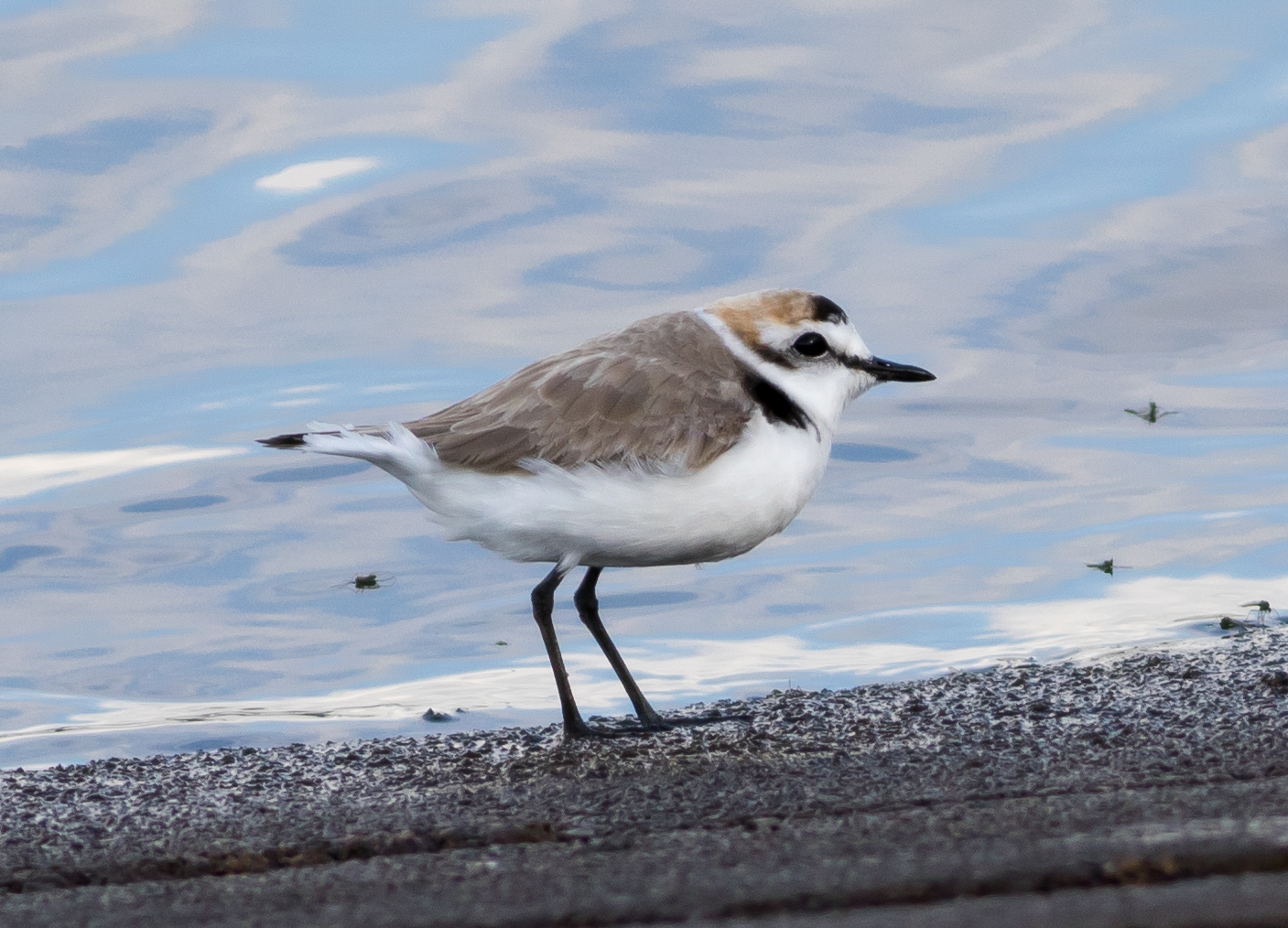
Kentish Plover - Audenshaw Reservoir
After a 20 minute walk in the
biting cold and bitter wind (who’d have thought it was April?!) we caught up
with the small group of assembled birders and scoped out along the shoreline to
try and pick out the Kentish. Bingo – we soon had our target, and the bird
proceeded to show incredibly well, feeding along the water’s edge right in
front of us and taking advantage of the high quantity of flies congregating
above the water’s surface.
With both Little Ringed and
Ringed Plovers associating on the same stretch of bank as the Kentish, the
differences between the three were extremely apparent – the much cleaner white
of the Kentish Plover stood out from a distance, and the rich ginger cap,
incomplete black breast band and the neat black markings on the head were also clear
to see.
Having seen Kentish Plovers in
both Spain and Portugal, as well as the extremely similar Snowy Plover in America
(both species themselves split from the African White-fronted Plovers) it was
great to finally see a British bird at last – although I don’t think any of us
expected for one to turn up on the concrete banks of Audenshaw reservoir of all
places!
A far cry from a shingle beach down south - the concrete edges of Audenshaw!
Kentish Plover is also a fantastic
bird for the North West - the previous county record for Greater Manchester was
over 35 years ago, while another unexpected individual was recorded on my local
Neumann’s Flash way back in 1991. The female at Cockersand Abbey in May 2011
(slightly before my twitching days) was the last twitchable North West opportunity
however, and this was a bird I regrettably didn’t travel up for at the time.
Once a British breeding
species with a particular stronghold at Dungeness in Kent up until the 1930s, Kentish
Plovers sadly now only occur annually in very small numbers on passage, usually
at coastal locations in the southern counties. The birds will often get pushed
on by tidal movements (only being one-dayers as a result) so this was a bird
that I had been struggling to get back for the last 5 years, especially as very
few tend to reach the northern counties!
Still present the next day and
showing well on the banks of Reservoir 3, this was a brilliant local bird that
any North West birder would have been mad to miss, and although it appears to
have departed on the morning of the 27th, the majority who needed it
will most certainly have left happy after achieving stunning views of what was
a fantastic little bird!
With an Iberian Chiffchaff
turning up in Lancashire towards the end of our two week trip to Florida, I was
hopeful that this individual would stay the course and I’d be able to catch up
with this Iberian speciality on my return. Unfortunately however, doubts were
quickly raised about its identity – the song appeared untypical of Iberian
Chiffchaff once sound recordings taken on site were analysed and it was quickly
dismissed as an imposter – sadly, not making the grade.
Luckily however, the UK seems
to be experiencing a spring influx of these delightful Mediterranean songsters
at present, and after a year’s absence with no records during 2015, there have
been a further three additional reports of Iberian Chiffchaffs this past week,
with individuals in Coverack in Cornwall, Tresco on Scilly and of course,
Telford in Shropshire.
First reported on the Sunday
afternoon straight after our 8 hour flight back from Orlando and quickly
confirmed as being the real deal, I had no chance of getting down to Shropshire
until a week later, where thankfully this Mediterranean speciality had set up
territory in a patch of woodland, often showing well and calling frequently.
The Iberian Chiffchaff in Telford, Shropshire
After a leisurely lie-in on
the Saturday morning, we made our way down to where the bird had set up
territory just off Granville Road in Telford (TF2 7NB) for the early afternoon,
wholly expecting it to be in full song when we arrived and showing well in the
now glorious sunshine (it had apparently snowed that morning!). Sadly however, it
didn’t pan out that way, and we endured a painstaking 2 hours staring at a
group of trees in the freezing cold (the warmth of the sun had completely vanished
to be replaced by menacing looking rainclouds and a chilling breeze) where the
bird only called once distantly! Starting to worry, it was a relief therefore
when we heard the distinctive call further around the corner, and heading over
that way with the group of assembled birders following, Alex eventually tracked
down this subtle warbler, calling just a few feet in front of us low down in
the branches and showing well.
For the next ten minutes or so
we followed our target through the trees as it worked its way along the
hedgerow, often perching in full view and treating us to blasts of now familiar
song. Sounding the initial first notes of “chiff chiff chiff”, this was quickly
followed by a warbling variation, much different to any of the Chiffchaffs or
Willow Warblers that were also present on site that had been singing throughout
the afternoon, and unlike several recent birds in West Sussex and
Cambridgeshire a few years back (and possibly the Lancashire bird) it was also quite
clear that this was not a mixed singer. While every time I pressed record on my camera to try and capture the call the Chiffchaff seemed to go mute (typical!), Alex managed to get an excellent video of the song, illustrated below:
Formerly treated as just a
race of Common Chiffchaff in the past, Iberian Chiffchaffs were recognised as a
separate species by the BOU 18 years ago due to a range of differences,
including vocalisation, morphology and genetics. Indeed, as well as the call,
there were slight variations in the plumage that while subtle, were still
noticeable in the field at Telford. The bill was slightly longer than a Common
Chiffchaff with a much paler lower mandible, while the legs were much lighter,
appearing to be an intermediate shade somewhere in between Chiffchaffs and Willow Warblers.
The plumage was also a brighter green than a Common Chiffchaff, often looking a
grey-olive colour, while there was a yellowish wash to the head, cheeks and
extensive supercilium, again more so than you would expect to see on a Common
Chiffchaff. Studying the photos of the bird later at home, I could also clearly
see the indistinct and broken eye-ring that is limited to just the lower edge
of the eye – another pro Iberian Chiffchaff feature.
The broken eye-ring on the lower edge of the eye is clearly visible, as is the yellowish colouration of the head and breast
With only 37 accepted records
in Britain, this is a bird I have been wanting to catch up with in the UK for a
while, having missed the last local bird in Blackpool back in May 2011. With
the vast majority of records occurring in the last 10 years however (25 out of
the accepted 37), Iberian Chiffchaff has fast turned from what was once a mega
rarity in to a now nearly annual expected spring overshoot, with small influxes
like this occurring in several of the past recent years.
With the finer plumage details
matching up and the call (which has been recorded and sonagramed) spot on for
Iberian Chiffchaff, there is no doubting the ID in my opinion, with this
individual being the real deal. It was great to enjoy hearing him sing
prolifically and show so well for us – a great addition to my British list
after seeing a pair in Spain two years ago and a fantastic bird to hear in
person.
Iberian Magpie – 14th February –North of Aljezur on the N120, Rua 25 de Abril. (40+ travelling flock moving through the trees. Common and numerous throughout.)
Spanish Sparrow – 14th February – Ria de Alvor, small dirt track (Caminho da Espargueira). (A small number of males interspersed with House Sparrows. Only ones of the trip.)
Day 2 – Aljezur, Monchique and Lagos
Bonelli’s Eagle – 15th February – East of Maria Vinagre off the M1002 Estrada do Carrascalinho. (Two seen in total, soaring high)
Black-shouldered Kite – 15th February – South of Mexilhoeira Grande on the Rua 25 de Abril (north of the N125). (Seen well hovering and hunting. Only one of the trip)
Day 3 – Castro Verde to Faro
Great Bustard – 16th February –Castro Verde, west of Gueirero and east of Alcaria do Coelho, in fields north of the road. (Three individuals seen, though distant. Only birds of the trip.)
Black-headed Weaver – 16th February – Pools at Quinta do Lago at the San Lorenzo Golf Club (off Rua Douro). (Male and several females seen well in the reeds. Male paired up and singing. Only birds of the trip.)
Also of note:Probable Spanish Imperial Eagle - Castro Verde, south of Corte Pequena. Too distant to confirm but pale underside, apparent white rump and dark tips to the wings.
Notable Species: Cattle Egret - Frequent all over and very common White Stork - At many sites and common throughout Greater Flamingo - Several individuals at Ria de Alvor Purple Swamphen - Numerous on the golf course at Quinta do Lago Little Bustard - Large flock seen at Castro Verde, south of Corte Pequena. Black-winged Stilt - One seen at Ria de Alvor Kentish Plover - Three seen on the salt marsh at Quinta do Lago Audouin’s Gull - One seen on the pool at Quinta do Lago Black-bellied Sandgrouse - A handful seen in the fields at Castro Verde, north of Sao Marcos da Ataboeira Pallid Swift - Several individuals flying around the pools at Quinta do Lago Hoopoe - Several seen throughout the trip Crested Lark - Numerous and several seen throughout the trip Crag Martin - Numerous and several seen throughout the trip Red-rumped Swallow - A couple seen at Castro Verde, north of Navarro Sardinian Warbler -One seen in the scrub surrounding the fields at Ribeira de Aljezur Fan-tailed Warbler -A handful seen throughout the trip. More often heard Iberian Grey Shrike -Numerous throughout the trip Spotless Starling - Several seen throughout the trip Serin - Several seen throughout the trip
Additional species: Mallard Gadwall Shoveler Teal Pochard Tufted Duck Red-legged Partridge Little Grebe Great Crested Grebe Cormorant Little Egret Grey Heron Spoonbill Red Kite Marsh Harrier Hen Harrier Common Buzzard Kestrel Peregrine Moorhen Coot Ringed Plover Golden Plover Lapwing Turnstone Dunlin Redshank Greenshank Black-headed Gull Mediterranean Gull Yellow-legged Gull Lesser Black-backed Gull Rock Dove Stock Dove Woodpigeon Collared Dove Common Swift Great-spotted Woodpecker Barn Swallow House Martin Water Pipit Meadow Pipit White Wagtail Grey Wagtail Robin Black Redstart Stonechat Song Thrush Blackbird Blackcap Dartford Warbler Cetti’s Warbler Chiffchaff Firecrest Wren Great Tit Blue Tit Magpie Jay Raven Carrion Crow Starling House Sparrow Chaffinch Linnet Goldfinch Greenfinch Corn Bunting
With our final day in Portugal dawning and with brilliant blue skies weather-wise, we checked out of our hotel and left Lagos for the last time, making the journey up north to the well-known plains around Castro Verde an hour and a half away. Hoping our toll passes from the hire car company were working as we sped through countless check points, we were soon at our destination to begin the search for one of the species we were both most looking forward to seeing – Great Bustard.
The entrance to the Great Bustard Reserve in Castro Verde
Arriving at the gates to the popular Great Bustard reserve at Castro Verde, we were disappointed to find them closed, and without a guide we were sadly unable to enter. However, scanning the surrounding plains the habitat looked ideal, so we took the car down a nearby side-road in an effort to locate any wandering Bustards. Searching the distant fields, I soon locked on to three large birds heading distantly left - surely our target.
The fields around the reserve - ideal habitat for Bustards
Being just too far away to confirm and quickly disappearing behind a hill, we decided to try and relocate them in the car, driving around the reserve and following the roads down to Viseus before heading east towards Guerreiro. Expecting dusty and potholed tracks in our hunt for the Bustards, it was a pleasant surprise to be met with road surfaces all in excellent condition even in this remote area – a reoccurring theme we noticed throughout our time in Portugal and putting the British roads to shame!
As we stopped to scan, the cries of Black-bellied Sandgrouse echoed overhead, and we were treated to several flyover flocks during the morning. Like elsewhere in Portugal, the fields were teaming with bird life, and we encountered masses of larks and Corn Buntings in the lush grasses either side of the road.
The lush fields of Castro Verde
Iberian Grey Shrikes and Spotless Starlings were a regular sight perched on the wires, while White Stork nests seemed to adorn every other telegraph pole, the huge structures balanced on specially placed platforms.
White Stork nest
Raptors were also in abundance here, and we encountered several Common Kestrels, Common Buzzards, Red Kites and even Marsh Harriers – the latter a species I wouldn’t normally associate with this type of habitat. Sadly, the Lesser Kestrels eluded me yet again - something that will have to be put right with a trip to Extremadura in the future!
Marsh Harrier - an unexpected sight on the plains of Castro Verde
Approaching the patch of fields the Bustards looked to have flown to, we stopped the car at regular intervals to scan the surrounding plains, the heat haze making viewing somewhat difficult. It wasn’t long before Alex’s eagle eyes spotted one however, and getting me on it, we quickly noticed a further two individuals feeding with the first, gradually moving up the slope. Finally, a long-awaited lifer for both of us in the form of three magnificent Great Bustards.
More than likely the three birds we had spotted flying near the start of the reserve, we watched as they fed in the short grass, an iconic species in these parts and a bird we had both been wanting to see for some time. Despite the distance and heat haze, we managed a few record shots through the scope and admired the sheer size of these incredible birds.
Extreme record shot of a very distant Great Bustard!
Even though flocks of up to 60 had been reported recently, these three individuals were the only ones of our trip, despite driving the tracks around Castro Verde until well in to the afternoon.
With a whole scattering of Great Bustard records around Castro Verde and the area being a well-known and important site for them, the best thing for anyone looking for them is simply to drive around the area, stopping the car and scanning for any movement on the plains. The fields around the reserve are a particularly good location for sightings if you can’t get on to the reserve itself, and the eBird map below shows the hotspots around Castro Verde.
Distribution of Great Bustards this year from eBird
With the weather forecast to be considerably more promising for our second day in Portugal, we decided to head back up to Aljezur to see if the sun would tempt out the Snowfinch. Arriving back on site early the next morning, the conditions were a huge improvement on the day before – glorious blue skies and puffy white clouds met us as we pulled up at the side of the fields. Several Hoopoes soaked up the sun on the sandy banks lining the road, while the Iberian Grey Shrikes from Sunday again gave excellent views perched out in the open.
Hoopoe - always a welcome sight in the Med
Iberian Grey Shrike
The increase in bird life from the day before was soon apparent, with a greater number of Crested Larks happily feeding in the short grass at the side of the road, along with the familiar Meadow Pipits and Goldfinches. On closer inspection, we managed to unearth a Thekla Lark amongst them, the white eyering, distinct dark lores, and shorter bill distinguishing it from the similar Cresteds.
Thekla Lark - note the clear black lores and distinct eyering
Several Corn Buntings foraging amongst the straw in one of the fields were also new in from yesterday, offering some hope that the Snowfinch may still make an appearance. Sadly it wasn’t to be, and a rather confiding male Sardinian Warbler was the best new bird we could manage.
Male Sardinian Warbler - one of my favourite Mediterranean warblers
With the Snowfinch having been present for around a week prior to our visit and apparently favouring the field where a large bull had been kept (according to reports it liked to feed in the straw), the fact the bull had now been taken away may have played a factor in the Snowfinch’s untimely departure. Disappointing to say the least, but after searching the entire surrounding area it was clear that the Snowfinch had most definitely moved on.
The dreaded Snowfinch fields
With the rain threatening to dampen our day once again and having seen enough of the same patch of daisies to last a lifetime, we decided enough was enough and headed out further in to the Portuguese countryside in an effort to locate some of our other targets for the trip. Travelling east inland towards the Serra de Monchique mountain range, we scanned the wires, fences and trees scattered throughout the lush green farmland in an effort to locate any Black-shouldered Kites, a species I was especially keen to see.
With a Snowfinch present in southern Portugal over the first week of February along with a whole host of Iberian specialities that me and Alex hadn’t managed to catch up with in one of our visits to Spain, we decided to book a last minute break to Portugal in the hopes of catching up with some of our previously missed Mediterranean targets.
A new country for both of us, we touched down at Faro airport late on the Saturday evening ready to hire our car the next morning for a full days’ worth of exploring. Awaking bright and early in our hotel on the Sunday, our first bird of note was a singing Fan-tailed Warbler displaying enthusiastically over the reeds and tall grasses that surrounded our balcony, quickly followed by several House Sparrows chirruping away. Despite a careful search however, no Spanish Sparrows were interspersed amongst them – a key target for me during the trip. Several Barn Swallows and House Martins darted low down below the balcony, skimming the tops of the reeds and being a nice reminder of the spring and summer months still to come back in Britain.
After picking up our hire car we were on the road by 10, travelling along the south coast of Portugal to our first stop at Aljezur to see if the Snowfinch was still present. The 6th record for Portugal and a species that we had missed whilst in the Pyrenees two years ago, this was a bird that we could potentially jam in on out of habitat without having to make a special trip up to the high mountains.
The high Pyrenees of Northern Spain where Snowfinches would be more at home!
Hearing that Iberian Magpies (one of our key targets of the trip) were supposedly ridiculously common in this area of Portugal prior to leaving the UK, we were expecting to be inundated with them as we made our way along the roads. Surprisingly this wasn’t the case, and we didn’t encounter any until at least nearly an hour in to our journey as we neared Aljezur. Stopping off at the side of the road to let an impatient driver past, we took the opportunity to scan the surrounding trees for signs of any birds. A female Blackcap darted quickly through the leaves and out of sight, before a large grey bird flying right caught my eye, quickly followed by another, then another, then another! Getting better views, the ID was confirmed - incredibly we had stumbled upon a large travelling party of Iberian Magpies and our first lifer of the trip! Counting up to 40 individuals present from the road, we hurried out of the car and ventured down the adjoining dirt track, in pursuit of what was now a fast flying and very loud flock on the move.
Record shot of our first Iberian Magpies
With some of the flock perched on the nearby branches, we rattled off a few record shots – and then they were off, chattering noisily as they ventured deep in to the impenetrable thicket of trees on the other side of the path. Purely by chance, we had notched up our first new bird and one of our main targets of the trip.
It's no secret that I love bright and colourful birds, and the Golden Pheasant at Wolferton Triangle is no exception. Having last seen this magnificent bird over a year ago now back in
December 2014, we took the opportunity to revisit the area at the end of 2015
during our trip to Norfolk in an attempt to get further views of this most
charismatic of birds.
Dividing birders opinions, with many regarding him as part of the “Plastic Fantastic” crew, I am firmly in
the ‘admirers’ camp, loving the touch of colour and vibrancy that he brings to
the woods of Norfolk. Love him or loathe him, there is no denying that with
a fiery golden plumage and sporadic sightings, the Golden Pheasant is a very
special bird indeed.
Parking up at the favoured spot where he is most often seen (on the northern edge of the triangle
just before the ‘Give Way’ sign), we watched and waited for any hint of crimson
and gold amongst the thick Rhododendron undergrowth....
Waiting for the Golden Pheasant to emerge.....
With mornings being
the best time of day to catch a sighting, we were there bright and early, arriving at just after half 8. We didn’t have to wait long – a little before
9am we struck gold – a hint of vibrant yellow and striking red emerging slowly
from the hedge line – our Golden Pheasant.
We watched on as he ventured
across the verge and on to the road, stopping to pick at seeds along the
roadside edge before crossing over to the other side. Foraging for around 20
minutes, this was our longest encounter by far, and we enjoyed fantastic views
as he paraded in front of the car in all his fiery glory, eventually
disappearing back in to the undergrowth of his favoured triangle. Always an amazing experience with this bird, it was brilliant to watch him at length, and interestingly,
unlike our visit a year earlier, this time we didn't see any Common Pheasants
in the area at all.
With a number of birds once
present in this particular location, it is now possible that sadly just one male
remains. Comparing my photos from this winter with those taken over a year
earlier and studying the head markings, it is clear to see that this is the same
individual - the feather patterns on the neck match up perfectly.
Both photos show the extensive dark patch in the bottom corner of the golden hood.
Not as easy to see on the bird's left hand side, looking closely, both photos show the same black stripe patterns and gold spacing.
I also took a look at many of
the recent photographs of the Wolferton Golden Pheasant taken in the past few months to ascertain
whether these too were all of the same individual. Again, looking at the
patterns on the neck feathers, the position and thickness of the stripes are
identical, indicating that they are indeed all of the same male. In particular, the thick patch of black stripes in the bottom corner of the bird's right hand side can clearly be seen on all photographs.
Photos kindly supplied by David Johnstone (Top Left), Christopher Teague (Top Middle) Max Hellicar (Bottom Left) and Harry Murphy (Bottom Middle).
Whilst not as obvious, the black stripes and the gold spacing in between are also identical on the bird's left hand side.
Photos kindly supplied by Steve Gantlett (Top Left) and Harry Murphy (Bottom Right)
Whether there are indeed other
individuals present in the triangle remains to be seen - there could well be
females remaining undetected in the secrecy of the Rhododendron cover or other males that rarely venture out on to the road, meaning
that the same showy male gets repeatedly photographed. However, the fact that
each photograph I've found over the past year depicts the same individual indicates it is highly likely that he is indeed the very last Golden Pheasant in the Wolferton Triangle - an extremely sad fact if true. If anyone has any photos that possibly depict a different bird, or if two birds have been seen together, I would be interested to hear.
One thing is for certain, once
this particular male’s time is up and he is no longer found to be strutting
proudly around the triangle, it will become much harder to see this elusive
species in Britain, and the Wolferton Triangle will most certainly be a lot less colourful as a
result.
For a further look in to the
history behind the Wolferton population and an in depth analysis of the
genetics regarding the black throat patch on the birds, check out last year’s blog
post here.
With the Hooded Merganser at
Corsham Lake in Wiltshire presenting a tempting opportunity having never seen
this species before, even in America, on Saturday I made the 3 hour journey
down south so me and Alex could decide for ourselves just how genuine a vagrant
this particular individual was.
Having been present at the
lake in the grounds of Corsham Court since the Monday, we arrived just after
lunch and squelched our way through the mud to the water’s edge. Scanning the
lake, we could see several Mallards and 4 Goosanders resting on the opposite
bank, as well as numerous other ducks out on the water, but no sign of the
Hooded Merganser – surely we couldn’t
dip a potential escapee (the shame!).
Speaking to the birders
present with scopes already lined up and cameras poised at the ready, it
transpired the bird had simply moved left down a channel behind the reeds and
was busy feeding temporarily out of sight. Reassured, we headed that way, and
soon managed to lock on to it – constantly diving in the shallow water and
taking advantage of the apparent rich source of food amongst the reeds.
Success! One Hooded Merganser showing exceptionally well….. perhaps a little
too well?!
Watching the bird for the next
hour, we obtained excellent views as it fished in front of us, at one point coming
to within just a few metres. Expertly manoeuvring through the channel, it often
came to a patch of open water not obscured by any branches or reeds, offering a
great opportunity to really take in the oversized head and fluffy crest during
the moments that it surfaced.
So, was the Hooded Merganser
getting just a little bit too close for comfort? Usually when vagrant wildfowl are
extremely confiding it can often be a sign that they have escaped from
captivity, in many cases resulting in the individual not getting accepted or
instead, getting placed firmly on the dreaded Category E of the British list.
Indeed, Cinnamon Teals, Mottled Ducks and even White-headed Ducks have all met
this fate in Britain, having never made it on to category A and instead getting
resigned to the depths of categories D and E. As captive wildfowl are extremely
numerous in Britain with birds often escaping, such records should always be
treated with caution.
White-headed Ducks - sadly resigned to Category E of the British list despite many candidates
Hooded Mergansers have always
had a troubled journey when it comes to getting accepted on to Category A of
the British list – it wasn’t until 2008 after careful scrutiny and
consideration that the first was accepted – a female or immature male present on
North Uist from the 23rd October to the 1st November 2000
(a whole 8 years after the sighting). Since then, 7 records in total have been
accepted.
In general, certain points always
need to be considered when assessing whether a species of bird that is often
kept in captivity is indeed a genuinely wild vagrant. As well as the obvious
essential features such as being unringed and having unclipped wings, the
bird’s wariness of people is a key indicator, as is its behaviour in terms of
feeding – natural sources are a yes while coming to bread (in terms of
wildfowl) is often seen as a no go. The Corsham Hooded Merganser has been seen
to be unringed on both legs, often displaying its legs to observers whilst
preening and at some points even coming completely out of the water and on to
the bank – clearly displaying a lack of rings. The wings also appear to be
unclipped.
No bling!
Its apparent tameness however
could prove to be an issue. Whilst the Hooded Merganser was indeed seemingly unperturbed
by the 10 or so birders lining the bank, it should be noted that it was
extremely focused on hunting for fish and other morsels in the shallows. One
interesting theory in particular is that when the Mallards swam close to the
bank, they disturbed the sediment in the water and this in turn made it easier
for the Hooded Merganser to catch larvae and other invertebrates that were
disturbed by the movement.
Another point to consider is
that over in America where Hooded Mergansers are native, they often come to
within a few feet of people, sometimes even taking bread or other food - as the
three videos below demonstrate perfectly.
The Corsham bird’s apparent tameness is
therefore certainly no reason to cast any doubt over its wild credentials. Whilst
it has been reported to have been feeding on bread on some occasions,
Goosanders have also been observed to do this in the wild, and it would make
sense for any wild bird to take advantage of whatever food source is offered.
Other key points that need to
be assessed in the case for genuine vagrancy is the bird in question arriving
at the right time of year to tie in with natural migration, as well as
departing in good time to continue with its journey. Whilst the Radipole male
in Dorset apparently arrived during fierce storms that battered the south
coast, the fact that it has not moved on since and is still present 8 years
later completely destroyed its case as a true vagrant, as did the fact that it
arrived in June.
With the Hooded Merganser at
Corsham Lake having now departed after a stay of just 6 days (whilst we were
there it was constantly diving for food – perhaps feeding up before moving on),
this can only strengthen the argument of it being a wild bird.
Turning up in February is also a
positive point for the Corsham bird, as wild Hooded Mergansers in America are very early spring migrants, leaving their wintering grounds in February and March. This winter saw huge
Atlantic pressure systems bringing many American wildfowl species across, with numerous Green-winged
Teals, American Wigeons, Lesser Scaups and Ring-necked Ducks all present in
good numbers in the UK.
Ring-necked Ducks and Lesser Scaups all regularly make it over to the UK
With several records of Hooded Mergansers in the Western Pal this
winter, including presumed wild individuals in both the Azores and
Iceland, as well as other vagrants such as American Coots, it is highly likely
that the Corsham bird could have been blown over the Atlantic during the
extreme weather conditions seen in November and December when the winds originated
strongly from North America, arriving elsewhere on the continent before the
urge to move on kicked in.
It's also worth noting that the female reported in Forth
in Scotland back on the 2nd February for two days could well be the
Corsham bird. First seen on the pond at the Safari Park in Blair Drummond, it
is essential however that an escapee from there is eliminated first and
foremost. Escapees from any centres nearby to both the Forth site and the site
in Wiltshire will then also have to be ruled out for the Corsham bird to have
any chance of being accepted.
Whilst the fate of the Corsham
Hooded Merganser is uncertain, regardless of whether or not it is accepted it
was still a fantastic bird to watch and to get such good views of. I’ll
certainly be keeping my fingers crossed that it does indeed tick all the
required boxes of being wild and earns a place on to category A.