A tale of nature, wildlife and birding from Cheshire, North Wales and across the globe....

A tale of nature, wildlife and birding from Cheshire, North Wales and across the globe....
Showing posts with label Category A. Show all posts

Friday, 16 June 2017

Mega!! Elegant Tern at Pagham Harbour, West Sussex!

After a relatively poor spring in terms of mega migrants, we thought a trip up to Glasgow so Alex could attend a concert would hopefully not result in us missing anything major on the birding scene…. We should really have known better, as right on cue with just 3 days to go after a spring of silence, it seemed the fates were against us and the birding Gods were punishing our naivety as the mega alerts wailed in to action **MEGA – Elegant Tern in Hampshire!!**
Elegant Tern in Hampshire
Pulses racing, our excitement was short lived as in the brief hour the Elegant Tern was present on the sandy spit at Hayling Island, only 6 observers managed to connect with it before it flew off out to sea, with nothing further until the Friday night when it was seen flying off towards West Sussex late afternoon after a 10 minute visit to Sandy Point.

Thinking it was unlikely to be pinned down to a site and with many of the Sandwich Tern colonies along the Hampshire coast situated in inaccessible locations, the fact that the mega alerts went off once more signalling the Elegant Tern had been refound at Pagham Harbour in West Sussex 10 minutes before we were due to set off for Glasgow didn’t cause too much alarm, as it surely wouldn’t hang about long enough for the twitching masses to connect with, its departure 20 minutes later adding weight to our misplaced hopes. 

How wrong we were, as the entire journey up to Glasgow and the evening therein after consisted of a constant stream of mega alerts telling us the tern was still present and showing well to its steadily increasing crowd of admirers, all happily ticking this potential first accepted record for Britain. 
Pagham Harbour, West Sussex
The Elegant Tern was a definite crowd bringer!
Colour ringed and DNA confirmed as a pure Elegant Tern in France where it usually hangs out, this was the best chance in history to get this species on our British lists – and we were heading off in the opposite direction up to Scotland!

There was only one thing for it, and with alarms set for 3:40am after a short snatch of sleep after the concert had finished, we were soon on our way back down a deserted M6 and heading for the south coast – a trip from Glasgow to Cheshire with the small matter of a diversion to West Sussex well underway!

465 miles and 8 hours later we arrived at the RSPB Pagham Harbour car park, the parking attendant’s walkie-talkie crackling in to life as he directed us to a parking spot informing us that the tern had just this second flown off – horrendous timing. However, with the Elegant Tern having developed a pattern of heading out to sea to fish for periods of time before returning to “Tern Island” to rest, we set off on the 30 minute walk to where the bird was spending its time hopeful that it would soon return.
Pagham Harbour - West Sussex
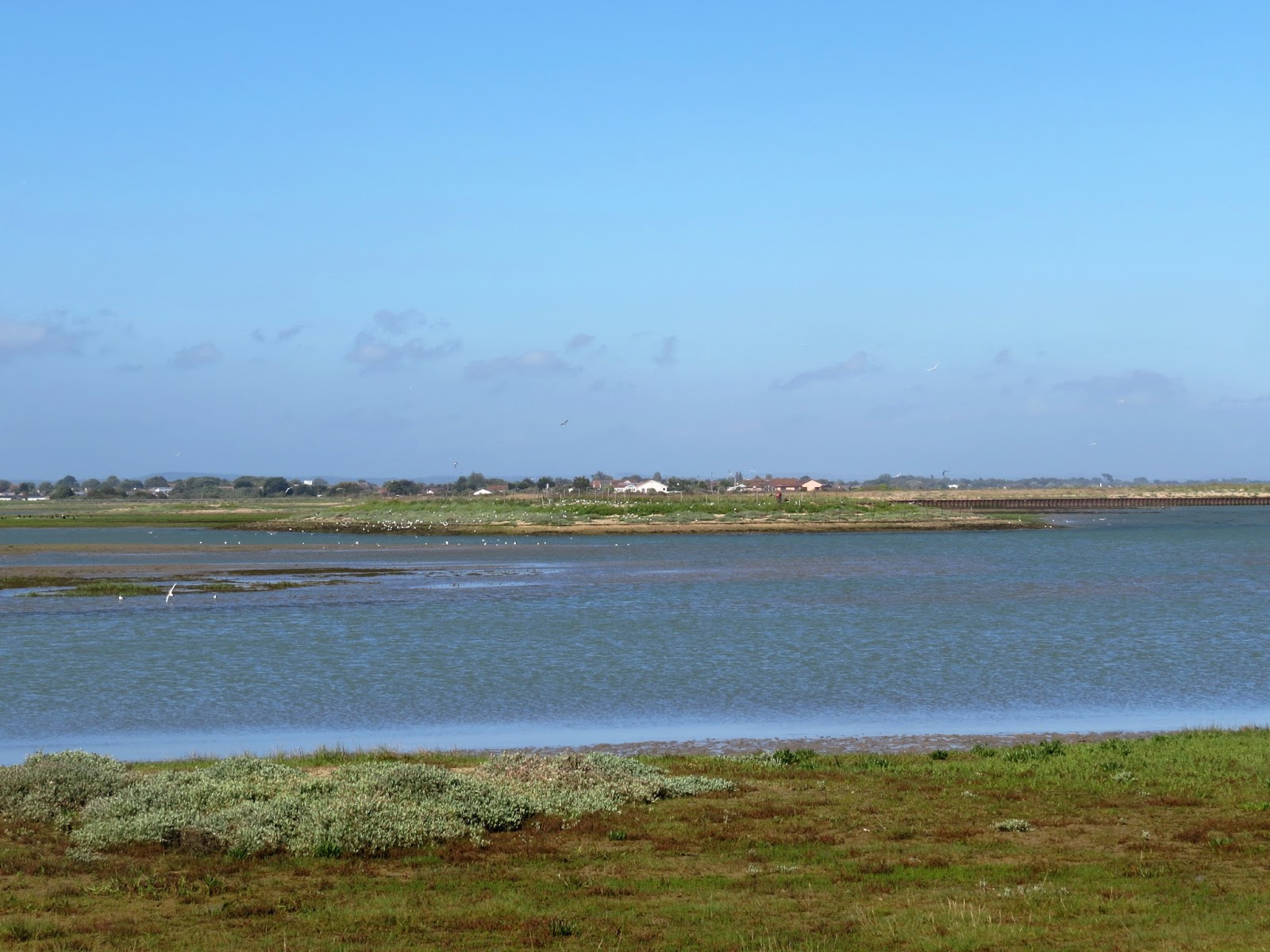
Blue skies over Pagham Harbour
3 hours later we were still hoping - there was still no sign of the Elegant Tern coming in to the harbour despite religiously checking every single Sandwich Tern that sped past us. With the sun having long since departed there was also now a definite chill in the air, bringing up goosebumps on a number of short-sleeved bare arms in the crowd of waiting birders. 
Sandwich Tern
Plenty of Sandwich Terns..but no Elegants amongst them!
Our morale at this point was decidedly low, surely, after our mammoth effort the tern hadn’t done the dirty and moved on after seeming so settled? With our hopes slowly diminishing, eventually the cry went up that we were hoping for – someone had just seen the Elegant Tern in flight over the island! Hurrying over to the point of the muttering and the source of the cry amongst a jumble of birders and scopes, a hectic few minutes followed, as directions were bandied around and I just couldn’t get on the single orange billed individual amongst a hovering mass of swirling Sandwich Terns. Having only the one scope between us proved particularly difficult; binoculars useless in being able to distinguish the bill colours in the fast moving and distant tern flock and I was definitely starting to panic that our tern would get flushed or hunker down unseen in the vegetation.
Pagham Harbour, West Sussex
The patch of vegetation the Elegant Tern favours - in-between the two bungalows
Pagham Harbour, West Sussex
"Tern Island"
Eventually however, after a good ten minutes of mental anguish, the cry went up that it was hovering over the island again, and getting my eye to the scope I was finally able to clasp eyes on a huge orange billed tern hovering over the coastal vegetation, facing towards us before turning and showing off the monster carrot coloured bill in all its glory, a pale orange in shade and with a slight curve to the tip. Success, relief and Elegant Tern and a British mega safely in the bag!

Proving exceptionally elusive in the afternoon we were there and with Alex wanting better views, we only saw the Elegant Tern once more in the next two hours, only realising that a small group of birders were watching it from the top path above the steps as we were leaving the site. Peering through their scopes revealed the Elegant Tern settled happily amongst the vegetation on the island, partially obscured behind the foliage but displaying its large orange bill on occasion as it preened and raised it in to the air. 
Elegant Tern - Pagham Harbour, West Sussex
Perhaps the worst record shot ever seen. The orange bill is noticeable though! 
With time marching on and the prospect of a long drive back ahead of us after such an early start, with the tern once more disappearing into the green we decided to call it a day (our hope of only being on site for a couple of hours a distant memory after being at Pagham for around 5 hours!), making the long walk back to the car park and pleased that our efforts of driving from one end of the country to the other in pursuit of this mega tern had paid off! 
Pagham Harbour, West Sussex

Elegant Terns in Britain and the Western Pal:

Elegant Terns have danced with acceptance onto the British List for a number of years now, with presumed individuals seen in Devon and Wales in 2002, along with another bird found in Dorset back in May 2005. An orange-billed tern species fitting the profile for Elegant Tern was also photographed off New Quay in Ceredigion in 2015.

However, despite 5 birds being accepted in Ireland from 1982 onwards, none have been officially recognised on the British list due to apprehensions of them possibly being the result of hybridisation with Sandwich Terns, which has so far been impossible to rule out on visual appearance alone. Recent studies in France however have well and truly disproved this theory after 3 individual Elegant Terns found breeding in Sandwich Tern colonies along the French coast were caught, rung and had their DNA analysed, with the results proving beyond doubt that the 3 birds concerned were indeed 100% Elegant Tern. As opposed to Mitochondrial DNA analysis which incorporates genes from the maternal parental lineage (and in turn wouldn’t be able to rule out a Sandwich Tern father) multilocus barcoding from nuclear DNA was used in the French studies, meaning genes from both the mother and father birds were taken in to account and thus establishing a definite species parentage. A fantastic article by Birdguides looks at this study in depth, as well as the full occurrence of Elegant Tern in Western Palearctic waters. 

Coupled with an additional two unringed birds also seen off the French and Spanish coasts in recent times, there is the distinct possibility that an impressive 5 Elegant Terns (at least) could be frequenting our Western Palearctic waters. This is made even more remarkable by the fact that two of these birds have paired up to breed since 2009 at L’Albufera (one of these birds is a rung and DNA assured pure Elegant Tern), signalling that there could well be a pure pair of Elegant Terns breeding in Europe. 
Elegant Tern distribution in Europe
Distribution of Elegant Terns in Europe
Usually inhabiting the Pacific coastline of Western America and enjoying quite a limited breeding range, it is fascinating as to how 5 Elegant Terns all ended up in Western Pal waters, even going so far as to breed together. It’s possible that the birds were blown off course from the Central Americas or while travelling around the South Atlantic Ocean, ending up in South African waters before heading up north to Europe each breeding season. Indeed, sightings of ringed birds off Cape Town and Namibia during the winter months indicate that the European Elegant Terns do overwinter there.

Sightings of each of the three ringed birds are well recorded, along with their breeding successes each season, and any hybrid chicks are ringed and monitored. As the hybrid young don’t visually display Elegant Tern characteristics (instead having black bills with a small yellow blob on the end) the chances are that if any orange-billed Tern seen in British and Irish waters looks like an Elegant Tern, then it most probably is an Elegant Tern.

The Pagham Harbour bird has thankfully been identified from its colour ring combination as one of the DNA tested pure Elegant Terns (known as bird C), removing any possible doubt as to its parental credentials and hopefully assuring it a safe passage straight on to Category A of the British list. The recent DNA analysis should hopefully also allow the previous records in Britain in 2002 and 2005 to be reviewed with a view to acceptance, based on the fact that they are highly unlikely to be hybrids.

Residing in France during the breeding season at Banc d’Arguin, Bird C – a male – was first seen in 2002 and was rung a year later, breeding in subsequent years intermittently from 2005 to 2013 with a Sandwich Tern. Bird C was also seen down in France up until mid-May, before it ventured north up into British waters. Whether it now stays to breed amongst the Sandwich Terns at Pagham Harbour is another matter, although it was reportedly seen to engage in courtship behaviour with a Sandwich Tern on several occasions. 

Tuesday, 1 March 2016

Hooded Merganser - Corsham Lake, Wiltshire - will it get accepted on to Category A?

With the Hooded Merganser at Corsham Lake in Wiltshire presenting a tempting opportunity having never seen this species before, even in America, on Saturday I made the 3 hour journey down south so me and Alex could decide for ourselves just how genuine a vagrant this particular individual was.

Having been present at the lake in the grounds of Corsham Court since the Monday, we arrived just after lunch and squelched our way through the mud to the water’s edge. Scanning the lake, we could see several Mallards and 4 Goosanders resting on the opposite bank, as well as numerous other ducks out on the water, but no sign of the Hooded Merganser –  surely we couldn’t dip a potential escapee (the shame!).

Speaking to the birders present with scopes already lined up and cameras poised at the ready, it transpired the bird had simply moved left down a channel behind the reeds and was busy feeding temporarily out of sight. Reassured, we headed that way, and soon managed to lock on to it – constantly diving in the shallow water and taking advantage of the apparent rich source of food amongst the reeds. Success! One Hooded Merganser showing exceptionally well….. perhaps a little too well?!
Hooded Merganser - Corsham Park, Wiltshire
Watching the bird for the next hour, we obtained excellent views as it fished in front of us, at one point coming to within just a few metres. Expertly manoeuvring through the channel, it often came to a patch of open water not obscured by any branches or reeds, offering a great opportunity to really take in the oversized head and fluffy crest during the moments that it surfaced.
Hooded Merganser - Corsham Park, Wiltshire
Hooded Merganser - Corsham Lake, Wiltshire
So, was the Hooded Merganser getting just a little bit too close for comfort? Usually when vagrant wildfowl are extremely confiding it can often be a sign that they have escaped from captivity, in many cases resulting in the individual not getting accepted or instead, getting placed firmly on the dreaded Category E of the British list. Indeed, Cinnamon Teals, Mottled Ducks and even White-headed Ducks have all met this fate in Britain, having never made it on to category A and instead getting resigned to the depths of categories D and E. As captive wildfowl are extremely numerous in Britain with birds often escaping, such records should always be treated with caution.
White-headed Ducks - Spain
White-headed Ducks - sadly resigned to Category E of the British list despite many candidates
Hooded Mergansers have always had a troubled journey when it comes to getting accepted on to Category A of the British list – it wasn’t until 2008 after careful scrutiny and consideration that the first was accepted – a female or immature male present on North Uist from the 23rd October to the 1st November 2000 (a whole 8 years after the sighting). Since then, 7 records in total have been accepted.

In general, certain points always need to be considered when assessing whether a species of bird that is often kept in captivity is indeed a genuinely wild vagrant. As well as the obvious essential features such as being unringed and having unclipped wings, the bird’s wariness of people is a key indicator, as is its behaviour in terms of feeding – natural sources are a yes while coming to bread (in terms of wildfowl) is often seen as a no go. The Corsham Hooded Merganser has been seen to be unringed on both legs, often displaying its legs to observers whilst preening and at some points even coming completely out of the water and on to the bank – clearly displaying a lack of rings. The wings also appear to be unclipped.
Hooded Merganser - Corsham Lake, Wiltshire
No bling!
Its apparent tameness however could prove to be an issue. Whilst the Hooded Merganser was indeed seemingly unperturbed by the 10 or so birders lining the bank, it should be noted that it was extremely focused on hunting for fish and other morsels in the shallows. One interesting theory in particular is that when the Mallards swam close to the bank, they disturbed the sediment in the water and this in turn made it easier for the Hooded Merganser to catch larvae and other invertebrates that were disturbed by the movement.

Another point to consider is that over in America where Hooded Mergansers are native, they often come to within a few feet of people, sometimes even taking bread or other food - as the three videos below demonstrate perfectly. 


The Corsham bird’s apparent tameness is therefore certainly no reason to cast any doubt over its wild credentials. Whilst it has been reported to have been feeding on bread on some occasions, Goosanders have also been observed to do this in the wild, and it would make sense for any wild bird to take advantage of whatever food source is offered.

Other key points that need to be assessed in the case for genuine vagrancy is the bird in question arriving at the right time of year to tie in with natural migration, as well as departing in good time to continue with its journey. Whilst the Radipole male in Dorset apparently arrived during fierce storms that battered the south coast, the fact that it has not moved on since and is still present 8 years later completely destroyed its case as a true vagrant, as did the fact that it arrived in June.

With the Hooded Merganser at Corsham Lake having now departed after a stay of just 6 days (whilst we were there it was constantly diving for food – perhaps feeding up before moving on), this can only strengthen the argument of it being a wild bird.
Hooded  Merganser - Corsham Lake, Wiltshire
Turning up in February is also a positive point for the Corsham bird, as wild Hooded Mergansers in America are very early spring migrants, leaving their wintering grounds in February and March. This winter saw huge Atlantic pressure systems bringing many American wildfowl species across, with numerous Green-winged Teals, American Wigeons, Lesser Scaups and Ring-necked Ducks all present in good numbers in the UK. 
Ring-necked Duck - Priorslee Lake
Ring-necked Ducks and Lesser Scaups all regularly make it over to the UK
Lesser Scaup - Marshside RSPB
With several records of Hooded Mergansers in the Western Pal this winter, including presumed wild individuals in both the Azores and Iceland, as well as other vagrants such as American Coots, it is highly likely that the Corsham bird could have been blown over the Atlantic during the extreme weather conditions seen in November and December when the winds originated strongly from North America, arriving elsewhere on the continent before the urge to move on kicked in.

It's also worth noting that the female reported in Forth in Scotland back on the 2nd February for two days could well be the Corsham bird. First seen on the pond at the Safari Park in Blair Drummond, it is essential however that an escapee from there is eliminated first and foremost. Escapees from any centres nearby to both the Forth site and the site in Wiltshire will then also have to be ruled out for the Corsham bird to have any chance of being accepted.

Whilst the fate of the Corsham Hooded Merganser is uncertain, regardless of whether or not it is accepted it was still a fantastic bird to watch and to get such good views of. I’ll certainly be keeping my fingers crossed that it does indeed tick all the required boxes of being wild and earns a place on to category A.