Pied Wheatear had been missing
from my arsenal of British Wheatears for some time now, having never managed to
make it down to the Nottinghamshire bird back in 2013. With no readily
available birds in the 5 years since, I therefore jumped on the chance to pay a
visit to the bird that took up residence on the sea wall at Dove Point in
Meols on the Wirral in November, less than an hour away from home and showing extremely
well to the masses.
Pied Wheatear!
The Wheatear and its many admirers!
Sure enough, upon pulling up
next to the assembled crowd of birders and cameras, the Pied Wheatear was
instantly on view – quite possibly the easiest and quickest twitch I have ever
been to!
Over the next few hours the
Wheatear continued to show exceptionally well, flitting from point to point on
the sea wall and never disappearing for more than a minute at a time, on one
occasion flying down on to the floor and proceeding to scurry right up to my
boots! Extremely confiding and showing no fear, it didn’t even seem too
bothered when locals passed right next to it with their dogs!
Aged as a first winter male,
whilst some questioned the ID with relation to the width of the black band on
the end of the tail (and the similarity to Eastern Black-eared Wheatear), tail
patterns vary between individuals and this particular bird is well in the range
for Pied. The dark feather colouration of the mantle along with the white edges
to the feathers creating a ‘scaly’ effect are also both classic for Pied,
nailing the ID.
Note the scaly looking back - a key feature for Pied Wheatear
Having already been present
for two days before being identified from photos and the news put out to the
masses, this was the first record for Cheshire/Wirral and a fantastic local
bird to connect with.
With Whiskered Tern still
being a species I needed in Britain, two turning up at Long Eaton Gravel Pits
in Derbyshire on Friday morning before relocating to Attenborough Nature
Reserve across the border in Nottingham for the remainder of the
evening had me tempted to make the journey over the next day for my last
remaining species of ‘Marsh Tern’ to see in the UK.
However, it seems the terns
had other ideas, and checking my phone in the early hours of Saturday revealed
them to have departed overnight, leaving just a solitary Black Tern in their
wake. Fast forward a few hours and having drifted back off to sleep, I was this
time woken up by a phone call from Alex (my previous weeks lie in had been cut
short by the news of the White-crowned Sparrow at Woolston Eyes) – the two
Whiskered Terns had been re-found at Sandbach Flashes in Cheshire, just 20
minutes away from my house.
Grabbing a quick breakfast on
the way out, we were soon on our way, and 20 minutes later were enjoying great
views as the two terns paraded around Elton Hall Flash, swooping low over the
surface of the water to feed and displaying their gorgeous sooty grey bellies
and bright white contrasting under tails.
Perching regularly on several
of the wooden fence posts submerged in the water, we were treated to excellent
scope views of the pair, on some occasions even flying alongside and perching
with the single Common Tern that was present and in turn offering a great
comparison between the two species.
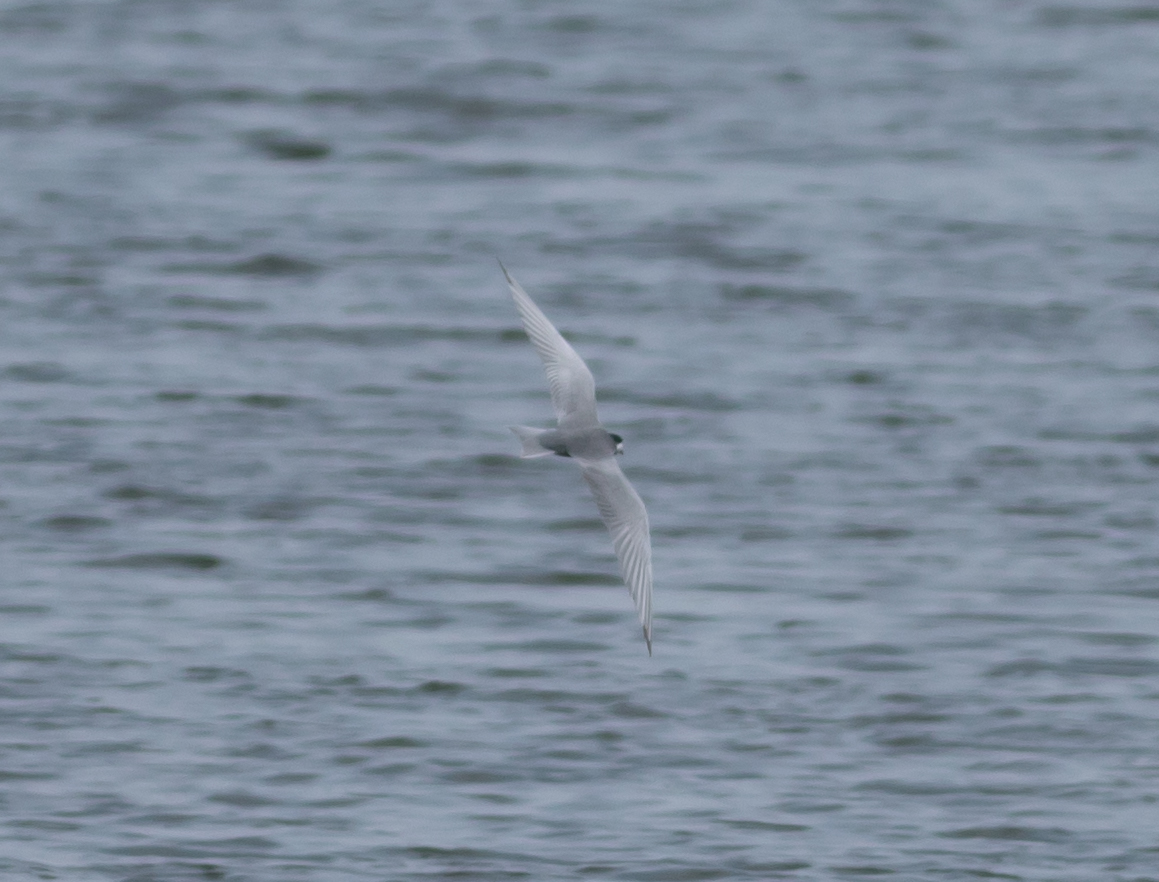
Both Whiskered Terns together
Common Tern on the left, Whiskered Tern on the right
The size different was
extremely noticeable in flight – the Whiskered Terns being much smaller, while
the Common’s longer tail feathers were also apparent. We were also able to note
another key identification feature of Whiskered Tern - their shallow forked
tails were clear to see as they dipped and dived, while their greyish rumps
also contrasted to the Common’s pure white backs.
The shorter forked tail and grey rump of the Whiskered Tern is clear to see in flight
Mostly keeping their distance
and remaining in the middle of the flash, one would occasionally power over to
the near side, on one occasion feeding just metres away in the corner, giving
outstanding views to the gathered crowd before moving swiftly back over to the
far edge of the water.
Looking superficially like a cross between a Black Tern and a Common Tern, the gorgeous jet black hoods, blood red bills and dark crimson feet all stood out, even at a distance.
Departing as expected the next
day, two (probably the same) were reported from Saltholme RSPB in Cleveland,
adding further mileage to their tour of the UK. With several other Whiskered
Terns reported in Gloucestershire, Hampshire and Somerset over the past few
days, the warm weather and winds from the continent seem to have resulted in a
mini influx of these delightfully acrobatic terns, and being the very first
site record, they are another great local bird for Sandbach Flashes.
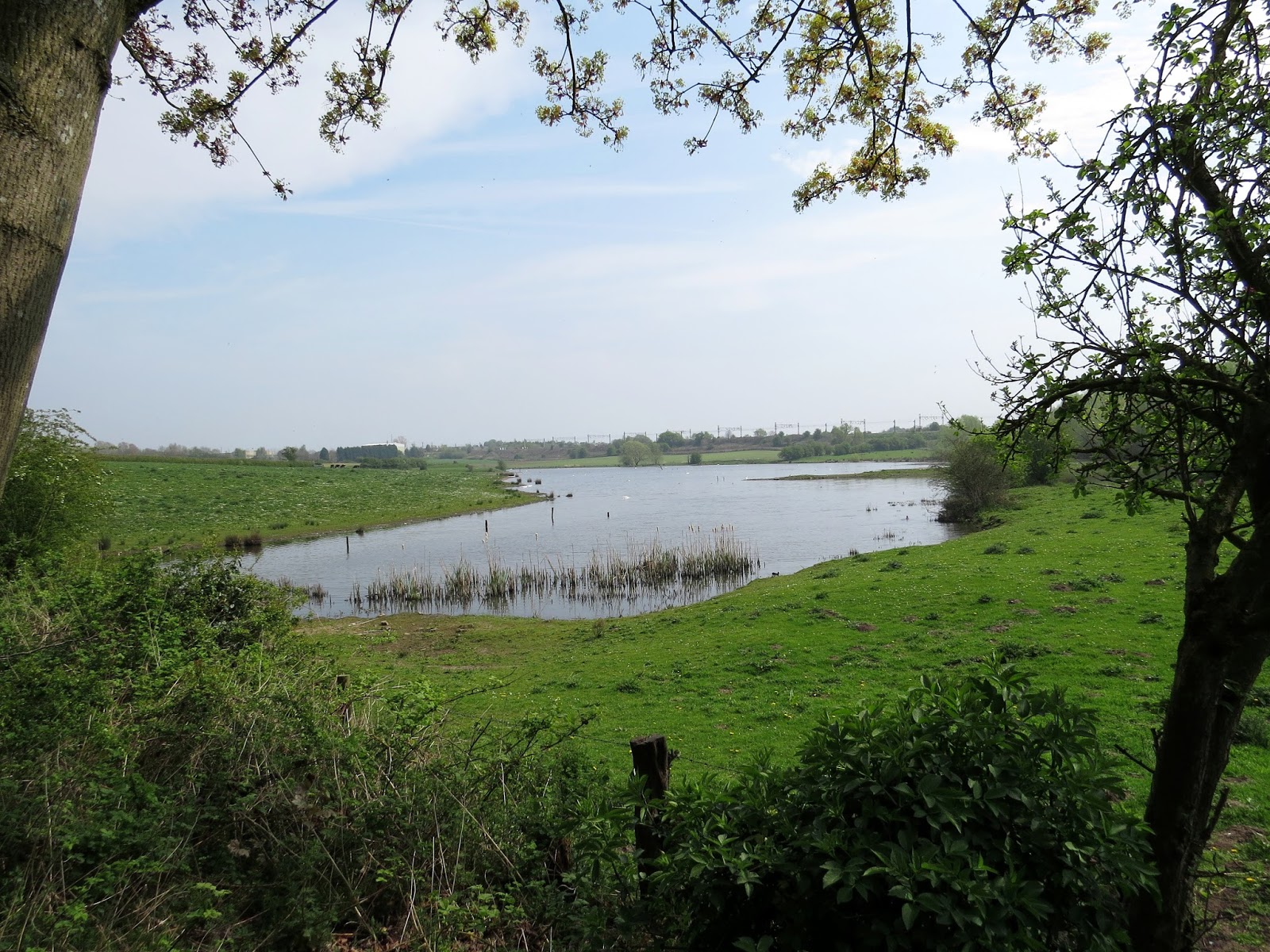
Elton Hall Flash
Having seen just a single bird
in Southern Spain two years ago and having missed a juvenile bird at Burton
Mere Wetlands in the Autumn of 2010, these were the first local Whiskered Terns
in 5 years that I could get to, and it was great to see this European rarity
relatively close to home – always ideal!
With an Iberian Chiffchaff
turning up in Lancashire towards the end of our two week trip to Florida, I was
hopeful that this individual would stay the course and I’d be able to catch up
with this Iberian speciality on my return. Unfortunately however, doubts were
quickly raised about its identity – the song appeared untypical of Iberian
Chiffchaff once sound recordings taken on site were analysed and it was quickly
dismissed as an imposter – sadly, not making the grade.
Luckily however, the UK seems
to be experiencing a spring influx of these delightful Mediterranean songsters
at present, and after a year’s absence with no records during 2015, there have
been a further three additional reports of Iberian Chiffchaffs this past week,
with individuals in Coverack in Cornwall, Tresco on Scilly and of course,
Telford in Shropshire.
First reported on the Sunday
afternoon straight after our 8 hour flight back from Orlando and quickly
confirmed as being the real deal, I had no chance of getting down to Shropshire
until a week later, where thankfully this Mediterranean speciality had set up
territory in a patch of woodland, often showing well and calling frequently.
The Iberian Chiffchaff in Telford, Shropshire
After a leisurely lie-in on
the Saturday morning, we made our way down to where the bird had set up
territory just off Granville Road in Telford (TF2 7NB) for the early afternoon,
wholly expecting it to be in full song when we arrived and showing well in the
now glorious sunshine (it had apparently snowed that morning!). Sadly however, it
didn’t pan out that way, and we endured a painstaking 2 hours staring at a
group of trees in the freezing cold (the warmth of the sun had completely vanished
to be replaced by menacing looking rainclouds and a chilling breeze) where the
bird only called once distantly! Starting to worry, it was a relief therefore
when we heard the distinctive call further around the corner, and heading over
that way with the group of assembled birders following, Alex eventually tracked
down this subtle warbler, calling just a few feet in front of us low down in
the branches and showing well.
For the next ten minutes or so
we followed our target through the trees as it worked its way along the
hedgerow, often perching in full view and treating us to blasts of now familiar
song. Sounding the initial first notes of “chiff chiff chiff”, this was quickly
followed by a warbling variation, much different to any of the Chiffchaffs or
Willow Warblers that were also present on site that had been singing throughout
the afternoon, and unlike several recent birds in West Sussex and
Cambridgeshire a few years back (and possibly the Lancashire bird) it was also quite
clear that this was not a mixed singer. While every time I pressed record on my camera to try and capture the call the Chiffchaff seemed to go mute (typical!), Alex managed to get an excellent video of the song, illustrated below:
Formerly treated as just a
race of Common Chiffchaff in the past, Iberian Chiffchaffs were recognised as a
separate species by the BOU 18 years ago due to a range of differences,
including vocalisation, morphology and genetics. Indeed, as well as the call,
there were slight variations in the plumage that while subtle, were still
noticeable in the field at Telford. The bill was slightly longer than a Common
Chiffchaff with a much paler lower mandible, while the legs were much lighter,
appearing to be an intermediate shade somewhere in between Chiffchaffs and Willow Warblers.
The plumage was also a brighter green than a Common Chiffchaff, often looking a
grey-olive colour, while there was a yellowish wash to the head, cheeks and
extensive supercilium, again more so than you would expect to see on a Common
Chiffchaff. Studying the photos of the bird later at home, I could also clearly
see the indistinct and broken eye-ring that is limited to just the lower edge
of the eye – another pro Iberian Chiffchaff feature.
The broken eye-ring on the lower edge of the eye is clearly visible, as is the yellowish colouration of the head and breast
With only 37 accepted records
in Britain, this is a bird I have been wanting to catch up with in the UK for a
while, having missed the last local bird in Blackpool back in May 2011. With
the vast majority of records occurring in the last 10 years however (25 out of
the accepted 37), Iberian Chiffchaff has fast turned from what was once a mega
rarity in to a now nearly annual expected spring overshoot, with small influxes
like this occurring in several of the past recent years.
With the finer plumage details
matching up and the call (which has been recorded and sonagramed) spot on for
Iberian Chiffchaff, there is no doubting the ID in my opinion, with this
individual being the real deal. It was great to enjoy hearing him sing
prolifically and show so well for us – a great addition to my British list
after seeing a pair in Spain two years ago and a fantastic bird to hear in
person.
Sunday saw us head over to
Donna Nook on the east coast in Lincolnshire so Alex could catch up with the
drake Blue-winged Teal that had been present there for a couple of weeks now.
Arriving at the main car park we were met with considerable negativity, with a
group of birders telling us the bird wasn’t about that morning, that the pond
was extremely hard to find (with us needing to wade through thick reeds and
quick sand to get to) and that the walk was horrific with the pool miles away
from the car park! Not fancying our chances, we made the walk over to the pool,
which in all honesty was no way near as bad as everyone made out – merely a 30
minute journey along the beach!
After following the directions we had been given, we tracked down the pool the
teal had been favouring, and we joined the 4 or 5 assembled birders on the
large grassy bank who had already located the bird on the island in the middle
of the water just in front of us, well hidden and camouflaged in the
vegetation.
Spot the teal!
After a while, this attractive
American visitor swam out on to the open water where it proceeded to feed
around the other side, venturing to the left and right of the trees and giving
good views as it dabbled in the small reeds.
Having seen a drake already at
Inner Marsh Farm in Cheshire back in 2013, it was nice to catch up with a
second, and with a cast of gorgeous showy Yellow Wagtails and my first Lesser
Whitethroats of the season trilling happily and flitting around in the scrub, a
good day’s birding was had.
For anyone going, the pool has
seemed quite hard to find for some – see directions below:
Blue-winged Teal map at Donna Nook
Parking at Donna Nook car park
(LN11 7PD) off Marsh Lane, take the walk to the right on the boardwalk and
follow the gravel track past the salt marsh to Point A. Once the track runs
out, turn left through the wooden fence and onto the sand, following the beach
right. MOD debris and a broken down helicopter will be on your right, with a
dead seal further up the beach to the left. Continue along the beach and follow
the path where stated on the signs due to the MOD Firing Range. You will need
to count the tall brown Quad Towers on the right hand side in the dunes – once you
reach the third one at Point B, turn right in to the dunes and immediately left
there is a large, rusty gate to stop the cattle leaving the field (Point C).
Enter this field walking along the flat grass, then head right at Point D
through the small dune scrub until you reach a large grassy bank, with a large
pool and several smaller pools adjacent. The Blue-winged Teal can be found on
either the large flat pool on the right, or one of the smaller pools to the
left with the small shrubby islands, where it can hide in the vegetation on
either side. If wanting a close approach and to cross over to the other bank on
the seaward side of the pools, wellies is advisable as the surrounding mud can
be quite sticky!