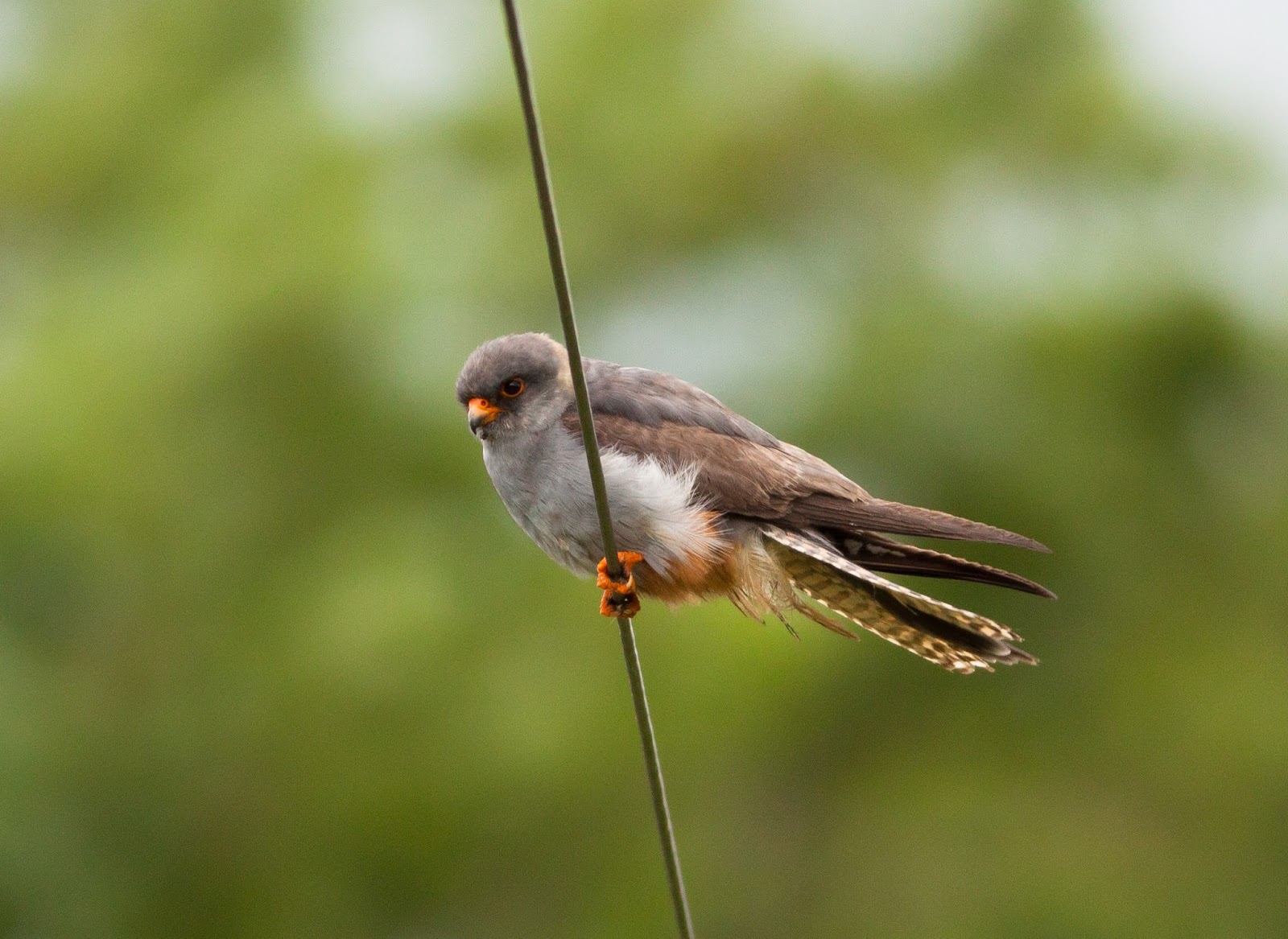
When a report of a Red-footed
Falcon photographed in Staffordshire broke early on the Thursday evening, I saw
this as a welcome opportunity to catch up with this beautiful species which has
so far managed to elude me. With negative news on the Thursday night however I
assumed the bird must have moved on, so was pleased to see it had been re-found
and was showing well early on the Friday morning.
Heading to the fields outside
Whitfield Colliery in Chatterley that the falcon had been frequenting after
work on the Friday afternoon, I immediately saw the bird as soon as I had
stepped out of the car – possibly the fastest twitch in existence!
Sat on the grass right in
front of the fence where the assembled birders were stood, this stunning falcon
was showing much better than I could have ever imagined, foraging for insects
amongst the earth and making short flights to its favoured perches in the
field.
Favouring the last horse paddock on the left before the entrance gates
to the Colliery, this particular individual has been faithful to this location
since it was discovered, ranging between the telegraph poles, wires and fence
posts and rarely moving far. With several horses churning up the soil, it’s
clear that there is an abundance of insects here for the falcon to hunt,
keeping it locked down to this one particular site.
With such a showy individual
this was a fantastic opportunity to get some photos, and the bird’s tendency to
perch on the wire relatively close to the road was welcomed by all those that
had come to admire it.
I’ve missed several of these
eastern falcons over the last few years, with a first summer male in Derbyshire
back in 2011 (which was unfortunately found dead later on) and a fantastic
adult male at Lakenheath Fen in Suffolk both sadly out of reach. With
relatively few individuals reported in the UK last year, I had made Red-footed
Falcon a definite target to see this year, although the birds reported further
down south earlier in the spring were just a little bit too far. With an apparent
invasion of Red-footed Falcons in Spain this summer, there may yet be more of
these fantastic little falcons reported from our shores as the year progresses.
Whilst the Staffordshire bird
was a first summer male as opposed to one of the more colourful adults,
Red-footed Falcons change their plumage at different rates, and this particular
individual was extremely well advanced, with a gorgeous sooty grey body complete
with vibrant orange legs and bill and fiery red eyes. The barred underwings and
tail were the main features separating it from an adult male, as well as a
little bit of chestnut colouration on the neck.
Several birders present were
checking the underwings to make sure this wasn’t an Amur Falcon – very similar
to Red-footed Falcons but with a white underwing. With just one British record
to date from Tophill Low in Yorkshire in 2008, the individual in question was
originally thought to be a Red-footed Falcon, until it was later re-identified
from photos as an Amur Falcon almost a month after it had first arrived (and
ironically it wasn’t seen again!) Having been present for a month from the
middle of September to October and being in moult for the duration of its stay,
the bird was only identified when the white underwing
coverts became clear to see on several photos after it had completed its moult.
There is every possibility that this extreme mega may be overlooked in the UK,
and a recent record from the Faroe Islands offers some hope that this far
eastern falcon may make a return to Britain in the future.
 |
| No white on the underwings here! |
Heading back to the Red-footed
Falcon on Sunday with Alex, we both had excellent views as the bird performed
for the crowds once again, sometimes even coming to within 5 metres as it
hovered above the grass looking for insect prey.
Being so obliging ad putting
on such a show, this is most definitely one of my favourite birds of the year
so far, and one that is definitely worth making the effort to go and see!