A tale of nature, wildlife and birding from Cheshire, North Wales and across the globe....

A tale of nature, wildlife and birding from Cheshire, North Wales and across the globe....
Showing posts with label Aberdeen. Show all posts

Thursday, 27 September 2018

MEGA!! Sooty Tern at the Ythan Estuary, Aberdeenshire!!

The summer holidays are always a tricky time when it comes to twitching, especially as Alex has six weeks of freedom while I’m stuck at work, and as such I always dread the mega alert going off during July and August…
Sooty Tern - Ythan Estuary, Aberdeen
Sooty Tern! Not the most expected of summer megas!
Typically, no more than 3 days (!) into the holiday the mega alert sounded in to action once again, this time signalling the relocation of the Sooty Tern that had been flirting with the east coast for the past few weeks, finally getting pinned down at none other than the Ythan Estuary, home of the long staying and famous King Eider that now calls the beaches and river mouth its home. Groan. On a Monday this was probably the worst time for a bird to appear, and meant I had 4 days to endure before I could make the trip up (while Alex went dashing up to the Ythan without me…) 
Sooty Tern - Alex Jones
Alex's views of the Sooty Tern.... without me!
Originally spotted off Brownsman Island on the Farnes at the start of July, with a gap of two weeks before it was seen again flying past Inner Farne (and later landing briefly at Long Nanny in Northumberland for a few hours) the Sooty Tern had actually been seen fleetingly at the Ythan on the Friday evening, but with no sign at all over the weekend it wasn’t until 5pm on the Monday that it was re-found on the mussel beds, performing well all evening for those initial observers.
Ythan Estuary - Aberdeen
The mussel beds on the Ythan Estuary where the Sooty Tern set up home
Showing well all week since, treating onlookers at the famous tin hut to fantastic fly-bys and perching obligingly on the rocky shore, it was somewhat disheartening to see the “no sign” reports come trickling through on Friday morning, carrying on in to lunchtime. With a tricky decision to make and a potential dip on the cards after a long drive of 6+ hours, it may have seemed risky to press on with no sign, but it was a case of definitely NOT seeing a Sooty Tern sat at home as the only alternative, so leaving work at lunchtime, me and my Dad made the long journey north in what initially seemed like a bit of a doomed mission from the get go.
Aberdeen
The weather was absolutely ATROCIOUS (this was not night!)
Arriving as darkness approached in absolutely torrential rain and with lightning so close it practically shook the car, there had still been no sign of the Sooty Tern all day. Never the less we made a quick attempt to scope out from Inch Road (standing in a tin hut in a lighting storm didn’t seem like the best of ideas) but with darkness soon closing in and the tern colony just a touch too distant in fading light, we failed to make out a Sooty Tern amongst the wheeling flock of white.  

Thankfully, despite heavy rain forecast all weekend, Saturday morning dawned with a refreshing break in the weather and dry skies, and on checking my phone the impossible seemed to have happened – the Sooty Tern was back. Luckily our hotel was only a ten minute drive from the Ythan, and after a rather tense wait of an hour or so when the bird had gone missing out at sea, thankfully the cry went up as one stately Sooty Tern came swooping in to view.
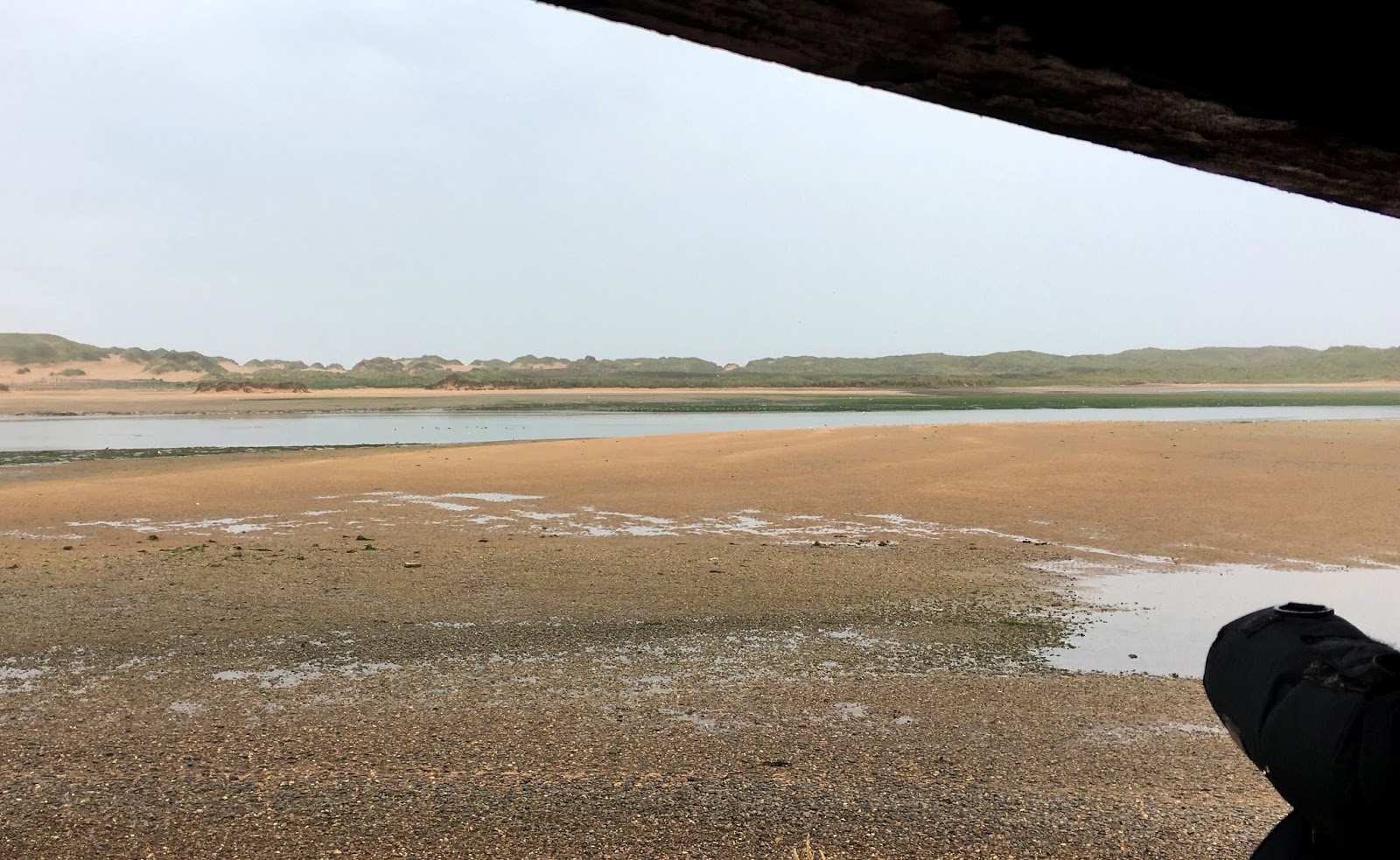
Ythan Estuary - Aberdeen
Waiting for the Sooty...the view from the famous tin hut!
Much larger than the assorted Commic Terns, with jet black wings and giving off a distinctive Skua-like silhouette, the Sooty was truly unmistakeable, and we watched as it gave further fly-pasts before continuing left down to Inch Road before settling down distantly on the algae clad rocks with a handful of Sandwich Terns.
Sooty Tern - Ythan Estuary, Aberdeen
Sooty in the rain....
Sooty Tern - Ythan Estuary, Aberdeen
Zoomed in....when I say distant I really mean distant!
Deciding that heading back to the car and driving to Inch Road instead of walking along the now soaking wet dunes would be the best option (it was now starting to rain quite heavily) we raced back to the car and nipped round to the car park at Inch, the Sooty Tern conveniently perched right in front of us and providing great views despite the now torrential downpour. Brollies in one hand and camera in the other I was able to reel off some record shots before the Sooty alighted once more, circling round to the tin hut and back before powering off up the river upstream and lost to view as a distant spec. Excellent timing and Sooty Tern well and truly in the bag!
Sooty Tern - Ythan Estuary, Aberdeen
Despite having seen Sooty Terns before at the Dry Tortugas islands off Florida and Michelmas Cay in Australia, I was still struck by just how large the Sooty was compared to our resident tern species (Common, Arctic, Sandwich, Little and Black were all present on the Ythan during our visit, making it a 6 tern day!) and it really was unmistakable when flying among the swirling masses of white.
Bridled Tern - Farne Islands
The Farne Islands Bridled Tern back in 2014. Sooty Terns differ from the very similar Bridled Terns by their larger size and much darker, uniform black back and upperwings compared to a Bridled Tern’s lighter grey. 
Usually found in tropical seas around Australia and the Caribbean, this Aberdeenshire bird was realistically only the third twitchable record in recent years (following on from the widely twitched and popular bird that frequented the Skerries off Anglesey and Cemlyn Bay during July 2005 and the moribund bird found on a Northamptonshire gravel pit back in 1980) so I was especially keen not to miss this opportunity – who knows how long it will be before the next twitchable Sooty in Britain! 
Our views of Sooty Tern on Michelmas Cay last summer
Despite seeming like a no hope situation when setting off on the Friday, this was most definitely a case of “he who dares wins” and I’m glad I followed my usual mantra of persevering with a planned twitch even if negative news surfaces while en-route – thankfully this time the gamble paid off!

Thursday, 7 July 2016

White-winged Scoter off Murcar, Aberdeen!

White-winged Scoter is one exceptionally good looking bird. Ever since seeing the pictures of a drake photographed off Musselburgh back in 2013, I wanted to see one for myself – the extravagant flick of bold white eyeliner contrasting against the midnight black tones and striking pink bill elevating them a cut above the rest in Scoter terms. Yes, Velvet Scoters are attractive, but White-winged Scoters are in a whole different league.
White-winged Scoter - Murcar, Aberdeen
Record shot of the American White-winged Scoter
With very few records of either race (Deglandi or Stejnegeri) occurring in British seas (just one record of Deglandi from Aberdeen in 2011 and one record of Stejnegeri photographed in Lothian in 2013 – but not actually seen at the time) White-winged Scoters are a truly rare bird in Britain indeed, so when reports surfaced of an adult drake Deglandi type mixed in with the regular Scoter flock off Murcar Links Golf Course in Aberdeen, it was a no brainer to get up there.

Monday, 19 January 2015

Harlequin Duck makes landfall in Aberdeen!

Whilst sat in TGI Fridays tucking in to my birthday meal of Jack Daniels chicken at the start of the month, an alert popped up on my phone announcing that a Harlequin Duck had been seen and photographed at Seaton Park in Aberdeen – one of my personal ‘must see’ birds and an incredible record for Britain! Originally put out as a female but later re-identified correctly as a first winter male, this proved to be a great ‘unblocker’, being the first really twitchable one in my lifetime after the Wick bird of 1991 and the two first summer females in Ayrshire 5 years later. With a handful of birds making it to the remote Hebridean islands in the past 15 years, this mainland bird was extremely welcomed and it was fingers crossed he would stick around until the following weekend.

With several previous birds overwintering there was a good chance it would, and sure enough, after a tiring 6 hour journey up to Aberdeen in less than ideal weather conditions and an overnight stop in a hotel, we arrived at the site and immediately locked on to this arctic wonder as he happily went about his business – a long way from home in the unexpected location of a stretch of river in the local park!

Harlequin Duck

Like its Icelandic counterparts, this Harlequin Duck tended to favour the fast, rough torrents of the rapids, flying from point to point as it continued to dive for food in the depths of the icy flows, plunging down to take advantage of the clear rich pickings in the river below. A pair of displaying Dippers were a nice sight on the rocks, as well as several drake Goldeneye in their beautiful black and white plumage and up to 3 Goosander – again highlighting the rich food source available in this small stretch of river.

Representing just the 19th record of this stunning duck for the UK, this individual tended to favour both the reeded area of the river to the left of the toilet block as well as the rapids immediately to the right, providing great views as he dived down on the river in front of us for a prolonged period before flying downstream past the development works to the furthest point of the river, where sadly there was no access.

Harlequin Duck

With the nearest population being Iceland, where over 5,000 pairs breed each year, it is highly likely that, due to the fierce Northerly gales experienced lately and the bird’s location on the East coast in Aberdeen, the most likely source of origin for this Arctic dweller will be from these rocky coastlines – displaced after the fierce storms that battered the North Sea. The Harlequin Duck’s range also expands further afield, with birds found in Greenland, Eastern Russia and NW and NE America, and birds sometimes wintering further south in California and North Carolina.


Distinctive in their breeding plumage with their fantastic showy orange and slate-grey colouration, this first winter male sadly looked more like a female, with an overall appearance of dark chocolatey-brown feathers. However, the distinctive round white spot behind the ear was clearly visible, as was the white patch in front of the eye and clear cut white line on the breast. Obviously not yet in his full breeding finery, it would be great if this male sticks around to develop his full breeding plumage – where a second visit to tie in with our planned Scottish Highland trip at Easter may well be on the cards!