A tale of nature, wildlife and birding from Cheshire, North Wales and across the globe....

A tale of nature, wildlife and birding from Cheshire, North Wales and across the globe....

Tuesday, 5 January 2016

New York Trip Report - Day 8 (Inwood Hill Park)

Day 8 -  Thursday 28th May 2015

With Wednesday having been dedicated to sightseeing at the Statue of Liberty and several species being regularly reported at Inwood Hill Park that we hadn’t yet seen during our trip (Orchard Oriole, Rose-breasted Grosbreak, Hairy Woodpecker and Veery in particular), we decided to head up to the northern most point of Manhattan for our penultimate full days birding in the hopes of cleaning up on a few extra birds. 
Statue of Liberty, New York
Having not seen any in either Central or Prospect Park, and with individuals seen frequently here according to e-bird, our main target here was Orchard Oriole - slightly smaller and duller than the brightly coloured Baltimore Orioles we had become accustomed to.
Baltimore Oriole - New York
One of the Central Park Baltimores - the only Oriole species we had managed to locate as of yet!
Arriving at Inwood Hill and walking the short stretch from the tube station, we were soon heading along the winding paths that made their way through the huge trees and up the hill the park is named after. With much denser tree coverage than at Central Park, it was interesting to see how this difference affected both the species and the number of birds that we found.

A calling White-breasted Nuthatch was the first notable bird of the day, creeping up the trunk of one of the large trees lining the path before stopping to feed on a small morsel it had discovered lodged inside a dead branch. Being at the very tail end of migration now meant that we only saw a handful of warblers – the usual American Redstarts and Common Yellowthroats were flitting amongst the leaves while a female Blackpoll was the only other warbler species of note. A very quick view of a male House Finch disappearing behind a branch was a good addition for the day, while only our second Great-crested Flycatcher of the trip was equally as brief.

Heading east along the trail, we heard an alarm call echoing loudly through the trees and moving slowly closer to the source of the noise eventually revealed a woodpecker. Calling Alex over, I was sure I’d found us one of our target missing species – the larger size and positively huge bill in relation to the head eliminating any thoughts of the more familiar Downy. With Hairy Woodpeckers not often recorded in Central or Prospect Park, it was a relief to finally catch up with this chunky woodpecker after seeing so many Downys during the week. 
Hairy Woodpecker - Inwood Hill Park, New York
Hairy Woodpecker - at last!
Hairy Woodpecker - Inwood Hill Park, New York
Calling continuously and with a male Baltimore Oriole flitting around the branches nearby, I did wonder if the Hairy had a nest somewhere nearby. We watched this charismatic woodpecker for a good while as it scrambled up and down the dead branches above us, providing fantastic views and showing off the dagger like bill.


Significantly larger than the Downy Woodpecker, size is the main thing to take note of when separating these two similar American Woodpeckers, but as is often the case with a lone individual on a trunk, a true idea of size can sometimes be hard to determine when there is nothing to compare it to.
Hairy Woodpecker - Inwood Hill Park, New York
The beak is therefore another key feature to look out for, and on the Hairy Woodpecker it is usually the same length as the head, as opposed to the small, stubby bill of a Downy. 
Hairy Woodpecker - Inwood Hill Park, New York
Note the huge bill with regards to the size of the head
The outer tail feathers will also separate the two, as Downy Woodpeckers will have black bars all along the outer tail feathers compared to the all-white ones of the Hairys.
Hairy Woodpecker - Inwood Hill Park, New York
The white outer tail feathers were also clearly noticeable

Monday, 28 December 2015

New York Trip Report - Days 5 & 6 (Green-wood Cemetery, Prospect Park & Niagara Falls)

Days 5 & 6 -  Monday 25th May & Tuesday 26th May 2015

The next day we decided to concentrate on finding one of the missing species so far on our trip and one that we had thought we were guaranteed to see – Veery. With a lady at Prospect Park on Saturday mentioning she had seen them in abundance at Green-wood Cemetery, we took the tube back down to Brooklyn again in the hope of catching up with this tiny ginger thrush.
Greenwood Cemetery, New York
The tombstones at Green-wood Cemetery
Starting off the morning at Prospect Park, it was now evident that migration was most definitely reaching the tail end, with just single male Chestnut-sided and Blackpoll Warbler along with a couple of Common Yellowthroats and American Redstarts flitting about the trees in a 45 minute period. This was a complete contrast to Saturday morning when the woods were absolutely alive with activity and birds were positively dripping off the trees in comparison! It really goes to show just how incredible a fall of birds can be.

Walking around the lake and keeping our eyes peeled for the pair of Belted Kingfishers that had been seen yesterday, a Song Sparrow stood out from the numerous Red-winged Blackbirds nesting in the reeds, their distinctive calls carrying across the water. The large swallow flock from two days ago had also reduced in numbers, with just a handful of Chimney Swifts chattering above the surface of the water. I managed to pick out a Tree Swallow again fluttering over the waves, the iridescent marine blue plumage shining out, but the increase of pedal boat numbers due to people enjoying the gorgeous weather on what was a bank holiday meant there was very little bird activity.
Birds Revenge....
The birds revenge on Alex...
Red-spotted Purple Butterfly showed extremely well at the edge of the water, and despite having a plastic sheet detailing the common New York butterflies, this was the only species we managed to positively ID (and the only one that actually remained still enough to do so!)
Red-spotted Purple Butterfly - Prospect Park, New York
Red-spotted Purple Butterfly
We headed through the bustling Brooklyn Streets and on to Green-wood Cemetery, stopping to get some refreshing juice in the heat. A small falcon flew overhead above the apartment blocks, and although probably the first American Kestrel of the trip, I didn’t get enough on it to get a positive ID before it had sped off over the trees.

Green-wood Cemetery held a variety of birds that we otherwise hadn’t seen in Prospect Park. A Chipping Sparrow hopped along the road pecking at the crumbs left behind by relatives visiting their loved ones, while a House Finch foraging by the side of the leaf strewn path was only the second of our trip. 
Downy Woodpecker - Greenwood Cemetery, New York
This Downy Woodpecker got our hopes up as being a Hairy before we got a closer look - another species we had yet to find in New York

Friday, 18 December 2015

New York Trip Report - Day 4 (Doodletown & Plumb Beach)

Day 4 -  Sunday 24th May 2015

Sunday dawned with bright blue skies and sun, perfect weather for what was my most looked forward to day of our trip – Doodletown. Part of Bear Mountain State Park and situated just over an hour’s drive north of Manhattan, this fantastic area is a well-known and popular destination amongst New York birders.
Black Vultures, New York
Lots of Black Vultures took advantage of the clear skies - the diagnostic white tips to the wings were visible even at a distance
Hiring a car for the day, despite our reservations, turned out to be a brilliant decision, and we were soon well on our way, crossing the George Washington Bridge and heading north through New Jersey. We encountered our first Black Vulture of the trip taking advantage of the thermals, passing several more as we travelled, along with a classic American cop chase encounter unfolding right in front of our eyes. A quick chase resulted in the two motorcyclists crashing head first over their handlebars before being pinned down, cuffed and seeing 5 guns pointed at their heads by the American police.

Getting slightly lost finding the car parking area for the start of our walk at Bear Mountain, we stopped at a layby to reassess. A Northern Mockingbird (a bird we had so far missed in the two parks) immediately flew in to the sunny clearing, beak laden with juicy caterpillars and indicating a nest may be nearby. 
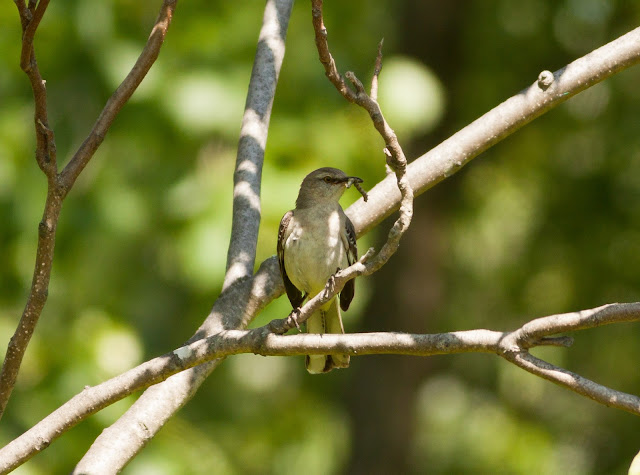
Northern Mockingbird - New York
Northern Mockingbird with caterpillars - presumably to feed young
A small, brightly coloured bird perched on the wires also caught my eye, and a closer look through binoculars revealed a fine male Indigo Bunting, again another bird that we were yet to catch up with on the trip. With a second bird flying through the Mockingbird clearing, we were really able to admire the stunning bright blue plumage that gives the birds their name. Eventually seeing around 4 in total, this was the only location during our trip that we managed to connect with these brightly coloured wonders.

Heading back to the car, it soon became clear that we wouldn’t be going anywhere anytime soon – neither of us had any idea how to start the car! Luckily a passing cop helped us out and thankfully we were on our way again, having had a much better experience of American cops first hand than the two unfortunate motorcyclists earlier.
NYPD
Reaching our parking layby opposite a small body of water, our first Turkey Vulture of the trip soared low down overhead. Distinguished from the Black Vultures by the strip of silver on the underwing, the two are easily told apart even from a distance. A Great Blue Heron (the American equivalent of our Grey Herons) passed overhead, its sheer size apparent, while a male Yellow Warbler flitted through the trees.
Turkey Vulture - Doodletown, New York
Turkey Vulture - The thick white stripe on the underside meant we could tell the two vulture species apart easily
The sun now beating down, we headed up the trail to track down some of the many warbler wonders that breed here. Unlike the warblers passing through Central and Prospect Park that merely pass through on their migration, the warblers at Bear Mountain actually stop to breed in the area, meaning a whole variety of new species would be opened up for us. With such mouth-watering treats as Hooded, Cerulean, Blue-winged and the delightfully named Worm-eating Warbler all easily accessible here, yet only encountered very occasionally in the Manhattan parks, we hoped to catch up with this colourful cast on their breeding grounds.
Black Vulture - Doodletown, New York
Black Vulture
Heading up the trail and admiring a large flock of Black and Turkey Vultures that were right overhead, we had barely gone a few metres before we picked up the high pitched call of a Cerulean Warbler. This beautiful powder-blue warbler was high up on my list of most wanted birds to see, and within a few minutes of peering up in to the tree, I caught sight of a movement amongst the twisting vines as a fine male flitted through the leaves, giving great views as it remained stationary on an exposed branch. Bingo. Much easier to see than we had expected and our first target safely in the bag – Doodletown was proving to be a doddle!
Doodletown, New York
One of the typical warbler-rich trails at Doodletown
Heading down the track and having memorised the songs of the warbler species we expected to see here, we soon stopped when I recognised a familiar call coming from a tree by the side of the trail – Blue-winged Warbler. Within moments, I caught a glimpse out of the corner of my eye as a flash of colour flew towards the telegraph pole at the side of the road next to us. Singing continuously, for such a brightly coloured bird it was almost impossible to relocate – the sound so loud but the bird seemingly obscured deep in a bush somewhere to our right. Finally, I had it, a gorgeous male, nestled within the branches and leaves of the shrub right in front of us. 
Blue-winged Warbler - Doodletown, New York
We stopped to watch this beautiful warbler, now busy preening, and took in the bright sunshine yellow body, blue wings and olive green back. Settled and content, the Blue-winged Warbler continued to sing his heart out, and we left him to attract a mate in peace, another of our target warblers off the list.
Blue-winged Warbler - Doodletown, New York
The 'Blue-winged Warbler's Blue wings'
Another familiar call soon caught our attention, and a quick check of our app revealed it to be a Yellow-throated Vireo. This proved to be a nightmare to find, the call emanating from different parts of the trees as this elusive bird seemed to move all over the place. After around 15 frustrating minutes, we eventually pinned it down to a stand of trees on the other side of the trail, the yellow throat and double white wing-bars unmistakeable.

Walking further up the trail, we stopped at a clearing overlooking a stand of woodland. A bird flying out of the trees and over the path caught my eye, and raising my binoculars I was stunned to be greeted by a pristine male Hooded Warbler – Alex’s number 1 target bird of the trip. 
Hooded Warbler - Doodletown, New York
The equivalent of my male Blackburnian Warbler, panic then ensued as I tried to direct him to the bird – luckily in a much shorter time than it took me to find the first Blackburnian at Central Park! With the classic “baby baby, I love you” song that was ingrained in our memory, we watched as this beautiful warbler sang from the branches opposite, the jet black hood standing out from the bright yellow body (reminding me of a bumble bee) and ecstatic that we had tracked down our main target at the site.
Hooded Warbler - Doodletown, New York
Our much sought after Hooded Warbler!

Sunday, 13 December 2015

New York Trip Report - Day 3 (Prospect Park)

Day 3 -  Saturday 23rd May 2015

We arose bright and early the next morning ready for our first day at a new location – Prospect Park in Brooklyn. Taking the tube and arriving at around half 8, it was obvious that despite not being there at the crack of dawn, the day would provide a wealth of birds – there had evidently been a huge fall in the night. Taking just a few steps down the path, I immediately heard a call that was now engraved in my memory – the high pitched chiming trill of a Blackburnian Warbler high at the tops of the trees. With decent views the day before but no photos, I was keen to try and catch up with what would be our second individual of the trip, and we headed in the direction the call was coming from to try and track down this fantastic warbler.
Blackburnian Warbler - Prospect Park, New York
My favourite bird of the entire trip - Blackburnian Warbler!
The perfect overnight conditions had obviously brought down a large number of birds in the park, and the trees were alive with brilliantly coloured warblers in every direction we looked. Craning our necks to see right to the tips of the branches, the bright yellow of a male Canada Warbler caught our eye in the leaves above while several Magnolia Warblers flitted from branch to branch. Red-eyed Vireos called from the very tops of the trees, while American Redstarts and Northern Parulas flashed their lively colours in abundance.
American Redstart - Prospect Park, New York
American Redstart
And then we had it. A beautiful male Blackburnian Warbler foraging at the tips of one of the branches high above our head, the vibrant tropical orange throat unmistakeable as it peered through the leaves. Grabbing my camera, I was finally able to get some record shots of what was for me, the star species of the trip.
Blackburnian Warbler - Prospect Park, New York
The bright orange throat was clear even at a height
With the Blackburnian Warbler disappearing high in to the very tops of the trees, we continued exploring the rest of Mid-Wood to see what other goodies we could find. A quick, mouse-like movement up the trunk of a tree at the side of the path turned out to be our first House Wren of the trip, providing brief views as it crept up the bark. Much more elongated than our Wrens back in the UK, the difference was clear to see, and we watched as it scurried high up the tree and disappeared out of sight around the back of the trunk.

Heading further in to the trees, an extremely showy Ovenbird provided great views as it perched on an open branch right in front of us, while numerous American Robins and Swainson’s Thrushes turned over the leaves almost everywhere we looked in the search for insect prey. 
Ovenbird - Prospect Park, New York
Ovenbird - showed so well but the light was terrible!
Swainson's Thrush - New York
Swainson's Thrush
A great spot by Alex of a pale coloured warbler above the undergrowth resulted in a female Bay-breasted Warbler, our first new warbler species of the day and a bird which we hadn’t managed to locate in Central Park. Quite a large bulky warbler, the females are readily identifiable by an overall peachy wash to the belly and two thick distinctive white wing-bars that can be seen even at a distance. A great bird to catch up with and one of our main targets for the day crossed off our list.

Following the twisting trails around Mid-Wood, the birds kept coming thick and fast. A female Black and White Warbler gave the best views yet as it foraged right in front of us on the wooden sides of the path, this time completely unobscured from any branches and providing the perfect opportunity to get some photos.
Black and White Warbler - Prospect Park, New York
The Black and Warblers moved more like a Nuthatch!
Black and White Warbler - Prospect Park, New York

Thursday, 3 December 2015

New York Trip Report - Day 2 (Central Park)

Day 2 -  Friday 22nd May 2015

With our jet lagged internal clocks still operating 5 hours ahead in UK time, we were able to get out bright and early the next morning ready for a dawn start on what was our second day in the Big Apple. With news that my most sought after species (Blackburnian Warbler) had just been spotted at a part of Central Park called Cherry Hill, we rushed out to try and catch up with what could potentially be a difficult warbler to add to our trip list.

It was immediately obvious that there had been a small fall of migrants during the night – we had barely gone a few metres in to the park when the chattering of birds in the entrance trees at Artisans Gate distracted us. Two Red-eyed Vireos were moving stealthily through the leaves at height, quite elusive but occasionally giving good enough views for us to clearly see that bright red eye that gives them their name. Luckily, this was one of the commonest Vireo species we saw in New York, and we had great views on almost every day of our trip. Interestingly, they seemed to be instantly attracted to Alex’s pishing noise – something to bear in mind the next time one is reported in the UK!
Red-eyed Vireo - Central Park, New York
The red eye that gives the Vireo its name was clearly noticable even at a distance!
Moving on to Cherry Hill, we immediately spotted the trees the Blackburnian had been reported in, and it was no easy feat trying to spot a small warbler at the top of these towering giants. A Canada Warbler flitted briefly through the leaves, while the bright yellow of several Magnolia Warblers caught our eye in the early morning light. Deciding that a row of smaller trees positioned in the sun may hold more birds, we headed over to keep watch for any warblers passing through. Several female American Redstarts hovered in search of prey, and whilst not in the same league visually as the fiery black and red males, it was still great to watch them as they foraged, their long and rounded yellow-patched tail distinctive.

A pair of Swainson’s Thrushes hopped along amongst the pine needles below (their spectacles again confirming that this was indeed the species we had seen the day before) while an extremely showy Gray Catbird foraged near enough under our feet. A flash of yellow and black caught our eye, and our first male Common Yellowthroat of the trip popped in to view.
Swainson's Thrush - Central Park, New York
The spectacle markings were always obvious on the Swainson's Thrushes we saw
Swainson's Thrush - Central Park, New York
Common Yellowthroat - Central Park, New York
Male Common Yellowthroats were not as numerous as the females
With no sign of any Blackburnians, my attention turned to a small, drab brown looking warbler skulking in the shrubs lower down. With a diagnostic white triangle on the wings, this could only be one thing – a female Black-throated Blue Warbler. While no comparison to the beautiful shimmering blues of the male, it was still a great addition to our list, and one of only a handful we saw all trip.

With the Blackburnian Warbler seeming to have moved on, we decided to make our way to the Ramble, one of the best spots in Central Park and an area guaranteed to get us some new species. A showy Red-winged Blackbird perched obligingly in a nearby bush as we passed the lake, while the high pitched calls of several Cedar Waxwings in the tops of a tree soon gave their presence away.
The Lake - Central Park, New York
The view of Manhattan from across the lake
Exploring a small garden near Robert Wagner Cove, we encountered our first Red-bellied Woodpecker (bizarrely named as the belly is completely lacking any red colouring) showing incredibly well on a fallen trunk at the side of the path. With a gorgeous black and white chequerboard back, this was definitely one of the most attractive woodpeckers we saw in America, and we often spotted them creeping up the sides of the trunks.
Red-bellied Woodpecker - Central Park, New York
Continuing on around the lake and along the road, amongst all the early morning joggers Alex noticed a large brown flycatcher perched in the top of one of the trees in Strawberry Fields. Having received a Twitter alert of an Olive-sided Flycatcher in the area, this could only be one thing. Getting good views through our binoculars, despite the distance across the road we could clearly see the well-marked olive brown patches on the sides, a great addition to our list and an uncommon bird in Central Park in some years.
Olive-sided Flycatcher - Central Park, New York
One of the easier flycatchers to ID!

Monday, 30 November 2015

New York Trip Report - Day 1 (Central Park)

Day 1 -  Thursday 21st May 2015

Being a destination we had both been eager to visit and with Central Park well known as a migrant hotspot during the epic spring migration, we booked 10 days in what is perhaps the most well-known city in the world – New York.  Whilst this bustling hub of metropolitan life may not at first glance seem a typical birding destination, the parks attract an incredible array of species during spring and autumn migration, with over 20 species of warbler waiting to be found on a typical May morning. Also home to such iconic sights as the Empire State Building, Times Square and the Statue of Liberty, as well as the natural wonder that is Niagara Falls being easily accessible through flights to Buffalo, New York was the perfect choice for our first journey in to American birding.
Central Park, New York
The famous view of Central Park and the Manhattan skyline
Basing ourselves at the Park Central Hotel in Manhattan for the duration of our stay, we were just 3 blocks from the entrance of Central Park, and with one of New York’s many tube stations situated right outside our hotel, the rest of New York was easily accessible to us via public transport, meaning we managed to explore 3 of New York’s 5 boroughs during our stay (Manhattan, Brooklyn and Queens). With a wealth of parks and wildlife refuges scattered through New York offering the many birds passing through a place to rest up during migration, a fantastic diversity of species can surprisingly be found living alongside the 8 million people that call the city their home, and without doubt, this was the best trip that both of us have been on to date.
New York, America
New York, America
Landing at JFK airport just after lunch, despite the 7 hour flight there was no time to rest. After checking in to our hotel 3 hours later (the border queues at the airport were huge!) we immediately took the 5 minute walk to perhaps what is the most iconic park in the world to begin our trip – Central Park.
Sheep Meadow, Central Park
The famous Sheep Meadow in Central Park
Having already familiarised ourselves with the species we should come face to face with and having tried to memorise the calls, along with our Sibley Guide we were well equipped to begin our adventure, despite neither of us having any experience with American birds apart from the strays and vagrants that make it across to Britain.

Completely artificially created and nestled within the towering skyscrapers, Central Park is an absolute mecca for birds during May, with the peak usually occurring during the second week. Luckily for us, migration this year was late, as we weren’t able to fly out until the 21st, giving us the whole of the last week and part of the third to see what goodies we could unearth. With their bright colours, vibrant patterns, and often quirky names, warblers were naturally high up on our list and were the main focus during our time in New York’s parks.

Taking bets as to what the first new bird we’d spot would be (Alex thought Chimney Swift while I went for Great Blue Heron due to JFK being so close to the water) we were both proved wrong, with that honour going to the classic American Robin.
American Robin - New York
American Robin - our first new species in America!
Hopping around on the grass just a few feet from the entrance, we had our first American species in all its glory – much larger than I had expected and more similar in size and structure to a Blackbird than a Robin. I couldn’t resist stopping to take a series of photos (despite Alex telling me we had to focus on the rarer species on our first day and not get distracted by the common) although this was definitely justified as these initial shots proved to be my best of American Robins throughout the whole trip!

Dragging me away and heading in the direction of the Ramble, we soon racked up some of the commoner species. A Blue Jay taking advantage of some leftover bread was just as beautiful in real life as depicted in our books, while the bright red flash of a Northern Cardinal looked positively tropical in comparison to our normal backyard birds at home. Huge flocks of House Sparrows and Starlings also provided a touch of familiarity, having been introduced here and thriving in the urban landscape of Manhattan.
Blue Jay - Central Park, New York
Blue Jays were relatively common
Northern Cardinal - Central Park, New York
Northern Cardinals were also a regular sight
Northern Cardinal - Central Park, New York

Monday, 16 November 2015

Crag Martin in the bag - Crooked Spire, Chesterfield

Crag Martin! What a bird, what an agonising week in work and what a roller coaster ride of emotion - all thanks to one tiny Mediterranean Hirundine taking to the skies in a Derbyshire town!
Crag Martin - Crooked Spire, Chesterfield
After missing the well twitched Crag Martin at Flamborough in April last year due to flying out to Spain the same weekend it arrived, me and Alex were sure it would be a considerable wait until we got another opportunity to see this mega bird in Britain again – if ever. Even though we had seen plenty during our trip to Spain, it wasn’t quite the same as seeing one in the UK, and the Flamborough Crag Martin definitely fell in the category of one that got away….

Fast forward a year and a half to last Sunday morning when the alert on my phone came through detailing the incredible report of a Crag Martin flying around the crooked spire in Chesterfield! This was an opportunity we simply couldn’t miss! Leaving on first news and despite the bird disappearing on several occasions, it reassuringly kept returning to the spire throughout the afternoon, obviously favouring the tall structure as a point of interest in the Chesterfield landscape.  I had a good feeling – it felt like we would connect.

However, at 13:50 news came out that the bird had flown off and not yet returned, and despite a vigil at the spire with another hundred or so birders in the hope that it would come in to roost, there was sadly no sign through to dusk.
Chesterfield's Crooked Spire
Several birders were convinced it would be back in the morning, with Crag Martins on the continent often returning to the same structure or spot once they have taken a liking to it, and were staking out the crooked spire from dawn. The mega alert noise on my phone while walking through the door at work on Monday morning therefore stopped me in my tracks and my heart sank – it had to be the Crag Martin back. Phew – false alarm, it was only the Hudsonian Whimbrel in Cornwall. A second alert 10 minutes later however wasn’t so welcome – the Crag Martin was indeed back and flying around the spire! Gutted was an understatement.

An agonising work in week then ensued, before the dreaded news on Wednesday came though that there had been no sign at the church all day – this mega visitor had apparently departed without us managing to connect.

However, searching for ‘Crag Martin’ on twitter late on Thursday night, I came across a tweet from the same day by a birder saying he had enjoyed views of it flying around the spire that very morning! What on earth?! Sending the photo to Alex he sent the news in to Birdguides in case the bird had been remarkably refound – we still weren’t sure if this was a mistake or even a wind up after all the local publicity the bird had been receiving. Regardless, the report being publicised the next day worked, and sure enough (despite the sighting at one point being renounced as a hoax/plane) at half 9 that morning the few birders present confirmed the unbelievable – the Crag Martin was back for more! Every weekday worker/twitcher unable to get time off breathed a collective sigh of relief across the country. The Crag Martin twitch was back on!
Crag Martin Tweet

Thursday, 5 November 2015

Autumnal Birding - Short-eared Owls, Scaup, Jack Snipe and Cetti's

With the rustic tones of autumn coming to a close and the cool chill of winter fast approaching, I’ve been able to catch up with a selection of good birds locally as the seasons shift and the birds follow suite.

Short-eared Owls in particular seem to be in great abundance this year, and I managed to see up to 6 different birds at Parkgate/Burton Point during the recent high tides, all taking advantage of the large numbers of voles and other small mammals forced out of the vegetation as the water levels rose. With further individuals at Frodsham Marsh as well as this beautiful bird found hunting along the banks of the River Clywd in Rhyl, the winter of 2015/16 already seems to be a bumper year for these charismatic owls.
Short-eared Owl - River Clwyd
There also appears to have been a mini-invasion of Firecrests taking place throughout the North Wales coastline over the past few weeks, with up to 5 spotted at Conwy RSPB near the pond bridge and further individuals scattered across the coastline and up to the Great Orme, particularly around Llys Helig Drive.

The female/immature Scaup at Eirias Park boating lake also provided excellent views when I visited, and having been associating with a group of Mallards for several weeks now, is still present. Whilst occasionally flushed by dogs (such as on one occasion while I was present) the Scaup seems to have taken this small patch of water to its liking, showing fantastically well and being easy to spot on such a small water body. With the lake slowly being drained for the winter however, it will more than likely soon move on, perhaps to the coast or to one of the other pools or lakes nearby.
Scaup - Colwyn Bay, Wales
Burton Mere Wetlands is also playing host to two Jack Snipe at present, most often seen from the first boardwalk screen hidden amongst the stubble of cut reeds. Cryptically camouflaged and usually asleep amongst the Common Snipe with its beak concealed, the distinctive facial markings give the ID away along with the darker and bolder patterns on the back. Luckily, we managed to get great views of one individual doing its characteristic bobbing motion as it moved through the reeds before settling back down and remaining hidden behind the vegetation.
Jack Snipe - Burton Mere Wetlands
Two Cetti’s Warblers have also taken up residence in the patch of reeds between the reedbed screen and the second hide. Usually remaining hidden deep within the depths of the reeds, with just the distinctive explosive call giving their location away, we were lucky to get amazing views as they became incredibly active late in the afternoon before heading off to roost, showing unbelievably well and performing right in front of the screen out in the open. These were by far my longest ever views of Cetti’s Warblers, having previously only ever got glimpses at various reserves before the bird dashed back in to the safety of the reeds. A pair of Brambling on the feeders were also lovely to see, completing what has been a fantastic few weeks for classic autumnal/winter birds.