Monday dawned with beautiful
weather yet again, and our hopes were high as we set off from Hugh Town at
around 5pm. With (thankfully) no Wilson’s yet again on Sunday, this was our
last chance to connect in what had so far been a disastrous year for sightings.
With the previous latest sighting being the 17th July, no one was
really sure what was causing the absence of birds, although one theory was that
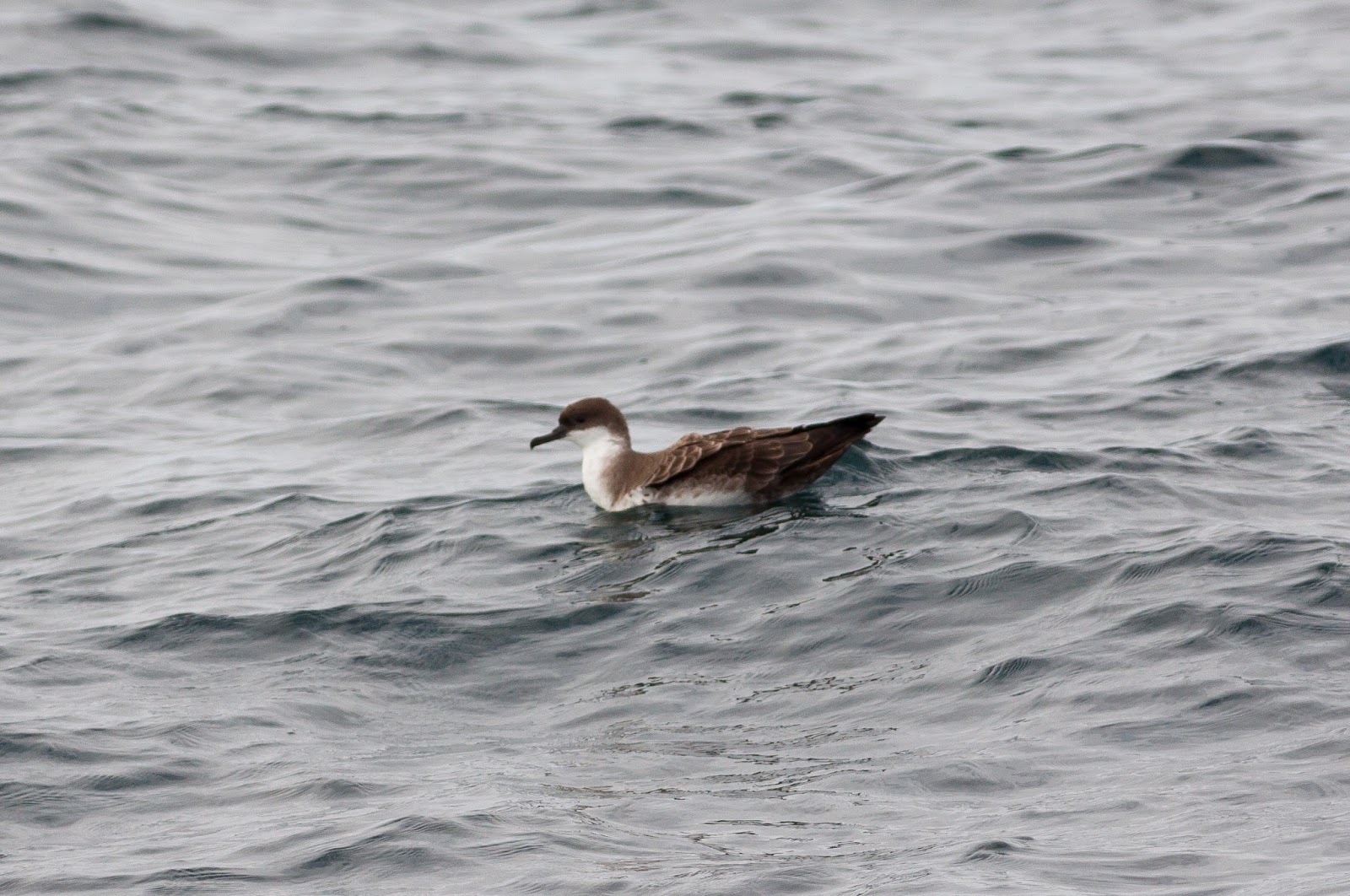
the seas were a touch too cold. Close fly-by views of Great Shearwaters
yesterday had us hoping they would put in a repeat performance tonight, and
luckily we weren’t disappointed.

In a brilliant sequence of events
unfolding over around 60 seconds, the call went out of a Bonxie sat on the sea,
which the boat began to head towards. This plan was swiftly abandoned however,
as a Sooty Shearwater zoomed past the side of the boat at close quarters. With
everyone reaching for their cameras, a second shout 10 seconds later came from
Scott of “Great Shearwater!” Having picked up his camera he had looked up
expecting a Sooty Shearwater, but instead had laid eyes on a Great that had
come out of nowhere! Fantastic!
We watched for several minutes as
this large shearwater gave several circuits of the boat (all thoughts of the
Sooty were long forgotten by now!) and we took in the diagnostic dark cap, dark
and white tail and the extremely dark upperparts. Much larger and agile than a
Manx Shearwater, the difference in size and flight style was obvious, and the
pale underwings with dark smudges were also clear to see.
In total, we eventually had an
estimated 5+ birds (told apart by the difference in pattern on the underwings)
and several in particular gave absolutely breath-taking views, coming to within
7 metres of the boat (they were so close my lens wouldn’t focus!). One in particular
kept diving below the surface right in front of us to feed on the fish remains
thrown overboard – a behaviour I wasn’t aware of in Great Shearwaters. Everyone
watched in awe as the bird performed spectacularly, making circuits around the
boat and giving a show that none of us would forget in a hurry. What a way to
see a lifer!
Sadly as the light faded, we
unfortunately just couldn’t make a Cory’s or Wilson’s materialise, and despite
the best efforts of everyone on board, it just wasn’t to be this year!
Just a week later, 3 out of the 4
pelagics managed to connect with a Wilson’s, whilst the Sunday pelagic scored
absolutely incredible views of a Fea’s Petrel soaring around the boat – the
ultimate in pelagic birding and one which we will hopefully connect with on
future trips! Whilst we had been a week too early for the Wilson’s, this may
have been a blessing in disguise, as not booking on the Sunday pelagics would
have resulted in heartbreak had we been there a week later and missed the
Fea’s!
Checking past records, the second
week in August has traditionally been the best for Wilson’s, with a 54% score
rate, while Fea’s can turn up at pretty much any time. The fact that both this
years and last years bird turned up within a couple of days difference between
dates could indicate that anywhere around the 16th and 18th
is ideal – boding well for next year’s trip falling between Monday the 15th
and Saturday the 20th.
Exploring the islands on our
final day before the ferry back gave us an opportunity to admire the subspecies
of Speckled Wood found on the Scilly Isles (subsp Insula). Slightly more orange
than our individuals on the mainland, whilst the difference is only slight,
fluttering around the trees the butterflies were noticeably more orange.
We also
got great views of a number of eels in the streams surrounding Lower Moors
Nature Reserve- another new fish for me and a species I have been wanting to
see for a good while.
Lower Moors itself is renowned
for attracting a whole host of megas over the years, including a recent
overwintering Northern Waterthrush and a Black and white Warbler found
frequenting the lichen covered trees on the outskirts of the boardwalk trail!
Whilst not as productive in recent years as in its heyday in the 80’s and 90’s,
hopefully these beautiful islands can soon start producing the goods again in
terms of mouth-watering American vagrants.
 |
| Lower Moors trees - once home to a Black and White Warbler |
With next year’s trip already
booked, fingers crossed that we are able to time it right to connect with
Wilson’s next time around, and maybe even secure once in a lifetime views of
that most mythical of petrels like the lucky few on the Sunday’s pelagic –
bring on the Fea’s!