A tale of nature, wildlife and birding from Cheshire, North Wales and across the globe....

A tale of nature, wildlife and birding from Cheshire, North Wales and across the globe....
Showing posts with label Cornwall. Show all posts

Thursday, 5 March 2015

Pacific Diver in Marazion

As we had a whole weekend free after visiting the Little Bunting, me and Alex decided to head back down to Cornwall to try and spot the Pacific Diver that overwinters around Mounts Bay near Marazion each year.

Pacific Divers have only recently been split from the near-related Black-throated Divers, and with only 8 accepted records for the UK, is a real mega. There were no accepted records in the UK or Europe even prior to 2007, but early that year 3 different individuals were identified, a first winter inland at Farnham Gravel-pits in Yorkshire from the 12th January to the 4th February, another first winter on the Llys-y-fran Reservoir in Pembrokeshire from the 2nd Feb to the 20th March, and this adult bird in Mount’s Bay, Penzance which first arrived on the 17th February. What caused this mini influx is unknown, although the fact that the species became wider known to birders, with more people aware of the ID features, may have contributed to the 2 other birds being found and subsequently IDed that very same winter.

Remarkably this is the 9th winter the Marazion bird has been back, although vagrant Pacific Divers do seem to show a tendency for remaining faithful to a site, as incredibly the Llys-y-fran bird returned again in the Februarys of both 2008 and 2009! Who knows how long the Cornwall bird will continue coming back for, although it has been showing far more regularly and reliably this winter than in previous years.

St Michael's Mount, Marazion
A view of St Michael's Mount from the Station Car Park
On arriving at the Station Car Park, we soon picked up several close in Great Northern Divers, but after determining the Pacific wasn’t anywhere near this car park, we adopted a different strategy to our first visit and decided to make our way along the bay, stopping off at various points. We headed over to Penzance, viewing from the road, where another GN was picked up along with a Black-throated not too far away in front of the rocks – the white diagnostic flank patch visible even at a distance. 2 Eiders fishing near the marina were nice to see, as were a pair of Gannets diving just off shore.

Deciding the best point to view from would be Long Rock Car Park itself, especially as that was where all the reports had been coming from lately, we the headed that way – managing to find it this time tucked away over a level crossing down one of the small lanes (on our last visit we just viewed from the Station Car Park, unaware of this better viewing point).  With just a few Great Northerns hanging around, there was still no sign of the Pacific, having last been reported at 10:30am that morning. Several other birders turned up as it neared to high tide, including the birder that had reported it this morning, but with still no sign we decided to head back round to Penzance and check the Jubilee Pool area. With no luck there, we returned to Longrock for one last check before the light faded, and joined the birder who had seen it that morning.

Alex spotted a different looking diver relatively far out beyond the rocks and as we got our scopes on the bird it was clear to see it wasn’t a Great Northern – structurally different with an exceptionally dark back, rounded head, and a clear, bright white contrasting throat and chest. The black line along the throat was also solid – no white collar indentations or dark curves around the neck. As divers tend to have a habit of doing as their name suggests, we were lucky that this one was busy preening, allowing us to really study the features. Despite the distance, our bird was clearly visible above the water, and the absence of the white flank patch that would otherwise indicate a Black-throated was apparent from all angles – the bird was a solid black colour all over down to the waterline. It had to be the Pacific. The man who had seen it earlier was also confident that this was the bird that he had seen this morning, and with it being way to far to determine a definite chinstrap, the absence of the white flank patch clinched the ID for me.

Sadly the light faded at this point, rendering viewing much harder (especially in my scope!) and we watched in dimming light until the bird eventually took off from the water and flew out far to sea – presumably to roost.

On our previous visit we had encountered a similar looking diver at very close range, and on seeing the bird again it was now clear that it was the same that we had been watching 2 weeks earlier. On our first visit we just weren’t armed with enough knowledge on the ID, and actually talked ourselves out of it being the Pacific back in the hotel! Having never seen one before and being alone with no one else to confirm, we just weren’t 100% confident on the ID to add it to our lists.


This brilliant video taken by Mark Hipkin in November 2014 was really useful in getting to know how the Pacific Diver would look in the field.

A lone diver’s proportions and size is always difficult to assess when it’s on its own with no other birds to compare it to, although the much smaller size (at one point I exclaimed it was nearer GC Grebe size) and the much shorter, stubbier bill that we noted should have told us it was the Pacific that we were watching and not a GN diver or BT, especially as there was a clear absence of a white flank patch.

It just goes to show that a little bit of research, knowledge and ID insights can go a long way (my excuse is that Pacific isn’t well document in my Collins!) and that you really need to know what you’re looking for in the field (as demonstrated on our first visit, when a couple were adamant that a young GN diver was the Pacific over and over again!). Having only ever seen one Black-throated Diver before (extremely distantly at Carsington Water, where it was the only diver present) I also wasn’t familiar or experienced enough with the structure of smaller divers in the field – another point that meant I just wasn’t 100% sure what we were looking at on our first visit. I always like to be 100% sure of a bird’s ID myself before I add it to my list, so I’m really glad we made the huge effort to come back to Cornwall in order to be fully sure that we had indeed seen the Pacific Diver.


For anyone looking to visit, the best vantage points can be seen on the map below. 

Pacific Diver Marazion Map

Pacific Diver Marazion Map
We saw the diver at points 1 and 3, and it apparently favours the area around the rocks (2)

Thursday, 6 November 2014

Cornish Road Trip Part 2

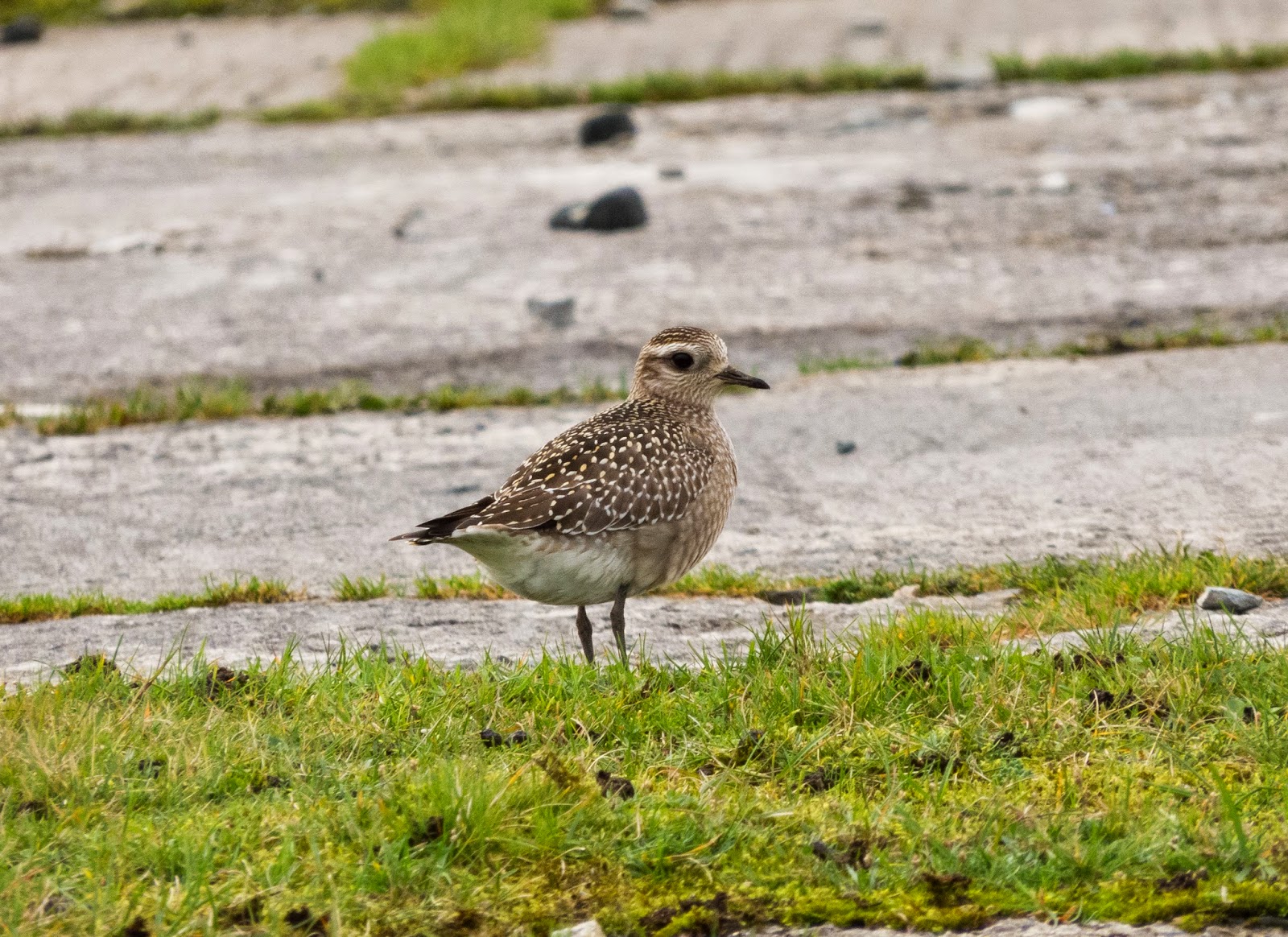
After heading to Davidstow Airfield in the morning to track down the American Golden Plover that had taken up residence there (it was clearly in no hurry to move on from its new found home, having been present for over a week), it was rather frustrating that we couldn’t relocate it next to its usual haunt of the small pool next to the windsock. After driving around for about an hour checking the surrounding grassy fields, with no sign of the bird anywhere, we were just about to give up (another lifer seemingly slipping out of our grasp) when Alex made an absolutely cracking find, spotting the bird right next to the car hidden in the centre of the runway! It had evidently proven hard to spot for everyone, as 4 other cars had driven past it already whilst we were there, the bird blending perfectly in to the concrete surroundings and completely undeterred by the trail of cars moving slowly down the runway in search of it. We quickly alerted the other cars looking, and stopped to admire this beautiful looking American wader.

American Golden Plover

American Golden Plover

Though rather bleak looking and containing few pools, Davidstow Airfield has surprisingly attracted its fair share of American waders over the past 5 years, with White-rumped, Baird’s and Semipalmated Sandpipers, as well as several Buff-breasted Sandpipers all recorded amongst the abandoned and eerie runways.

We sat and watched the AGP for a good while, the bird positioned right outside my passenger door allowing for some excellent photo opportunities and showing fantastically well at such a close range. This allowed us to really take note of the golden and silver speckles on the plumage and admire it as it happily foraged for worms in a small patch of grass.


As a juvenile, it was distinguishable from our resident Golden Plovers by the prominent white supercillium and overall greyer and duller colouration – illustrated perfectly at such a close proximity.

American Golden Plover

American Golden Plover

American Golden Plover

 After getting our fill of the plover, we then headed back up north to Somerset to try and catch up with the reliable juvenile Pallid Harrier that had taken up residence at the newly created Steart WWT reserve. Upon arrival, we were told we had just missed it showing well by 5 minutes (shouldn’t have stopped at that service station en-route!) so we stuck it out by the hide waiting for it to reappear, entertained by one of two Great White Egrets present mooching around in front of us.

After half an hour or so, the cries went up, and it had indeed taken off from the marsh and was gliding smoothly across the reeds. Whilst distant, the orange colouration could just be made out (my favourite plumage type for Pallid Harriers) and we watched the bird for around 5 minutes before it was lost to view in the marsh again. Deciding that the other path offered much closer views, we headed off that way, and whilst sat scanning our surroundings, amazingly, by sheer chance, both me and Alex had our scopes independently on the exact patch of reeds to coincide with the moment the bird took off again – providing close prolonged views and allowing us to see the distinctive features a lot better.
Seart WWT
The saltmarsh the harrier was favouring.
Pallid Harriers have much slimmer and narrower wings than Hen Harriers, and the juveniles can be told apart by the unmarked bare orange undersides lacking any of the streaking that is usually found on Hen Harriers. The distinct pale collar on the neck and solid dark boa pattern also separates them from the extremely similar Montagu’s Harrier, and this coupled with the contrast between the solid dark secondaries and pale primaries are the best ways to tell the two species apart.


After deciding to head back down south that evening to Hampshire for the Siberian Stonechat that was showing at Titchfield Haven, we made the 2 and a half hour journey to our next stopover in Southampton to rest up and enjoy a delicious meal of crispy lamb and chilli fried chicken (some of the best food I’ve had out in ages so most definitely worth a mention) and the prefect remedy for getting stuck in the tedious and unexplainable hour long delay we encountered near Wiltshire!

Monday, 3 November 2014

Cornish Road trip Part 1

Thursday the 23rd October saw the remnants of Hurricane Gonzalo bring a whole host of American goodies to our shores, with a scattering of mega thrushes discovered in the usual inaccessible places whilst good numbers of seabirds passed by, brought closer by the strong buffeting winds. It was with great anticipation that we waited for the inevitable mega alert to go out, and sure enough, there was little disappointment as news of a Yellow-billed Cuckoo hiding in the valleys of Porthgwarra broke first, swiftly followed by the incredible record of a Black-billed Cuckoo on North Ronaldsay, (the first for 24 years) and a Chimney Swift soaring across the skies of the Outer Hebrides. As the Black-billed cuckoo had disappeared as quickly as it had dropped out of the sky in hot pursuit by the Merlin chasing it, and that the Chimney Swift was on a remote island hundreds of miles away and largely inaccessible, whilst being nearly 350 miles away, the Yellow-billed Cuckoo was the only realistic option.
Yellow-billed Cuckoo - America
Yellow-billed Cuckoo in its native America
With a track record of quickly perishing (usually after 1 or 2 days) or moving on, we were slightly apprehensive as to whether it would still be showing on the Saturday. Sure enough, as we were making the 6 hour long journey to Cornwall, the negative news that there was no sign was a little disheartening, as the bird had either done a Friday night flit or had succumbed to the cold Cornish weather that night.

This was probably our best chance to see this species without having to travel to an island location, and this was the first mainland bird since 2000 (also in Cornwall), so we were desperately hoping it would be relocated. Quite frustrating, as the bird could simply be hiding out of sight, hidden in a tangle of twigs and branches just a few hundred metres away over the vast moors. After joining in the hundreds of other birders in a fruitless search of the surrounding moorland, we decided to call it a day and head to the bay at Porthgwarra for a spot of seawatching after hearing that several Balearic Shearwaters were moving through that morning.

Upon arrival, several Balearics were quickly picked up shearing across the waves (a lifer for me) and their dusky under parts in comparison to the white of the more regular Manxies was apparent. I was quite keen to see this species, as it isn’t one you would usually see with ease or at close quarters living in Cheshire. I don’t normally get good views of birds whilst out seawatching (more often than not usually just distant dots) but the extremely close proximity of the passing birds at Porthgwarra was an excellent opportunity to see commoner species at a closer range than I’m used to. Several Arctic Skuas travelled past in the half an hour or so that we were there, both dark and pale phase, and it was great to see their plumage at close range, as opposed to a distant black speck on the horizon harassing terns.

With no sign of the American Golden Plover that had been reliably present until today, we decided to try and track down the juvenile Rose-coloured Starling that had made a home of Penzance’s retail park, taking a liking to the Sainsbury’s, Morrison’s and KFC car parks. The bird proved tricky to track down, but after around an hour of driving around we eventually spotted it perched on the wires outside Sainsbury’s (and then again at Morrisons where we’d moved to get better internet signal!) showing well.

The Rose-coloured Starling juv showing on the wires opposite Sainsbury's

Unlike the Rhos-on-Sea adult that I saw back in 2012, this juvenile was quite grotty looking, with no sign of the handsome pink and glossy black colouration of the mature birds. It clearly stood out among the European Starlings however, the paler sandy brown colouration making it relatively simple to pick it out with ease.

The adult bird from Rhos-on-Sea back in 2012 - a lot nicer to look at!


With a few days off work, we decided to stay in Cornwall and make a long weekend of our failed cuckoo mission, and with late news of the American Golden Plover returning towards dusk, we had positioned ourselves perfectly, staying at a Golf Club just 10 minutes away from the site, ready to track it down the next morning and make the most of our Cornwall trip.