Mallorca – an idyllic Mediterranean island retreat, steeped in Spanish culture and popular with holidaymakers and tourists alike. The largest island in the Balearic archipelago, this beautiful location is packed full of both interesting and fascinating flora and fauna, with a number of notable bird species to be found here including Black Vultures, Marbled Ducks, Moustached Warblers, Red-knobbed Coots and of course the endemic Balearic Warbler.
Found in just a handful of places on earth having recently been split from Marmora’s Warbler, finding this beautiful and charismatic Sylvia warbler is understandably the main reason for any birder’s trip to this stunning island, and we of course were no different. Allowing ourselves three days to track down this Mallorcan endemic, we planned our trip to maximise success with this species, hoping to catch up with our remaining targets in the process.
Housekeeping:
Our trip to Mallorca involved exploring the Northern half of the island around Alcudia and Port de Pollença, incorporating Boquer Valley, Embassament de Cúber and Parc Natural de s'Albufera de Mallorca, with specific targets of Balearic Warbler, Black Vulture, Moustached Warbler and Red-knobbed Coot. 4 lifers and 70 species in total were seen during our 3 days in Mallorca, covering the 19th February – 21st February 2017.
We hired a car for the duration of the trip from Hertz and flights were direct return from Manchester to Palma. With four main targets encompassing three locations in Mallorca, from our base in Playa de Muro we had easy access to all of the key sites in the area, with no journey taking more than an hour. We stayed in a total of 2 hotels during the trip – a late arrival into Palma saw us stay in the town for the night at Hotel Hesperia Ciutat de Mallorca, before heading north the next day to our base at Viva Blue & Spa hotel – a self-catered apartment room complete with outside pool.
Viva Blue & Spa Hotel
Daily Diary
Day 1:
Arriving late on the Saturday evening at Palma airport, our after dark arrival left no opportunity for birding, instead navigating the short journey through town to our hotel for the night on the western outskirts of the city.
Awaking bright and early the next morning to crystal clear skies and glorious sunshine we were out on the road early, the arterial motorway that cuts through the island making light work of our journey north to our first site of the trip – the famous and iconic Boquer Valley.
The view down to the sea from the Boquer Valley
Passing through the delicate blossom orchards and olive groves as we neared the historic town of Pollença, a solitary Booted Eagle was our first bird of note as we travelled through the old fashioned farmland and terracotta buildings, shortly followed by a large vulture drifting effortlessly between two huge swathes of mountain. Stopping the car excitedly in the hope it could be a Black (Cinereous) Vulture – a new species for us both – our bins revealed chocolate brown tones and a structure too small to be our hoped for Black, the soaring figure instead being our first Griffon Vulture and in reality one of only two for our trip.
The views from the Boquer Valley hillside
Reaching the small rocky car park nestled at the base of the Boquer Valley we began the gradual climb up the boulder-strewn hillside, a single Blackcap foraging in the white blossom of an orchard garden a reminder of the spring still to come back in the UK, while several Black Redstarts skipped amongst the parched grassland below. As expected, it wasn’t long before a stunning male Blue Rock Thrush flew in to view, our first of many in what is their traditional favoured mountain habitat, while a small number of Great Tits, Robins, Chaffinches and Goldfinches all chattered noisily from the stand of conifers lining the track.
Blue Rock Thrush
Manoeuvring through two sets of metal gates and through the courtyard of an abandoned Spanish villa before heading up the valley path, the thick shrubs and bushes taking over the dry terrain held an abundance of Sardinian Warblers, their scratchy songs emanating from between the thorns and occasionally treating us to a glimpse of their midnight black hoods and fierce, piercing scarlet eyes as they popped up to survey their territory. Serins also darted from branch to branch here, whizzing across our heads and performing their enchanting display flights, the buttery coloured males attempting to charm their female counterparts with bursts of cheery song while an aerial chase between Kestrel and Peregrine erupted in the skies above us.
Heading much further down the valley our feet trod the familiar and well-worn path that countless birders had inevitably walked over the years, all with the same end goal in mind and with eyes and ears alert for a snatch of song carrying on the breeze or a flash of deep dark grey disappearing in to a bush. We, like hundreds of others before us, were on the trail of the Balearic Warbler – endemic to Mallorca and the main reason for our visit to this Mediterranean island.
Goats were in abundance at the Boquer Valley!
One of the most popular and well known sites on the island to find this charismatic Mallorcan endemic, Boquer Valley is notoriously productive at producing this coastal maquis specialist, with more records here than at any other site. Favouring the knee high scrub at the farthest end of the valley by the sea as opposed to the taller shrubs inhabited by the Sardinian Warblers earlier on in the route, it wasn’t long before a flash of dark grey caught my eye.
Sure enough, raising my bins excitedly revealed our prize – our first Balearic Warbler, perched precariously on a patch of lilac flowers and belting out loud bursts of song across the valley. Success, and our Balearic endemic safely in the bag!
Balearic Warbler!
Getting photos of this Mallorcan treasure was a different story however, and as quickly as he’d appeared he was gone, disappearing into the depths of the shrubs and taking another ten minutes to relocate slightly further down the slope. By this point, the pleasant sunshine of the morning had completely disappeared, leaving in its wake a cool sea breeze circulating around the valley.
With the towering mountains putting the whole area into a dark shade, the temperature had also dropped dramatically, and it was perhaps a case of the lack of Mediterranean sun bringing a premature close to our Balearic Warbler concert. In a further two hour stake out we only heard the song twice more, and despite scrambling up and down the loose shale slope in an attempt to secure further views of perhaps two individuals, we only caught glimpses as they flew around the valley and clambered through the bare shrubs.
Balearic Warbler
At one point we were able to fire off some record shots as one swayed on the top of a nearby bush, bright orange legs splayed and delicately feeding on the tiny spiders nestled amongst the buds, but on the whole they proved to be extremely tricky to photograph, rarely staying in one place for more than a couple of seconds and having a habit of completely vanishing without a trace into a patch of scrub.
As well as the Balearic Warbler, we also stumbled across this Sombre Bee Orchid (Ophrys fusca), a new species of orchid for me. Finding just a solitary plant on the scree covered slope, this is a species native to the Mediterranean.
With the temperature dropping further and with aching ankles and feet due to the challenging terrain, we decided to call it a day and make our way back down to the base of the valley, a flock of over 20 Ravens flying overhead a notable sight while several more Song and Blue Rock Thrushes darted over the scrubland. One particular male gave fantastic views perched on a favoured terracotta roof in the abandoned yard at the base of the mountain, the deep royal blue feathering glinting in the spring light under the floating white blossom petals.
Blue Rock Thrush - I guess they do like rooftops after all...
With the afternoon to spare we decided to make our way through the mountains and towards the Embassament de Cúber, travelling along the elevated Ma-10 mountain road from Pollença to Fornalutx in an attempt to locate one of the many Black Vultures that inhabit the island. Having missed them on mainland Spain during our previous visits we were keen to catch up with these magnificent birds, which can be found in good numbers soaring high up above the mountains on Mallorca.
With Alex expertly manoeuvring the winding mountain rounds, we soaked up the incredible scenery and breath-taking panoramic views of this part of the island, a new vista at every turn and showcasing the natural charm that the Balearic islands hold. Black Redstarts and Robins darted out in front of the car on several occasions as we made our way higher up in to the mountains, demonstrating the sheer abundance of these species on the island.
Black Redstarts were abundant on Mallorca
Arriving at Embassament de Cúber and parking up in the small car park, we scanned the surrounding hillsides, safe in the knowledge that this particular area was a hotspot for our target Black Vultures. Two Crag Martins zipped over the surrounding cliffs, dancing above the ledges and wheeling through the sky, their white tail windows shining through in the light, while a small handful of Cormorants fished the glassy waters of the reservoir itself.
Embassament de Cúber
The donkeys at the reservoir were particularly friendly!
Suddenly, Alex called out that he had the vultures, two large black shapes circling distantly over the far mountainside. Scrambling out of the car to set up the scope, he got on them just as they disappeared behind the crags, unfortunately not reappearing again for me to take a look. The perils of limited baggage and only taking one scope!
Mountain - minus the vultures!
With the thick fog and cloud rolling in to obscure the tops of the mountains, we decided to head in the direction the vultures appeared to be travelling, and emerging from a tunnel on the Mirador Ma-10 viewpoint slightly north of the Embassament, I spotted three large shapes soaring to our left.
Black Vultures!
The viewpoint from Mirador Ma-10
Pulling over in an extremely well placed lay-by and getting the scope on the birds revealed we had indeed relocated our targets, and we watched as they proceeded to drop down on to the top of the mountainside to feed on a nearby carcass, dwarfing the Ravens already in attendance.
Black Vultures feeding on a carcass on the mountainside
Two more birds, this time flying much lower down, soon appeared from the nearest cliffs, soaring effortlessly ahead and displaying their exceptional wingspan, before disappearing back in to the mist. Like flying barn doors, Black Vultures are significantly larger than the Griffon Vultures, and it was fantastic to successfully catch up with them and watch on as they fed.
Flying barn door!
Bizarrely, what was a deserted lay-by had now become packed full of German tourists in the space of 10 minutes, and with a solitary Red Kite drifting above us as the clouds rolled in subsequently hampering our view, pleased with our success we called it a day.
The mountain where a few minutes earlier we had been watching the vultures feed, was now completely obscured by clouds!
Navigating the twisting mountain route once more we continued on to our hotel for the night, situated just south of Port d’Alcudia at Playa de Muro and positioned directly outside the famous Parc Natural de s'Albufera de Mallorca.
Parc Natural de s'Albufera de Mallorca - the view from our hotel!
Indeed, parking the car upon arrival and scanning out over the reed-fringed pool opposite the hotel complex, we instantly spotted 3 fine Auduoin’s Gulls roosting on the posts, a species that despite once being severely depleted in numbers has made an excellent comeback.
Auduoin's Gull
With our feet aching and after sampling the buffet offering at the hotel, we were well placed for exploring this fabulous reserve the following day, and pleased with our success for the day we headed to bed looking forward to the avian delights the wetlands would bring.
There are a number of birds that Alex has on his British list over me that are going to be pretty hard to topple – Marmora’s Warbler, Common Yellowthroat and Cream-coloured Courser all spring to mind as being the ones that will try and see it out to the bitter end. Having not gone for the female Rock Thrush that turned up at Spurn back in spring 2013, despite there being a fine spring male on the Scilly Isles back in April earlier in the year, this was still a species I had not yet managed to grip back.
Fast forward to a wet Thursday in the middle of October when the welcome news of an adult male Rock Thrush broke, having been found at Pwll-du Quarry in the heart of deep south Wales. With photos emerging later that day and a number of happy twitchers connecting, my opportunity to grip back on this mega Mediterranean stray suddenly looked set to be a real possibility.
Common Rock Thrush at Pwll-du, South Wales
With clear skies and a strong Redwing passage later that evening, it was touch and go as to whether the bird would indeed stick around, but sure enough, after a slow start on Friday morning and again on the Saturday, the reports of it still being on site came trickling in.
Making good time down the motorways and arriving in the welsh valleys after lunch, a quick ten minute stride up the muddy track later and rather surprisingly we were instantly watching our prize - one fine male Rock Thrush perching proudly in a bare tree right in front of us, just one happy photographer stood below it rapidly clicking away.
With the crowds of birders on site rapidly descending on the tree the bird soon flitted across to a nearby slope where it immediately began to probe the soft mossy tussocks, providing great scope views for all assembled. Whilst nowhere near in the same league visually as the earlier male on Scilly, the Pwll-du Rock Thrush was still every bit as charming, hints of chestnut orange coming through on the belly and flanks, whilst also sporting a back flecked with numerous delicate white speckles.
Having lapped up the views for around 20 minutes or so, the Rock Thrush suddenly took flight, flying strongly over the hillside and down the other side of the valley, apparently flushed by two people breaking the skyline on the top of the hill behind it we later heard.
The views from Pwll-du!
Despite extensive searching on the slopes and in all three quarries for the rest of the day, the Rock Thrush sadly couldn’t be relocated, and we felt extremely lucky that we’d arrived when we did – one more service station stop and we could have been facing a very painful dip and a return visit the following weekend!
Alex's great little video of the Rock Thrush
With 28 accepted records at present this was by no means a “mega mega”, but it was still a great bird that I had been wondering when I would get another opportunity to see, especially having never even seen one abroad in Spain. Having so far been around for a good two weeks, the Rock Thrush is still present now, having seemingly set up home on the welsh mountainside and developing a taste for the abundance of mealworms that have been laid out for it by opportunistic photographers - although whether this is doing its health any good is another matter entirely. Being just a few miles away from both the Blorenge Marmora’s Warbler and the Newport Yellowthroat, who knows what other treasures and grip-backs this little corner of Wales can deliver – an adult Cream-coloured Courser perhaps parading on one of the hillsides would certainly be most welcome……
Scops Owl is a species I’ve
always wanted to see in Britain, coming in at number 9 on my top ten most
wanted species. Having always loved owls, this quirky, angry looking miniature
bird of prey has always been a firm favourite of mine when visiting falconry exhibits,
and the only birds I’ve seen in the wild are a pair that were flying around a
park in northern Spain several years ago, in the pitch black and just managing to make them out through the inky darkness as they sat perched in the trees, “bong”ing
away in that characteristic and bizarre manner.
Scops Owl in Britain!
It’s been over ten years since
the well-known Oxfordshire bird back in 2006 (bar a few records on the northern
Scottish Isles and Scilly in between), therefore when the message popped up on
my phone of a Scops Owl found in Ryhope near Durham I nearly did a double take,
even more so when it transpired that this was actually the real deal and not another
‘car alarm’ false start as has been reported in the last few years.
Photos of the bird sat
roosting soon began to flood social media as expected (all with ‘that leaf’
obscuring the top of its face!) and it became extremely hard to sit back and
watch as scores and scores of birders connected.
Luckily the Scops stayed put and we eventually found ourselves making our way up north in order to try and
see this remarkable little owl for ourselves - thankfully still in the same
Elder bush it was first found in when we arrived and showing well for the small
crowd of birders that had gathered round to admire it. Scops Owl in Britain –
result and relief!
Sat relatively out in the open
half way up the bush we were treated to excellent scope views of what can most
certainly be a difficult bird to see well – I definitely wasn’t expecting to
connect with one on British soil any time soon that’s for sure, and especially
not showing so well!
Phone-scoped shot of the Scops
A roosting Scops Owl during the day on mainland Britain is
the best it’s going to get as far as this often cryptic and well-hidden species
is concerned, and luckily this individual stayed around long enough for the
majority of those who wanted to see it to connect. Luckily the Scops had chosen
to roost in a tree that couldn’t be approached too closely, thankfully
alleviating the risk of someone getting too close for comfort and flushing it.
The Scops bush....
....and its admirers
With no sign in recent weeks the question remains as to whether it finally has moved on to continue with its
migration south to Africa for the winter, or if it is merely keeping a low
profile out of sight in an as yet undiscovered roost - either way this was an
absolutely top notch bird and one I’m extremely glad I got the privilege to see
so well on mainland Britain. With 84 accepted records in Britain to date this is by no means a “mega mega” but it was still an absolutely superb bird that was most definitely worth travelling for and a bird on my personal wish list for Britain.

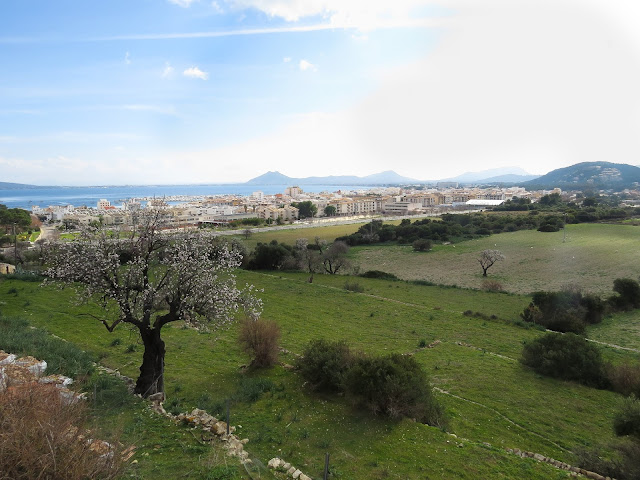


 Found in just a handful of places on earth having recently been split from Marmora’s Warbler, finding this beautiful and charismatic Sylvia warbler is understandably the main reason for any birder’s trip to this stunning island, and we of course were no different. Allowing ourselves three days to track down this Mallorcan endemic, we planned our trip to maximise success with this species, hoping to catch up with our remaining targets in the process.


 Awaking bright and early the next morning to crystal clear skies and glorious sunshine we were out on the road early, the arterial motorway that cuts through the island making light work of our journey north to our first site of the trip – the famous and iconic Boquer Valley.


 With the towering mountains putting the whole area into a dark shade, the temperature had also dropped dramatically, and it was perhaps a case of the lack of Mediterranean sun bringing a premature close to our Balearic Warbler concert. In a further two hour stake out we only heard the song twice more, and despite scrambling up and down the loose shale slope in an attempt to secure further views of perhaps two individuals, we only caught glimpses as they flew around the valley and clambered through the bare shrubs.