The Dry Tortugas National Park
– 100 square miles of pristine and beautiful island habitat tucked away around
70 miles offshore from Key West in the crystal clear waters of the Gulf of
Mexico. World famous for its picturesque views, stunning blue ocean environment,
coral reefs, bird life and the 19th century fort that gives one of
the islands its name, it was the impressive seabird colonies and reputation of
the fort as a legendary migration hotspot that drew us to this fantastic
location.
Only accessible via boat or
plane as part of an official tour, we booked ourselves on to one of the day
trips – and boy did it deliver. Before we had even reached the shore we’d got
our first (rather unexpected) pelagic lifer in the form of an Audubon’s
Shearwater, taking off from the water as the boat sped across the surface
before flapping alongside, disappearing in to the distance as the boat powered
forward. Rather similar to our Manx Shearwaters back home, the rather more
‘flappy’ flight style of the Audubon’s Shearwater was extremely noticeable, the
serene gliding of our Manxies most definitely absent and the wings slightly
shorter and broader. Manx Shearwaters are also extremely rare in these waters,
with very few records indeed.
 |
| Prepared for all weathers! |
With the only colony of Masked
Booby in the continental US found on a part of the Dry Tortugas island chain
known as Hospital Key (only visible from the boat trip over), we asked the
captain if we could stop by on the journey across to take a look at these
fascinating seabirds. True to her word, around 10 minutes from shore the boat
stopped temporarily opposite the famous Hospital Key, and despite the
continuous bobbing on deck due to the waves (looking through a scope proved to
be a tad tricky) we and the handful of other keen birders on board got great
views of around 75 Masked Boobies sat on the white sand.
 |
| Masked Boobies! |
Superficially similar
to a Gannet, these beautiful black and white seabirds had a distinctive
posture, and despite the distance we could make out their shorter yellow bills,
black faces and characteristic black patches on the wings.
With the boat moving on from
the Boobies after 5 minutes of watching and approaching the jetty to dock, the
lifers kept coming thick and fast. Nearing the seabird colonies meant hundreds
of Sooty Terns and Brown Noddies were now streaming overhead and all around the
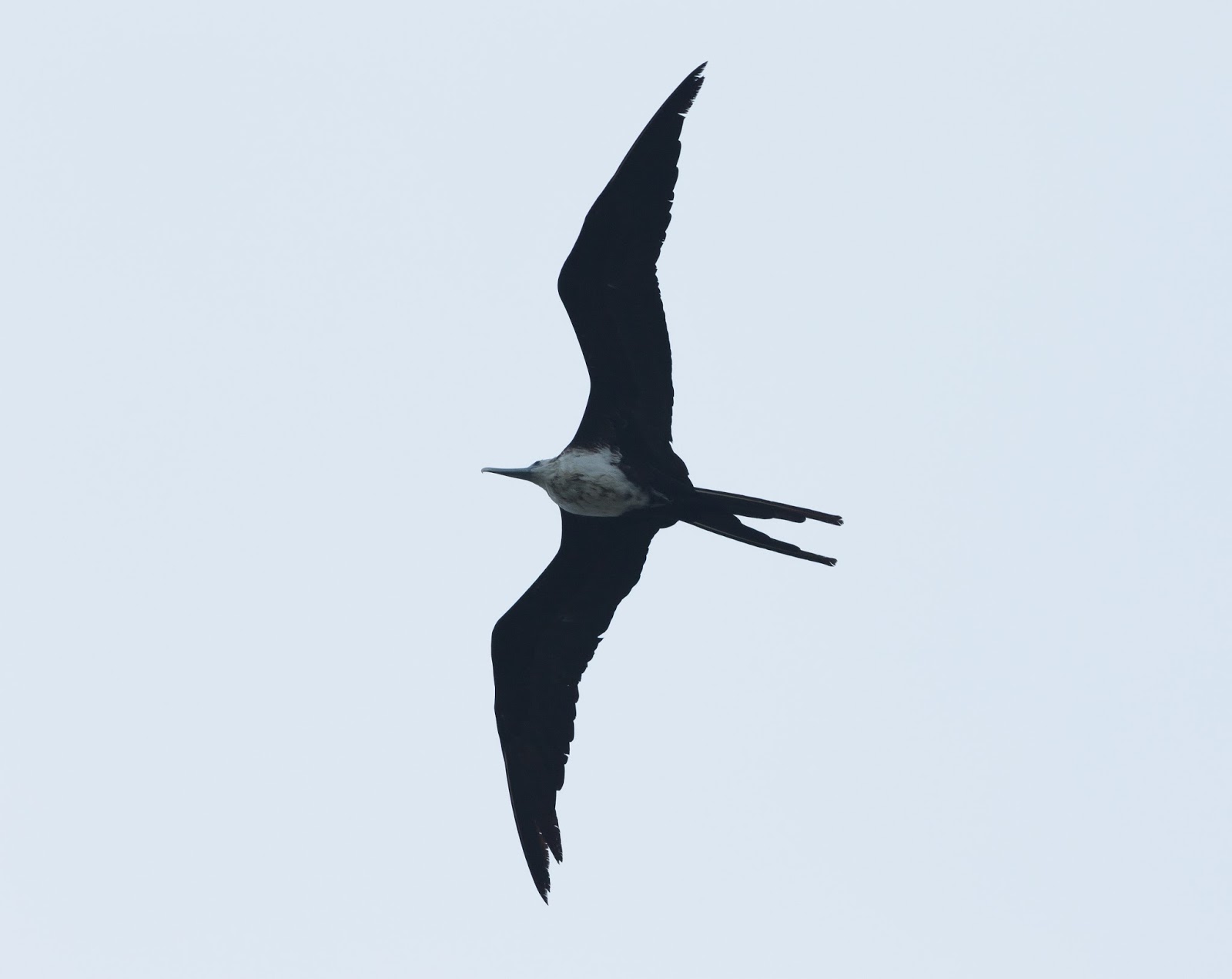
boat, accompanied by several Magnificent Frigatebirds soaring serenely along on
the thermals, dwarfing everything else with their sheer size.
 |
| Brown Noddy |
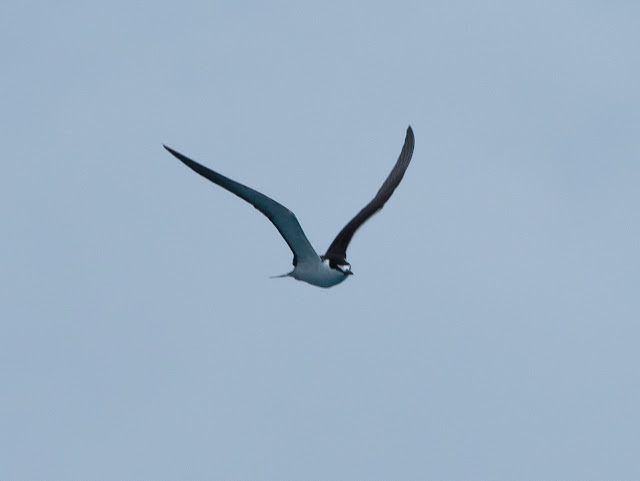 |
| Sooty Tern |
 |
| Magnificent Frigatebird |
The Dry Tortugas
are the only significant nesting sites in the continental US for these tropical
seabirds, and it was a real privilege to see them up close. With a gorgeous
warm chocolatey brown plumage and white icing-sugar dusting on the head, the
Brown Noddies were particularly attractive – swarming in their hundreds around
Fort Jefferson and Bush Key.
Well known as being a
particularly hot migrant trap during the spring and autumn, we were keen to
check out what other goodies Fort Jefferson held, and heading in to the
compound we were met with a flurry of activity – the air was positively alive
with birds in every direction you looked.
Some of the very best birding
is often being bang in the middle of a huge fall during migration -
particularly when that fall contains such gems as the bright coloured American
warblers. Everywhere we turned there was activity, masses of Hooded Warblers
flitting through the limited tree cover, while Ovenbirds flipped over the
leaves below to forage.
 |
| Ovenbird |
A male Kentucky Warbler briefly perched on a branch was
our only bird of the trip, while an abundance of the ever present Palm Warblers
moved through the trees. Several Black and White Warblers – one of my favourite
American Warblers and reminiscent of small humbugs - were a great addition to
the day, as were the handful of American Redstarts that joined them.
 |
| The water fountain on Fort Jefferson was like a magnet for migrants |
Louisiana Waterthrush was our
first lifer in the compound, foraging along the ground and displaying the
extremely prominent and wide white supercilium vital for the ID, much bolder
and brighter than the Northern Waterthrushes we encountered in New York the
previous year. With much whiter underparts and a paler and less marked throat
in the Louisiana Waterthrush, the identification features separating the two
are extremely subtle at best.
 |
| Louisiana Waterthrush record shot |
Having missed Louisiana Waterthrush on our
last trip to America, it was great to catch up with this earlier migrant, and
even better to get a positive ID on what can be a tricky species.
With so many migrants present
in such a small contained area within the fort, the huge number of small birds
naturally attracted predators to take advantage of the easy pickings – several
Merlins, American Kestrels and Peregrine Falcons swooped down continuously out
of nowhere in an attempt to grab a meal.
 |
| Peregrines took advantage of the tired, grounded migrants |
Three cuckoos taking flight
from one of the trees turned out to be our only Yellow-billed Cuckoos of the
trip, their rusty wing colours diagnostic, while our second Solitary Sandpiper
probed in the soft grass below.
A large, long winged bird
suddenly bursting out of the tree cover before gaining height was immediately
obvious as a Nighthawk. With two conspicuous white patches on the wings, we
watched as it rose higher and higher out of sight, failing to get any photos
and the encounter lasting mere seconds. With two possible species on the
Florida Keys – Common Nighthawk and Antillean Nighthawk – and the call being
one of the only reliable ways of identification, the bird remaining silent
meant there was unfortunately no way of telling which of the two it had been.
While Antillean Nighthawks are usually much later migrants, meaning it was
highly likely to have been a Common, there have been records of Antillean on
the Dry Tortugas in very early April before, so with the particularly early
season in terms of migration, we just couldn’t rule it out.
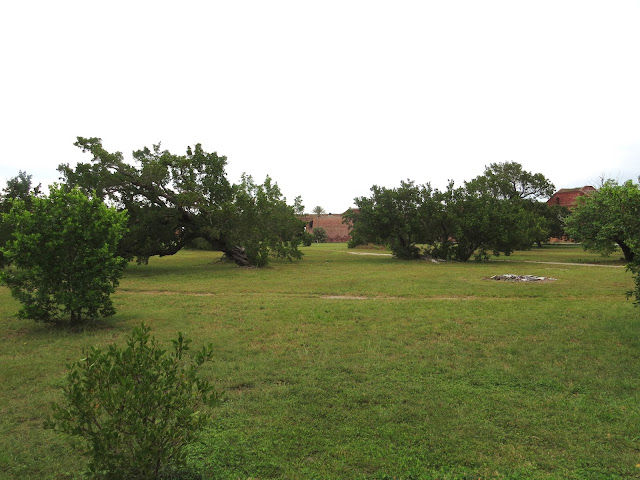 |
| Each bush on Fort Jefferson held something different! |
Splitting up our search, I
soon spotted something brown and black perched in the top of one of the trees –
male Orchard Oriole! This was another bird we had missed in New York despite an
extensive search at Prospect Park the previous year, but as quickly as it had
appeared it had vanished, flying over to the opposite side of the compound and
out of sight before Alex could get on to it. Alex it turned out however had
found his own treasure, two male Blue Grosbeaks in one of the trees above him.
Missing them by seconds, we headed over to the other side in an attempt to
locate each other’s birds, but could only find several Indigo Buntings and a
Scarlet Tanager moving through the leaves.
Catching sight of a slight
movement in the tree next to me, a small brown bird came in to view,
immediately recognisable as a Vireo species. Raising my bins to determine the
ID whilst thinking to myself how fantastic it would be if it had black
whiskers, I was absolutely gobsmacked to see that it did – two beautiful and
strongly marked black stripes running vertical from the bill – Black-whiskered
Vireo!! In a panic, I immediately grabbed Alex – this was a bird not to be
missed and could be our only opportunity to see this species. Relieved that he
soon got on it, we could really admire this stunning little bird – a mangrove
specialist and restricted in range in the US to just Florida. Again, thinking
we would be far too early to catch up with one, the exceptionally early start
to migration had played right in to our hands, meaning we struck it lucky with
both the overwintering birds and the usually later migrants that had left their
wintering grounds much earlier than usual this spring.
 |
| Black-whiskered Vireo! Amazing find! |
This did indeed turn out to be
our only Black-whiskered Vireo of the trip, and we were exceptionally lucky to
jam in to this iconic Florida species.
With the Black-whiskered Vireo
disappearing back in to the leaves, it soon became apparent there were several
other Vireo species knocking around the fort, and we had both Red-eyed and
White-eyed Vireos along with great views of a single Yellow-throated Vireo.
Suddenly, Alex called over –
he’d relocated the Blue Grosbeaks in one of the nearby bushes. With their
gorgeous rich royal blue colouration, these were truly stunning birds, and
later flying up in to one of the trees I was standing under I was really able
to appreciate their huge bills and rusty red wingbars – a useful feature in
separating them from the equally as bright Indigo Buntings.
 |
| The gorgeous royal blue of the Blue Grosbeaks was stunning! |
The lifers kept coming thick
and fast from this point. A gorgeous Summer Tanager popped out on one of the
branches in front of us, the beautiful scarlet plumage lacking any black (as
shown on Scarlet Tanagers) and with a huge yellow bill.
 |
| Summer Tanager |
Completely red in
colouration, this was an extremely attractive bird and another we had missed
out on seeing on in New York – the Dry Tortugas just didn’t stop delivering!
Turning our attention back to
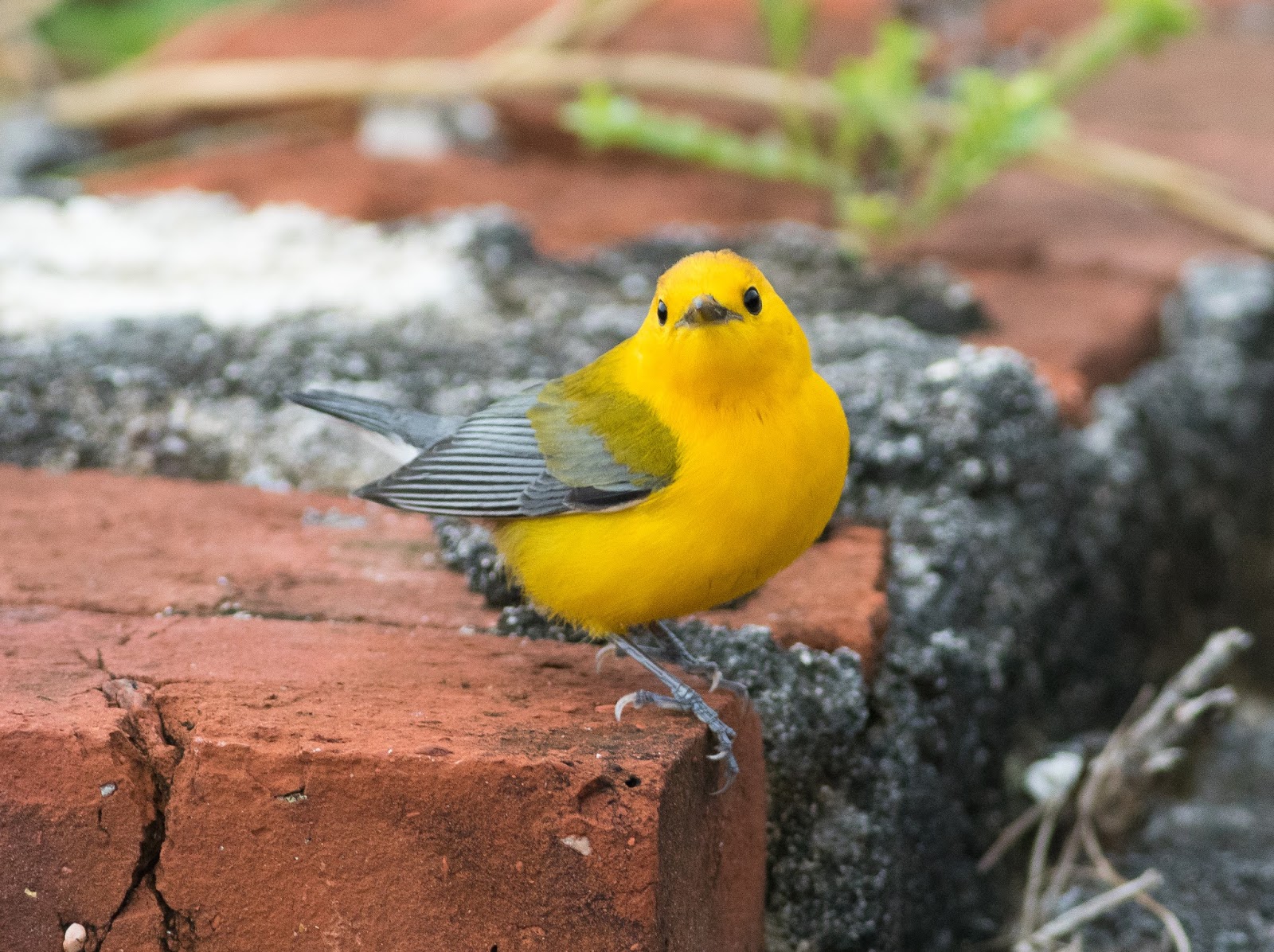
the wall, Alex suddenly called out he’d found a Prothonotary Warbler, a large,
bright yellow warbler reminiscent of an oversized lemon, and one of the species
I had most wanted to see on our trip. Another later migrant and with no set
site for Prothonotary Warblers, I had worried that we would miss them, and this
did indeed turn out to be the only one we saw.
 |
| Prothonotary Warbler - looking like a beautiful giant lemon! |
A personal favourite, we got
absolutely astounding views as it bumbled along the crumbled wall, at one point
hopping up in front of me less than a metre away. Shining out like a beacon, we
followed its progress as it foraged in the scrub in-between the bricks,
watching in awe of this truly incredible bird. Amazing!
With several other warblers
joining the Prothonotary in foraging, we soon had our first Tennessee Warbler
of the trip, swiftly followed by another Prairie Warbler and several more
Hooded Warblers. It was a breath-taking sight to see all of these brightly
coloured gems feeding alongside each other, powering up on this brief respite
from a long migration before making the next step on to the mainland.
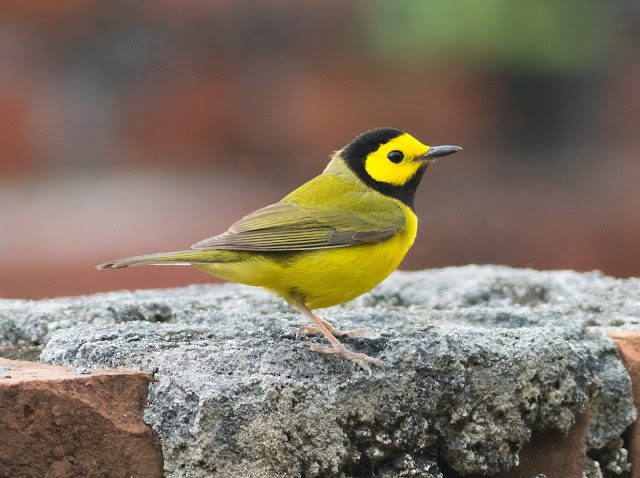 |
| Hooded Warbler - it was nice to see more males of this species after seeing several on our trip to New York the year before |
 |
| At one point several warblers were in the same metre squared patch of ground! Amazing! |
We also managed to catch up
with the male Orchard Oriole which had made a reappearance, this time Alex
managing to get on it too and sticking around long enough to let us get a
record shot of the gorgeous autumn colours. More subdued in coloration than the
bright yellows of the Baltimore and Spot-breasted Orioles, with his rustic reds
and blacks the male was stunning in his own right, much smaller than the other
oriole species that we had seen but just as beautiful.
 |
| Male Orchard Oriole |
After a jam packed morning
full of birds we were soon in the need of a welcome break for lunch, taking
advantage of the on-board buffet for some much needed refreshments and to take
shelter from the impending drizzle that seemed to have set in.
Deciding to devote the
afternoon to admiring the masses of seabirds that make the islands their home,
we took a wander along the white sandy shores, littered with old remnants of
coral and capturing a true picture of a tropical paradise.
Hundreds of Brown Noddies
rested on the old moorings around the harbour, offering fantastic views of this
tropical seabird up close.
 |
| Brown Noddy! |
 |
| The moorings were covered in hundreds of Noddies! |
Walking up to the rope
protecting the nesting area on Bush Key, we also got great scope views of the
Sooty Tern colony perched amongst the extensive cactus growth, these agile
fliers dipping and diving in a flurry of activity.
 |
| Sooty Tern! |
A walk around the island soon
resulted in breath-taking views of the mighty Magnificent Frigatebirds,
kettling above us in the air currents with their huge pterodactyl like wings.
 |
| Female Magnificent Frigatebird |
Providing our best opportunity to photograph these enormous birds and with at
least one male amongst them, we were able to get good views of the bright red
breeding pouch on the throat, distinctly different from the white markings of
the more numerous females.
 |
| And the male! |
With Long Key being the only breeding site for
Magnificent Frigatebirds on the continental US, it was a real privilege to
experience these incredible birds up close.
Our second Yellow-crowned
Night Heron of the trip, this time an adult, was also a bonus, giving great
views on the path in front of us and constantly flying back and to into the
fort walls.
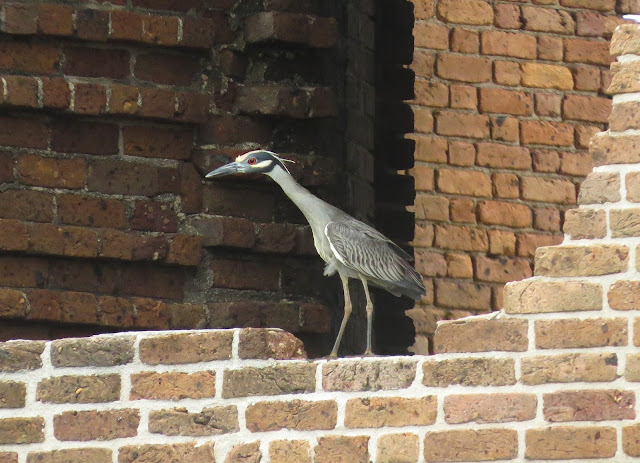 |
| Yellow-crowned Night Heron - an impressive adult this time! |
With just the Brown Boobies
missing from our seabird targets, we scoped out to scan the distant buoys and
perches in an effort to locate them. Alex soon found 4 individuals perched on
one of the metal posts, and although extremely distant, through the scope we
could just make out their long, gannet like pale bills and faces, different
from the resting Double-crested Cormorants in both posture and structure.
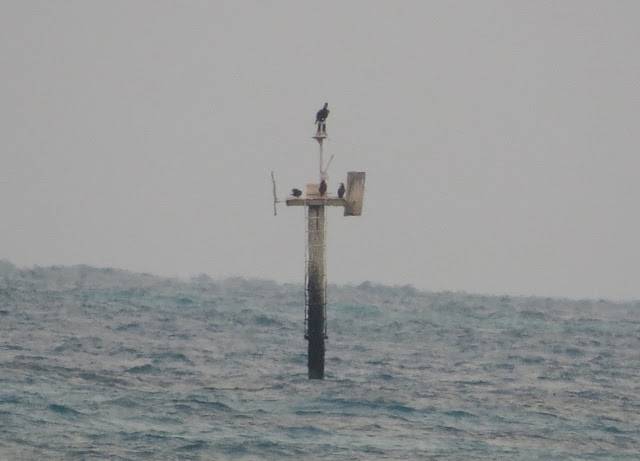 |
| VERY distant record shot of the Brown Boobies! |
 |
| And cropped! |
With our stop on the islands
coming to a close and our re-boarding time for the ferry back to Key West
rapidly approaching, we took one last look inside the fort for any additional
migrants – getting further views of a Waterthrush (presumably the same
Louisiana as earlier) and watching the Hooded Warblers still actively flit
around our heads.
 |
| Louisiana or Northern - we weren't sure! |
The birding here on the Dry Tortugas had been absolutely
outstanding, exceeding all our expectations and truly blowing us away with the
sheer pace, quantity and above all quality of the species stopping off on this
island hot spot. Several of the birds we saw here were also our only ones of
the trip, cementing our visit here as one of the best days of the entire trip –
the beautiful island setting only adding to our enjoyment.
With a hotel booked in Key
Largo for the night, we made the journey back up the Keys as soon as our boat
landed at Key West in the late afternoon. Several more White-crowned Pigeons
perching on the wires as we left the town were nice to see, as were the small
flocks of Brown Pelicans cruising alongside the road as we drove.
 |
| White-crowned Pigeon |
 |
| Brown Pelican |
Immediately after arriving at
our hotel 2 hours later, our brilliant day’s birding still wasn’t over. As soon
as he’d parked the car, Alex caught sight of a huge owl perched on a nearby
telegraph pole. Suspecting it could be one of the false decorative owls that
people put out to scare away pigeons, we couldn’t believe it when it turned its
head to gaze straight towards us, a set of fierce, piercing yellow eyes staring
us down. There was no mistaking this mighty being and our third owl species of the trip – the magnificent Great Horned Owl.
 |
| Great Horned Owl! (Real - not plastic!) |
With the light now fading and
it being almost dark, there was no real opportunities for photographs, but we
watched in awe as this huge bird of prey took off and soared silently over the
car park. Magical!
Extremely tired after a long
day our on the islands, we headed straight to the conveniently placed
restaurant next door to tuck in to some American ribs and fresh Florida
seafood, before crashing in to bed for a much needed night of sleep!