A tale of nature, wildlife and birding from Cheshire, North Wales and across the globe....

A tale of nature, wildlife and birding from Cheshire, North Wales and across the globe....

Thursday, 15 September 2016

Scilly Pelagic Magic - Wilson's!

Wilson’s Petrel – an elusive and enigmatic seabird that evades the vast majority of British birders during their lifetime, unless of course they’re prepared to make a lengthy pilgrimage to Cornwall each summer and spend time exploring the vast seas surrounding the beautiful Scilly Isles in search of seabird gold.
St Marys - Isles of Scilly
With Bob Flood, Joe Pender and the rest of the crew on board the now famous ‘Sapphire’ having well and truly mastered the art of tracking down these mysterious petrels, their Scilly Pelagic boat trips have a high success rate during summer weekends, often attracting up to 4 or 5 birds to the boat at once.

Having experienced 3 pelagics last August, but with no luck on the Wilson’s Petrel front (it was a very late year for them last year), this August again saw us make our way down to Penzance ready for the Scillonian crossing the next morning. Stopping off en-route to admire the long staying Dalmatian Pelican that’s been spending its time loafing at Restronguet Creek and the surrounding Cornish coastline for the past 3 months, we eventually had relatively distant views as it lifted up its head to show the magnificent yellow bill and confirm our suspicions as to the ID (it was asleep at first and looked like a giant washed up buoy!).
Dalmatian Pelican - Cornwall
The 'rancid' Pelican!
Having been tracked from Poland, Germany and France, only time will tell if this bird is accepted on to Category A of the British List!
Dalmatian Pelican - Cornwall
Restronguet Creek, Cornwall
Restronguet Creek
Arriving at St Marys on Scilly the next day, we had plenty of time to explore the island before our first of three pelagics on Monday night, taking in the beautiful beach scenery that St Marys has to offer and soaking up the sun. Unfortunately we didn’t find anything of note at either Lower or Higher Moors throughout our week on the island, several Snipe and a smattering of Common, Green and Wood Sandpipers being the best we could muster. 

With the moss and lichen coated trees and hidden marshy groves, it wasn’t hard to imagine the plethora of American vagrants the area has undoubtedly held in autumns gone by.
Common Snipe - Higher Moors, Scilly
Wood Sandpiper - Higher Moors, Scilly
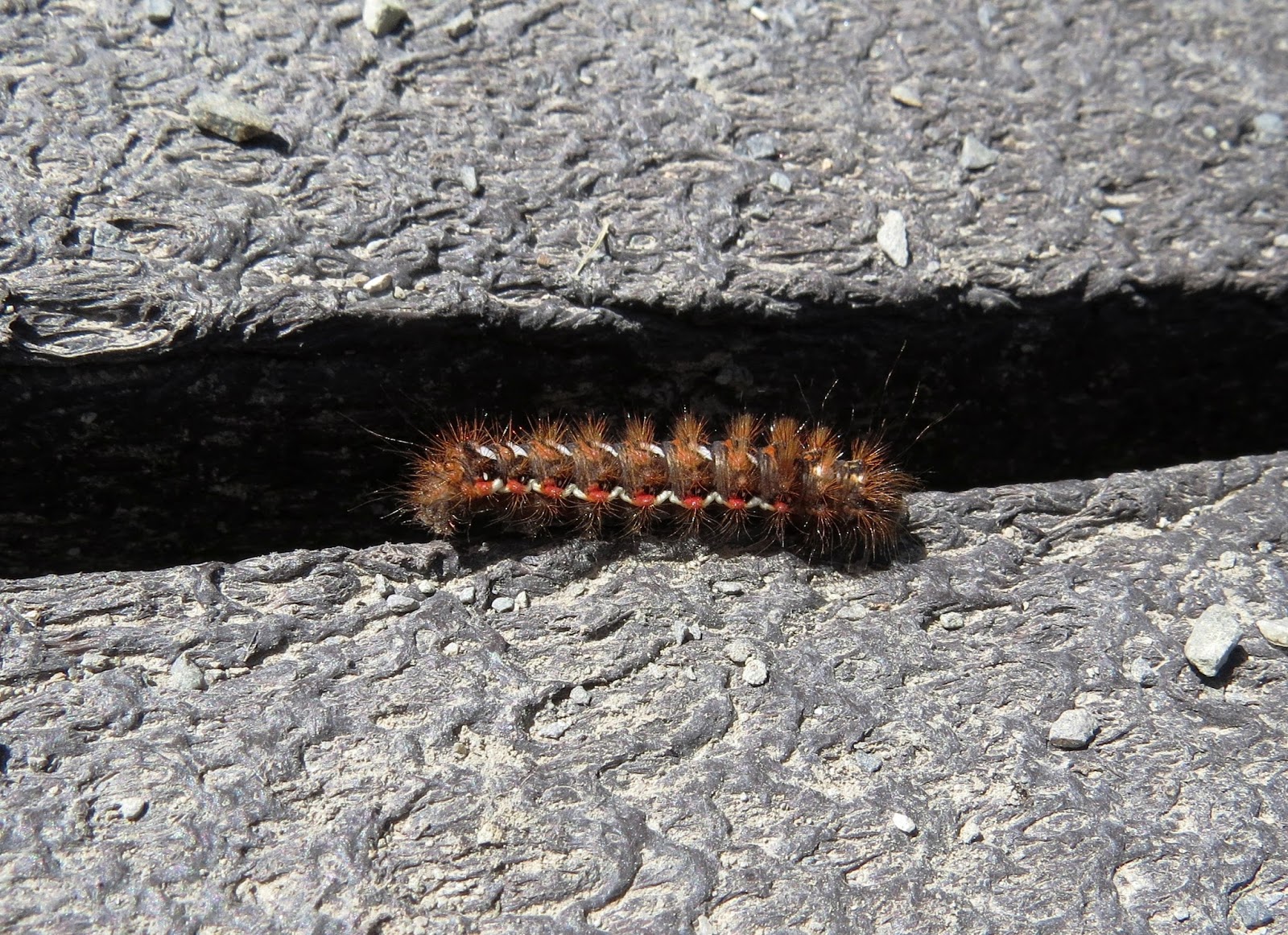
Knot Grass Moth caterpillar - Lower Moors, Isles of Scilly
A Knot Grass Moth caterpillar that we found on the boardwalk at Lower Moors
With Monday night’s pelagic sadly not featuring any of the large Shearwaters or our much sought after Wilson’s, we settled for point blank views of around 40 European Storm-petrels whizzing around the boat at top speed. A nice Long-tailed Skua that we watched approach the boat from being just a spec in the distance to flying overhead was also a bonus, as were the two Blue Sharks that were caught and tagged as part of the on-going research programme in to their distribution in British waters.
St Marys - Isles of Scilly
The beautiful Scilly scenery
Friday evening (and our next pelagic) soon dawned rough and stormy, a huge weather front from the west blowing in with ginormous waves forecast and winds in excess of 50mph! Certainly not ideal sailing conditions, and whilst the Scillonian had been cancelled due to the ferocious weather, in complete contrast we headed out in to the storm in pursuit of large shearwaters and petrels!

It was immediately obvious that the high westerly winds had brought in huge numbers of Shearwaters, and it didn’t take long before we had our first Cory’s – a lifer for me and Alex – soaring towards the boat, a second bird in quick succession. 
Cory's Shearwater - Scilly Pelagics
Having missed Cory’s Shearwater on our pelagics last year, this was a huge relief, and despite the howling gales we enjoyed incredibly close views as these remarkable seabirds expertly cut through the air with incredible power and grace.
Cory's Shearwater - Scilly Pelagics
The huge waves we experienced during the pelagic!
With approximately 42 Cory’s seen during our 5 hours out at sea, along with a handful of Great Shears, at times flying right over the boat, the evening was a huge success – even more so considering I’d managed to avoid the seasickness I’d suffered on Monday’s much calmer pelagic! Relief! With just one more pelagic left on our 2016 trip, it was well and truly last chance saloon on the Saturday to get our desired Wilson’s, and with the winds perfect and less rain forecast, we were definitely in with a shout!

Saturday dawned as wet and windy as Friday evening had left us – giving us barely any time to recover after the absolute battering (my knees and shins were bright purple with bruises!) we’d received being tossed around the boat the night before. Speaking to seabird expert and Wilson’s guru Bob Flood before the boat arrived, he was confident we’d be able to get a Wilson’s to the boat – fingers crossed he was right!
St Mary's Harbour, Scilly
St Mary's Harbour - if only the weather had been like this for our pelagics!
Huddling underneath 5 layers of coats, including a bright pink rain cape (it did the job!) in an attempt to avoid the driving rain and waves that were pouring upon us, singles of Cory’s and Great Shearwaters kept us entertained as we headed east of St Martins. Stopping the boat to commence drifting and chumming in an effort to draw in a Wilson’s, it was now a waiting game to see if they would materialise.

Numerous European Storm-petrels soon began to appear, attracted to the mixture of cod liver oil and mashed up fish pouring in to the water, the scent clearly having travelled in the wind. With the numbers of Stormies building, complete with several returning Bonxies, Cory’s and Great Shearwaters, the cry soon went up that everyone on board had been waiting for – WILSON’S!!

Scrambling over to the side and struggling to stay upright as the boat was buffeted about on the water, it transpired Alex was already on the bird, but with the huge winds creating large channels in between waves, it was all too easy for the tiny petrels to vanish behind a tower of water, and my target bird disappeared behind a huge blue wall of ocean.
Scilly Pelagic
The crashing waves we experienced on the boat trips - easy for small petrels to get lost behind!
With no sign over the coming minutes, I anchored myself to the side of the boat, ignoring the lashing wind (which actually ripped the hood off my mac it was that fierce!) and splashing waves, putting the extreme rocking motion of the boat and the associated seasickness out of my mind – I was now on red alert for Wilson’s!

Luckily, after an excruciating 20 minutes when the first bird didn’t reappear, the cry went up again – WILSON’S – it’s back!

Spinning around to face the back of the boat and squinting through the spray, the bird I had been waiting to see for over 30 hours of Scilly pelagics was finally in front of me, skipping over the waves almost in slow motion and hanging delicately in the air, a calm contrast to the raging torrent of water over which it hopped with ease – my first Wilson’s Petrel.
Wilson's Petrel - Scilly Pelagics
The magical moment lasted only a few seconds, the light pale panels on the wings standing out against the velvety black, while the long spindly legs trailed behind, dangling helplessly towards the water. For a brief moment, it seemed like the wind stopped howling and the waves stopped raging as we all locked on to this sought after scarcity in British waters, savouring the seconds and enjoying the moment by simply watching on as the petrel danced over the waves instead of scrambling around for a camera.

Then, in an instant it was gone, carried off by the wind and lost in the waves, aware once again of the crescendo of noise returning as the water crashed against the side of the boat, my mac flapping fiercely out of control in the gales. None of this mattered - finally we had our prize!

With the conditions still ideal for seabirds, we continued to chum, managing to attract a further two Wilson’s Petrels towards the boat, making approximately 4 in total. Managing a few shots with my camera as one passed the end of the boat (the majority of frames were out of focus black shapes or crashing walls of water) due to the intense rocking of the boat, I found it exceptionally difficult to even stand up straight, let alone hold a camera steady to take in-focus photos of a fast moving petrel!
Wilson's Petrel - Scilly Pelagic
The characteristic yellow feet that Wilson's Petrels show
Instead, it was better to just watch on and admire the Wilson’s spectacle unfolding before us, our last encounter being a bird cruising slowly past the boat at eye level, floating in the wind and giving everyone on board a memory to last a lifetime.

With three days to spare between pelagics, having booked on to dates at either side of the week, we used the spare time to explore more of the islands, taking a day trip out to the wonderful Tresco on the Tuesday – our first Scilly island apart from St Marys. Exploring the famous Tresco Abbey Gardens revealed none of the resident Golden Pheasants that are said to live there, but the beautiful garden features and the photogenic Red Squirrels were more than enough to keep us happy.
Red Squirrel - Tresco, Scilly
Tresco Abbey Gardens - Tresco, Isles of Scilly
The beautiful setting of Tresco Abbey Gardens
An Icterine Warbler that had been found on the Garrison during our stay also had us taking a trip up to this high point on the island, staking out the garden next to the football pitch until this monster of a warbler reappeared in the apple tree, proceeding to flit around elusively and feed for the next half an hour or so. 
Icterine Warbler - St Marys, Scilly
Present with at least two Willow Warblers, the Icterine was noticeably larger, with a huge orange bill compared to the Willow’s shorter and daintier beaks. Having only ever seen Melodious before, even abroad, this was a great new bird for me and one I had been hoping to bump in to for a while over several east coast visits. 
Icterine Warbler - St Marys, Scilly
Pied Flycatcher - St Marys, Scilly
A handful of Pied Flycatchers were the only other migrants of note
Having enjoyed a fantastic week on the island in perfect weather (in terms of both exploring and for generating excellent seabird movement!), with gorgeous scenery, excellent food and second to none hospitality at the B&B, we both thoroughly enjoyed ourselves on these charming islands. 
Cart - Isles of Scilly!
The Scilly Isles carts! One of the highlights of my week!
St Marys - Isles of Scilly
With our Wilson’s Petrel finally in the bag, along with excellent views of Cory’s Shearwaters and my first Icterine Warbler to boot, who knows when we’ll be back on these picturesque islands in the future – fingers crossed it’s whilst looking at a pristine male Blackburnian Warbler one autumn. We can but dream.

Tuesday, 13 September 2016

A super sandpiper weekend - Baird's at Worcestershire & Semipalmated in Hampshire

Having almost completed the extensive collection of sandpipers on the British list with just 4 remaining (Least, Upland, Baird’s and Semipalmated) it was a nice surprise when a juvenile Baird’s Sandpiper turned up at Upton Warren in Worcestershire, just over an hour down the road.

With the bird still present the next morning, we made the trip down the M6 in an effort to see this attractive sandpiper, and duly paying our £3 permit fee, headed over to the furthest hide on the reserve where the Baird’s had been showing.
Upton Warren - Worcestershire
With a juvenile Ruff also present for company, we soon locked on to the much smaller Baird’s, busily feeding on the far edge of the flash in the mud and working its way around the pool. Despite the distance making any decent photographs impossible, the views through the scope were excellent - the beautiful patterns on the back standing out even at range and the distinctive elongated profile created by the long primary projection clearly defined.
Baird's Sandpiper, Upton Warren, Worcestershire
Terrible phonescoped record shots of the Baird's! 
With a long, thin body and shorter legs, Baird’s Sandpipers are one of the most distinctive American peeps that make it over the Atlantic, and despite never coming in front of the hide during my visit as it has been doing on the following days, it was still fantastic to see and is now firmly in place as one of my favourite American sandpipers.

With a Semipalmated Sandpiper at Titchfield Haven also being retrospectively ID’d from photographs on Saturday evening (it was originally thought to be a Little Stint by on site observers), this provided the perfect opportunity to make it a double sandpiper weekend. Semi-ps have been a particular nemesis bird of mine for a while now, having previously dipped 2 in the past while a third bird at Hoylake could never be narrowed down from either a Semipalmated or Western Sandpiper.

Despite being over 3 hours away, the fact that the Semi-p was showing particularly well and still present the next morning saw us head down to Hampshire in the glorious sunshine in search of my second American sandpiper of the weekend.
Titchfield Haven NNR - Hampshire
Arriving at the hide and with the Semi-p instantly on show on a distant muddy bank, it took all of 5 seconds of viewing before the whole scrape was flushed! Potential nightmare! Luckily, the Semi-p and associating Little Stint didn’t go far, instead flying closer on to one of the smaller islands and providing the perfect opportunity to study the subtle differences between these two exceptionally similar species.
Semipalmated Sandpiper - Titchfield Haven, Hampshire
Semipalmated Sandpiper showing well!
Being roughly the same size (the Semi-p was a touch smaller than the Little Stint), the Little Stint was slightly brighter marked than the Semipalmated’s uniform grey colour, also demonstrating marginally darker and blacker legs in comparison. The lack of white tram lines on the back of the Semi-p was also conspicuous, allowing us to easily separate the two at a glance.
Semipalmated Sandpiper and Little Stint - Titchfield Haven, Hampshire
Spot the difference! The Semi-p is on the left while the Little Stint is on the right
As with the Semipalmated Sandpipers we saw in New York last year, I again got the impression of a slim bodied wader, slightly thinner than the Little Stint’s dumpier posture which again proved a useful characteristic in the field for separating the two.
Semipalmated Sandpiper - Titchfield Haven, Hampshire
Often hard to distinguish from the similar Western Sandpipers in America (such as the tricky Hoylake peep several years agao) the lack of any fiery tones in the upper scapulars as shown on Westerns and the shorter, straighter bill all aided in confirming the identification of what I consider to be quite a hard species to ID.
Semipalmated Sandpiper - Titchfield Haven, Hampshire
Luckily, the Semi-p flew right in front of the hide before we left, offering amazing views and emphasising the point that it is far more satisfactory to travel a longer distance for a bird that shows well than to get poor views of a bird that perhaps isn’t as far.

Alex's super video of the Semi-p - a big thanks to him for making the epic drive too

A great weekend full of sandpiper success and hopefully the start of what promises to be a fruitful autumn as far as American vagrants are concerned. 

Tuesday, 30 August 2016

Pantaloon Bees and Bee Wolves at Minsmere RSPB!

Having admired the many photographs of Pantaloon Bees at Minsmere RSPB doing the rounds on Twitter over the past few weeks, I was longing to see these interesting insects for myself.
Pantaloon Bee - Minsmere RSPB
Sadly, at over 4 hours away, Suffolk was just a tad too far to travel just to get my fix of quirkily named bees (if they had been referred to as Hairy Legged Mining Bees I don’t think I’d have been anywhere near as smitten with them) and it looked like any chance to see them would be off the cards. Luckily for me, the stars aligned at the beginning of August when a Purple Swamphen touched down at Minsmere, positively forcing me to take a day off mid-week to go and see it and offering the perfect chance to simultaneously search for these fascinating bees.

With the Swamphen safely under our belts, we headed over to the sandy patches of ground along the North Wall where the Pantaloon Bees had been seen, a helpful member of RSPB staff on hand to guide visitors and help identify any bees or wasps.

After a long wait searching in the cloudy weather, a number of other interesting bees and wasps buzzing around to keep us occupied, we eventually struck it lucky with a single Pantaloon Bee, busy excavating a burrow in the sandy ground, the thick bristly hairs on the back legs getting caked with sand as it scurried backwards through the substrate before scraping it off revealing the beautiful furry hairs underneath.
Pantaloon  Bee - Minsmere RSPB
It is only the female bees that have woolly “pantaloon” legs as they are the ones that sweep away the sand creating burrows in which to lay their eggs.
Pantaloon Bee - Minsmere RSPB
Truly fascinating creatures and the only species of Hairy Legged Mining Bee in the UK, we were totally captivated as we watched her dig out her burrow again and again, backing out of the entrance hole before dashing back in each time – amazing!!
Pantaloon Bee - Minsmere RSPB
Pantaloon  Bee - Minsmere RSPB
The majority of sandy burrows on the slope were also occupied by the ferocious sounding Bee Wolf – fearsome wasps that predate on the Honey Bees in the area, paralysing them and carrying them back to their nests in a rather menacing fashion.
Bee Wolf - Minsmere RSPB
Looking carefully, the Bee Wolves carry the Honey Bees in such a way that if they attempt to sting back, only the armoured part of the Bee Wolf’s body is presented.
Once stored in the burrow, the females will then lay an egg on the paralysed bee, ensuring the hatched larva has a sufficient food supply when it emerges. We saw several eyes peeking out of the occupied burrows, and these extensive tunnels can often hold up to 6 immobilised Honey Bees in chambers ready for the young wasp larvae to feed upon.

For anyone who hasn’t had the opportunity to experience these delightful and quirky bees themselves, a trip to Minsmere in sunny weather next summer is definitely recommended! 

Tuesday, 23 August 2016

Marsh Fritillaries!

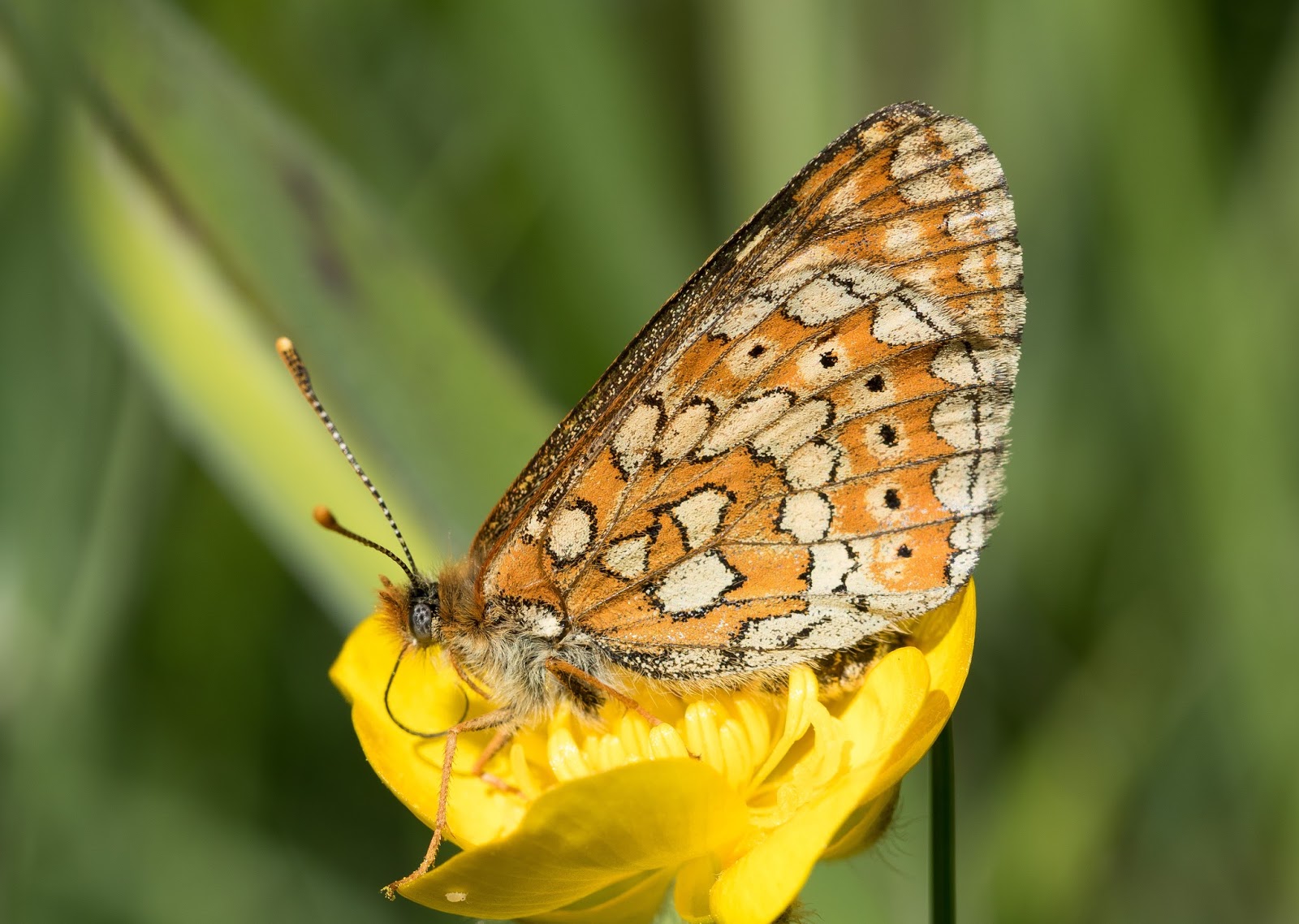
Marsh Fritillary is surely one of our most attractive British butterflies – a striking checkerboard of fiery oranges and burnt umbers flecked with delicate hints of gold and cream. A true delight of the Lepidoptera world. It was also a species that I had been extremely keen to catch up with after learning two years ago that there was a small population just a couple of hours away from home. Unable to visit in previous springs due to a combination of poor weather and being away in Mull and New York respectively during the last two flight seasons, this year we planned in a visit during the half term holiday.

Parking in the local village and walking the short distance to the entrance gate of the reserve, after a brief stroll along the boardwalk we had reached the small patch of ground where the fritillaries can be found. Almost instantly I spotted our first one – zig-zagging low down above the grass before alighting on a nearby flower to nectar and allowing relatively approachable views. Far more used to the restless and dancing flights of other species of fritillary, it was a refreshing change for these mosaic patterned beauties to tolerate a close approach!
Marsh Fritillary
Marsh Fritillary
Marsh Fritillary
Marsh Fritillary
In total we managed to find 4 or 5 individuals – luckily the fritillaries are just managing to hang on here, despite being reduced to just a small isolated population in what is sadly the last site for Marsh Fritillaries in the area.

With Marsh Fritillary colonies undergoing periodic population crashes and extreme swings in numbers, individuals will recolonise the area from other nearby populations as part of one large meta-colony in order to replenish numbers if they drop too low. If there is an absence of adjacent colonies nearby however, this lone surviving population could be in trouble if numbers do ever crash to unrecoverable numbers.
Marsh Fritillary
Marsh Fritillary
Once a relatively widespread butterfly, Marsh Fritillaries have undergone a serious decline in numbers, especially in continental Europe, and the British Isles are now considered one of the few strongholds left for this charismatic species. Despite this, they have suffered severe population drops even in Britain due to the draining of their fenland and marshy habitat for agriculture, making the Marsh Fritillary a definite species of concern. Appropriate conservation measures will hopefully see them continue to grace our wetland meadows for years to come.
Marsh Fritillary
Marsh Fritillary
Marsh Fritillary
Marsh Fritillary
Marsh Fritillary
Marsh Fritillary
Marsh Fritillary sites may be susceptible to trampling (especially if there are caterpillars still waiting to emerge in the undergrowth early on in the season) so it is always best to tread carefully and view from the footpath where possible.
Marsh Fritillary
With their gorgeous chequered patterns of orange, yellow and cream hues, Marsh Fritillaries are one of our most attractive fritillaries, and it was fascinating to study them up close as they nectared and rested on the strands of grass - we even witnessed two individuals mating on one occasion.
Marsh Fritillary
Marsh Fritillary
An incredibly enjoyable day at a beautiful reserve, and I for one really hope that the population continues to hang on and delight visitors for years to come.

Friday, 5 August 2016

MEGA!! Purple Swamphen at Minsmere - should it get accepted on to Category A?

There is no arguing that Purple Swamphens in Britain have a very chequered history – the records are littered with unscrupulous escapees and the possibility of a genuine vagrant reaching our shores always seemed a very remote possibility indeed. Fast forward 6 years from the last twitched individual (an escapee that took a liking to a muddy ditch in Saltney) and Sunday afternoon saw phones bleeping and twitter coming alive in the birding community as reports surfaced of a Purple Swamphen at Minsmere spotted lurking amongst the reeds surrounding the pool near South Hide.
Purple Swamphen - Minsmere, Suffolk
Purple Swamphen - Minsmere
Originally put out as ringed on the RSPB Minsmere Twitter feed before some hasty backtracking, it soon became apparent that this was the best candidate yet as a genuine vagrant, and most definitely had the potential to achieve what all British Purple Swamphens before it had spectacularly failed to accomplish – gain acceptance on to Category A of the British list.

Unringed, with full wings and most importantly being of the Western race of Purple Swamphen (‘Purple Swamphen’ as a species was split last year in to 6 full species, with Western Swamphen occupying Iberia and the Western Mediterranean), the chances were high that this could indeed be the real deal.
Purple Swamphen - Minsmere, Suffolk
Digiscoped shot showing the full wings
Booking a day off work for the Thursday, Alex drove the epic 4+ hour journey to Minsmere from Cheshire, setting off at an ungodly hour in the morning and still managing to experience the joys of the M6 in all its glory (lorry fires, rolled over lorries, exploding lorry tyres and the inevitable motorway closures that come with it) eventually arriving on site at just after half 10. Approaching South Hide, I was surprised to see a relatively large crowd of birders and scopes present for a weekday, and we joined the waiting assemble to try and get a glimpse of the much talked about ‘Purple Chicken’.
Minsmere, Suffolk
The view over the pool at South Hide - the very same pool that held a Black-browed Albatross last year! 
After keeping us on our toes for around 45 minutes having disappeared in to a channel, the cries soon went up that the hen was back on show, and sure enough, we soon got a glimpse as it slowly worked its way through the reeds and crept through the shallows. At more than twice the size of the nearby Moorhens and being bright purple, it stuck out like a sore thumb, looking extremely out of place in a British reed bed and at one point positively startling the Mallards that had been dozing peacefully on the water’s edge.
Purple Swamphen - Minsmere, Suffolk
With over 40 records of Purple Swamphen in Britain in the past and with all considered to be escapees, what's to stop the Minsmere bird joining them in the realms of escaped Swamphen purgatory? One huge point to consider is that the majority of records in Britain refer to the Grey-headed form of Purple Swamphen - found throughout Asia and the most commonly kept type in captivity. The Minsmere bird being of the Western type therefore immediately elevates it to the top of the list of likely wild candidates, with vagrancy potential from the Mediterranean and Iberia much higher than from across Asia and the probability of it being an escapee being significantly less.
Grey-headed Swamphen - Florida
Grey-headed Swamphen - more often to be found in captivity than Westerns
Whilst mainly found across Iberia, Western Swamphens have very recently colonised Southern France as a breeding location, and 2016 has seen an unprecedented number of birds disperse much further north than ever before – to date 8 records have surfaced of 9 birds found across DrĆ“me, RhĆ“ne, SaĆ“ne-et-Loire and even as far north as Morbihan. Granted, Suffolk is much further (and contains the added hurdle of the English Channel) but following the French records in a line north leads straight to East Anglia, perhaps displaying a natural path of dispersal.
Purple Swamphen Distribution 2016
Map showing the Northerly Purple Swamphen records during 2016.
Accepted as being genuine records in France if of the Western form, not all French birds have complied however, and a bird seen in 2014-2015 in Gironde relates to an African Swamphen of unknown origin and almost certainly an escapee, proving that not all records can be taken as gospel of being non-captive. 

Whilst at first glance the English Channel may pose as a stumbling block in the path of a Wild Purple Swamphen, it actually transpires that this species has made open water crossings before, with records from islands such as Malta, Menorca and Sardinia. The closely related American Purple Gallinule also has various records of long distance vagrancy (across the Atlantic Ocean no less) under it's belt, while other species of crake and rail have similarly shown instances of extreme distance flights, dispelling any myths that this family of birds are poor flyers. 
American Coot - Florida
American Coot and American Purple Gallinule - two species that have made the epic crossing across the Atlantic and dispelling the myth that rails are poor flyers
Often thought of as non-migratory birds, many species of Crakes and Rails do indeed move, often in the summer months, and it is entirely plausible that what at first glance may seem unlikely, is in fact a very real possibility.

However, one question to consider surrounding the Western Swamphen’s ability to travel long distances revolves around the large die off of Western Swamphens in France during the harsh winter of 2012, when several hundred birds were killed due to lack of food and starvation as their ponds froze over solid. If the conditions were so tough to the point of death, then why didn’t the Swamphens simply move elsewhere in order to survive?

Whilst most records of Purple Swamphens can quickly be attributed to being an escape, often traced back to a specific collection, two other great candidates for being Britain’s first genuinely wild Purple Swamphen have occurred in the past, yet have both been rejected; a bird found in Cumbria in 1997 that was rejected on the basis of being thought to be a hybrid between two races and therefore deemed to be of captive origin, and a promising individual at Sandbach in Cheshire back in 1971. Thought by many to be of the Western form, the record was rejected presumably on the basis that it couldn’t be proven that it wasn’t an escapee, especially with no pattern of previous natural occurrence in Britain. If the Minsmere bird does eventually get accepted, then surely this record must also be reviewed.  
Western Swamphen - Portugal
Western Swamphens in their native Iberia
All in all, the chances of the Minsmere Western Swamphen getting accepted as the first wild bird for Britain look very good - rumours of a recent escapee in the area were put to bed after the bird in question was found to be of the common captive Grey-headed race, and with the unprecedented numbers of Western Swamphens dispersing in Northern France,  realistically it was only a matter of time before one made the leap over the channel and ended up on British shores.